
EPISODE · Apr 25, 2026 · 18 MIN
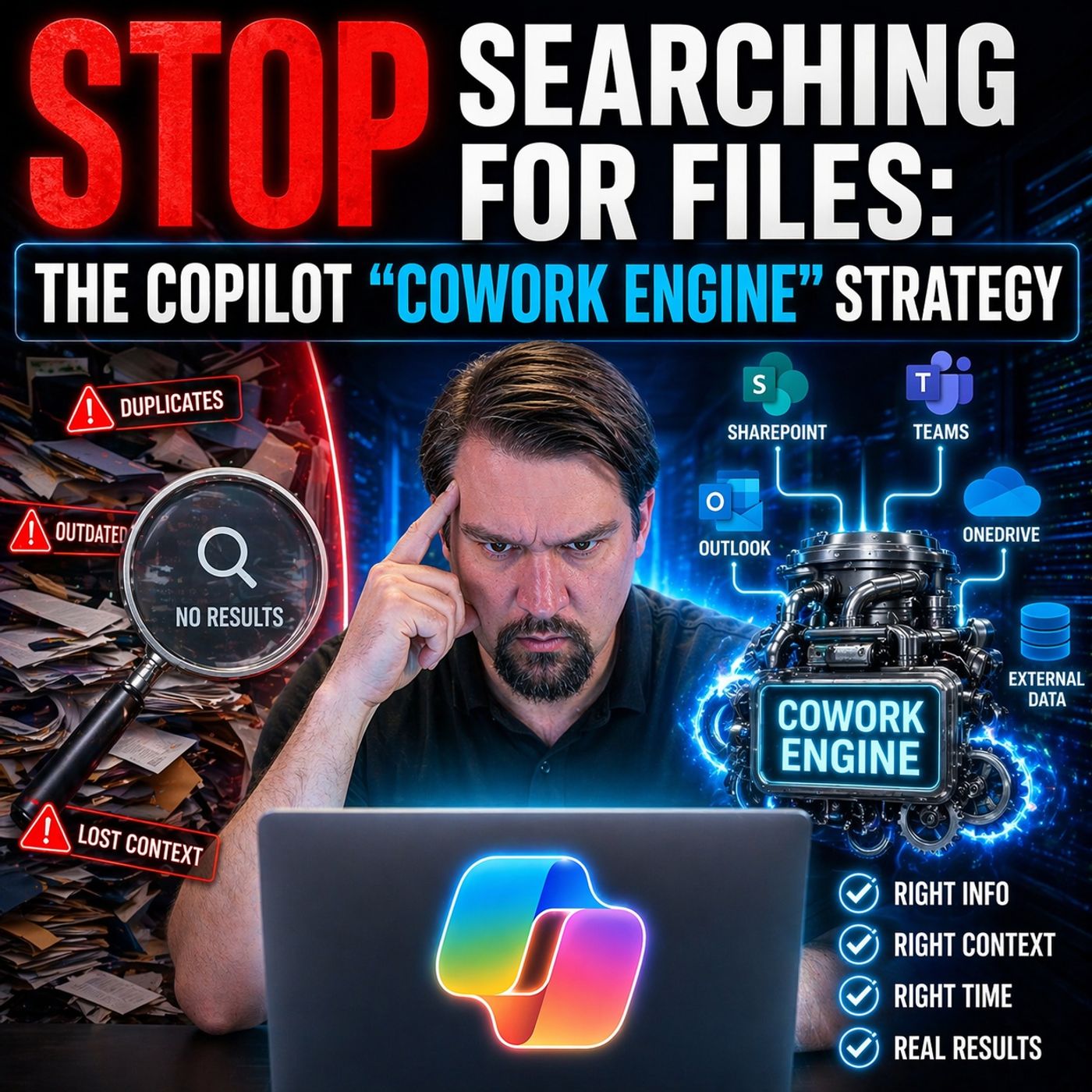
Stop Searching for Files: The Copilot "Cowork Engine" Strategy
from M365.FM - Modern work, security, and productivity with Microsoft 365 · host Mirko Peters - Founder of m365.fm, m365.show and m365con.net
Search is not a feature.It is a failure signal. If your day starts with a search bar, your system is already working against you. What most organizations call “document management” is, in reality, a high-density storage system for dead data. Files are stored, duplicated, renamed, and forgotten—while the burden of finding meaning is pushed entirely onto the human. You are expected to remember:where something was savedwhich version is correctwhether “Final_v2” is actually finalThat’s not productivity. That’s manual retrieval labor disguised as knowledge work. The gap becomes obvious when you compare it to consumer search. At home, you find what you need in seconds. At work, the same action can take twenty minutes—and still end in uncertainty. That gap isn’t about technology capability. It’s about architectural failure. This is the Search Tax. It shows up quietly, but its impact is massive. Time lost to searching compounds across teams, turning highly skilled employees into navigators of clutter instead of decision-makers. It also creates dependency loops—people interrupt colleagues because they can’t trust what they find. And most dangerously, when the “right” version isn’t obvious, people guess. And guessing in business is expensive.FROM ASSISTANT TO ARCHITECT: THE COWORK ENGINE SHIFT Most companies are still using Copilot like an assistant—reactive, prompt-driven, and dependent on human direction. That model doesn’t remove the Search Tax.It just speeds up the wrong process. To actually eliminate search, you need a different paradigm: the Cowork Engine. This is not a chatbot. It’s an execution layer. Instead of waiting for instructions, the engine:understands relationships between dataassembles context automaticallyexecutes tasks in the backgroundAt the core of this model is what we can call Work IQ—a system-level understanding of how information connects across your organization. It doesn’t just see files; it sees:how emails relate to documentshow meetings influence decisionshow timelines connect across systemsThis is where the shift becomes real. You’re no longer asking: “Where is the file?” You’re saying: “Prepare the output.” And the system does the rest.STRUCTURED CONTEXT: FROM DATA GRAVEYARD TO SIGNAL LAYER The biggest mistake organizations make is giving AI access to everything and expecting clarity. That approach creates noise—not intelligence. If your system contains thousands of outdated or duplicate files, the model doesn’t magically filter them. It gets confused by them. The result is inconsistent outputs, outdated insights, and a growing lack of trust. The solution is not more data. It’s better context. A Cowork Engine requires a curated layer where:authoritative sources are definedduplicates are removedexternal systems are connected intentionallyThis is where structured platforms and connectors come into play. Instead of forcing users to jump between tools, the system pulls in:live operational dataverified documentsrelevant communication threadsThe key shift is simple but powerful: The system assembles context so the user never has to search for it. Work no longer starts with navigation.It starts with ready-made understanding.GOVERNANCE-BY-DESIGN: TRUST AS INFRASTRUCTURE Speed without control is risk. That’s why governance in this model isn’t an afterthought—it’s built directly into how the system operates. Permissions define visibility. Identity shapes context. Sensitivity travels with the data. This means:the system only sees what the user is allowed to seeoutputs inherit classification automaticallycompliance is enforced during execution—not afterInstead of auditing after the fact, the system ensures correctness in real time. This is what turns AI from a liability into a trusted coworker.FROM SEARCH RESULTS TO EXECUTION: THE AUDIT PACK EXAMPLE The difference between old and new architecture becomes obvious in high-pressure scenarios. Take a compliance audit. In the traditional model, this triggers a manual process:searching multiple systemsdownloading filesreconciling versionsbuilding reports manuallyIt’s slow, fragmented, and error-prone. In a Cowork Engine model, the workflow flips. You provide intent: “Build an audit pack for Vendor X.” The system:retrieves authoritative contractsscans relevant email threadsextracts decisions from Teams conversationscompiles a structured, validated outputWhat you receive is not a list of links. It’s a decision-ready artifact, complete with traceability back to source data. The human role shifts from searching to validating.MEMORY AND RAG: HOW THE SYSTEM GETS SMARTER What makes this model scalable is not just retrieval—it’s learning. Traditional AI resets with every interaction. The Cowork Engine does not. It builds a persistent memory layer that:captures correctionsstores preferred formatslearns decision patternsOver time, the system evolves:fewer errorsless reworkmore alignment with business expectationsThis transforms AI from a tool into a living system of institutional knowledge. Your data may be shared across competitors. Your memory layer is not.MEASURING SUCCESS: FROM SEARCH TIME TO DECISION SPEED You can’t measure this transformation by counting prompts or outputs. The real metric is: TIME-TO-DECISION How long does it take to go from request → to trusted action? Supporting this are two critical indicators:Rework RateHow often outputs need correctionSearch DependencyHow often humans still need to “look things up”When the architecture is right:decision cycles shrink dramaticallyrework approaches zerosearch becomes irrelevantThat’s when you know the Search Tax is gone.FINAL TAKEAWAY Search was designed for a slower world. A world where:data was smallerdecisions were slowernavigation was acceptableThat world no longer exists. Today, speed comes from context, not discovery. If your system still requires people to hunt for information, you are operating at a structural disadvantage. The companies that win in 2026 will not be better at searching. They will be better at not needing to search at all. Become a supporter of this podcast: https://www.spreaker.com/podcast/m365-fm-modern-work-security-and-productivity-with-microsoft-365--6704921/support.
Embed this episode
What this episode covers
Search is not a feature. It is a failure signal. If your day starts with a search bar, your system is already working against you. What most organizations call “document management” is, in reality, a high-density storage system for dead data. Files are stored, duplicated, renamed, and forgotten—while the burden of finding meaning is pushed entirely onto the human. You are expected to remember: where something was saved which version is correct whether “Final_v2” is actually final That’s not productivity. That’s manual retrieval labor disguised as knowledge work. The gap becomes obvious when you compare it to consumer search. At home, you find what you need in seconds. At work, the same action can take twenty minutes—and still end in uncertainty. That gap isn’t about technology capability. It’s about architectural failure. This is the Search Tax. It shows up quietly, but its impact is massive. Time lost to searching compounds across teams, turning highly skilled employees into navigators of clutter instead of decision-makers. It also creates dependency loops—people interrupt colleagues because they can’t trust what they find. And most dangerously, when the “right” version isn’t obvious, people guess. And guessing in business is expensive. FROM ASSISTANT TO ARCHITECT: THE COWORK ENGINE SHIFT Most companies are still using Copilot like an assistant—reactive, prompt-driven, and dependent on human direction. That model doesn’t remove the Search Tax. It just speeds up the wrong process. To actually eliminate search, you need a different paradigm: the Cowork Engine. This is not a chatbot. It’s an execution layer. Instead of waiting for instructions, the engine: understands relationships between data assembles context automatically executes tasks in the background At the core of this model is what we can call Work IQ—a system-level understanding of how information connects across your organization. It doesn’t just see files; it sees: how emails relate to documents how meetings influence decisions how timelines connect across systems This is where the shift becomes real. You’re no longer asking: “Where is the file?” You’re saying: “Prepare the output.” And the system does the rest. STRUCTURED CONTEXT: FROM DATA GRAVEYARD TO SIGNAL LAYER The biggest mistake organizations make is giving AI access to everything and expecting clarity. That approach creates noise—not intelligence. If your system contains thousands of outdated or duplicate files, the model doesn’t magically filter them. It gets confused by them. The result is inconsistent outputs, outdated insights, and a growing lack of trust. The solution is not more data. It’s better context. A Cowork Engine requires a curated layer where: authoritative sources are defined duplicates are removed external systems are connected intentionally This is where structured platforms and connectors come into play. Instead of forcing users to jump between tools, the system pulls in: live operational data verified documents relevant communication threads The key shift is simple but powerful: The system assembles context so the user never has to search for it. Work no longer starts with navigation. It starts with ready-made understanding. GOVERNANCE-BY-DESIGN: TRUST AS INFRASTRUCTURE Speed without control is risk. That’s why governance in this model isn’t an afterthought—it’s built directly into how the system operates. Permissions define visibility. Identity shapes context. Sensitivity travels with the data. This means: the system only sees what the user is allowed to see outputs inherit classification automatically compliance is enforced during execution—not...
NOW PLAYING
Stop Searching for Files: The Copilot "Cowork Engine" Strategy
No transcript for this episode yet
Similar Episodes
No similar episodes found.
Similar Podcasts
No similar podcasts found.