
EPISODE · May 1, 2026 · 18 MIN
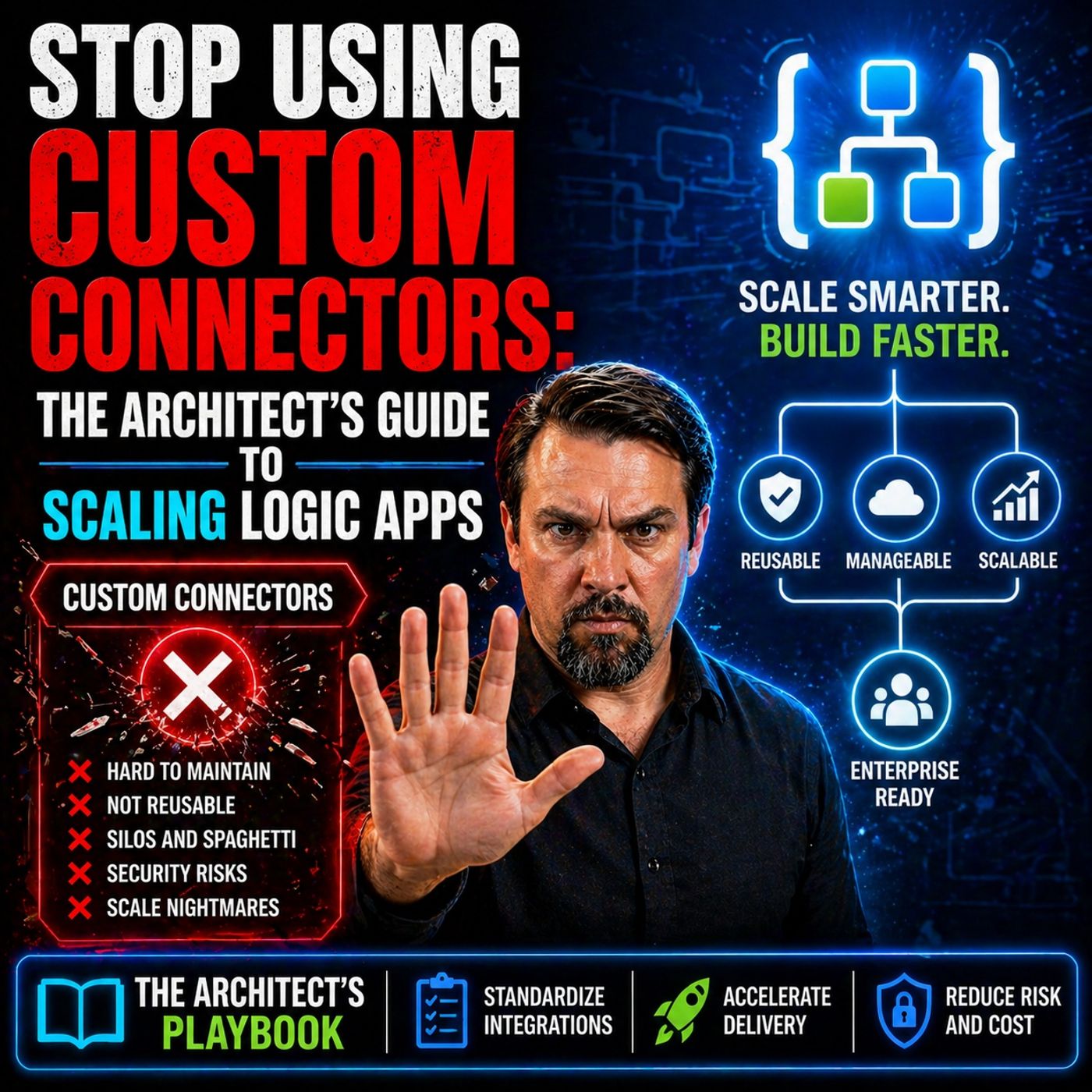
Stop Using Custom Connectors: The Architect's Guide to Scaling Logic Apps
from M365.FM - Modern work, security, and productivity with Microsoft 365 · host Mirko Peters - Founder of m365.fm, m365.show and m365con.net
Your automation strategy looks like it’s scaling—but underneath, it’s accumulating invisible debt. What feels like speed today becomes fragmentation tomorrow. Custom connectors promise fast integration, low-code accessibility, and quick wins. But by 2026, they’ve quietly become one of the biggest blockers to governance, security, and cost control in enterprise environments. This is the fragmentation tax—and most organizations are paying it without realizing it. While teams celebrate rapid delivery, architecture slowly erodes. Connectors multiply, ownership becomes unclear, and visibility disappears. The result? A system that works… until it doesn’t. The top architects have already made the shift. They’ve stopped building flows and started building infrastructure—moving toward Logic Apps Standard as the foundation for scalable, governed automation.⚠️ THE CUSTOM CONNECTOR TRAP The problem isn’t the tool—it’s the assumption behind it. We assumed that making APIs easier to access would empower the business. In reality, it created a new layer of Shadow IT. Every custom connector becomes a black box: easy to build, hard to monitor, and nearly impossible to govern at scale. What starts as a simple wrapper quickly turns into a distributed risk surface. Governance tools can tell you a connector exists—but not what it actually does. That lack of visibility creates serious consequences, especially when sensitive data flows through insecure or over-permissioned APIs. Where custom connectors break down:Lack of deep visibility into API behavior and data flowIncreased security risks due to inconsistent authentication and permissionsHigh maintenance overhead when APIs change or evolveDependency on individual makers instead of centralized architectureOver time, this leads to fragile systems tied to people instead of platforms. When employees leave, integrations break. When APIs change, flows fail. What looked like agility becomes operational chaos.💸 THE HIDDEN COST: THE API TAX Beyond governance, there’s a financial reality most teams overlook. Consumption-based models charge per action. At small scale, it feels negligible. But as automation grows, those tiny costs compound into a significant and unpredictable expense. You’re effectively paying more as you become more efficient. This is where the model collapses. High-volume workflows—something as simple as invoice processing—can generate millions of actions per month. At that point, you’re no longer optimizing—you’re leaking budget. Logic Apps Standard flips this model entirely. Instead of paying per execution, you move to a fixed compute cost. Custom integrations run locally within the runtime, eliminating per-call charges and stabilizing your spend. The shift is not just technical—it’s financial. You move from unpredictable scaling costs to a controlled infrastructure model that aligns with enterprise growth. 🔐 GOVERNANCE AND NETWORK CONTROL AS A REQUIREMENT Security is no longer optional—and architecture now defines compliance. Most low-code flows rely on public endpoints, meaning your data leaves your environment and travels across shared infrastructure. For regulated industries, this is a critical failure point. You cannot enforce Zero Trust principles if your automation layer depends on public network paths. Logic Apps Standard changes this by embedding automation inside your own virtual network. Instead of exposing data externally, you bring the runtime into your security perimeter. Traffic becomes private, controlled, and auditable. This isn’t just about protection—it’s about control. You define how data moves, where it flows, and who can access it. The architecture itself enforces governance, rather than relying on policies to catch issues after the fact. 🏗️ FROM CITIZEN DEVELOPMENT TO ENTERPRISE ARCHITECTURE There’s a fundamental shift happening in how automation is built. Low-code tools made it easy to create solutions—but they also removed the discipline required to maintain them. Building directly in a browser with no separation between development and production leads to fragile, unstructured systems. Logic Apps Standard introduces a different mindset. Automation becomes code. Workflows are developed locally, version-controlled, and deployed through pipelines. Changes are intentional, traceable, and reversible. What changes with the architect model:Development moves from portal-based editing to structured environmentsDeployments become controlled through pipelines and source controlUpdates can be isolated to specific workflows, reducing riskIntegrations shift from UI-driven automation to API-first orchestrationThis is where automation matures. It’s no longer about building something quickly—it’s about building something that lasts.🔮 THE 2026 ARCHITECT MODEL: FROM FLOWS TO ORCHESTRATION The future of automation is not trigger-action—it’s event-driven orchestration. Instead of linear flows, systems now reason about processes. They handle complex, multi-step operations across systems, data sources, and timelines. Logic Apps Standard enables this shift by supporting both lightweight stateless workflows and durable, long-running processes. It also removes the limitations of low-code environments. When needed, you can extend workflows with custom code, integrate deeply with services, and design systems that reflect real business complexity. This creates a layered architecture:Power Automate handles user-facing, lightweight automationLogic Apps Standard manages core integrations and data pipelinesThe result is a system that balances flexibility with control—empowering users without sacrificing structure.🛣️ THE MIGRATION PATH FOR SCALABLE AUTOMATION Moving away from custom connectors doesn’t happen overnight—but it starts with clarity. Begin by identifying your most critical connectors, especially those with unclear ownership or high execution volume. These are your highest-risk assets and your biggest cost drivers. From there, the goal is not just migration—but re-platforming. You’re not copying flows; you’re rebuilding them within a model designed for scale, governance, and reliability. This is where organizations start to see measurable impact—reduced costs, fewer failures, and a dramatic improvement in visibility across their automation landscape. 🧭 THE BOTTOM LINE Custom connectors were never meant to scale your enterprise. They were a shortcut—and shortcuts don’t hold up under pressure. If your automation isn’t fully visible, auditable, and governed at the transaction level, it’s not ready for enterprise use. The shift to Logic Apps Standard is not just a technical upgrade—it’s a structural correction. Stop building disconnected solutions.Start building systems that scale. Because in 2026, the difference between success and failure isn’t how fast you build—it’s how well your architecture holds together.Become a supporter of this podcast: https://www.spreaker.com/podcast/m365-fm-modern-work-security-and-productivity-with-microsoft-365--6704921/support.
Embed this episode
What this episode covers
Your automation strategy looks like it’s scaling—but underneath, it’s accumulating invisible debt. What feels like speed today becomes fragmentation tomorrow. Custom connectors promise fast integration, low-code accessibility, and quick wins. But by 2026, they’ve quietly become one of the biggest blockers to governance, security, and cost control in enterprise environments. This is the fragmentation tax—and most organizations are paying it without realizing it. While teams celebrate rapid delivery, architecture slowly erodes. Connectors multiply, ownership becomes unclear, and visibility disappears. The result? A system that works… until it doesn’t. The top architects have already made the shift. They’ve stopped building flows and started building infrastructure—moving toward Logic Apps Standard as the foundation for scalable, governed automation. ⚠️ THE CUSTOM CONNECTOR TRAP The problem isn’t the tool—it’s the assumption behind it. We assumed that making APIs easier to access would empower the business. In reality, it created a new layer of Shadow IT. Every custom connector becomes a black box: easy to build, hard to monitor, and nearly impossible to govern at scale. What starts as a simple wrapper quickly turns into a distributed risk surface. Governance tools can tell you a connector exists—but not what it actually does. That lack of visibility creates serious consequences, especially when sensitive data flows through insecure or over-permissioned APIs. Where custom connectors break down: Lack of deep visibility into API behavior and data flow Increased security risks due to inconsistent authentication and permissions High maintenance overhead when APIs change or evolve Dependency on individual makers instead of centralized architecture Over time, this leads to fragile systems tied to people instead of platforms. When employees leave, integrations break. When APIs change, flows fail. What looked like agility becomes operational chaos. 💸 THE HIDDEN COST: THE API TAX Beyond governance, there’s a financial reality most teams overlook. Consumption-based models charge per action. At small scale, it feels negligible. But as automation grows, those tiny costs compound into a significant and unpredictable expense. You’re effectively paying more as you become more efficient. This is where the model collapses. High-volume workflows—something as simple as invoice processing—can generate millions of actions per month. At that point, you’re no longer optimizing—you’re leaking budget. Logic Apps Standard flips this model entirely. Instead of paying per execution, you move to a fixed compute cost. Custom integrations run locally within the runtime, eliminating per-call charges and stabilizing your spend. The shift is not just technical—it’s financial. You move from unpredictable scaling costs to a controlled infrastructure model that aligns with enterprise growth. 🔐 GOVERNANCE AND NETWORK CONTROL AS A REQUIREMENT Security is no longer optional—and architecture now defines compliance. Most low-code flows rely on public endpoints, meaning your data leaves your environment and travels across shared infrastructure. For regulated industries, this is a critical failure point. You cannot enforce Zero Trust principles if your automation layer depends on public network paths. Logic Apps Standard changes this by embedding automation inside your own virtual network. Instead of exposing data externally, you bring the runtime into your security perimeter. Traffic becomes private, controlled, and auditable. This isn’t just about protection—it’s about control. You define how data moves, where it flows, and who can access it. The architecture itself enforces governance, rather than relying on policies to catch issues after the fact. 🏗️ FROM CITIZEN DEVELOPMENT TO ENTERPRISE ARCHITECTURE <br...
NOW PLAYING
Stop Using Custom Connectors: The Architect's Guide to Scaling Logic Apps
No transcript for this episode yet
Similar Episodes
No similar episodes found.
Similar Podcasts
No similar podcasts found.