. . . . .
I guarantee you. No candle is displayed as a candle, rather than a candle, but, too, the light. Because of it, there is also a little bit of a candle as well, whether it's not a brand such as a fit, fit to the same size, or rather than the way to it. There is a little more well-known, like to try to see, stick to the day, and then right. Or, in terms of media, there will be more than a little bit. Amongst many other subjects, more than a great wonderful, and it's been amazing, informative days on when it comes to science and discussions.
...released two years ago, actually, and this all comes together to make her an excellent guide through Bowie's costume and style choices. Regardless of the topic, Mel's writing honours any subject she approaches with her depth of exploration and eloquence, and I guarantee it's always imbued with a sharp observation, wit, and laugh-out-loud humour. So, with no further ado, a reminder to switch off your phones or put them to silent, and please join me in welcoming the delightful Miss Mel Campbell. Thank you for that lovely introduction, Tanya. You're like nuts on a bar. Completely complimentary. Basically, I want to flag before I begin that I'm not a massive Bowie expert. My expertise comes through the field of costume because costume has been an interest of mine both through the fashion side of things and through the performance.
side of things. So I'm a film critic in addition to all the other things that I managed to cram into my work. So I'm always up to wondering what costume does for a character, what it does within the context that it's been used, and what other contexts costume draws on. So when we look at David Bowie, we can look at all the different kinds of costumes he's had in his career. He's had album artwork and promotional photo costumes. He's had music video costumes. He's had costumes that he's worn on stage, on tour, and in TV appearances. And he's been in films as well, and he's got costumes for those two. Basically, Bowie's got a costume for everything. And I think that the costume that first springs to your mind might have a lot to do with the kind of...
Bowie that is your Bowie, because everyone's got a Bowie, am I right? For me, this is my Bowie. And of course, you can't have a talk about David Bowie's costumes without talking about Jareth the Goblin King in Labyrinth. These costumes are wonderfully evocative. In this particular one, he's dressed like the white owl that he transforms into. He also wears lots of black things. And notice how he's really into balls? That's no coincidence, because that's the other thing that people think of when they think of David Bowie in the film Labyrinth.
But I will get to David Bowie's bulge later on. First, I want to talk some more about Bowie's influences because he's a smart dude. If you've ever come across Bowie's list of 100 top books, I can't see anything in the audience, but I'd be interested to know who's interested in Bowie's top 100 because it's a wonderfully diverse set of both fiction and nonfiction that has informed who he is and the kind of way he sees the world. So I want to talk about just a few of the influences that I've identified. Who knows if they're what Bowie himself would identify. But the first of this is German Cabaret. Now, we often think of Bowie as being a completely original person, you know, someone who just sprang out of nowhere and who...
had their own ideas about how to do things but you can't disentangle Bowie from the context of the 1970s in which he really became popular so in the late 60s Bowie was just sort of wandering around you know he tried so many different kinds of musical styles he had embarrassing novelty singles he tried being a mod he tried you know big beat R&B type music, but it was only really in 1969's Space Oddity that the idea of what Bowie was really sort of coalesced. But in the late 60s, it was interesting that he was trying all sorts of stage work. He was a mime, which I'll get to in a little bit, but he was also really interested in the period of the 1920s and 1930s in Germany, which is when the cabaret scene in the Weimar Republic was really flourishing. The movie Cabaret came out in 1972, so this is not something Bowie was the first person to discover, but he was really interested in the people who were performing in Europe in that time.
When we look at albums like Hunky Dory and the intense gestural vocabulary that he brought, particularly to this very feminised period in his work, I'll get to Bowie and gender a bit later on because we can't have a talk about Bowie without talking about gender. But when we look at someone like Marlena Dietrich who also used her hands in a really gestural way and when we think about the cabaret scene which was about you essentially being rooted to the spot or doing a small little dance on the stage and it's your facial expressions and your gestures that really communicate what you're doing. Here's another one that I found. Look at how he's holding his hands in that picture. And then another similar picture of Dietrich.
Another influence for him was the Italian Commedia dell'arte. He was friends with a mime in the late 60s called Lindsay Kemp. Now, Kemp was very influential with the way that Bowie learned how to handle himself on stage. In fact, Kemp later on said to a music journalist, I taught David to free his body. So he'd like to take credit for absolutely everything that Bowie went on to do with his body. But, I mean, we all know the Ashes to Ashes Piero character. This costume was designed by Natasha Korniloff, who would go on to collaborate with Bowie throughout the 70s.
Yeah, it harks back to the early collaborations with Lindsay Kemp. So they did a pantomime, just in time for Christmas 1967, called Pierrot in Turquoise. It starred Kemp as the title Clown Pierrot. So if you're familiar with the Commedia dell'Arte stereotypes, Pierrot is the sad clown. He's in love with Columbine, but she doesn't love him. She loves Harlequin, the hot guy, instead. And so Pierrot gets horribly, horribly jealous and kills Harlequin, which is the story that we're looking at in the Pierrot in Turquoise, which is this particular panto. But we did the soundtrack, and he also appeared as Cloud. So he's already got the red hair. He's tantalisingly on the cusp of all this crap.
crazy stuff that he would be doing in the 70s. And it was apparently Kemp who taught him how to do makeup mime style, which came in so handy during his Ziggy Startups and Aladdin Sane periods. But what I also find fantastically interesting about this is that it's one of the first times that the colour of turquoise and blue in general becomes associated with David Bowie. I think that it's one of the key colours, and we'll see it again and again when we're looking at different kinds of costumes that Bowie is wearing all the way through his career in the different phases. So I'll touch on a few of those later, but I want you guys to keep that in mind, turquoise.
So another of his influences is Japanese Kabuki theatre. Oh, hang on, before I get to that, I've got a saucy anecdote. Who knows the complete truth? There's probably only David Bowie, Kemp and Kornilov because Bowie was sleeping with both of them, the mime guy and the costume lady. And once Kemp found out, he lived up to the role of the betrayed Pierrot and slashed his wrists. And then when he came on stage, his bandages just kind of started leaking and he was bleeding all over his Pierrot costume. And everyone's like, this is extremely, you know, authentic. Wow, Pierrot is really heartbroken. But yeah, there are so many crazy stories like that of people getting horribly injured on stage and the audience is like...
But I won't go into those today. So Bowie and Kemp continued to collaborate all the way through the Ziggy Stardust period. Kemp also appears in the video for John I'm Only Dancing, if you want to have a look at that later on. There's some kind of dancey mime stuff happening apart from that. And, of course, there was no hard feelings because Kurnalov ended up designing some of his sauciest costumes later on, so we'll get to those. But now to the Kabuki theatre. We all know that line, that Ziggy was like some cat from Japan.
Bowie was really, really fascinated by a Japanese designer called Kansai Yamamoto, whose designs were really, really avant-garde, but they did draw from an essential kind of Japanese-ness. And he was particularly influenced by Kabuki, which is the kind of very over-the-top theatre, as opposed to Noh, which is NOH, which is the sort of more classical theatre. Anyway, so basically... Kansai Yamamoto later said that a lot of the costumes that Bowie wore were influenced by hikinuki, which is the method of changing your costume really quickly. So if you have to be a different character, if your character has to go somewhere else, that's Yamamoto there. I love the matching jumper, don't you?
So basically, that came in so handy for Bowie on stage because he would come out wearing this amazing kimono-style outer cloak that would then rip away with press studs to reveal the fascinating saucy bodysuits underneath. So you can see the costume's actually being ripped by people who are holding the very edges of it. It's longer than Bowie's arms, so they just seize the edges of it and rip it off. And can you imagine being in the audience? There are some wonderful photos, I've got a couple of them later on in the slideshow, of people just extending their arms towards Bowie. They were going mental for him. And can you imagine the theatricality of this kind of quick costume change?
They've had them sometimes on those sort of ex-country-has-got-talent sort of shows. People will sort of magically transform into different costumes. I love that. It's one of my favourite things. But basically, Bowie couldn't afford the original Yamamoto costumes early on in his career. And one of the most famous ones, which is the bunny jumpsuit, or woodland creatures, as it's more officially known, he bought from a boutique because it was just so outré that no one would actually buy it in London. It was just sitting on the shelves until Bowie went, you know, I think I can rock this. I don't care that it's technically a woman's leotard. I'm going to rock it anyway.
But once he got into Aladdin Sane, he actually had some bank and could commission Yamamoto to create costumes for him, which he did in spectacular fashion. We'll get to those as well. Bowie has also been really fascinated by ideas of dystopia, and specifically British dystopia. And so particularly a lot of his tailored clothes, you'll see are distressed and sort of falling apart. But they do hark back to particularly British ideas. So A Clockwork Orange, which came out in 1971, was a key influence for Bowie. And the jumpsuit that appears at the very start of the David Bowie years' exhibition. Can I get a show of hands? Who's been to the exhibition?
If you haven't, go. If you have, go again. It's tremendous. I love it so much. But the first thing you're confronted with is the jumpsuit that Bowie wears on his performance on Top of the Pops on July 5th, 1972, which he called Ultraviolence in Liberty Fabrics. Now, Liberty, of course, Liberty of London is a quintessentially English company, and they produce beautiful, small prints. So notice how the prints have sort of been put together in a way that suggests the crotch-centric framing of those cod pieces that they wear in A Clockwork Orange, and those boots that he wears have that kind of drooginess to them. So this was the introduction of this character, Ziggy Stardust, that blew everyone's minds and also played guitar. We can't forget the Ziggy.
played guitar. But also, later on in his career, he worked with Alexander McQueen, who was then quite a young emerging designer. They never allegedly worked together in person. They would correspond and they would talk on the phone, but apparently it was very much a long-range collaboration. But this beautiful Union Jack Coat, which of course appeared on the opening slide when you guys all came in here, a major part, look how distressed it is, but also look how cleverly McQueen has pieced together the Union Jack. So the middle part looks like a belt, but we've got the diagonal panels and the kind of flared gauze that he's inserted in the back. It's like a military jacket. Again, the British red coat is such a redolent English stereotype, but here we show that it's like a world gone wrong where we actually had to make our military coats literally out of the state. I don't know, I'm maybe getting a bit too excited there. But we worked with McQueen on a lot of beautiful coats, some of which you can see in the exhibition. I'm not sure if this is one of the particular McQueen coats, but this is from the era where he did a tour called the Outside Tour, where he was wearing this kind of...
distressed post-apocalyptic stuff that he kind of felt like it was 1995 at the time and he felt like we're coming up to the millennium and questions of who we are, who the state is, what society is, have all been sort of coming into question. Technically it's called decadence and it happened as well at the end of the 19th century. There was a massive crisis, particularly among the intelligentsia, about what was going to happen when we ticked over to the 20th century. As it turned out, it was pretty much World War I in 1914 that proved to be that crisis point. But for a lot of people, as they were approaching 1900, there was that same kind of...
terrible fear and what I like about these coats of Bowie is that they really reference that old-fashioned style of tailoring. I'll talk some more about tailoring later on as well. There's also like a cool singlet kind of t-shirt thing and distressed pants and bizarre belt that he wore around about that time and they're all made of linen and they're kind of beautifully distressed. You can see those in the exhibition downstairs. Now it's time to talk about Bowie's body.
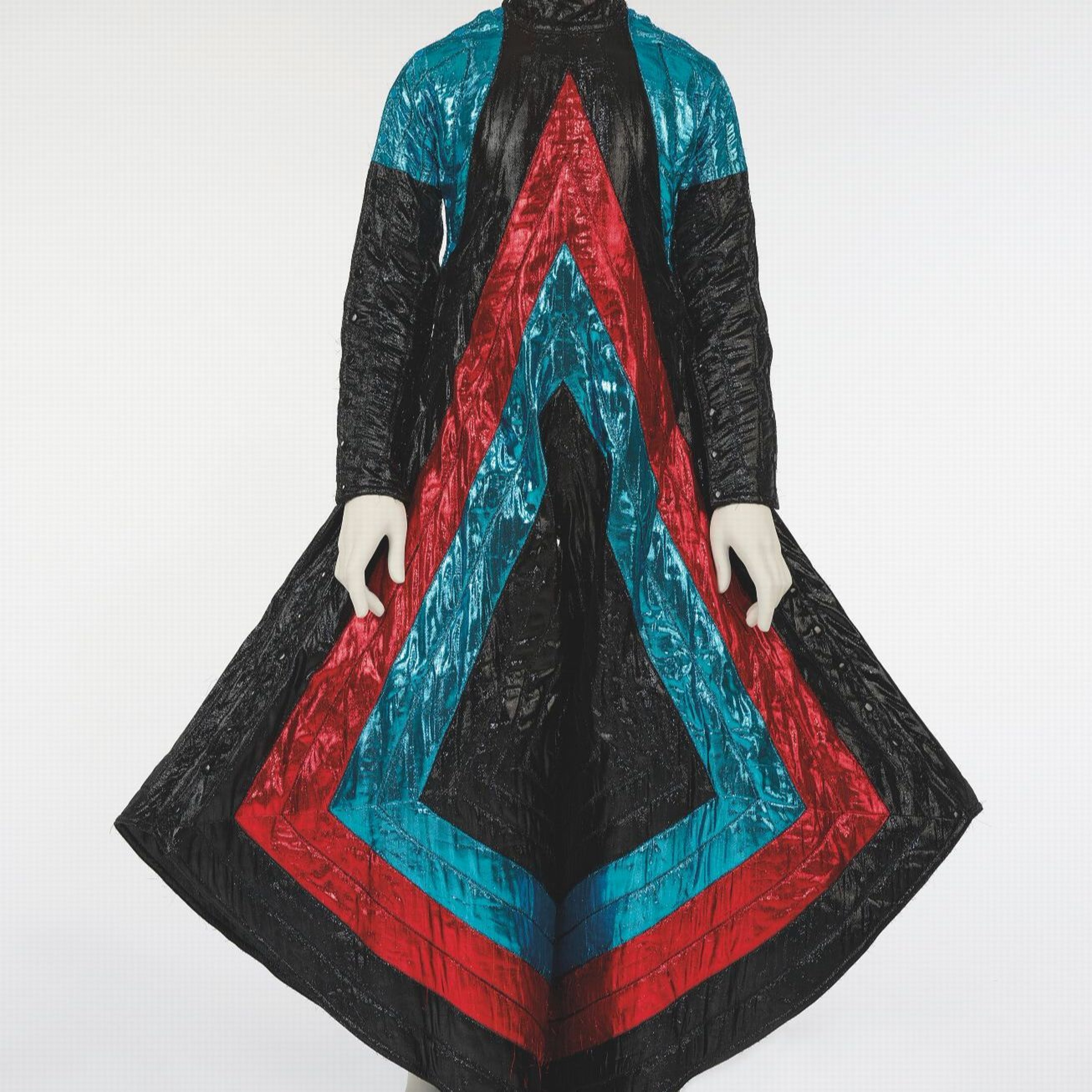
Lindsay Kemp obviously thought he invented Bowie's body, but Bowie's body is a collaboration, which I find completely fascinating. We think of our bodies as something that is intrinsic to ourselves, something that we have an internal decision to display to the world. But what's fascinating about Bowie is that so many people have felt like they've had a piece of him, that they've owned him somehow, and they've helped create the body that we now think of as David Bowie's body. Let's first talk about abstracting the body. So this is one of the most famous costumes. This was one by Kansai Yamamoto during the Aladdin Sane tour in 1973. And notice how the grooves, the stripes on it, are like a record. He's literally turned himself into a record with these enormous bulgy legs. There are also some fascinating photos that show the costume in motion. This is the most famous picture, but imagine how weird it would have looked flapping around as Bowie was doing all his antics on stage, because he was known for being a very physical performer. He wasn't just a stand-on-the-stage person at that time.
This rigid German cabaret costume he used in a guest appearance that he made, which was completely notorious, on the December 15, 1979 episode of Saturday Night Live. He was the musical act, and Martin Sheen was the host that night. Now, Bowie had been hearing about this amazing cabaret performer in New York's kind of art club scene called Klaus Nomi, and so he got Klaus and another club guy called Joey Arias to be his backing singers. Klaus had this amazing countertenor voice, and his cabaret stuff was a mixture of doing classical music but with bizarre electronic effects or appearing in a cloud of smoke and then vanishing again. completely weird, completely bizarre. Bowie loved it, obviously. So this appearance that he made on Saturday Night Live is not your average musical show. There they are. Basically, there was this weird, rigid...
that Bowie couldn't even walk in. He had to be carried by the two backing singers. That's Klaus wearing the black. Yeah, he literally had one of them holding his arm on either side and they carried him from the back of the stage to the front of the stage. There's video of that in the show downstairs as well, which is hilarious. Now, a lot of people at the time were thinking, oh, here's Bowie. He's ripping off some young club kid who's come up with this original idea. But the weird thing was that it wasn't their idea. It was actually Bowie's idea because Bowie was the one who was obsessed with German cabaret. And he remembered that it was Sonia Delaunay who had come up with these bizarre costumes.
in the 1920s. I think that's 1922. So you can see the man's costume looks very similar to the one that Bowie wore. But then Klaus Nomi loved it so much that he went on to adopt a similar kind of rigid tuxedo look for his own work. And he was one of the first famous people to die of AIDS in 1983, which was a real shame and a real loss because he was a very weird and individual person who probably should still be contributing. So that's kind of the abstract side of things. But of course, now we've got to get to sex because it's Bowie, come on. And gender, you know, we're not sure if he's a boy or a girl. So this particular Man Who Sold the World period, the Man Who Sold the World was the song that Bowie was actually singing while he was performing this bizarre thing. So he was harking back to ideas of gender with that performance as well because this is what he actually looked like when he...
when the song came out. And, of course, when he took off the weird outfit on Saturday Night Live, he and his backing singers were wearing these weird little skirts. And one of the other songs that they performed was Boys Keep Swinging, which was a notorious episode for censorship, because there's a line in that song that goes, other boys check you out. But they thought that this was a dangerous thing to be actually teaching the youth of America, so they censored that line. However, there's another line in the song that goes, life is a pop of the cherry. They did not censor that one. Nor did they censor a bizarre puppetry episode, which we can call puppetry of the penis, because that's what happened. I don't, unfortunately, have the penis part. But, basically, Bowie performed against a green screen, hanging this...
tiny puppet around his neck so it looked as if he had this undersized body and he was manipulating the body and at the end of the performance he fetched out of those trousers that you can see there a really proportionally quite large penis which he waved around and that went straight to air. They didn't have a problem with censoring that. Here's a picture of what it actually looked like when Bowie was doing the puppetry. Okay, now this is another notoriously censored TV costume. This costume is also downstairs. What's hilarious is that that weird sort of one-legged jumpsuit bit was not even meant to be part of the costume at all. There was meant to be a third hand that reached around from behind and cupped Bowie's crotch, but the TV networks felt that that was too rude. And so they said to Kournikov, who had designed this outfit, you've got to come up with something else. This is just way too rude. And so she came up with this jumpsuit, but it looks ridiculous because we know that what happens when that is taken off is like completely nakedness. So it just highlights the nudity that they weren't allowed to show.
Of course, now I'm going to talk about the Ziggy Stardust era and the catsuits, which we can't get away from. Now, the weird thing is that these had such public acceptance that knitting patterns were made for them. You could get your mum or your grandma to knit for you. Knit me a Ziggy jumpsuit with my butt cheek hanging out one leg and with my bulge firmly accentuated. Again, these were Yamamoto catsuits.
The weird thing about Ziggy Stardust was that he combined the homely with the avant-garde. Bowie described Ziggy as part Nijinsky and part Woolworths. He copied the hairstyle from a teen magazine. He insisted he copied the entire thing, the colour, the cut, everything from a magazine targeted to teen girls. But it's interesting that he should mention Nijinsky because blue, I want to come back to that colour blue issue. Basically, Nijinsky's best known role, he was a ballet dancer with the Ballet Russe at the first half of the...
the 20th century. And his production of The Blue God with costumes by Leon Buxt was famous. It was iconic. And there you can see a photo, which you can't get the colours, but there's the sketch for the costume and there's the actual costume. And look at the use of pattern. Don't you think it's interestingly similar to the way that pattern was used in the Ziggy Stardust costumes? Let me just go back there. There we go.
I find it fascinating the way that these things echo. Whether they're intentional or whether they're unintentional, it's part of a cultural context that you can't separate from Bowie. So when I say that he's not completely original, it's not me trying to put him down. It's me saying that he's so clever in picking up all these diverse influences and weaving them into something that appeared completely innovative and that was both shocking and at home in England, to the point where your grandma could make it. Here is the famous rabbit suit that he bought from Off the Rack in a London boutique. Now, this was made for women. Basically, none of these Yamamoto costumes were for men, and Yamamoto remembers thinking, whoa, when he saw Bowie designing these clothes that he, Yamamoto, had made for women. So one of the things that you will notice with a lot of the Ziggy Stardust outfits is that they emphasise parts of the body that are traditionally the sexualised parts for women. So the thighs, for instance. Men's thighs are rarely seen. You'll have shorts, maybe, but you won't have, like, right up to the crotch in the way that you do with women's outfits. The shoulder cutouts as well is something... Oh, I have to show you the back view of this bunny.
jumpsuit. Pretty risque. But I want to also contrast how it looks on a woman. Because Kate Moss actually wore the very same outfit when she accepted an award on Bowie's behalf at the Brit Awards last year. And you can see that it looks a lot more like a pair of hot pants on her rather than the sort of briefs that it looks on Bowie. And I think that might be because his torso is just longer than Kate Moss's. But think of how thin Bowie is that a woman can fit in. And a model, a waif, that's how Kate Moss made her fortune.
But basically Yamamoto and Bowie developed this almost like simpatico relationship where Bowie said that it was like a kind of telepathy. Whatever I think of in my mind, he produces for real. Yeah, I just want to read you a little bit of the speech that Bowie wrote for Kate to deliver when she accepted this award. It was for the best album. Oh, no, I've forgotten what the album was. It came out in 2013 and it was a massive comeback for Bowie. And it basically had the same artwork as one of his previous albums, but he just crossed out the old name and added in the new one. What was that?
Oh, I thought someone had come up with a name. Anyway, the speech that she read out on his behalf read in part, in Japanese myth, the rabbits from my old costume that Kate's wearing live on the moon. Kate comes from Venus and I from Mars, so that's nice. I'm completely delighted to have a Brit for being the best male, but I am, aren't I, Kate? Which I think is very, very Bowie. See, I wanted to contrast... When we look at Bowie in a lot of these costumes, you kind of think, where's the bulge? There's the bulge. That's the first thing I wanted to point out with this one. But also look at the way that the orange and the blue colours are coming through again in the famous eyepatch outfit. Oh, yeah, look.
Just wanted to put that one in there. Ahoy. And again, have a look at the blue and the orange. And look at the way that it's the feminine shoulder, one shoulder. You don't see that in men's costumes at all. You see their torsos being pretty much completely covered up or you see both shoulders. But yes, the one shoulder is a feminine look. And this is the one that I find very sexually confusing because look how high it's cut in the side. You just never ever see dudes wearing outfits like that. And look at how he's exposing his nipple in that saucy fashion. Okay, now the suits. Basically...
English tailoring in the 1970s is often thought of as being really way out there, but it again hailed back to previous periods in history, from the Edwardian era, even further back to the Victorians. So this is my favourite, favourite outfit in the entire David Bowie's exhibition. It's what he wore in the video for Life on Mars. And we can see the beautiful blue, the red and the metallics. I love how the silver in his tie is echoed by the silver bracelets. The blue eye shadow echoes the blue in the suit. And this is a beautifully tailored 1970s suit. But there's something just a little weird and off about it, a little bit fey, that makes it not quite what you would wear to the office in the early 70s. And you can see the extreme streamlining through the torso. That was also very typical of British tailoring at the time, to have quite small shoulders, small waist, and then to flare out right at the bottom.
of the pants. Now, of course, I haven't talked about the Thin White Duke yet. This was a period in Bowie's life when he was basically going off the rails, or should I say he was going on the rails. Basically... He said that at this time in his life he was subsisting on red peppers, cocaine and milk, which does not sound like a very healthy diet, but it does, however, sound like a very weight loss friendly diet. So when he was in The Man Who Fell to Earth in 1974, well, he was filming it in 75, it came out in 76, the costume designer May Ruth has said that he was so thin that she had to put him in boys' clothes some of the time because men's clothes were simply too big for him. So a lot of the time the thin white Duke era is thought of as a kind of, well, the white, the cocaine, the thin because he didn't eat, and also he was moving away from that whole...
as a reaction against the whole glam rock movement that he in part had spearheaded. But I also want to bring it back to the cabaret movement, which is all about ironic contrasts. So the music that he was making during this Thin White Duke period, which coincided with his move to Berlin in the late 70s and three of his most critically acclaimed albums during that time, he would have this persona that was very deadpan, very cold and antiseptic, and the beautiful tailoring reflected that, the crisp white shirt and the tailored vest and the pants with that very slim silhouette. Yet the songs that he sang were really over the top. They were about...
romance and emotional agony. And it's that kind of irony that he was drawing on just as much as expressing what was going on for him in his life at that time. But my personal favourite is not The Thin White Duke. Like, The Thin White Duke's cool. It's kind of the hipster Bowie. And it's the Bowie that I think a lot of lesbians draw on when they adopt that kind of androgynous Bowie persona.
However, I like Dorky Bowie coming into the early 80s. What I wanted to show these particular pants for you are that they're very similar to Oxford bags, which were a really popular men's trouser style in the 1920s and 30s, which again is a key period for Bowie. So I just wanted to show that he's always harking back. He's always thinking about the past. But it was really when he got into Let's Dance and the tour, the world tour of that time, the Serious Moonlight tour. Serious Moonlight is one of my favourite Bowie lyrics of all time. That's when he started wearing these very over-the-top cartoonish suits that almost had a 1940s look to them. Very high-waisted pants.
sometimes distressingly high-waisted pants and very jaunty ties, braces, hats. And at one point he dresses up as Hamlet, which I love. Here he is wearing a hat, looking like some kind of noir detective, but not like a grim noir detective, like a Dick Tracy cartoon noir detective. And considering that this came well before the Warren Beatty film, Dick Tracy, I think is quite interesting. Bowie's always been one of the first people to pick up these things that other people then follow.
Oh, hang on. I wanted to show these for the braces. And also look at the pants that he's wearing in the left-hand side of the picture. It's a nautical style of pants that's known as fall front pants. And they were popular up until maybe the middle of the 19th century. The vertical fly didn't come in until really quite recently in menswear. And so dudes would actually unbutton their fly and a flap would fall open. Much like if you're wearing a onesie now and you've got those flaps that button up at the back. That's what the front of the pants used to look like. And then they were still very popular as part of military uniforms. So it's that military look that Bowie's going for there.
Oh, here's my favourite bit, the Hamlet outfit. It wasn't the first time that Bobby had actually sung to a skull on stage. He'd done that back in the 70s. But I love the fancy Hamlet military-style coat that he wears. And I also love how his socks and shoes match. It's such a brilliantly specific look. And to think that he wore it on stage when it might be thought of as ephemeral, you might only see it really, really small from the back of the arena. Yet he's put so much effort into it. Oh, and here we are. We're back to that coat.
which was basically worn as he performed fashion at the VH1 Fashion Awards in New York. What I love is that he's representing Englishness, but he's also representing decadence. So to wear that coat is a really cheeky move when you're coming into a fashion industry award. He's been tremendously, tremendously influential on fashion. And I could have had so many more pictures of all the other designers that he's influenced. One of the most notable is Hedy Slimane, whose look for Dior had a really skinny silhouette that has really come back into menswear in a massive way. But because Bowie himself is so thin, so sleek, and looks so great in really...
tailored clothes. The idea of designers inspired by that slim silhouette, you could say that Bowie has inspired the suits that people now buy from chain stores, much the same way as teenage people could cobble together outfits in the 70s that were based on Bowie's stage costumes, because he himself is what's called a bricoleur. Bricoleur in French originally meant a kind of... home DIY handyman, someone who just used what was lying around to fix the problems that were there. But in cultural theory, the term bricoleur has come to mean someone who puts together outfits, who puts together culture based on the things around them. The paradigmatic example is the punk using the safety pin as the earring or using garbage bags, literally harnessing tools of refuse to produce a really exciting new look.
Has this microphone suddenly got a lot louder? Anyway, I finally want to end with the video for David Bowie's 2013 song, The Stars Are Out Tonight, which was directed by Florio Sigismonti. Now, you might know her best as the director of the film The Runaways, which was basically set in that same period in which David Bowie first came to prominence. So I like the idea that she's got that background, but here she is basically drawing on all the things that David Bowie has been and putting them to a weird use. Basically, the...
The film clip plays with the fluidity of his sex, his gender, his inspiration of other people, and also almost the generational issue. Bowie's still cool nowadays, but there are younger people who are growing up and are inspired by Bowie to do their own thing, and that's what this video... recalls as well. So basically the storyline is that Bowie and Tilda Swinton play a very conventional married couple who you see they're laughing at what's on television that night. And this deliberate ironising of what Bowie could have been if he had never been a pop star is one of, for me, the most delightful things of this video. And notice how they're wearing yellow, which is a couple that I don't really associate with Bowie that much at all. And yet Tilda Swinton is kind of like a female Bowie in her androgyny. She first came to fame as the star of the film Orlando, in which she literally switched genders from being a man to a woman over the course of centuries. It's based on a Virginia Woolf novel.
Over time, she's kind of taken on that ethereal quality in pop culture that Bowie has, so I love the way that Sigismondi cast her as Bowie's very conventional wife, but then they are troubled by a pair of stars who are played by models. That's Andrea Page on the left there. She's from Melbourne originally, but she came to fame as a kind of haute couture model who was male, but who modelled female clothes, and now, of course, she's transgender, so she has decided to be known as Andrea from now on, which perhaps she always had been, but we insisted on calling her Andre. There she is on the left, and on the right there is the Dutch model Saskia de Brau, and they're also haunted by the ghost of the young David Bowie, who's played by a Norwegian model named Isiland Stero. And what I like is that it shows Bowie and Tilda Swinton both first becoming really afraid of these weird characters and then incorporating them somehow back into their lives. And notice how they're both wearing these very androgynous outfits now, and then the stars have taken on the roles that David Bowie and Tilda Swinton had at the beginning of the clip, wearing the yellow, staring mindlessly at the television. So it's a comment on celebrity, it's a comment on gender and sexuality, it's really lots of fun. And they're also screening that down.
stays in the exhibition too if you want to have a look or if you remember having a look at that. Maybe I'll stop at this point and if there are any questions that you have, we can talk some more. Thanks, guys. Are there any questions? All right, well, thank you all for coming very much and please join me in thanking Mel. You have been listening to an ACMI podcast. For more recordings, go to soundcloud.com slash ACMI online or the ACMI website.