
Oh, wait, you're listening to Radio Lab from WNYC. That lime doesn't cut it very much, it's really powerful. It's basically straight round, yeah. This is a very traditional Guadalupe drink called T-Punch.
As in punch? As in punch. Ready? Hey, I'm John Abenrod.
I'm Robert Proulwich. Just Radio Lab. Today, we're going to go off to an island. Yeah, small little corner of the globe, which, in its very surprising way, is trying to figure out how to understand itself.
Buffet itself. It gets the winds of the wider world. Yeah, exactly. Comes to us from our reporter, Simon Adler.
So I went to Guadalupe a couple weeks back, which is this French overseas department, basically a territory of France. Where's Guadalupe? Guadalupe is a series of islands in the Caribbean, a bit east of Puerto Rico and 400 miles north of Venezuela, more or less. Okay, so just landed.
The runway we landed on here was just bordered on both sides by the super lush green walls of flora. I have no idea what they were. And the story I want to tell actually starts on a watermelon farm. It's okay if I park here?
Owned by this couple, Sully and Lois. Thank you so much for being willing to do this. They looked to be in their late 40s. So how many?
Sully had on a pair of glasses, t-shirt, and cut off blue jeans, and Lois was wearing one of those floppy hats and big rubber boots. Okay, good. So you were born here in Guadalupe? Yeah, I was born in Guadalupe.
Yes. In what part of Guadalupe? I was born in Pointa Pete. So after growing up in Guadalupe and graduating, Sully decided to get off the island for a bit.
Went overseas for work. And Guiana is the ex-bitish Guiana. Lois. Oh.
And fell in love. It's true. Anyway. Then I came back to Guadalupe 20 years ago to establish myself in the farm area.
And did you buy this farm right here? Actually, I didn't buy it. The one was in the family for a long time. Okay.
So I decided just to give them a hand, and then we ended up staying, so, you know. So it wasn't planned that you would be? It wasn't planned at all. Another time.
And eventually they kind of fell in love with farming. We enjoyed it. It's a new, a different way of living. You know.
They've got like 60 acres of land. These rolling hills, bordered by the ocean, filled with their crops. Tomatoes, sweet peppers, pumpkins, and watermelons. Watermelons are our main coop, yeah.
So, Saline Lois took me out to their actual farm. So this is the, oops. These are what we have to harvest still. And there, in this field, I was surrounded by just hundreds and hundreds of these enormous watermelons.
But these are huge. Yes. They weigh about 20 to 25 pounds. And this was actually why I was there.
Because these watermelons, in this field, for the past 15 years, have been under attack. This one is another one that was punctured and... This one is fresh. Oh man.
Okay. They've been here recently. Yes. Golfball-sized hole poured into the side of it.
It has a diameter of maybe two inches. And the watermelon itself has just been emptied out. It's incredible. It's like...
I've deflated balls. And you walk on and it's the same thing and the same thing. This field was just littered with hollow water. This is the worst attack we've had in about three years.
As I said, it's especially because you were coming. I'd like to ask this because I think it's time. Who or what is doing all this? Raccoons.
Raccoons. Raccoons. Of course, raccoons. Yes.
I think they're kind of... No, they're so not cute. No, no, no. But even if you think they're horrible, you have to give them that they are clever.
They were sneaking into Sully and Lois' field at night, finding the biggest ripest watermelon in the patch, boring a tiny hole into it, scraping out the juicy innards they just scoop it out and chowing down. It's a fiesta. And for Sully and Lois, this was a huge problem. You'll be stuffed anyway.
You're able to lose a third of it. A third of the watermelon crap would just be... Yes. Meaning...
It could go up to 20% of your venue, yeah sure. Thousands of dollars. So we couldn't stun this loss is too much. We had to do something.
We had to fight. So what did they do? Well, so 15 years ago, Sully and Lois declared war. Meaning what?
Well, to start with, we put an electric fence around our field. Zap them, keep them away. Okay. But pretty quick, in order to put the branch and walk on the branch and get into your field anyway.
They built a sort of bridge. I mean, they would walk over the branches. Yeah. So then they've got to try something new.
This time they're like, we have to be there at night, chasing them, blast music at them, we'll run around. We fly to the side with new things. At one point, Sully even souped to just throwing rocks at the raccoons. He picked up a rock and he just...
I'm a good peltier. But you can stay in the field all night long. So next thing they decided to try is, okay, let's put some traps out in the field. We tried to trap some, but they're very smart.
These big metal sort of tripwire cages. But one day there was no trap. We found the trap in the woods and it was all bent up. They run away with the trap, yes.
The raccoons were actually destroying them. So let me just see them say, oh, shucks. So for the final attempt, they decided, okay, we had to try the dogs. Guard dogs, but guard dogs in the field.
But the next day, when we came, it was a package, it was a massacre. The raccoons killed one of your dogs. Exactly. It was intestines war outside, so it was a jewel to the dead.
Oh, yeah, really? So you know what kind of animal you're dealing with? This confirms every feeling I have about raccoons. They are not just clever.
They are fierce and immoral. I think there was good and bad in every one of these were obviously not very nice raccoons. And if I were in Lois and Sully's position, of course, I would show these raccoons. Is that what they did?
Well, or poison them. Something. Well, yeah, I thought that if anybody would be on board with some sort of a eradication campaign, it would be totally unload. Right.
But when I floated this idea by them, if I was you, I would want to kill those raccoons. You just kind of looked at me funny. Killing them is a little harsh. They're attacking your livelihood.
Yes, yes. It's hard. I'm trying to understand how you... I know it sounds strange because I myself, putting myself in your position, I would find it strange to...
It's just maybe a sentimental feeling, you know. Why mental feelings? What does that mean? Well, here's the thing.
The people of Guadalupe, they acknowledge that these raccoons are super destructive. They know that they are attacking not only watermelon farms, but goat farms and chicken farms that they're going in tipping over trash cans in downtown Port-au-Pete. But yet, simultaneously, they adore them. Guadalupe just very lovely, so lovely.
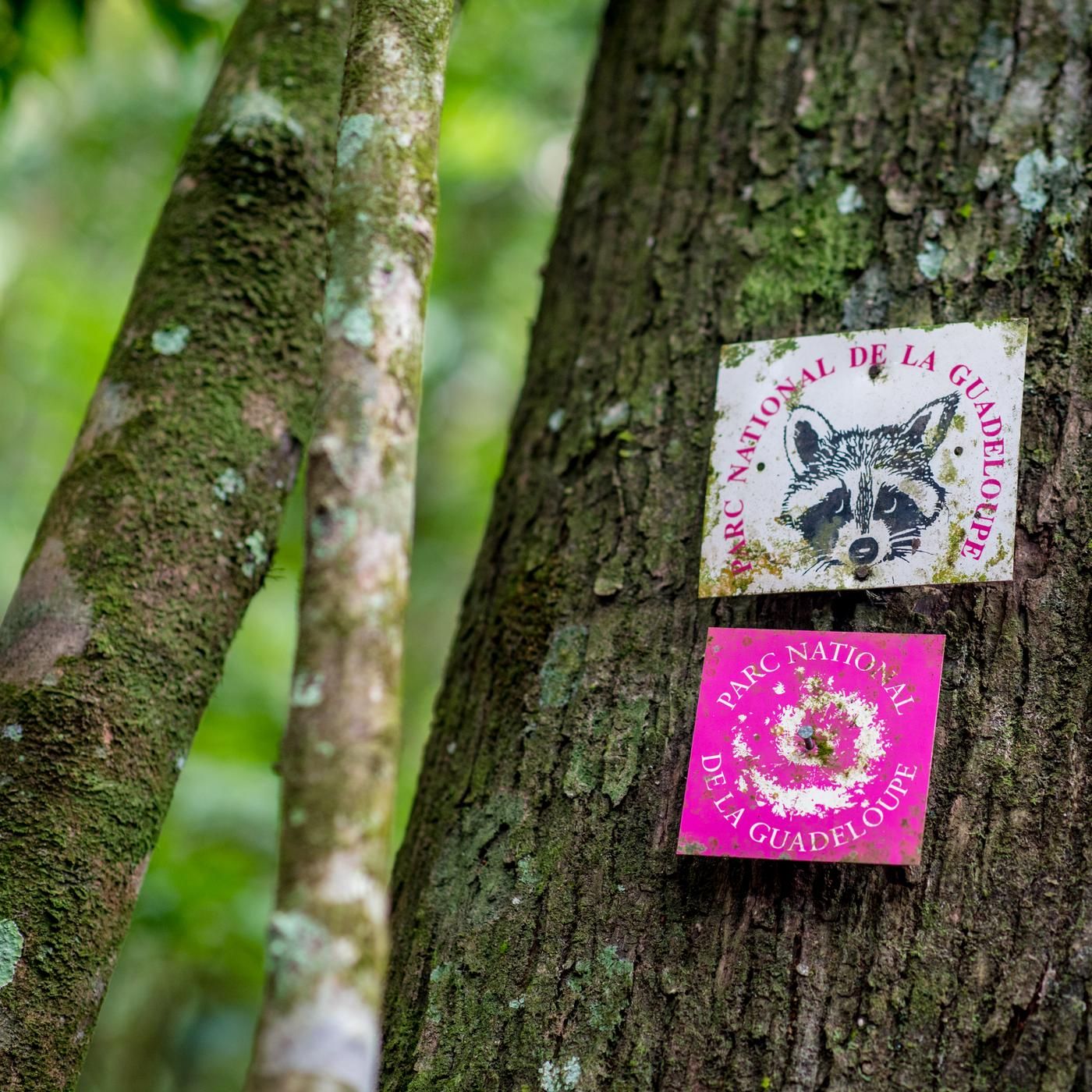
Of course, we love the raccoons. They put them on their postcard. We just think it's so cute. Driving down their main highways, you see billboards where people's logos for their advertisements for their entire company is a raccoon.
Like it's everywhere. There is a statue of a raccoon. The zoo with bin vin vinue, zoo de guadalupe. They're the number one exhibit.
Here they are. The first thing you see when you walk in. We have many in the trees there. Oh, wow.
A couple of them, they're like monkeys. And on the way out of the zoo. When you walk into the gift shop, got a coffee cup with a raccoon on it, a snow globe with a raccoon in it. Keychains.
I might have to get one of those. People love the raccoon. People are raccoon crazy on this island. Why?
Well, it's really complicated. It has to do with the history of the island. It has to do with who came to the island when and who gets to say what happens on the island. It has to do with power.
Is it talking about a raccoon here? That's still the way. Yeah. All of these problems and ideas are inside the raccoon's tail, in fact.
In this tail. The tail of the raccoon and the tail about the raccoon. Yeah. Explain this a little better.
Well, the trouble all started in 1911 with this guy, Garrett Miller. He was a scientist working at the National Museum in D.C. The museum on America. This, by the way, is Blending Gimmel.
She was a wildlife police, spoke to my interpreter, Sally Stanien, and she told us one day Miller was just hanging out in his office when a boxer died from Guadalupe and he opened it up and found a very much dead raccoon. Yeah, sort of misshapen skin and accompanying skull. This is Christopher Helgen, curator of mammals at the National Museum of Natural History, part of the Smithsonian Institution. It actually has the same job that Miller had back in 1911.
Anyway, this raccoon that Miller had in front of him looked a lot like the North American raccoon, but it was small and different in quite subtle ways. And so... Miller, after some inspection, Miller baptized the Guadalupe and raccoon at a distinct species. Scientific name.
Prociently. Prociently. Prociently. The Guadalupe and raccoon.
Putting a name on it and recognizing it as a new species implied a deep history of the presence of raccoons in Guadalupe. Hundreds of thousands, if not millions of years. And over these millennia, these raccoons had evolved into their own distinct species. Found nowhere else on the planet.
So is that when the Guadalupe and raccoons began to love raccoons when they realized they had their own one and only? Yeah, but it took a while to catch on. I mean, this discovery was initially only being talked about in these arcane academic scientific journals. It's not like this discovery was on the front page of the Guadalupe in times or anything.
But then in the 1980s, you know, conservation really came into its own. Scientists started worrying about species disappearing from the planet. And in particular, they started worrying about this raccoon. These raccoons, you know, were being recognized as potentially endangered.
But being there only on these islands, there probably aren't that many of them. Like, we've got to protect these things. And so since Guadalupe is an overseas French department, France decided to do just that. February 17th, 1989, legislation was created to protect the raccoon.
And shortly after the passage of this law, Guadalupe opened up its first national park. And the raccoon became the mascot, the symbol of the national park. And as the mascot of this new national park, it really became that symbol of protected species. It was celebrated.
People were like, okay, nice, we love the raccoon. And more than just a symbol of the importance of protecting the natural environment of Guadalupe, over time, the raccoon became, in a way, a symbol of Guadalupe itself. It's really that symbol for people, like, you can definitely see it as the whole evil in the US. Aside from raccoons, you didn't really have hardly any other mammals that are native to these islands apart from bats.
And so if the raccoon is the one furry critter running around, then everyone can point to and say, this is something special. You know, this is not the same as a raccoon you'll find anywhere else. That is an exciting thing. It's a powerful thing.
And a point of pride, I think. I mean, we're not late in this time, so. Okay. Come in.
Okay. Bocio? Nah. And ah, and ah.
Very good to meet you. How are you? How are you? It's very large in a lot of shows.
Asia doesn't help things. This is Namari Joseph. And you were born here in Guadalupe? Yes, yes indeed.
She's an older woman, maybe in her 70s wearing this pink floral dress. Her house was right on the highway with a field in the back. And that, she says, is where the raccoons would hang out. Pretty young men.
There was a whole bunch of them just chilling in the area because all this behind the house was sugar cane. They actually came and fed on the sugar cane. Did you say, ah, ah, please, while you were out there? I love seeing them.
I mean, there was always some time of pleasure and excitement, like seeing those raccoons out there. And at some point, there was one that we really became acquainted with. At that point, she scootched her chair over and picked up this black and white photo that was that was sitting on her dining room table and inspected it. Can I see the photo that you have here?
It's good to see the photo that you have here. It's good to see. Basically, what's on the picture is Sophie. And I'm feeding her bread that I didn't do milk.
Sophie was a pet raccoon that now had back in the late 80s. Ah, but what I'm sorry. And she talked about Sophie as if she were her child. Oh, baby, baby, make come whoa, girl, girl, girl.
You're making the gesture of like cradling a baby. I am like, I'm sorry, baby, baby. I'm sorry, baby, baby. I can't wait.
I'm sorry, baby, baby. Sophie, I can't wait to wait. Sophie. Sophie, yes.
Sophie. He would run around. And like, every time I called her name and everything, she would just like come running. Yeah, then me, what?
Sophie. I was really close to him. And like, when other people came to visit they could see that I have this rare animal with me. And at one point she got really quiet.
Ah, she's sorry. And grass, the photo very tightly. Sophie. You're holding it to your heart You're holding it to your heart When he died, I cried I cried his name It was a really painful time for me It's important sometimes to have something of your own I almost got the sense that having this raccoon as its national animal Was a way for Guadalupe to distinguish itself from France Guadalupe has always been pushing against France trying to declare some sort of cultural or national independence In fact, just a couple years before this law was passed A group called the Guadalupe Liberation Army This group that was fighting for independence from France blew up a section of Guadalupe's airport, a studio in the government-owned TV station Even a Chanel fashion perfume store in Central Paris The explosion tore out windows and doors and left racks of high-fashion clothing in shreds And it fell to me, like in some small way, the raccoon had become a way for the Guadalupeans to say to France This is ours, not yours And because of that, it also became a point of tension between France and Guadalupe Yeah, what do you mean by that?
The morning after I met up with Naa, I went to this police station Hello, good to see you To talk to these police officers Do you mind saying your name for me? Vied, vorro, autonee, antonee, jalcy, moamzy, simone As well as a couple others, all of them but one were white and French They were stationed here in Guadalupe And they took us up into this sort of war room Which was the second story of this bungalow-type building out in the middle of the jungle Everybody was sitting around this makeshift boardroom table Pretty quick, after the meeting started, they booted up this powerpoint We've got a powerpoint up with a picture of a raccoon displayed up against the wire This image of a raccoon crouched down in this chicken wire cage Wait, so what's going on here? Well, they're planning a raid to liberate this raccoon In fact, they had the location where it was being held mapped out with entry points designated They even had the license plate number of the man believed to be holding the raccoon And why exactly are they doing this? Well, because, as Anthony Groyo, the leader of this whole operation explained to me You only got most of the space before The law passed in France back in 1989 declaring the raccoon as a protected species It specifically outlawed killing raccoons, transporting raccoons, and even...
Having raccoons for pleasure, you can't raise a raccoon as your own pet Sometimes we're taking away a child of the family, literally But in France, the law says they can't be held as pets And as a police officer in here, I'm speaking as a police officer I have to be here to enforce the law, period, no questions asked And so, once the briefing was over, they headed outside Strapped their pistols to their belts through the rest of the gear in the back of these SUVs And took off Everyone is rolling out, we're in three vehicles, and 20 minutes later We arrive at the top of this hill peering down into this lush, dense jungle We get halfway down the hill, and... What? Someone here? Yeah, apparently someone is here In this clearing we spot this man, he doesn't see us There's a guy in a red shirt with a camouflage hat on, he's got his hand behind his back The cops tell us it's too dangerous, you guys can't go any further So, Sally and I duck behind some trees And then Simone and Anthony wearing a wireless microphone Rush into the clearing to confront Hello sir!
Hello? Anthony started grilling him a bit Can you tell us a little bit about the law? Ask him if you know about the law, said he did And even though I was like 30 yards away, I could see that the guy just seemed confused And pretty harmless I'm all good here, he's cooperating Right away He told him where the raccoon was Oh, there he is In this chicken wire cage behind this giant tree Cute little guy This rough looking raccoon They pull out a toolbox, wire cutters The raccoon is grabbing the wire cutter Like I thought it was playtime or dinnertime They cut open the cage, reach into it, these thick leather gloves And then they grab it by the neck And threw it into this kind of dog carrier box thing And... You sure what it will be?
The mission is a success It went as swimmingly as, you know, you can get I gotta say this whole thing sounds a little... This episode is sponsored by BetterHelp Guys, it's tax season, are you as stoked as I am? No, no, of course you aren't Because taxes can be super stressful I know that I'm gonna owe money And so I'm avoiding all the emails from my accountant I'm not alone 88% of Americans reported financial stress at the start of 2026 So it's normal, but it doesn't mean you have to white knuckle your way through When life feels overwhelming, therapy can help Better help makes it easy It says by matching you with one of their over 30,000 licensed professionals Tailored to your knees And if it's not a perfect fit, you can switch at any time And look, a therapist can't fix your money problems But they can help you address shame, guilt, avoidance Get matched with a qualified professional on BetterHelp You can sign up and get 10% off at betterhelp.com. That's better h-e-l-p.com.com.com.
Keeping up with this economy matters And in a world full of hot takes and noise, Marketplace does things differently I'm Kyle Rizdall, the host of Marketplace, a daily podcast that delivers independent award-winning journalism dedicated to making you smarter about this economy You can listen to Marketplace on Spotify Oh no, much for this, for just releasing a path? Yeah, no agreed But we're gonna go foot easily Later that morning we went on the second rate What are we expecting from this scenario? And the seriousness clicked into place for me I don't know if I'm not putting this on It's really a different setting We walked into this courtyard surrounded by maybe 10 houses Many of them made of sheet metal And do we know where the raccoon is supposed to be? It's right there under those trees You pointed out this pile of trash surrounding this enormous white cage And they're inside with this golden-looking raccoon The house is all around, so we need to see who is really in charge of this raccoon But before the officers could do anything to free it A crowd started to gather That was it?
No, no, no, no A woman has just arrived Basically what's going on? Three or four people showed up Head started poking out of windows And Sally overheard one of them saying That someone snitched and said that there was a raccoon in the area Said someone snitched And I suddenly realized that All of the officers were very on edge So we're just going to live Why can't we just take the raccoon? Just for safety reasons they don't want to Stay here to go And we got out of there So tell me what was going on in that second situation Because a lot of it was over my head I mean, it's really understanding that the context is setting I mean, this is not just the police I mean, it's white police forces coming into an overwhelmingly black and poor neighborhood That has a lot of significance in this context In fact, when I was talking to Naa about this the night before No, no, no, no, no She said that if police officers had ever come to try to take Sophie I mean, they would have had to take me in as well I would have taken my husband's gun and I would have shot When we come back from break, the tail thickens We'll be right back This is Timothy Fransick calling from Stillwater, Minnesota Radio Lab is supported in part by the Alfred P Sloane Foundation Enhancing public understanding of science and technology in the modern world More information about Sloane at www.slom.org I'm Chad Abunrod, I'm Robert Krollwich This is Radio Lab and we're back with reporter Simon Adler Who's telling us the story of the Guadalupe in Raccoon Which, as we just heard from the people of Guadalupe, is both a point of pride And a point of tension We are in the back rooms We are beyond the public areas, exactly And to understand what happens next We're going up to the sixth floor of the museum We have to go to the Smithsonian Museum of Natural History Here in the U.S., with momologist Christopher Helle Where we are now is what's called the typed collection The world's largest library, essentially, of dead mammals I have to say, for such a grand place, it's a little visually underwhelming Basically, just a bunch of locked white cabinets But that said, the behind the scenes area where, you know, the real treasures are stored Can we take a quick detour, so I can explain what he means by that? Sure So, scientists, taxonomists, their job is to name and differentiate species, right?
So how do they do that? Well, let's talk about sharks, because sharks are kind of cool animals, right? Imagine there's this shark species, it's swimming around, it's having a great time And at some point, half of the sharks in this shark population decide to leave To go somewhere else I don't know, they go to deeper waters or to a different ocean They get cut off from their previous shark family They don't seem for a long time And over thousands, or maybe a million years, they actually start evolving on their own As sort of a new type of shark They become different enough that they've become a new species That's what the scientists come in and try to figure out How do they make that determination? Well, so basically it's a comparison game They compare them to old sharks, do they look the same?
Are their dorsal fins taller or shorter? They look at how they behave in the water, how they move through the world, is that different? Nowadays, they'll even just do genetic work And if they decide it is in a species of shark At that point, they do this sort of wacky thing that I had no idea about Once they've decided that this shark is a new species, scientists will go and kill one of these sharks They will stuff it, put it in a box, and then they will store it in a locked cabinet In a natural history museum somewhere Because, ever after, for hundreds of years, that specimen becomes kind of a gold standard The definition of that species There's a different key, four types than others Every kind of moth, or mite, or mollusk, or mammal, you know, every oak tree, every kind of zebra Somewhere in the world, there is a museum cabinet, where locked down there is a physical specimen of that organism So it's like, it literally is like the natural museum histories of the world, or like the library, the card catalog of life And the room that Helgen took me into, in the sixth floor of the Smithsonian It was just cabinet after cabinet after cabinet after cabinet, filled with these type specimens Including the Guadalupe Raccoon type specimen The very specimen Miller inspected back in 1911 So here we go Helgen bent down and opened this one particular cabinet I'm pulling out a big metal drawer And inside, this is it right here Here it is, right in front of you This sort of ratty looking, taxidermy raccoon It's maybe not the most pretty sight The ears are a little bit broken and bitten off Some of the stuffing was coming out of the belly But that's probably how it arrived Now Helgen first saw this raccoon back in 2000 And one of the first things he did was Turned it over and looked at it and it's small Maybe like an 18 inches long, just like Miller had reported But then he popped open this little white box that had the skull in it And take a look, what do you see here? He pointed out these fine white lines crisscrossing the dough These are open sutures, which show that they're still growing In other words, it's not an adult Which the Helgen was a big deal Because ever since being a kid, he was suspicious of the Guadalupe Raccoon It didn't add up to me I just had a suspicion of, you know, these Caribbean raccoons didn't make sense He said, if you look at islands, they usually don't have just one native mammal species walking around This made Guadalupe an outlier, and so I'm gonna put it on this tray The fact that this thing was a kid It meant that there was nothing special, at least, about its size And, you know, by the time I laid my hands on this one and looked at the skin and skull I'd seen so many raccoons in museum collections that, you know, I knew there's skulls and teeth really well And so when I saw this, and one of the first things I noticed is that There was just nothing that looked any different to me from the common raccoon in the North American raccoon And so Helgen decided to do some genetic work He compared the DNA of these Guadalupean raccoons against North American ones Did the math?
We made the comparisons and our clear answer came through Not only are these, you know, not very different They are just simply North American raccoons You mean Guadalupean raccoons are the same ones that come in and torment my garbage cans? The exact same raccoon! You know, common, literally garden variety raccoon that we have in our own backyard Now, for scientists and conservationists, it is a real turnabout You know, it goes from being distinct, special, endemic, you know, found nowhere else to just the opposite Invasive species Someone Helgen started publishing papers on the raccoon in 2002 Conservationists were excited Because raccoons, they can have real impacts People do things like eat sea turtles, birds, nests, birds, eggs, including some that are potentially endangered They were hurting actual endangered species And so now that they have proof, now that they are certain that this raccoon doesn't belong here Then they feel finally we're going to be able to go out and start doing something about this Protect the actually special ones, get rid of this one sort of faker But putting conservation aside, what you've got is this native to the island national icon animal That has suddenly become an interloper Brought there within the last, you know, 200 years Probably just not a boat Huh, well, we're given everything that you've told us about the colonial history How did the Guadalupeans react to this? Well, we went down in 2004, Helgen and his mentor to Guadalupe And we talked to some people associated with the zoo and with the government management of the park And it was just a very brief conversation He made sure that they had heard the news You know, guys, this raccoon that's found only in your country, it's not what you thought it was And it doesn't belong here And I remember that the message that came back to us was Essentially, thank you very much, but We're going to hold on to our raccoon Meaning, according to Blandin Kimol There was no major communication campaign held to make sure that the population knew that there was a change in status The government never really told anyone And when someone did say something Like Gerard Berry here He's a native Guadalupean longtime conservationist In a few years back, I was interviewed by a reporter and I told him what I knew for a fact And everyone was just saying off with his head Some of my friends were like, how could you possibly say this?
You know, you should not have said this, this is bad And so, for over a decade now, nothing has changed The laws haven't been amended And because the government's kept this so hush-hush Many people on these islands still don't know the truth Well, so my understanding of the story is, for many, many years There was this thought that, in fact, I accidentally broke the news to not Recently, it was discovered that, no, in fact, it's the same species that lives in the United States Does that change your feelings about Sophie or about the Guadalupean raccoon in general? I can find it in the United States, but wait, so is it possible that maybe it was brought to the United States? The scientists say that it was brought here from the United States I always thought that the raccoon was really endemic to Guadalupe It is kind of sad for me to know that it's not endemic to Guadalupe I mean, I wish it would have been so, to be honest And then, I had the even less enviable task of informing not that just this past July In fast, for exultants, others, you may be able to do this now Do you pass this regulation? We recognize that we cannot act on all the thousands Basically, a blacklist of invasive species whose negative impacts concern the European Union The thing is, particularly in Germany, the raccoon is terribly invasive These raccoons have actually been called Nazi raccoons, as they spread from Germany throughout the continent And so, the raccoon made the list And that means that member states like France and thus very likely overseas agencies like Guadalupe will have to start managing or even eradicating them From the folks I've spoken with, there's a good possibility that in the next year the raccoon is going to change from being a protective species to being a species that can be hunted, trapped, and killed It's a good possibility to protect them It's a good opportunity to protect them No, no, no, no, if you want to do that, you can do it It's a good opportunity to protect them It's a good opportunity to protect them People can start hunting raccoons, like, we have to protect them No, no, no, no, no, no It's not a specific species?
Yeah, ok, got it? I just don't care Angelic Charlotte, owner of the Guadalupe Sea, you don't care No, I don't care. It's just the raccoon of Guadalupe It's kind of an imposter, isn't it? It kind of tricked everyone, didn't it?
He's not responsible of the person saying it was another species. People make an error. He didn't do anything. You must respect the animal, you know?
Even Sully and Lois, the watermelon farmers from the beginning of this story, said at the end of the day, if let's say, they say, okay, as of this day, the raccoons are no longer whatever. I don't see myself taking a rifle running to the field and just lying in with to shoot them no. It's just that we have a few type of wildlife, you know, no snake, no thing, so, you know, it's the bigger one, the biggest one. So people adopted it as a national animal.
That's it. One of those, if you can't be with the one you love, love the one you're with, types of it. Could be. That's a good one.
So, as a pragmatic person, I know it's an invite this species today. I know it. But I know also, I think it's cute. And I think I like it.
So, what is the best balance to find? You see? I don't know. It's kind of interesting that we in America love the bald eagle, a kind of wretched bird that steals other people's nest and is generally a vulgar animal, actually, but we never think of it that way because we've given it majesty and we give it, you know, it's talons there.
You see both, you know, peace and war. It has been, we've dressed it up. It's been given America. I think every time a nation chooses to identify with some wild thing, it's mostly really about the people identifying, not about the animal.
Yeah, I totally agree. I see like this. Like, you have this fact, right? There is a fact here that the raccoons didn't show up a million years ago or whatever.
It was probably more like 200 years. That's most probably a fact. Yeah. But then there's a stuff on top of that which is like, are they natural?
Are they invasive? Do they belong here? Those don't feel like facts. And like, who gets to make those judgements?
The scientists? I don't know. I certainly didn't realize the extent that this was a deep-seeded cultural battle in which I was, you know, entering. Who have inserted yourself?
Yes, strongly. Again, Christopher Helkin. It's just the same information, you know, different responses. And I think that one of the deep questions of that, of this story, lives in that, which is like, you've, you came to a scientific truth.
And the question becomes, should that scientific truth win the day? I mean, as a scientist, you know, I would say yes, you know, as a conservation biologist, I would say yes, it's important to show us that taxonomy really matters. This animal didn't belong. And, you know, really perhaps it should be removed from the island.
But at the same time, it's really a question for Guadalupe. You know, this is their island. These are their animals running around on it. And it can be very challenging for scientists like myself to come to terms with.
But that's how the world works. One more thought before we go. Is that all right? Yeah.
Yeah. Before Helkin officially sank or dethroned this Guadalupe and raccoon, there's actually another guy with a similar hunch. This Parisian momologist named J.M. Pawns.
And in one of his papers, he wrote that even if it can be proven that the Guadalupe and raccoon is no different from the North American raccoon, that the best answer might not be its reclassification or eradication. But instead, it's isolation. He wrote that its, quote, insular distribution prevents gene exchange with the mainland and is likely to warrant different selective pressures that should favor short-term genetic differentiation that may lead to a long-term speciation process. What does that mean?
Meaning, if they were able to keep these North American raccoons on Guadalupe isolated long enough, maybe someday they could be reclassified yet again this time as real Guadalupe and raccoons. What's your response to Guadalupe? Pawns said that. But, you know, I like it, but I have to say, you're going to be waiting a long time.
That's going to take over. If you want to give super, super thanks to Sally Stagnier, who was our translator and got Simon everywhere he needed to go and made sure that it all worked out. And to Ali Penil here in New York, who helped us make sense of the whole thing before we left. So, we owe a huge debt.
And to the people of Amagnon, David Xavier Albert, Lauren Spaptis-Salamo and Florian Kirschner. And to Bernie Bin Mion. And most especially, thanks to Simon Adler, who reported in the produced the whole story. I wonder what you guys just want to paragraph real quick before we go.
You know how we were arguing about whether the raccoon is a good creature or a immoral creature. And I was looking for ammunition on the internet to find... Oh. That was...
I found this thing. I found this thing. It's in a blog called The Truth About Raccoons. Oh boy.
And it contains this paragraph. Every time I'm pretty sure it's not true. It goes. And I quote, raccoons are one of the only land mammals who can also walk on the bottom of riverbeds holding their breath for up to an hour, but they eat both live prey and carry on and consume up to 20 pounds of raw meat at a time, then go without food for a week.
Their skeletal structure is found in no other animal, and that combined with their ferocity and complete lack of moral fiber, make them perhaps our most dangerous enemy. I rest my case. That was no case, I was just proud of being here. I was hate speech.
That's it. One. Hi, my name is Sally Singey. I'm a love-lose interpreter.
So I'm reading the stuff right now. I'm reading a lot of videos by Gavin Webb, dealing with cases our director sound design, starring Willery Senior Editor, Jamie Orte, her senior producer, our sound include Simon Adler, Reneth Rowell, James Double, Matthew Oakley, Robert Coolidge, Annie McEwen, Aladdin affair, Melissa O'Donnell, Ariane West, and Molly Webster, with help from Tricky Hunt, Lana Dina Bonini, Agar Patawi, Stevie Wang, and Katie Ferguson. Our fact-checker is Michelle Harry. All right, that's it.
Thank you.