
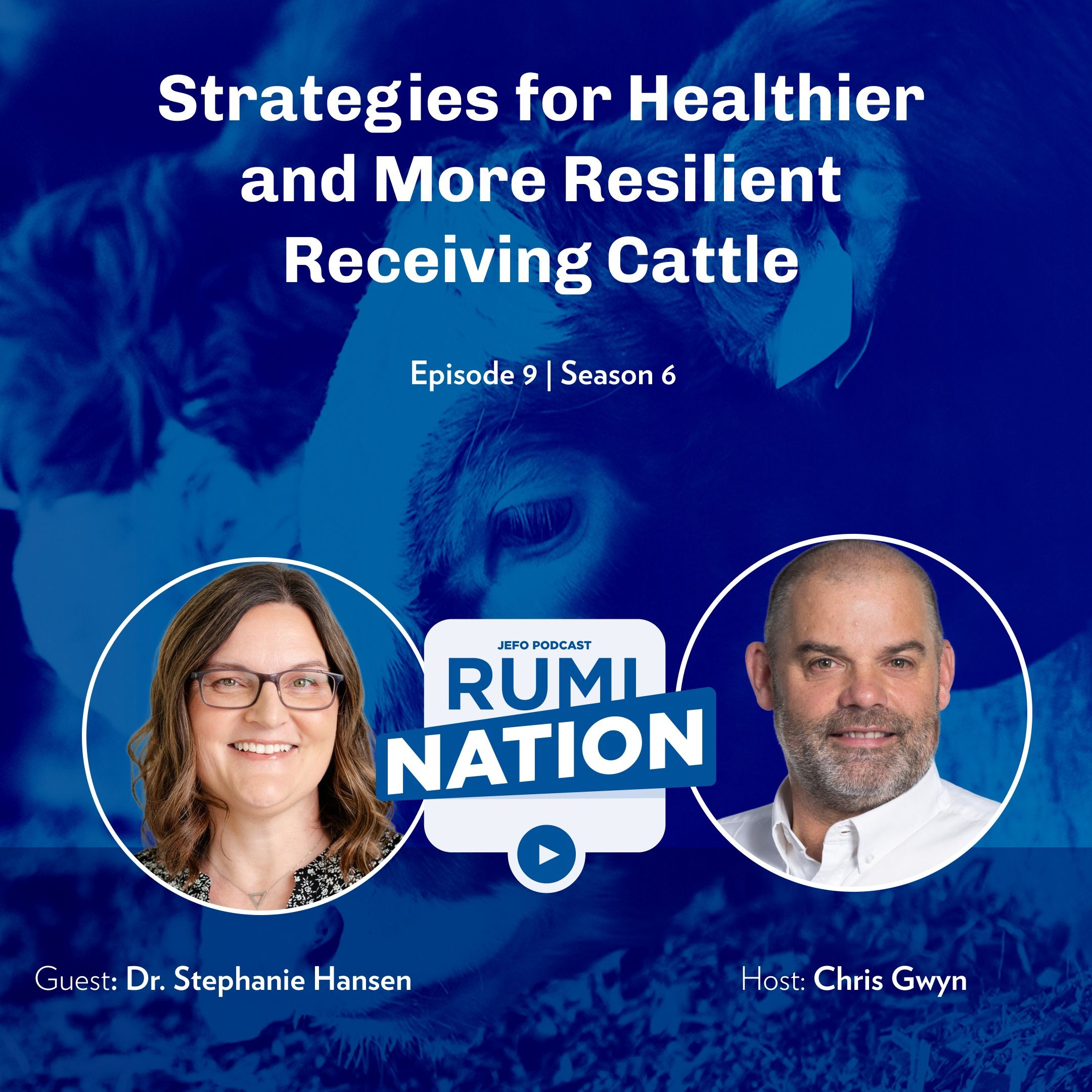
EPISODE · Oct 7, 2025 · 20 MIN
Strategies for Healthier and More Resilient Receiving Cattle
from RumiNation · host Jefo
Timestamps & Summary Chris Gwyn (01:44)Before we jump right in, I'd enjoy hearing about the journey that brings you to research and teaching.Dr. Stephanie Hansen I did not grow up on a beef operation, but my grandparents had cattle, and so I spent a lot of summers there. So, I had the beef bug, so to speak, by the time I went to undergrad at Iowa State, but I was never pre-vet. I was really focused on what we could do, and eventually I realized that what that was was nutrition to actually keep animals from having to see the vet if we didn't have to. And so I found my passion for nutrition through a senior-level nutrition class, and I call that my light bulb class, and I teach that now. So I've been teaching that for over 14 years, and I think that's really a full circle moment to be at the front of the classroom for the class that gave me the passion for nutrition. […]Chris Gwyn (03:33)I'm wondering, what have you seen as the biggest changes in cattle receiving practices that have driven some of those changes, whether it's science, economics, or consumer expectations?Dr. Stephanie HansenI think some of the biggest things we've learned in the receiving cattle nutrition is really the importance of what happened to that animal before they came to the feed lot. Now, of course, we're a very segmented industry, so it's really difficult to control that. But we do have a lot of people who will have retained ownership and will have the opportunity to really control more of the nutrition that gets into that animal from birth all the way out through harvest. […]Chris Gwyn (05:39)Are there impacts of consumer expectations that have also altered what we should be doing today from what we've done in the past?Dr. Stephanie HansenFrom a consumer perspective, I would say probably the biggest one, […] is that we have pretty aggressively moved away from mass treatment of animals on arrival. That's really a practice now that is restricted to animals who are at really high risk. […]Chris Gwyn (07:48)Are there emerging strategies or even feed additives that you're particularly excited about? What are we doing differently today that we didn't do in the past?Dr. Stephanie Hansen I think now, and moving maybe into the future, too, about this idea of precision nutrition. How do we go from making pen-level decisions for 100 head or 200 head in a pen to making single animal-based decisions? There are all kinds of challenges with that. But I think with some of the wearables and different technology sensors and stuff that we have now, we're increasing our likelihood of being able to do some of those things. […]Chris Gwyn (10:32)Do you find that, out of my naivety of knowledge, producers typically have a different diet for sick pens, or is it just fairly basic to get them back on feed and get them healthy again?Dr. Stephanie HansenI would say that, especially in the last several years, the philosophy has really shifted to get that animal back to their home pen if at all possible. Bad things in general tend to happen if you're in the hospital pen, right?Chris Gwyn (14:58)We're going to fast-forward five years? Well, let's say 10 years. What do you see as the modern twists that would impact the new standard in receiving cattle management or nutrition?Dr. Stephanie HansenI think two things. I think of wearable sensors, such as ear tags or collars. […] Right now, we've got some challenges where some of them interfere with other things, so you’ve got to figure that out. [Also], labor is going to continue to be one of our biggest challenges in the beef industry. We just don't have as many people who are willing to do some of the work that's required, or that labor force just simply isn't available. How do we help somebody become a better cowboy or cowgirl in terms of their ability to identify sick animals?Chris Gwyn (18:02)To summarize, maybe three or four key points that you'd like to emphasize to producers and veterinary nutritionists in relation to receiving cattle, management, technology, and nutrition that you'd really like to stick with them?Dr. Stephanie HansenI think the first one would be the more you know about what you're buying, the better. […]Think about strategic supplementation, making sure that you've got some fortification of critical minerals like zinc, critical vitamins like vitamin A, and some of the other things that maybe have been less researched, like vitamin C and the B vitamins. […]Are there ancillary or additional therapies that you can offer when an animal has to get pulled for a treatment? […]
Embed this episode
What this episode covers
Dr. Hansen explains how nutrition, minerals, and preconditioning improve cattle resilience, health, and performance in challenging feedlot environments.
Ready to play
Strategies for Healthier and More Resilient Receiving Cattle
No transcript for this episode yet
Similar Episodes
No similar episodes found.