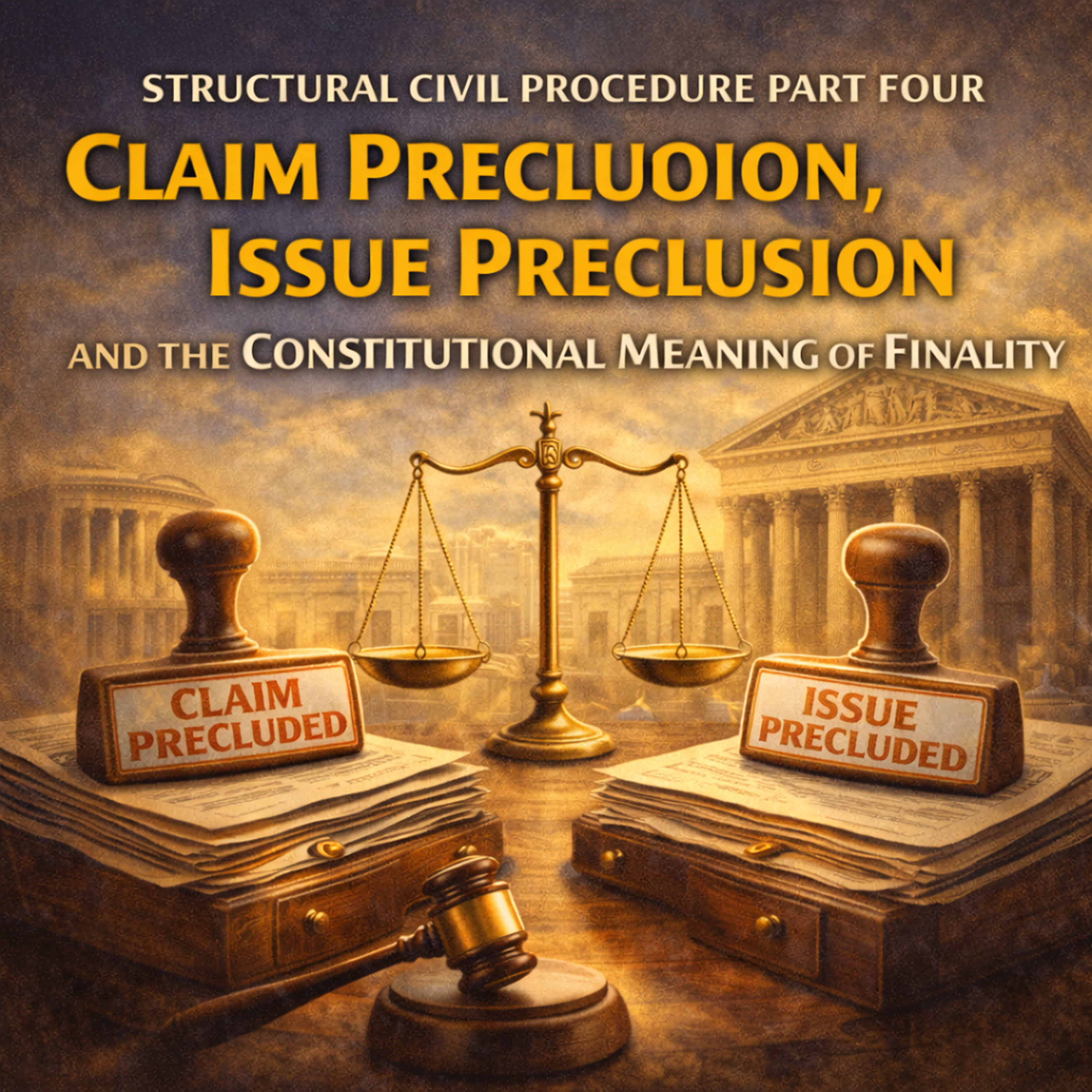
Structural Civil Procedure Part Four: Claim Preclusion, Issue Preclusion, and the Constitutional Meaning of Finality episode artwork

EPISODE · Mar 12, 2026 · 1H 6M

Structural Civil Procedure Part Four: Claim Preclusion, Issue Preclusion, and the Constitutional Meaning of Finality

from Law School · host The Law School of America

Issue Preclusion: The Systemic Power of Finality in Civil ProcedureIn this episode, we dissect the intricate doctrines of claim and issue preclusion—principles that dictate when a lawsuit truly ends and how judgments shape future litigation. Understanding these systemic rules is vital not only for exam success but also for navigating the complex landscape of modern mass litigation.Main Topics Covered:The fundamental distinction between claim preclusion (res judicata) and issue preclusion (collateral estoppel)How final judgments achieve systemic finality and the importance of the power of finalityThe five key elements ensuring proper application of issue preclusionThe constitutional and procedural limits on binding non-partiesThe role of courts' respect for judgments across different jurisdictions via the Full Faith and Credit ClauseHow doctrines adapt to mass litigation, such as class actionsKey Insights:Finality as systemic power: Judgments are more than mere resolutions—they possess a systemic authority that shapes future rights, reinforcing legal stability at the cost of occasional injustices.Claim preclusion is broad: It bars relitigation of claims arising from the same core facts if there’s a final, on-the-merits judgment between the same parties.Transactional test: Modern courts favor a pragmatic approach—claims are considered identical if they stem from the same operative nucleus of fact, preventing strategic claim splitting.Issue preclusion’s surgical precision: It prevents relitigation of specific issues actually litigated and essential to a final judgment, but only if those issues were actually decided and were appealable.Procedural safeguards matter: Default judgments, settlement agreements, and defaulted claims often escape issue preclusion because they’re not actually litigated or decided.Inter-jurisdictional respect: The Full Faith and Credit Clause ensures judgments from one state or federal court are recognized and enforced across jurisdictions, with application of the originating jurisdiction’s preclusion law.Non-party preclusion and due process: Strict mutuality rules have evolved into a more flexible framework allowing certain non-parties to be bound when fairness, representation, or statutory schemes justify it—foremost among them, class actions and statutory proceedings like bankruptcy.Practical Application:Approach complex fact patterns systematically: always start with claim preclusion, then move to issue preclusion if needed.Verify the finality, on-the-merits status, identity of parties, and whether the issue was actually litigated and essential.Always consider whether non-party preclusion applies under the six Taylor exceptions.Recognize the profound systemic importance: judgments are not just personal disputes—they shape real-world rights and systemic authority, often overriding individual participation for societal stability.Resources:Restatement (Second) of JudgmentsBernhard v. Bank of America (California case establishing non-mutual issue preclusion)[Full Faith and Credit Clause - U.S. Constitution](https://constitution.congress.gov/constitution/article-4/)[28 U.S.C. Section 1738](https://www.law.cornell.edu/uscode/text/28/1738)Taylor v. Sturgell (Supreme Court case on non-party preclusion)Federal Rule of Civil Procedure 13 (Joinder and Counterclaims)Connect with the Experts:Legal Professor on Civil ProcedureCivil Procedure PodcastMaster these doctrines with a structured, methodical approach, and you'll confidently navigate the systemic power of finality in civil litigation—crucial for both exams and real-world practice.

Issue Preclusion: The Systemic Power of Finality in Civil ProcedureIn this episode, we dissect the intricate doctrines of claim and issue preclusion—principles that dictate when a lawsuit truly ends and how judgments shape future litigation. Understanding these systemic rules is vital not only for exam success but also for navigating the complex landscape of modern mass litigation.Main Topics Covered:The fundamental distinction between claim preclusion (res judicata) and issue preclusion (collateral estoppel)How final judgments achieve systemic finality and the importance of the power of finalityThe five key elements ensuring proper application of issue preclusionThe constitutional and procedural limits on binding non-partiesThe role of courts' respect for judgments across different jurisdictions via the Full Faith and Credit ClauseHow doctrines adapt to mass litigation, such as class actionsKey Insights:Finality as systemic power: Judgments are more than mere resolutions—they possess a systemic authority that shapes future rights, reinforcing legal stability at the cost of occasional injustices.Claim preclusion is broad: It bars relitigation of claims arising from the same core facts if there’s a final, on-the-merits judgment between the same parties.Transactional test: Modern courts favor a pragmatic approach—claims are considered identical if they stem from the same operative nucleus of fact, preventing strategic claim splitting.Issue preclusion’s surgical precision: It prevents relitigation of specific issues actually litigated and essential to a final judgment, but only if those issues were actually decided and were appealable.Procedural safeguards matter: Default judgments, settlement agreements, and defaulted claims often escape issue preclusion because they’re not actually litigated or decided.Inter-jurisdictional respect: The Full Faith and Credit Clause ensures judgments from one state or federal court are recognized and enforced across jurisdictions, with application of the originating jurisdiction’s preclusion law.Non-party preclusion and due process: Strict mutuality rules have evolved into a more flexible framework allowing certain non-parties to be bound when fairness, representation, or statutory schemes justify it—foremost among them, class actions and statutory proceedings like bankruptcy.Practical Application:Approach complex fact patterns systematically: always start with claim preclusion, then move to issue preclusion if needed.Verify the finality, on-the-merits status, identity of parties, and whether the issue was actually litigated and essential.Always consider whether non-party preclusion applies under the six Taylor exceptions.Recognize the profound systemic importance: judgments are not just personal disputes—they shape real-world rights and systemic authority, often overriding individual participation for societal stability.Resources:Restatement (Second) of JudgmentsBernhard v. Bank of America (California case establishing non-mutual issue preclusion)[Full Faith and Credit Clause - U.S. Constitution](https://constitution.congress.gov/constitution/article-4/)[28 U.S.C. Section 1738](https://www.law.cornell.edu/uscode/text/28/1738)Taylor v. Sturgell (Supreme Court case on non-party preclusion)Federal Rule of Civil Procedure 13 (Joinder and Counterclaims)Connect with the Experts:Legal Professor on Civil ProcedureCivil Procedure PodcastMaster these doctrines with a structured, methodical approach, and you'll confidently navigate the systemic power of finality in civil litigation—crucial for both exams and real-world practice.

NOW PLAYING

Structural Civil Procedure Part Four: Claim Preclusion, Issue Preclusion, and the Constitutional Meaning of Finality

0:00 1:06:42

No transcript for this episode yet

We transcribe on demand. Request one and we'll notify you when it's ready — usually under 10 minutes.

The Small Business Startup School – Business Notes | Financial Literacy | Retail Psychology – For Professionals & Entrepreneurs The Small Business Startup School Inc. Starting or buying a small business? While personal circumstances may vary, business patterns remain timeless. On The Small Business Startup School, we explore strategies, insights, and practical solutions to help entrepreneurs confidently navigate their journey.Hosted by Ola Williams—a retail entrepreneur, fintech founder, and financial coach with over two decades of experience—this podcast marries financial awareness and retail psychology with optimism to deliver actionable takeaways.Join us to learn, grow, and connect as we uncover the keys to business success.Let’s continue to learn together and be encouraged to keep on connecting! The 48 Laws of Power by Robert Greene (Full Audiobook) Robert Greene Amoral, cunning, ruthless, and instructive, this multi-million-copy New York Times bestseller is the definitive manual for anyone interested in gaining, observing, or defending against ultimate control – from the author of The Laws of Human Nature.In the book that People magazine proclaimed “beguiling” and “fascinating,” Robert Greene and Joost Elffers have distilled three thousand years of the history of power into 48 essential laws by drawing from the philosophies of Machiavelli, Sun Tzu, and Carl Von Clausewitz and also from the lives of figures ranging from Henry Kissinger to P.T. Barnum.Some laws teach the need for prudence (“Law 1: Never Outshine the Master”), others teach the value of confidence (“Law 28: Enter Action with Boldness”), and many recommend absolute self-preservation (“Law 15: Crush Your Enemy Totally”). Every law, though, has one thing in common: an interest in t Guardians Of Innocence Guardians Of Innocence Guardians of Innocence is a powerful and informative podcast designed to equip parents, teachers, and communities with the knowledge and tools needed to protect children from the growing threat of trafficking. Each episode dives deep into the tactics traffickers use to target vulnerable children—both online and in real life—and provides actionable advice on how to recognize the warning signs.Through expert interviews with cyber safety professionals, law enforcement, and survivors, we uncover the latest grooming methods, share real-world stories, and empower listeners to become vigilant guardians of innocence in their own families and communities.Guardians of Innocence is more than just a podcast; it’s a call to action to safeguard our children, raise awareness, and foster a united front against trafficking.Listen. Learn. Protect. The Laura Ingraham Show Laura Ingraham The most-watched woman in the history of cable news brings her no-holds-barred political and cultural commentary to podcasting with The Laura Ingraham Show. A bestselling author, breast cancer survivor, and mother of three internationally adopted children, Laura was the most listened-to woman in talk radio before launching her own podcast. A trailblazer across media platforms, she brings a unique perspective to this twice-weekly show, drawing on her experience as a white-collar criminal defense litigator and a Supreme Court law clerk.New episodes drop twice a week—delivering the clarity, courage, and common sense America needs.

Frequently Asked Questions

How long is this episode of Law School?

This episode is 1 hour and 6 minutes long.

When was this Law School episode published?

This episode was published on March 12, 2026.

What is this episode about?

Issue Preclusion: The Systemic Power of Finality in Civil ProcedureIn this episode, we dissect the intricate doctrines of claim and issue preclusion—principles that dictate when a lawsuit truly ends and how judgments shape future litigation....

Can I download this Law School episode?

Yes, you can download this episode by clicking the download button on the episode player, or subscribe to the podcast in your preferred podcast app for automatic downloads.
URL copied to clipboard!