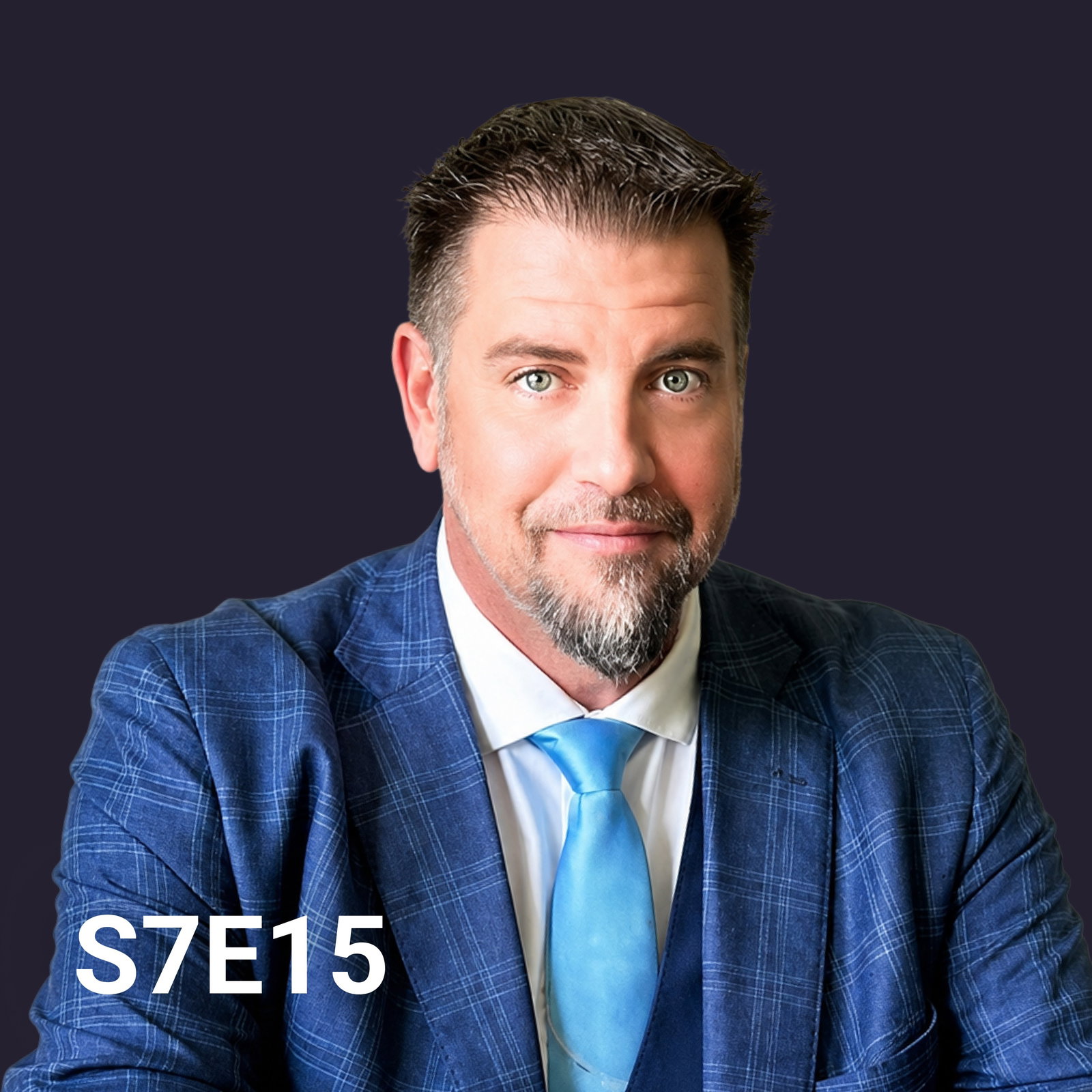
There is a special kind of exhaustion that comes when you're building with AI. You've got the license, you've got the pilot, you've got a chat window that generates whatever you ask for, but then you hit the wall, the workflow that almost works, the dependency that loops back on itself, victories that only come after you've quietly moved the finish line. Today, we're talking about how to get around the wall. Welcome back to Invisible Machines. I'm Josh Tyson, joined as always by Rob Wilson, co-founder and CEO of OneReach. Rob and I are co-authors of Age of Invisible Machines, the first best-selling book about orchestrating AI, and this is the podcast where we explore the future of intelligence through conversations with the people shaping it. Evan J. Schwartz is Chief Innovation Officer at AMCS Group and an adjunct professor at Jacksonville University, where he teaches a course in AI stewardship. He approaches the wall from three angles, inside the company, next to the customer, and in the classroom.
His advice? Score a quick win by delegating necessary but low-value work to AI with humans providing the judgment, and then zoom out and ask how the whole cycle might run if AI had been there from day one. Along the way, he names the trap that burns most teams, asking for features before you've articulated the structure, named the actors, and decided where change is allowed to live. The framing is simple once it clicks. Structure comes before features. Let's hear more from Evan J. Schwartz.
Well, Evan, it's great to see you again. Welcome to the show. Same. Missed you guys. Hopefully you've been super busy since we caught up. I know I have been. We have. And one of the things we were busy with was thinking a lot about AI and what it's doing to doing, actually, because I think you made the point when we were talking before that we get a lot of identity out of doing things. Even if it's stuff that we don't necessarily like doing, we get some value out of doing it. And so now AI seems to be coming for the doing.
And it feels like a lot of people who are having experiences with AI that they feel good about are people who are, at first we're thinking, you know, they're making things. And that's probably true to a degree, but I think what they're really doing is directing. It's almost like the work of a film director, like marshalling all these different people and technologies together to do truly novel things. And we feel like that's an important moment, right, for a person to have, and particularly a person inside of an organization. So you have experience seeing the light bulb go off for people. So maybe we could start there and just talk a little bit about that first tipping point where someone really starts to understand what they might be able to do with AI now that they don't have to do as many things.
Sure. So where I came to this is across what I call the three swim lanes. So my role at AMCS, professionally, across companies, my ability to support our customers. So seeing it from the outside, looking in, seeing it from the inside, living in it. And also as an educator, as an adjunct professor at Jackson University, we're seeing the impact on the way things are changing through education, particularly higher education, of being able to graduate what? What are we graduating today?
And this has been about two years in the making. In fact, my next course, which starts in August, is going to be the culmination of about two and a half years of living it, seeing it from the outside, and preparing the education. I call it AI stewardship, where exactly what you were talking about. The class is going to be around architecture and development. But you can take any particular vertical thing, and you're now slicing it or bifurcating it from the top end, the design, the thought process, the outcome piece, and then the implementation details of the doing.
And AI is taking across the board most of what I call output versus outcome type of strategy. We the humans are still today very much in control of the outcome, while AI is becoming increasingly more in charge of the output. And it's how you as AI steward are driving that particular step in the process to produce this. To me, the most significant piece to really grasp is that you're no longer a specialist because you don't have to do the full vertical. You're broadening at the top end like an inverse pyramid. So in the class I'm teaching, you're a little bit of an architect. You're a little bit of a product marketing, a product owner, a product manager. You're a little bit of a team lead and understanding how to communicate into the AI to get it to work. And what I'm proving in this course is that if you can describe what are the actors, what are the areas that are going to change together, right? You can make sure you give it the policy decisions on where dependencies need to point before you even talk about what it is you're asking it to do. You're describing the structure. Then you're describing what it is to do. What it produces then.
is phenomenal. When we think about automating something, we usually immediately imagine something we already do making machines do it in the same way we do it. I think that's just baked into it. When people say, well, we should automate this process. They usually don't mean, oh, we should make it better. And then let a machine do it. They usually think, oh, you mean have a machine do exactly what we're already doing. And I don't even know that people consciously think about that. You know, AI is so transformative. And the real opportunity is in doing things better than you do it.
and that it's a different kind of intelligence. So even doing it the same way that humans do it is the wrong approach anyway, because it's not the same kind of intelligence. We call it artificial intelligence as if it's like mimicking human intelligence. And I guess to some degree mimicry is correct, but it really is a completely different kind of intelligence. If that's the pointed idea that automation works best when you adapt the way or what you do to optimize for the machine, then you start to get into the fact that the larger the organization is, the more change you're trying.
to create at one time. We have companies that come with like 55 use cases, right? And they'll have it on a sheet and they're like, okay, we want to automate all these, right? And you're like, so should we go through each one of these and redesign how each one of these should get done? Or do you just want to automate it the way it is? Because if we just take the 55 use cases, automate the way you're doing it today.
you're going to be back at this because A, it's going to be harder to automate the way you're doing it in a lot of these cases because it's not designed to do it exactly the way a human does it. But also we're going to be doing it because you've not taken advantage of the biggest value of AI, which is you have an unlimited army of people now just sitting around waiting to do stuff at a fraction of the cost, like do more, do better. You're absolutely on the right track. I think you're old enough to remember the arrival of the internet. And there was a handful of, because this is what fueled the dot-com bubble, right? There was a handful of everybody, myself included, that just could see the vision of how great the internet was. And business after business threw internet across their business like a blanket. And so what? I still have the filing cabinets full of paper. I still have this rubber stamp. I'm still cutting my finger on, you know, paper cuts. Nothing has changed. And now you come to today, we couldn't imagine a business being a business without the internet.
No one can even think of what that would be like without the internet. We're seeing the same kind of hallmarks with AI. People are trying to just lather AI on top of their business. To your point, I want to just automate what I've got or I want AI to do this work for me. And they're missing the point. But it's funny, they do think it's easier too. And in a lot of cases, it's not because it is a different intelligence. Like doing it exactly the same way a human does it can make it even harder in a lot of cases, at least from my experience.
Well, what I'm working with companies on is making it a two-step process and accepting that from the beginning. And the first way is not to take your processes as is and fully automate them. It's to delegate down to AI the necessary but low-value work and compress the high-value work into your humans. And what you're going to get is an immediate lift and gain. You're not going to get the asymmetric lift of rethinking your business, but you will have at least paid for the AI, seen progress, and built confidence. And look, we're humans. We're lazy, we're messy, and we're greedy.
as just innate things. So we have to work with the things that we've got, and humans are just generally messy. So if we don't get them on board with it, they're going to be resistant to change. Very much so. And there is no change without pain. So this gives you a quick victory and it builds that confidence. And then you're right. The second wave is how would I have done this if I had AI from the get go? Forget the process now. I've applied what I think is the less than multiples. I'm in a 30% efficiency, 40% efficiency gain here just to cover my costs. Great. I can go to my board and I can go to everyone yelling about putting AI sticker on the outside of the logo and tell them I've got it. But then the follow up is we need to reevaluate this like businesses are today. And then you start to see the multiples.
in returns and one of the success stories is a customer of ours and we did exactly that we just we did the we compressed the low value but necessary the stuff that they had to do and they got about a 50 return on that investment then we went back and to look at the entire iterative cycle and that's what you have to do you must have to zoom out you're not automating each one of these little cogs you're zooming out and rethinking with ai how could i do this whole thing and they're now able to take in bids process them run them through their gauntlet and send back a fully quoted ready to do business And they're winning business and having a truck heading that way to service that business they just got the bid in by later that afternoon, which means that their competitor is still trying to get everyone's schedules aligned for the meeting to talk about the RFP. That is asymmetric growth. Now you're getting there. But to me, it feels like still it's going to be a two-step process until we get to where we are today where the internet is. It's so apodectic that no one can imagine business without an AI. And I think one of the things that people struggle with is it feels safer to not. It feels conservative. It feels like, you know what, if we don't use it.
There's a last likely chance that something will go wrong or that we will waste money. And so let's not use it. And then we'll learn from everybody else's mistakes. And then we'll use it when it's safe to use. So in my AI stewardship model, there's four cultures. There's the risk averse, the pragmatic, the innovator, and the early adopter. And if you're going to adopt AI into your business, let's just say me and you worked at a company, we're clearly in the innovator category, right? But our company is risk averse. I can't run an innovator adoption program in a risk averse company like what you just described. I want to see it work. I'm going to implement known things. So typically risk averse companies will change when there's pain.
Without pain, there is no change. Very few of us run after the pain. We're probably the few in the sadomasochistic category that run at change to see if we can make it better. Most would be in that risk-averse category. The pain is I'm looking at a competitor. I got that RFP. I'm struggling to get my schedule together. And I realize by the time I've gotten my team together and even communicated with the proposal guy, oh, we've already given and awarded this to your competitor. Now you've created pain. Now I have to think differently. Like if we look at examples in the AI space, like automobiles, right? There's a velocity to this stuff. We're not using even a fraction of what's...
already available to us. Most companies are using less than 10% of what they could be doing. Every month, this grows what can be done, expands as models get better and we get better. I think it's a human thing, personally. I don't think it's a technology thing. I think humans and their ability to adopt this technology. I have this very strong feeling that in the not so near future, we're going to realize that the real scarcity is AI talent. Not people who can parrot cloud AI, but people who can actually use it with real experience and real success. It won't be about procuring.
the software or the technology it'll be the people and who's going to want to go to a company that's that's trailing yeah that's right the market and now you have a full staff that's trailing because none of them have that experience they haven't cut their teeth when you talk to students and stuff do you advise them like go somewhere that's adopting this stuff or you're hooking your train to something that's eventually going to lead you to a catch-up mode. Right. This reminds me a lot of the 2018s where mobile units have come out. It was intuitive to that generation. And businesses were put on notice that if you don't have interfaces that these graduates can use, you're not going to have employees. They will not work there. I mean, I actually did some of this work in 2015, 2016, where I put a GUI, a graphic user interface, over top of an old...
DOS-based command line-driven system because there was literally nobody coming out of the universities that even knew what a C prompt was. So the company was like, I don't know how to get off of this mainframe yet, but I need something that's going to bridge the gap until I could get to the next generation tech. My children use AI intuitively for things that just feel... superfluous, right? When next to what you were pointing out, what it can do and what you're using it for. But if you also look at Microsoft Word, not one person, even the most astute user of Excel or Word uses more than 15 to 20% of what those tools can do. And they have changed the business landscape forever. Nobody can go back. I think that the next generation is going to demand it. This is too much work. In my last job, I didn't have to do any of this. I had agents and AI that I could speak to that produces. I was driven on metrics. I was driving the bottom line of the company where I came from. You're asking me to produce this tiny thing. Then that's not me.
And you're right, the skill is the person that can look at that thing and is the ability to create the prompt, understand to source the data and know how to measure it. Not someone that can replicate, someone who can look into the ether and go, if you frame your prompt this way, if you give it the structure first, then you give it the requirements, you make it validate your architectural constraints first, you get a much better coded product out the other side. So build on that. Though that's going to be the one that can create that, not someone who can cut and paste prompts. All these prompt libraries, if I can get 5,000 funds, that's not doing anything for anybody. It's the person who can think through the constraints and capabilities of the AI and produce that. That's what businesses need. Because the reality is the world is entropic. It's changing. It's chaos everywhere. So I'm needing someone capable of adapting the tools I put in front of them to cope with that. With the scope and complexity of what you're describing, though, of getting some small wins and then starting to think about how to apply AI in these bigger ways, does it feel like mid-sized companies are actually...
a significant advantage over larger companies. What you're describing requires a lot of consensus around objectives, around how to organize knowledge and what kind of things you want to use this technology to do. Because if you don't really have a clear idea of that, you could get stuck in that space where maybe you start automating some of this lower value work. Does it feel at all like smaller companies because they can literally get everyone in a room together and actually have a face-to-face discussion about what are our problems, what are our constraints, what are we trying to do with this stuff? They have a lot better shot of getting firm footing and having a consistent conversation.
I'm going to say, first of all, school's not out. We haven't had enough runway for me to give you a definitive answer. The reality is that the smaller SMB companies, because they already have broad, you know, master of none, jacks of all trade type of guys, the entrepreneur that has to wear multiple hats, which is a strong fit for the model, they're going to have an early advantage, but they are going to hit. a wall where they're going to have a struggle to maintain that. And it's a discipline issue. So here's what I'm saying. They get greater returns earlier, but they tend to take on too much as a rule. They don't have the discipline from an organization yet because of that size. So they get off the ground much faster, but they tend to start to hit some kind of a drag. When you get to the midsize, those guys take a little bit longer to get up, but because they've got more discipline, the right of the crest, they spring forward in their ability to do more because they have larger resources. They already have a discipline structure. They can look in their organization and they can attack segments of it at a time.
and then because what you're seeing is you're seeing a compression of the orchard rather than this multiple things it's coming very compressed and spreading out when you get all the way up into the big tier ones they are behemoths they've always been that way they it's like a battleship trying to get turned into the ocean But they still can, depending on their structural approach, can break off into pods and working business units where they're running into most of the trouble. And that's why I'm saying the jury's out because I haven't seen one run with a long enough runway to go. Does it end poorly or not? But they have a lot more resources to run at this. They're able to organize their business in a way, but where they get stuck because they're so structured is I optimize one and I'm now overrunning.
a piece of connective tissue upstream because I've now optimized this so much, its output is exceeding the next feeder piece's ability to take it in. Or I'm draining the source of data that would go into that department so quickly that I'm now creating inefficiencies because I've made this so inefficient. So they're learning, and this is fairly recent, that they're having to eat themselves from the outside in. to the customer face until they can get down to the core. Otherwise, they've invested heavily in a segment, gotten it super efficient. Neither it's downstream or upstream that's going to pay the price. And because they're big business still, they're not going to run quickly to the next step. They're going to take their time. It's problematic. But I think that's just a structural challenge. Again, this is a digital workforce challenge, not a tech challenge. We're getting really good at getting this thing to produce the output we need at the quality and repeatability that we need it to do.
So that to me was the last technical hurdle now that we've learned how to do those. Everything else is a digital workforce challenge. And it's to Rob's point, how do I get everyone at the same level to be creators, orchestrators, stewards, pick a term here, director, I think is what you guys started with, that can produce new behaviors and understand the constraints to adapt. And then the change management is the last big problem that we've got to overcome. There is some part of me that as I'm interacting with really super large organizations, I end up talking to people in these organizations that totally get it.
Totally get it. You know, we're finishing each other's sentences. But then within that mechanic that they're stuck in, they cannot get other people on board within their org. They're one voice at the table. They're two voices out of 10. And it's a vote. And they go around the table. And what does everyone think? Well, since there's only two of you again.
that think that we should automate this stuff, we're going to stick with waiting. Yeah, I've seen it. And all I'm saying is right now, the battlefield looks tilted, asymmetric against the other side. But business has been like this for a long time. We can take AI out of the equation and you see the same battleship analogy with big business versus a smaller startup. And those businesses buy them or strategically take them out of the equation or adopt that tech and kind of divide or spin off activities to...
adjust their size to make them more agile. Their resources are so vast. They have options. I agree with you right now. They look very slow. What I'm waiting for is the pain threshold to reach that point to force action. I believe that there is no change without pain, but pain tolerance is different between the small business, the medium and the large. I think that once the big boys start to see these smaller five and 12 man startups hitting billion dollar valuations and starting to eat into their market share, then.
It becomes a top-down initiative. Boards start going, guys, do something, or I'm going to invest my money somewhere else to do something. We're also seeing a world right now where we're still very subsidized in the AI pricing, and we're seeing a lot of missteps where the cost of AI is not where we thought it would be. Now, you and I both know a lot of that's due to the misuse, mishandling of AI, the way that you implemented it. But there is a cost factor of AI that's going to come to fruition that I think is going to either price out the little guy if he's not careful. Yeah.
which will take a lot of that. And then the mid-tiers and the big businesses are going to have to figure out how to bring this to market. So in our company, our number one criteria for lead qualification is have you done it and failed? Because if you failed, you appreciate what we've done. If you haven't failed, then you don't. What that tells me fundamentally is that failure has moved them forward or else I wouldn't be saying that. Else I'd be saying, it doesn't matter if you've tried or not, you'll still appreciate what we've created. If we see this, it means that all that failure hasn't been for naught, right? It means that they have learned something significant. They know that it's way more complicated than they thought.
They know that pilots to production is not something you should take for granted. They know that, you know, somebody vibe coding a solution and showing it in a meeting is far from something that's actually going to move the needle. And that random acts of AI in your company is not a strategy, right? So they kind of, this failure seems to have created within an organization, this crisis essentially, or this moment where people get together and say, okay, how do we fix this problem? Which creates a level of consensus. It's remarkable how different the mentality is from we're in front of trying to implement this stuff.
which I think can be fast, easy to, okay, we've tried and we're humbled. Yeah. So you're just describing in a different way that there is no change without pain. There has to be some pain. And we're also talking about something that is a paradigm shift, just like the arrival of the internet was a paradigm shift. And when the internet came, there just wasn't enough there for new minds to see really how to use it. But there were visionaries everywhere that were confident in today. They would go, I told you exactly today was going to happen. You would not have a business without an internet. And there are people saying the same thing with AI.
To get business to that same conclusion is going to take time. It is a journey. And it's a journey that's going to have to be thwarted with pain. Because so many of the POCs I've seen, when you quietly talk to the person who built it, they move the goalpost. They hit walls that they couldn't figure out how to get AI across. So they just changed the goal and called it victory and then presented it. And now when you present it with that light, what was built appears miraculous. Anything could be done. But they've completely hidden all of the pain and suffering that, you know, a friend of mine was trying to do a music video. And one of the things is he couldn't get the AI to put the...
nozzle into the tank so in the video it was just spraying the car with gas so he just took that piece out right so he moved the goal post to get to and it was still a beautiful video But that wasn't the original one that he drew on the board. And there lies the gap of AI, is that when business comes to you with a requirement, I don't get to move the goalpost 99% of the time. This is the requirement. This is what we have to produce. I don't get to say we're not going to do governance or I'm not going to put, I don't get to do all of that. So you're right. It's so easy to do a POC because I'm presenting you finished work as though I intended to make it. When 99% of the time, that was not the goal I was going for. When the internet first came out, remember Zmodem on being able to do error correction for shifting files? We had internet, but we couldn't send a file without it being corrupted on the other end. There were things that needed to happen.
happen to get it to the point where we take for granted today that we're having a video conversation right here and there's no problems, no mistakes, no nothing. That takes time. So this is going to be the same kind of adoption program. It's a paradigm shift. It seems like if you're like a director or steward, this might be a somewhat frustrating time in a sense, because you might be in an organization and you might be the one person who gets it. And then every once in a while you meet a Rob who gets you all excited, but you still can't get anyone else in your company to buy in. It's almost like the strategy might be to like keep speaking up, but also keep sharpening your tools and wait, because having failed with this stuff means you kind of understand the scope. Or you understand the challenge, even if the scope's not fully well defined. Yeah, you at least have a better idea of what you're trying to accomplish. And it does feel similar to how conversations around UX were like 15 years ago, right? Like the people who really understood UX.
and saw the potential of what it could bring to a brand or a company, they were thinking holistically, they were thinking about information architecture, they were thinking about so many different aspects of an organization that could change in order to bring about this advantageous shift, but there wasn't much appetite for it. And it feels like the appetite arrived, like you said, Evan, when there was pain, or there was competition that was suddenly threatening your very existence. Yeah, the Apple to Android fight that's still going on today. If you're an Android guy, you love to config it. Most Android guys that are taking advantage of the Android are deep into config, know how to make that thing work, and make fun of Apple people that love their Apple.
Those Apple people didn't have to do anything but turn it on. And it works. It does everything they need it to do. It's intuitive. They can just naturally interact with it. Those are kind of the two worlds that ebb and flow. Before the internet, there were dial-up bulletin board systems, right? Those guys were the elite. They worked with command prompts. They knew ATT codes into a modem. You know, they were like little digital gods that could do things with computers. And they didn't like the internet.
Because it killed their precious bulletin board system, right? So you're going to have that level of resistance based on skill sets and age groups. But it will come. And my advice to someone who is frustrated at work, who has maybe a leadership who isn't really that forward thinking, is you have the ability in your hand, as long as you can stick within the governance of that company, and you've got an AI that's not leaking IP, to produce output faster than anybody else in that room. So keep doing it.
Yeah, I agree. When we were working on the Dreamliner, it was probably $2 billion worth of RMD to create the automation. And a lot of people don't know this, but it's like the first airplane that had orchestration. Every airplane prior had very dedicated closed systems. Like everything was singular, right? You didn't have a place that fed data into a centralized.
brain, let's call it. The one decision that was made very early on was there will be two orchestration systems. There will be one for non-essential and one for essential. The non-essential is Wi-Fi entertainment, right? And then the essential is all of the playing mechanics, right? And a lot of that had to do with essentially the compression of data into relevant pieces. So more data is not better in orchestration. The right amount of data is this feature reduction is key.
So that was like number one for why to have these two systems. When Wi-Fi goes down, if that was the same system and it's going down all the time on these flights. When companies deploy AI in the organization, which, you know, our whole premise was if you can automate a 787, you can automate a company. If you mix these systems together, if you have critical systems that are orchestrating, running alongside one orchestration system or disparate systems, which is what a lot have. They have different AI point solutions they purchase, right? Which is the old airplane. There's no way you're getting to automation.
That plane doesn't fly in the old architecture. It also doesn't fly if you treat all systems as they're critical or critical systems like they're not critical. So you have to have these very two distinct concepts, one that takes a lot more planning and one that takes a lot less planning. And we see that if you're on an airplane and somehow the entertainment system goes down for a second. it's inconvenient, but fine. When I say orchestration, I mean knowledge plus orchestration, right? Because in that system, it was knowledge of how to keep the plane level. You had to understand optimal boundaries, right? It's like a containment envelope. If the pilot pulls really fast on the yoke, the plane doesn't do what he said with his hands. The plane safely accelerates and climbs at the safest max rate. It's not a direct connection to the system now. You're talking about, okay, got it. You want to go up as fast as we can. Like these systems are designed to work within envelopes.
And that's how you want your company, right? You want your company that if someone's there and they suddenly jerk the yoke that, oh, no, no, we know what you're meaning. Safely climb as quickly as possible. So they go out and they take a use case that's more appropriate to writing an email to someone where a human's going to review it, edit it, right? And they're like, look, we automated this, right? Which is really the non-essential systems, which is quite easy to automate.
And then they drop into the use case that's critical, right? Into the same apparatus. And then that fails. And then they shit can the whole thing because they just fundamentally didn't separate mission critical workloads, which take a lot of human oversight, reading code, validating testing against non-critical use cases, which are lots of human interaction, lots of human review. And if it goes wrong, no big deal. I see this like as being one of the biggest issues companies have right now is not separating critical systems with non-critical systems. Yeah, look, I think you're probably very deep in the weeds getting it into that.
particular bucket. At a higher level, what is missing is we'll typically get a vision. We'll have a high-level AI vision statement, no architecture at all, whether it's solution or technical. Right, that's point solution. And then just, you know, take the hill at the bottom. Some of you may die, but that is a sacrifice. So run, go do it. Hoping to find some sort of kismet in all of it. And that's not how reality works. It's not going to weave itself together naturally. It just won't. What is missing, and it's the reason why...
I'm pushing so hard for the AI stewardship model is that it demands structure first. So it almost gets all the way back to the start of this, is that if you're going to write a piece of code, before you even talk about the feature, what are the constraints? What are the policies? What are the dependencies? What are the structure? Describe that. Make sure that there's no interdependencies, no circular dependencies. To your point, I don't have a critical system dependent on a non-critical system. If it's a critical system, I better have a way to continue to operate this if the system goes down. Someone better be able to get a pedal out there and start making the propellers go around without it. So those are the things that require...
orchestration. To your point, I need an architecture around this that allows me to run my business. We've got simulacrums of this in business on the manufacturing side. When you look at those assembly plants, those stations, and they're called operators rather than stewards, running a machine, looking at inputs, making sure that the recipe has been plugged in at each stage. We're hitting that. And then if we're off conformance, is there anything else in the recipe guide I can still make? Can I salvage this production run or not? There's a lot to learn from the discipline of that as we bring it into the back office, but it has never been designed that way. It's been loosely coupled.
almost not even i would even say pub sub data contract model between contracts and hr and legal and accounting it's more of i need this can you get it for me it's almost on demand service-oriented architecture and then we're trying to build some sort of automation around something that's event-driven on demand there's no way to predict what you're going to need or what changes are going to come at you so that is a missing piece and that i'm trying to push it into the stewardship model is structure first to define your output properly but you can only build that structure if you know what your outcome is Otherwise, what is your architecture meant to do? To your point, if I don't know I'm building a plane and it's going to have critical and non-critical, what is the structure I'm putting in place? I don't know.
So there's a new breed of solution architect that it needs to come into being. There's a new breed of application architect that is the steward commanding the AI that's producing that output. So someone has to be zooming up, and then you're going to see the organizational architecture. So the stewardship model I'm putting together is the AI steward, the guy running the thing. It's the operating model. What is the whole structure? And then there's the adoption model. How do you get all the stinky humans to adopt this thing? And in what order is your plan to get the adoption, to get the best, most efficient use out of it? Architecture is, first and foremost, to alleviate effort.
That's what it's there for. It will change. And when it changes, how do you reduce and make the most efficient effort out of it? And you brought this at the beginning is I think that people are confusing reduction of effort to automation. And those are two different things. It's easy to automate something that never changes and is repeatable. But if you've got sort of an end to end relationship going into the system and you're expecting this automation to cope with any number of inputs with any number of potential radical outputs, I don't know that you're going to get there the way you think you are.
Yeah, it's like flying a plane and imagining perfect conditions all the time. That's exactly it. I build a plane for no wind, no storms, no lightning. Yes. I still can't get over the fact that I think that we're on the precipice of a huge, huge deficit of human capital. Yeah. And the reason I say that is because it's not about learning the very specific things about how this technology works, but it's the rethinking of how businesses are run.
along with how technology is made and how businesses are structured and how they deliver their services. And all of this is a lot of learning. And the most important thing, I think, is that it seems very clear to me in my many years of doing this, that as much as I try to communicate with words on the page or in a podcast, nothing is a substitute for getting your hands on it. So now you have to find someone with a big budget that's willing to let you burn it so that you can learn. And that's hard to find as it should be, I guess. And so these people are going to be really rare. And I think at some point we're going to realize, I mean, they're already very rare in the narrow AI space. You know, if you look at what Anthropik's paying, but this is going to become more and more rare and more and more valuable to larger companies. And they're going to stop looking at what technology do I need? And they're going to stop looking at technology vendors to solve their problem. And they're going to have to start looking at HR and recruiting.
And I wonder what your thoughts are as you see these students coming out. They're like, okay, we want to know this stuff. But getting that hands-on experience is so critical. So I guess the advantage of a university today is they do have a slight larger budget able to allow the students to play. And I am getting...
across civil universities now. It's not just Jackson University. UNF is catching on to this and Atlantic Technical Institute in Galloway. So we're starting to get the higher education folks that are going to write that check to involve and give that opportunity to play and learn. They're getting on board with it, right? Because they need to, right? The whole point of their university is to output what is the next productive citizen going to be, what do businesses need, right? So that's great. And it's giving us an opportunity to learn and what we're finding and we're getting closer to it. The other side of the equation is how can we take what we learn?
and do a feedback loop back into business today. And I'll leave you with this because this is my biggest concern and I'm seeing it everywhere. Our best producers, human producers, right, are the best suited to be AI stewards because they already understand deeply how to produce the thing that they're now delegating the AI to produce. And the problem is, is their identity is so tied to that output that they're offended by it or they can't make the leap to look outcomes. I'm not going to say it's 100%. Right now, I mean, we're going to lose about 30%.
of our highest producing workforce because they're going to go, I'm not doing this. Not that they couldn't. It's because they won't. And we have nothing to blame but our own educational system for that because we create an education system that creates cogs. Yeah. And there's also a big component of them being asked to do their day job. And also.
automate their day job. The wrinkle there too is some people will find loopholes with that, right? Like, oh, okay, I'll automate this part of my job. I'm just not necessarily going to let you know that I did it. Well, I think enterprise systems are going to make that difficult because businesses have incredible visibility. The transparency and the observability rules are going to make it impossible to hide. But if the business, and this is how I advise the companies I work with, I like your vision on what you're trying to do, but your vision needs to explain to the people you're asking them to do it.
what their world looks like, too. What will they be doing as this AI steward now focused on outcomes? When do you decide to right-size your business? I'm a person plus AI strategist. My view is if your first rule of thumb is to try to cut headcount, you're doing it wrong. I'm not saying you're not allowed to resize your business, but that should be the provider of last resort. If you've invested all this money to train all these people to know how to command AI and produce that asymmetric outcome...
Why would you send them into the workforce for your competitor? Grow your business asymmetrically and just don't have to put any more in the headcount. You're almost nerping yourself by doing it. Now, at the end of that, if your empire has grown as big as you can grow it, by all means, right-size your business and be generous and send all these trained people into the workforce that know how to now compete with you and steal your business. By all means, do that. But that needs to be very clearly stated and not just put in a vision statement, lived. Because the second you break that contract, when you get out there, it's exactly what you're saying, Josh. And I've seen some companies go, I'm not participating in this. I'm not going to participate in my own extinction.
We're big fans of service design. And I think the key is not the verb, but like the asset, because you end up with this very easy to read, very easy objective that's oriented towards either customer or employee experience. And it's something that organizations could budget tokens for and measure success on and say like, this was the objective. It was experiential. And now we can say, did we meet this objective? Where the ROI is just meeting the service design spec. So anyway, this was great. I love talking to you as usual. You too, man. I enjoy it. I get educated every single time. I gotcha. Yeah, thanks, Evan. It was a blast. Appreciate it, guys. Thanks for hanging out with us on Invisible Machines. Remember to like, subscribe, and or follow us wherever you get your podcast media. Thanks to OneReach.ai for their support and much gratitude to the many people working behind the scenes to make this podcast great. Until next time, Awagi.