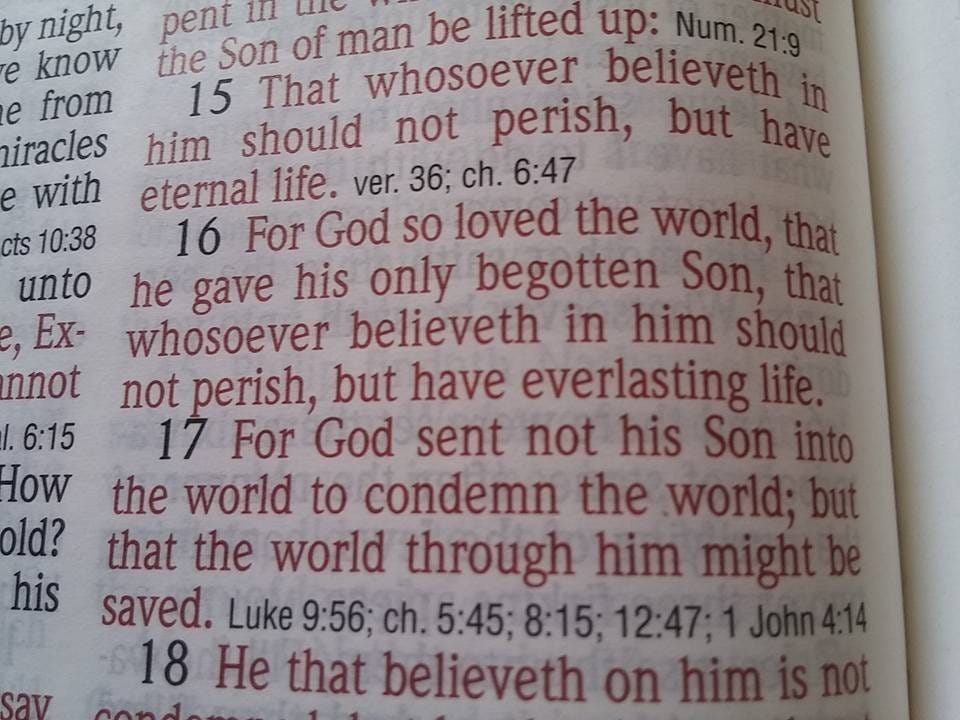
Study on John 3:16 "For God so loved the world..."
from Will ye also go away? Podcast Hosted by Max Wang
Most Christians would be familiar with this great gospel verse: John 3:16 "For God so loved the world, that he gave his only begotten Son, that whosoever believeth in him should not perish, but have everlasting life." What is the meaning of "the world" in this verse? Generally speaking, "the world" has the meaning of the earth, together with all its countries and inhabitants. But what was Jesus referring to when he said "the world" in John 3:16? Is this figurative or literal term? Once, a person asked me why it was “for God so "loved” (past tense) the world…” I told that person that it was the bible pointing us back to Genesis 3, to what happened in the beginning with mankind. Adam and Eve was “the world” at that time, and that was also God who foresaw the generations upon generations of people that shall come from them. Science have shown that before a baby girl was born, all her eggs were already fully formed. That means her daughter and her grandchildren and her granddaughters’ children were already in Eve. In fact, in the field of human genetics, “Mitochondrial Eve” refers to the earliest matrilineal ancestor from whom all living humans are descended: passed down from mother to offspring, and all mitochondrial DNA (mtDNA) in every living person is directly descended from hers. That would be “the world” throughout the history of mankind. Nevertheless, to gain a deeper understanding of the meaning of “the world,” let us begin by taking a deeper dive into the context of John 3:16. John 3:14-17 "¶ And as Moses lifted up the serpent in the wilderness, even so must the Son of man be lifted up: 15 That whosoever believeth in him should not perish, but have eternal life. 16 ¶ For God so loved the world, that he gave his only begotten Son, that whosoever believeth in him should not perish, but have everlasting life. 17 For God sent not his Son into the world to condemn the world; but that the world through him might be saved." Here, Jesus was quoting from the Old Testament, using the serpent of brass that Moses had made in the wilderness as a foreshadow of himself who would be crucified for the sins of "the world" that God the Father so loved: Numbers 21:8-9 "And the LORD said unto Moses, Make thee a fiery serpent, and set it upon a pole: and it shall come to pass, that every one that is bitten, when he looketh upon it, shall live. 9 And Moses made a serpent of brass, and put it upon a pole, and it came to pass, that if a serpent had bitten any man, when he beheld the serpent of brass, he lived." It was there in the wilderness that God instructed Moses to make a serpent of brass and set it upon a pole, so that whosoever was bitten by the fiery serpents, when they shall behold the serpent of brass, shall live. By the way, the fiery serpents were sent by God as judgment to the children of Israel. The serpent of brass that Moses made was a figure of the Son of man, Jesus Christ, who was crucified for the sins of "the world" in John 3:16. The psalmist calls Jesus a "worm" in this verse: Psalms 22:6 "But I am a worm, and no man; a reproach of men, and despised of the people." The context of this verse is prophetic of the crucifixion of the Lord Jesus Christ for the sins of "the world" in John 3:16. Therefore, the serpent of brass on the pole is the worm (Jesus) in Psalms 22:6. Also to be noted is that "worm" in old English is "wrym" and has the meaning: * (poetic) DRAGON, particularly one without legs or wings. * (poetic) SERPENT or SNAKE, particularly a large one. Job 25:6 "How much less man, that is a worm? and the son of man, which is a worm?" In that sense, the Son of God was prophesied to come as the Son of man who would be offered up for the sins of "the world" in John 3:16 that God so loved, so that whosoever believeth in him should not perish but have everlasting life. Connecting this back to Numbers 21:8-9, the people who were bitten by the fiery serpents and came to Moses for help would be a figure of "the world" in John 3:16 who came to Jesus for salvation. The previous verse tells us: Numbers 21:7 "¶ Therefore the people came to Moses, and said, We have sinned, for we have spoken against the LORD, and against thee; pray unto the LORD, that he take away the serpents from us. And Moses prayed for the people." The words "we have sinned, for we have spoken against the LORD, and against thee; pray unto the LORD, that he take away the serpents from us" tell us that the people were repentant, and they knew the sins they have committed against the LORD and against Moses. That was when Moses prayed for the people, and God forgave their sins. Those people would be a figure of "the world" in John 3:16 whom Jesus prayed for, and God the Father forgave their sins. Of course, not everybody was repentant. Not everybody who was bitten by the fiery serpents believe in Moses. The book of Job tells us: Job 33:21 "His flesh is consumed away, that it cannot be seen; and his bones that were not seen stick out." The venom of poisonous snakes such as the African spitting cobra can literally cause severe tissue destruction, because they contain toxins that directly destroy cells and cause tissue to die in a process called necrosis. These venoms specifically target and kill cells, leading to damage to the skin, muscles, and even bone. The flesh is literally consumed away. Job 33:22 “Yea, his soul draweth near unto the grave, and his life to the destroyers.” Without God’s provision of the serpent of brass, the end of the sinner’s soul would be death. Likewise, if God the Father had not given the world his only begotten Son, the end of every soul in this world would be death and hell. The context of Job 33:21-22 shows us how God delivers a repentant sinner: Job 33:27-28 "He looketh upon men, and if any say, I have sinned, and perverted that which was right, and it profited me not; 28 He will deliver his soul from going into the pit, and his life shall see the light." The words "I have sinned, and perverted that which was right" tells us that the sinner knows where he has sinned against the LORD and is repentant. In today's context, that would be the bible showing him where he had come short of the glory of God (Romans 3:23). Compare this to the people who came to Moses, and said "we have sinned" (Numbers 21:7). They knew where they had perverted that which was right, and it profited them not. The bible tells us in 1 Samuel 16:7 "the LORD looketh on the heart." It is repentance from the heart that activates God the Father, and cause him to perform a work in the sinner to deliver his soul from going down into hell, so that his life shall see "the light." The bible tells us: John 8:12 “Then spake Jesus again unto them, saying, I am the light of the world: he that followeth me shall not walk in darkness, but shall have the light of life.” Jesus is the "light of the world" that Job 33:28 was referring to. When God the Father shall deliver the soul of a sinner, he must also open his eyes to Jesus, so that he shall see "the light of life." That's why it is a serpent of brass in Numbers 21:8-9, because brass is a symbol of fire (Numbers 21:8 "Make thee a fiery serpent"). Except for the light coming from the fiery serpent (Jesus), a sinner cannot walk in the light. Proverbs 6:23-24 "For the commandment is a lamp; and the law is light; and reproofs of instruction are the way of life: 24 To keep thee from the evil woman, from the flattery of the tongue of a strange woman." Jesus is the Word (John 1:1), and the written word of God is light: this is the "light" that allows a sinner to walk in the way of life. There is also another way, which according to Matthew 7:13 "broad is the way, that leadeth to destruction." That is the broad way illuminated by darkness, by the flattery of the tongue of the strange woman. In the book of Proverbs, the strange woman is the opposite of the virtuous woman, who is a figure of the church of the living God. The church is the body of Christ, and the body of Christ is God the Fath… This is a public episode. If you would like to discuss this with other subscribers or get access to bonus episodes, visit willyealsogoaway.substack.com
Embed this episode
No transcript yet.