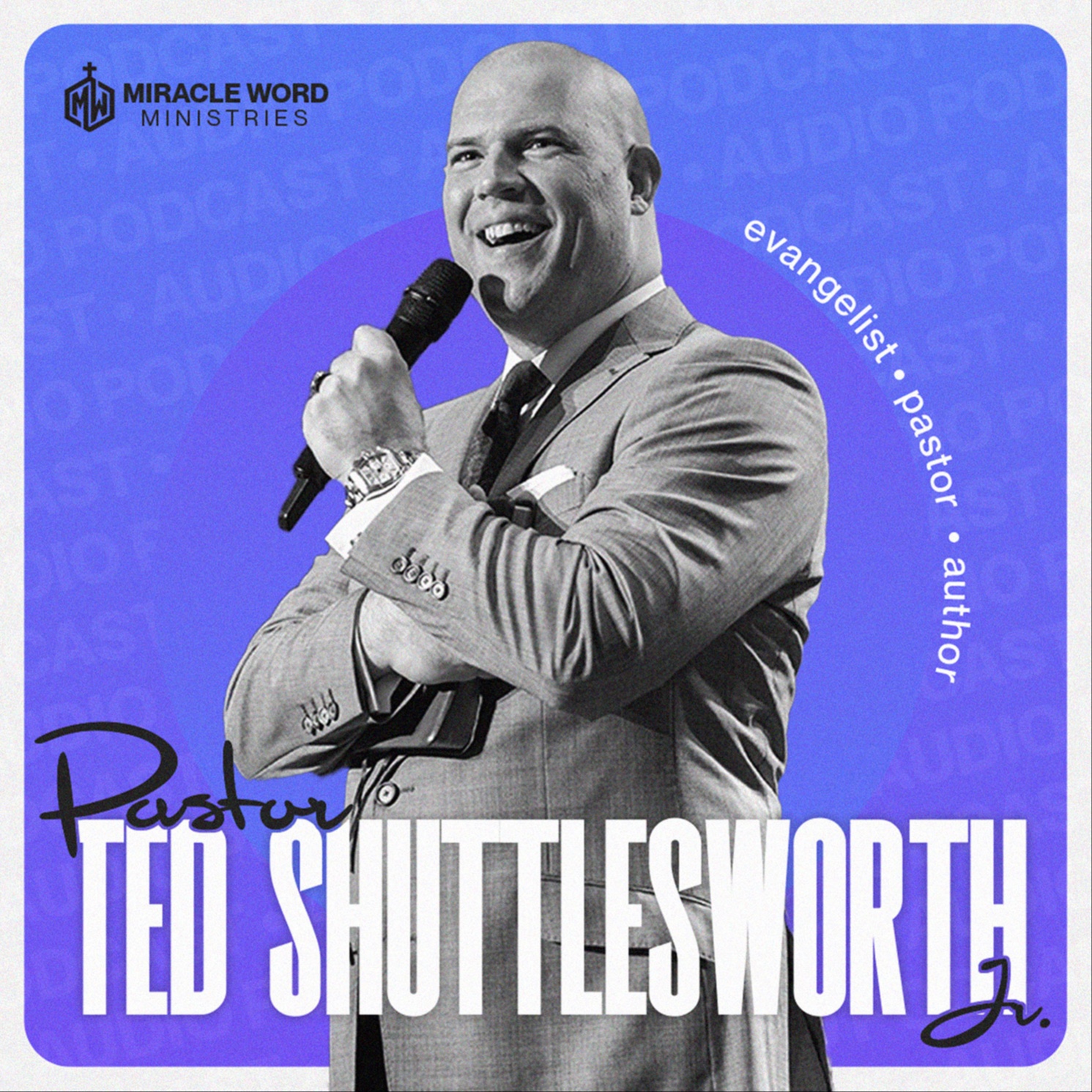
You're listening to the Miracle Word podcast. We believe that the word of God gives you the power to experience never ending increase in every area. If you're ready for revelation that will take you to the next level, you're in the right place. Here's your host, evangelist, author, and founder of Miracle Word University, 10 Shuttlesworth Jr.
I want to give you what I would consider to be some of the most important tools for Bible study that I've found that I'm using and the way that we're using these things. And it is going to help you because it helped me a ton when I started getting these and using them in the proper way. So, and I may tell you some things you've not heard of yet or heard of before. But take notes, write these down.
Of course, we'll post this. Keep these in a playlist for you guys afterwards. But the first thing that I will tell you is, number one, I was at a pastor's house one time. And he said to me, he said, you know, I've heard you preach, you know, that Jesus canceled the penalty for our sins on the cross.
And we were in his living room talking. And I said, yeah, obviously I believe that Jesus canceled the penalty of our sins on the cross. And he said, well, don't forget it. He said it's really through the resurrection because, you know, he had to go to hell and suffer on our behalf.
And I was like, really? I said, I've never heard that Jesus went to hell and suffered, you know, on our behalf. He's like, oh, yeah, you know, the devil, he started telling me the devil had control of Jesus spirit and dragged him to hell. And he suffered spiritually.
He died spiritually. I was like, really? Jesus died spiritually? Oh, yeah.
He went on and on. And I was like, where are you getting that from? And he said, well, don't forget. And he took me into Hebrews and he started to show me what he believed was proof that Jesus had died spiritually and that he needed to be born again before he was resurrected.
And I was like, really? I've never heard that. And he went into Hebrews and started pulling out these, this verse. And it's by the way, I'll read it to you in the King James version of the Bible.
Hebrews chapter one of verse five. And he said this, for under which of the angels said he, which is God at any time, thou art my son this day, I've begotten thee. And again, I will be to him a father and he shall be to me a son. And he said, see right there, right there's the proof.
The Bible says, and again, he will be a son to me. And again, I will be his father. It shows that he was not always his father, that there was a time in hell where Jesus was separated from God and was no longer his son. And the problem here is that this man had only ever read this verse apparently in the King James version and didn't understand that the writer of Hebrews was just transitioning from quoting one verse in the Old Testament to quoting another verse in the Old Testament.
So if you check out Hebrews one five, for example, in the English standard version, what does the Bible say? It says, for to which of the angels did God ever say, you are my son, today I've begotten you. And that's a quotation, by the way, from Psalm 27. And then he says, or again, again, this is a transitional word, or again, I'll be to him a father and he'll be to me a son, a quotation from Psalm 89.
So all the writer of Hebrews is doing is transitioning, it's like saying, or also he said, connecting to Old Testament verses by saying, or again, he said, but he read it because he'd only ever read one translation of the Bible, this passage. He was sure that that again meant that Jesus was going to be the Son of God again. The God was going to be his father again. It's not what it means at all.
And so the first thing that I will explain to you tonight, and it's very, very helpful for you to do this, is that when you are studying the Bible, one of the things that you'll have to remember is that when they translate the Bible into English for us, there's a translation spectrum. That's very important to know. There's a translation spectrum. And when you look at it, some English translations are on one end of the spectrum that we would call a word for word translation of the Bible.
Examples of these types of Bibles would be like the NASB, that's the New American standard Bible. The ESV, that's the English standard version, the amplified Bible. King James would be up there, New King James. Those Bibles are considered more word for word translations, but then on the far other side of the spectrum, you have translations of the Bible that are called thought for thought translations.
Those are things like the new living translation, things like that, where they're trying to give you just the thought that the author had in the best way they can in a thought that matches in English. The best way to see this is instead of taking each Greek or Hebrew word and trying to come up with an equivalent in English, they take the whole thought and bring it in and try to show people this is what the original thought was. So it's important to know that right in the middle of that spectrum, you'll have what's called functional equivalents. So you've got word for word, you've got thought for thought, and right in the middle, you have something called functional equivalents.
It's kind of the best of both worlds. Those are Bibles like the NIV, the new English translation, sometimes called the Net Bible or the NET, Bibles like that, they're right in the middle of the spectrum. And the number one tonight that I really want you to get, and this is so, so vital that you get this, it's so great to have when you're studying the Bible, a mixture of one of those types of Bibles for study from each of the sections of the spectrum. And when you're studying something in depth, you want to study it and see what does a word for word translation say, what does something in the middle of functional equivalents translation say, and then if I go all the way to the thought for thought, what would that type of Bible say in this passage and kind of look at it from all angles?
This is extremely, extremely helpful. And the other thing that happens is it helps you to never get locked in to thinking, this is what this scripture must mean like that pastor did. I've had many, many of those types of interactions over the years where somebody who has stuck with one translation their whole life thought the diverse meant something specific when in fact, if they would have just read it in any other modern translation, they could have easily seen that's not what that scripture means. That's not what it's about.
And so it's great to have, and I'm not telling you have to go out and buy one of these Bibles from each of these sections of the spectrum. Many of these are available online for free right now. And so, but I'll tell you, if I was going to choose, and I'll tell you what I do, because I think, I mean, I get into this a lot. I think about this a lot.
I'm looking at it. I'm always reevaluating. And I'll tell you what I do is this is the three that I choose from each of the sections in the spectrum. When you're in the word for word section, I really like and prefer the English standard version of the Bible.
I like that one the best for the word for word. The reason I know that the NASB might be a little bit more accurate to the word for word philosophy. However, I think there are things that the ESV says better than the NASB. An example of that would be where the Bible is talking about God's word being inspired.
The ESV actually says it the way the Greek says it, that all of God's word is breathed out by God. That's that's literal to the original Greek manuscript is God's all of God's all scripture is breathed out by God. The NASB continues to say all scripture is inspired by God. And so there are areas where I believe the ESV shines over the NASB.
One of those ways too would be readability. The ESV is a lot more fluid in its reading because of the way they did the translation than the NASB is. Some people have referred to the NASB as wooden or a little bit of a harder translation to read. So I do like the ESV a lot.
I do a lot of devotion in it. I preach from it a lot. On the other side of the spectrum, the thought for thought, I really like the new living translation. I'm a big, big fan of the NLT, a big fan.
It's a very fine translation of the Bible. I think there were 92 different scholars working on that new living translation. Maybe one of the first translations in recent years where Pentecostals were on the board of translation. It's a very, very fine translation of the Bible and I recommend it.
It's a thought for thought, like I said. It's a very, very good compliment in my opinion to that word for word ESV. And so for example, I use this a lot, like I use this example a lot. There's a passage in the Gospels where the Bible says that after the crucifixion, people returned home, a word for word translation would say, return home beating their breasts.
In our day and age, we don't know what that means. Culturally, we have no idea what it meant in that day when somebody beat their breast. The new living translation renders it differently though. It says, and they returned home in deep sorrow.
So there is a bit of commentary there because the manuscripts in the Greek do not say, great sorrow. They say beating their breasts. But that's what it was a sign of. When someone in that culture was in deep sorrow or grieved about something, they would beat their breasts.
They would beat their chest. And that's what they were doing after the crucifixion. And so though the new living translation is helping you along a little bit, it's just doing what the original language did for those heroes. They immediately understood what it meant when they read it.
That's what the new living translation does as well. Now, in the middle, that new English translation is the one I choose. I love the net Bible specifically. I love the net Bible full notes edition.
I've said this on the broadcast so many times. I've said this in Bible study made simple so many times. In my opinion, the net Bible full notes edition is one of the greatest gems given to the body of Christ in the last 100 years. The reason I say that is because when they were doing an all new translation of the scripture from the original, they allowed the translators to give us commentary and they recorded all of it.
I think it's like 60,000 translators notes, 60,000 translators notes from the Bible. They give you scriptural notes, translators notes, and textual criticism notes. Absolutely amazing. Gives you a full transparency.
For example, they'll say, this is why we translated this verse like this rather than like this. And they'll tell you why they made the decisions they made in translation to English. It's so helpful and so amazing. I'm just, I'm still in awe that they made it.
It's phenomenal. It really is. Tomorrow night, I'm going to take you inside my computer in tomorrow night's broadcast. And I'm going to show you some of these things and give you tips about Bible study at work and show you how they function together.
But the net Bible full notes edition, the other great thing about it, it's available for free online with the notes right now. And I think if you go to net Bible.org, net Bible.org, you can not only read their translation, we also have, what would that be? The full notes is in a separate window. So they sync up with one another.
So when you're going through the body of the text, you'll see little numbers. They will sync with that other window that have all the full notes right there. It's absolutely amazing. So one of the things that I want to show you tomorrow night is how valuable that that truly is for when you're studying the Bible.
It will open up your eyes to things that you would not have known, obviously, because you're not a translation scholar or anything like that. But they've given it to you as like a free gift. It's amazing. I love it.
I actually couldn't even believe it was real when I first found it. I was in a bookstore. I remember this. I was in the middle of a revival in a bookstore.
And I was going through the Bible section and found that net Bible. And I picked it up and it was one of the full notes edition hard covers. And I started going through it. I was like, this thing is absolutely amazing.
I was blown away. I bought it immediately. And then when I got back to my hotel room, I found out that there were digital versions of it, returned the hard cover about the digital versions for my olive tree Bible reader and my iPad. But I use it on a daily basis.
It's absolutely amazing. So I think those three translations, but a combination of something like that. So for example, you can do that. You can switch out those things.
You may choose an NASB and then an NIV and the new translation, something like that. But as long as you've got something from each of the three categories, I think you're good, because it opens your eyes to see what does a word for word say, what does something that's functional equivalent say, what does a thought for thought say, and you get the full spectrum of the Bible from all those different perspectives. So my number one, as people are just still logging on, my number one recommendation, part one tonight is this. Number one, don't ever just study the Bible or read the Bible with only one translation all the time.
We've been blessed with so many English translations of the Bible. It's absolutely amazing. So use one from each of the categories of the translation spectrum. Number two, second thing that I want to tell you tonight that will help you immensely is about your note taking system.
And this is important. Your note taking system. I cringe. I cringe when I see people taking handwritten notes, like on paper, we're in a notebook.
I cringe because I know what's going to happen. Those notes are going to go into a shelf somewhere, never to be seen again. If you need to search for something you took a note on one time, good luck. You don't have it at your fingertips.
And it can't be arranged. It can't be searched by a word search, a topic search, keywords, none of that's at your fingertips. So good luck if you take notes manually and you file it somewhere, you're going to be doing a lot of extra work and it's 2023, almost 2024. And there are some amazing digital note taking systems.
I don't know why anybody would not opt in their Bible study for some great digital note taking systems. I don't understand because if you're putting in the work to do the study and you're taking notes that you, I mean, they're obviously valuable because they come out of your study. Why would you not want to be able to access them again in future projects? And just to be able to think about this, some of you have been Christians 30 years, some longer than that.
Imagine how much Bible study you've done over 30 years. Imagine if you could just search one word or key phrase and every note you ever took in the last 30 years popped up in a search in front of you and you could browse all the notes you ever wrote that had that word or phrase in it. The value in that alone is mind-blowing. So I don't know why that people who are serious about studying their Bible insist on continuing to write handwritten notes.
I don't understand because there's no way unless you're like the best organizer in the world. Which nobody is. We forget half the things we ever wrote down. That's why our brains are not designed to retain tons of information.
They're designed to have ideas, ideas. And so what you want to do is you want to set up a second brain system so that you can keep your thoughts, you can keep all those things logged and tagged and ready for action any time that you're ready to do your next project or do your next study. So let me give you just a couple of assets that will help you. I love to use and of course if you jump in with us to Bible study made simple we have extensive videos on all these things.
But I really love to use Microsoft OneNote. I'm a big fan of Microsoft OneNote. I've been using it for a long time. It's an excellent free digital note-taking system.
It's an excellent free digital note-taking system. And you can get it for your phone, your tablet and your laptop. So it syncs with all your devices. You don't ever have to transfer data or anything like that.
If you make a note on one, it's automatically on the others. Just instantly. It's actually surprising to me how fast the data transfers. So it allows you to organize your notes into a hierarchical system.
Notebooks first, inside the notebooks you have tabs and inside each tab you have multiple pages. It's wonderful. Notebooks that contain tabs that contain pages. And you can even clip things and send them from the internet directly to your OneNote.
There's so many good things you can use like that. EverNote used to be another application that did the same thing. Now a lot of people are using an app called Notion. I don't prefer Notion over OneNote because it requires an internet connection.
If you don't have an internet connection, you can't access the things that you put in there. So I hate that because I'm always writing on planes and doing stuff like that. So I love Microsoft OneNote. I haven't installed on everything.
And I've got every sermon that I've written in the last, I don't have any decades on there. Notes I've taken, things I've got come across, things that I've taught, everything's in their log. Ideas for the future. Notes for the book sum writing.
All those different things. And I think Microsoft OneNote is so powerful because of its organization system. But also because of the fact it has such a rich search functionality available to it. So you open that program up and you type one word, it's going to pull up every note you've ever taken.
Let's say you were doing something on the Rapture and you have all these notes on the Rapture. Any time you've ever typed Rapture, that note's going to come up. It's going to give you a list of everything you've ever done on the Rapture. It's absolutely amazing.
And it's a time saver because let's then say, I want to do, you know, I'm 10 years down the road. I want to do the Rapture Mildred, the thing you're not going to be in. The 10 years down the road, you say, I want to do a study on the end times. What about all of the different things that I've studied over the years on the end times?
It's at your fingertips. It's absolutely right there. Within seconds, you'll be able to pull up and organize everything you've ever studied and written down on the end times. It's absolutely game changing.
It's a life saver. So the reason it's so powerful to have something like Microsoft OneNote, which continues to increase. They keep updating it. I think they're at the place now where even if you've put pictures, pictures that you've taken inside, like say, for example, you took a picture of somebody who's teaching and there was a whiteboard.
In fact, that's why they originally designed it this way. If you're in college and you take a picture of your teacher's whiteboard, and he's written a bunch of notes on it. One note will look at that PNG or that JPEG file and even see the writing inside the picture. And when you search in the search function, it will even pull up the picture that has the word written on the picture that you searched.
Absolutely amazing. And so it continues to be my opinion, one of the top tools that I use on a daily. When I tell you, I use this tool on a daily basis. That's not an exaggeration.
I have OneNote open many times a day, many times a day for all different reasons. And so I mean, think about practical applications of that. Think about just, for example, if you have to log receipts for your business, can you imagine just literally opening OneNote, going to the receipt tab every day and just taking pictures of the receipts? So you never have to keep receipts.
You never have to. You have a running log of every receipt you've ever had. I mean, the practical applications are through the roof. But using a digital note taking system will literally put you head and shoulders above the rest.
There's no question about that. Head and shoulders above the rest. You know how much time I save simply by saying, you know what, I'm going to go in this direction and study this topic. Let me first go into my OneNote and see what is the Lord already shown me over the years about this topic.
I may have forgotten in my natural mind, but because I have a second brain system set up, I can go back and say, oh, I forgot about that. I was a sermon I preached for seven years ago. I forgot all about that. I like those insights.
The Lord showed me back then. And I'm rehashing data, rehashing ideas. And then God showing me new things off that. Just that alone is worth the time you'll take to learn how to use the app.
And it's not that hard to use. I mean, you'll learn it within a day. But man, it is absolutely game changing. People probably wonder, is it available for Mac, Apple devices and PC or Google Play devices or whatever?
And yes, it is. It's available for PCs and Macs, Apple devices, Google Play devices, Android, all of that. You can get it no matter what device you have. And so I would recommend that you get it and start using it.
It will change the game for you. It will absolutely change the game for you. Bye, Mildred. God bless you.
Number three, let me hit number three. This is big because as I said a moment ago, we don't really understand the culture of Bible days. We didn't grow up in that culture. We don't understand their traditions unless we, you're someone who has studied, you know, Middle Eastern traditions from 2000 years ago in college or something.
But if not, we don't understand their traditions. We don't understand their mindset. We don't understand anything about the culture. And so having a cultural reference guide as a Bible student is an amazing amazing asset for you to have a cultural reference guide.
So number three, a cultural reference guide. We have a set that I'll reference very often. And if you want to know the name of this, it is the IVP, which just stands for Intervarsity Press, the IVP Bible Background commentary, the IVP Bible Background commentary, the edition or the volume that's written for the New Testament books is written by one man, Dr. Craig Keener, who is a Pentecostal Charismatic scholar.
And he's a scholar, a scholar, this man. Is like next level. He's absolutely next level. His commentary on the book of Acts alone is thousands and thousands of pages.
This man has done his homework, absolutely done his homework. And so I would highly recommend the New Testament volume and then the Old Testament volume, the IVP Bible Background commentary of the Old Testament has two or three authors that put the whole thing together. But both of them are far more valuable than you could ever realize. Just with something as simple as studying the woman with the issue of blood, Mark chapter 5, the woman who had the issue of blood who comes to Jesus and she's believing for a miracle and she says, if I can just touch the hem of his garment, I'll be made whole.
It goes beyond the background commentary tells you more about her life than just she had a problem with bleeding because in that day, in that culture, it was more than just she had a problem with bleeding. If you understand the law of Moses, the Bible says that any woman who was bleeding like that was ceremonially unclean and was not to touch anybody else or they became unclean, even sitting on something. If someone else sat on it after they did, that person became unclean. And so they were kind of outcast from society while they were unclean.
But until they were past that time of the month and then they had to be declared clean again. Here's a woman who has been doing this for 12 years, 12 years. Think about that. She's been called unclean for 12 years outcast.
So it's a mental thing. Imagine people calling you unclean for 12 years, being an outcast, not being able to come into society. It probably affected her ability to birth children, the commentary says, which meant back then, if a woman couldn't bear children, the Jewish men would find a way to divorce them, to divorce them in those days. And so there was so much more.
She couldn't work. So she's economically affected. You see that? So there's so many different things happening to her besides the fact she needs a healing miracle.
We wouldn't know any of these things if we didn't have the Bible background commentary. So it takes you deeper than just she needed healing. She needed a miracle. It shows you everything she's dealing with.
Everything she's dealing with. It shows you her mental state. It shows you her financial state. It shows you her relational state.
It shows you her physical state. Everything, absolutely everything. But the commentary shows us that. You have to see it from the culture.
And so it's extremely valuable. And when I found out, of course, I became a fan of Dr. Craig Keener years ago, especially knowing what a phenomenal scholar he is, but also finding out that he's a Pentecostal charismatic Christian and has written books along those lines, very, very encouraging. And those IVP Bible background commentaries, man, huge, huge help in your Bible study.
And I would reference those all the time if I were you. Number four, here's the fourth tool that I'm going to recommend to you tonight. There are tons of free tools, tons of free tools on the internet. One of the best that has the most at your disposal is blueletterbible.org.
Blueletterbible.org. Julie, the author of the commentary for the New Testament is Dr. Craig Keener. Dr.
Craig Keener, the Old Testament commentary has multiple offers, but you'll find them. You can find them on, it's ER at the end. You can find them on Amazon as well. But Dr.
Craig Keener is the author of the New Testament volume. But in these free tools like blueletterbible.org, you'll find commentaries, you'll find outlines of books, you'll find, of course, there's the interlinear Bible, which is extremely helpful. If you want to see the exact words that are in the original manuscripts of the Bible, there's so much at your fingertips if you go to blueletterbible.org. So many things in there.
And as I said, even the net Bible.org, that's all free. So literally you're paying for nothing and you get so much at your fingertips for free, absolutely free. Jared asks in the comments, what do you think about the Logos Bible software app? I use it to answer your question, Jared.
I have it on my phone. I have it on my iPad. I have it on my laptop. Logos is a great, great resource.
But again, you're going to be paying for the things that you're getting from Logos. Now there's a little bit of free stuff in there, but really you're going to either be paying for one of two things. Number one, you're going to be paying for a package that they offer. And they've really developed a huge amount of packages even based on what perspective of the Christian faith you're coming from.
Are you a Presbyterian? Are you a Baptist? Are you a Pentecostal? Are you charismatic?
They have books selected for each grouping, even denominationally. Or if you don't buy a package, and then there's levels of packages, by the way, but if you don't buy a package, you do what I do and you buy everything I'll a cart, which is how I choose to use Logos, Jared, is that I'll be studying online. What are the best books available by a scholar on this subject? What's the best commentaries from Galatians or whatever that might be?
And if I see that a book is recommended by people on like, you know, you'll get all these blogs, blog posts, like 10 best commentaries on the New Testament or 10 best commentaries on Paul's epistles or 10 best commentaries on the book of Galatians. If I'm looking for a commentary on the book of Galatians, and I see that like, four different blog posts from different people that I've come across have listed the same book in their commentary or in their blog post, I'm going to go grab that commentary because obviously these people that are reviewing them have gone through all these different volumes and have all said, man, this one's a five star. And so it is helpful to have that. And then I'll go into Logos and say, all right, they've got the commentary ebook version here.
I'm going to snag it. And so I do have Logos. I just full disclosure. I don't buy the packages.
I don't own the package. I buy each book, all a cart, each book, all a cart, but it's a phenomenal resource. Just like one note is just like all of tree Bible reader is, they're excellent resources. And I'm just going to say it, digital resources are the best.
They're far better, far better than the regular paper resource. They just are just for the functionality alone. And I don't think there's like, I'm not being like controversial with that. And always like, no way, the paper versions are better.
I mean, there might be some of that, but they're not functionally, they're not. I understand the feeling of loving to have a book in your hands. I'm that guy. I like the smell of a new book.
I love all of it. I've been a book reader for a long, long time. And I like holding the book in my hands and seeing how far the pages I'm this much to the end or whatever. But functionality, there's just no way to argue it.
Digital resources are far better. BlueletterBible.org has so much in there, common dairies, outlines of scripture. I mean, there's so go check it out. You'll be amazed that you're nothing you're having to pay for.
And I love using those. In fact, blueletterBible.org, one of the things that we highly recommend for a free resource inside Bible study made simple again, if you're just logging on, there's only a couple of days left to register for this brand new series decoding Bible doctrines. I want to encourage you to go over to Bible.miracleword.com before these days run out, just a couple more days and join us for decoding Bible doctrines. This brand new series where we're going to teach you how to confidently defend your faith and how to avoid and identify doctrines of demons, what Paul prophesied would come in the last days.
And so Bible.miracleword.com, it's only $15 a month. You get a video every single week, 30 to 40 minutes somewhere right around there. There's no pacing. You can do it at your own pace.
You're not going to fall behind. The content is yours to watch at any time. Plus you gain a massive library of stuff we've already put out, hours and hours that you can watch whenever you want. So it'll be very helpful to you.
And so those free tools are huge. The final thing before we take questions that I will recommend to you tonight is some sort of a book that's teaching you how to properly study the Bible. This course is built to do that, but we use a book that we recommend all of our students to get, whether it's the Kindle version or the paperback version. Again, you heard what I recommend, Kindle version.
But the book is called How to Read the Bible for All Its Worth. How to Read the Bible for All Its Worth. And I believe this is by Gordon Fee. Is that a Gordon Fee book?
How to read the Bible for All Its Worth? Yeah. Gordon Fee. And it's a book on teaching you how to properly study the Bible.
This is the book that we recommend. It's kind of the basis for how to study the Bible course that we're doing. But it'll open your eyes and show you things that you may not know. You may not understand.
You may not recognize the fact that you don't read every genre of scripture. And interpret it the same way. As Christians, we do not read the books of the law and interpret them the same way as we would interpret and read Paul's letters to the churches. You're not going to go read the poetry books and interpret them the same way as you would New Testament narratives.
It's just not the same. There are different genres of scripture. And by the way, just for your just for your knowledge, I have taken all of these genres of scripture in Bible study made simple and taught how to study and take away info out of each specific individual genre of scripture. We go from the law to the books of history to the books of poetry to the prophets.
We go on to the gospels to the narrative of the book of Acts, the epistles, general epistles, pastoral epistles. We go through all of it and then the apocalyptic books. And we teach you how to as a Christian, how should I read that genre of scripture and how do I interpret it properly and apply it to my life properly? What can I take away?
So I want to encourage you that that's why we kept this course very, very affordable for the reason. It's so important for the believer to get a hold of. So Bible.miracleword.com, go and get registered before time runs out. We only open this course two times a year.
We open it in the fall. We open it in the spring. This is obviously our fall semester. And this, see, one of the things you need to understand as well is that if you're not in for the fall semester, then you miss out on getting access to decoding Bible doctrines.
We're making these things available a la carte. But for example, we've already done, which is available to you right now, our series on how to properly study a book of the Bible. And we studied the book of Galatians together. And I show you the tools you need to properly study any book of the Bible.
We went from there to studying a character in the Bible. We chose King David. And I walk you through how to study a character of the Bible. We went from there and just finished how to take your devotions to the next level.
We called it supercharging your devotions and tools, tips, tricks to go deeper in your devotional time with God. And now we're jumping into this study on decoding Bible doctrines. So if you've never been a student inside Bible study made simple before, you'll have this huge library that you can access, but you won't get the series that were done in our previous semesters. You'll get this semesters series.
Dorothy says, is the Kindle an app or a device? There are Kindle devices, but you can get the Kindle app for your iPad, your phone, whatever you've got. There's a Kindle app even for the computer. So it's very useful.
And so the final thing, number five tonight is that book, how to study the Bible for all its worth. It's a wonderful read that shows you these things and gives you kind of that prime or that overview on how to do hermeneutics, which is just the interpretation and proper interpretation or division of scripture. And it's very, very helpful. All right.
So here we are. I'm going to take some questions here towards the end again tomorrow night on this part two of this broadcast. I'm going to take you into the computer and show you how these tools work, how they function together and show you some things you may have never seen before, but it's going to help you a lot. So I want to take some questions here at the end of the broadcast, whatever you have regarding Bible study.
If it's a question regarding the upcoming series, Bible study made simple, studying the scripture, Bible translations, whatever you got, give me some questions and let's, let's jump into the Q&A section. I love getting questions. Thank you, Lisa. Beverly said I don't know to use all the things you're saying.
And I can understand that it might feel overwhelming at first when you get started, but that's why we put together Bible study made simple. It's really what the title says it is. It does make it simple for someone who's never done this kind of study before. That's never looked into any of these tools before.
We break them down and even show you how to how to do it. Michael Saunders going deep with this question is the Septuagint the best to read for the Old Testament. Michael, you read Greek? Yes or no?
Do you read Greek? I was not aware of that. Please let me know if you fluently read coin a Greek. I will explain what the Septuagint is.
So for those of you that don't know, 70 scholars took the Hebrew Old Testament and they translated it into coin a Greek. It's one of the most important documents in Christianity in the history of Christianity, the Greek version of the Old Testament, the apostles, by the way, the apostles, when they were quoting the Old Testament in their letters to the churches, they many times were quoting from the Greek version of the Old Testament and not the Hebrew version of the Old Testament. Very interesting fact. And so yes, it's obviously Michael, one of the most important documents we have in history.
And I do have a copy of the Septuagint on my iPad in Greek. And it's interesting to go back and look at some of these things in Greek. Paul did it. Paul actually, the Holy Spirit re-inspired some Old Testament Scriptures because they're not always exact Hebrew matching the Greek.
So very interesting and a great question. It's very important. And I would tell anybody that can read Greek that they should obviously and probably they already do read the Septuagint. Christina says, what Bible translation would you recommend for a new believer?
No question about this one hands down the new living translation of the Bible. I would also probably recommend the net Bible to them because it's so well done and not that hard to understand. They're relatively close, but I love the new living translation. I would absolutely recommend that.
Scroll up just a little bit. All right, go back down. Jenny said, I find it easy to take notes on teaching and lessons, but what do you take notes on? I'm missing it.
What do you take notes on when you're reading the Bible? I just highlight and do know where to go from there. Great question. Jenny Stansfield asked that question.
I know you can't see this necessarily. Maybe you can. Yeah, you can. Do you see that in the camera?
Look at that. I split screen my iPad. See that? Can you see that?
One side is one thing. The other side of my Bible is you can see yellow highlights. Hopefully they're yellow side of my Bible. The other side is Microsoft OneNote.
You guessed it. The thing that I recommend. And so what I'm doing, I'm reading the Bible on one side of my iPad, and then I'm taking notes on the other side of the iPad at the same time. Digital and digital.
So I highlight digitally, and then I'm also making notes digitally at the same time. And split screening, do that on a laptop. You can do it on your iPad or tablet. If you're using a phone, you're going to have to switch applications back and forth.
I'm sure there's some kind of an Android phone that lets you split screen, but we don't necessarily have that functionality on an iPhone yet. But great question. Susan says, will you discuss albinism in the next series decoding Bible doctrines? I have some people in my life that like to debate.
I will be talking about how to defend your faith. So we may touch on some of that, Susan, in this upcoming series as well. Facebook user who is inside the Bible study made simple Facebook group. I signed up, started watching the videos.
Are the weekly videos already there? Yes, today the first one was dropped, which is the introduction to decoding Bible doctrines. And it's a very important video to watch. So you're going to want to catch that one from today as well.
So as he said, I was late. What was the thing you said about studying from three types of Bible translations? You're going to have to go back and watch the replay on that one because it's a little bit longer. Pastor, what do you think of the message Bible?
The message Bible and the passion translation, I probably would never pick one up in my entire life. That's basically what I think of them. I don't think much of them. They're both paraphrases of the Bible.
They're the ideas of one man, Eugene Peterson created the message Bible. And who am I always missing his name? Passion translation. Brian Simmons, the one who created the passion translation.
It's not even a translation. It's another paraphrase. So I don't think much of them, and I would never really use them for anything because we have the English language. We have probably the most and best translations that we've ever had.
A glut of translations. So many. We have so many fine ones. We've got the New American Standard.
We've got the ESV, the Amplified, New King James. We've got the NIV. We've got the NLT, the NET. There's so many that there's no reason to pick up a paraphrase.
Absolutely no reason. What's up, Chris? Great to see you. Scroll up.
Did I miss anything? Careful. This live. We're live right now, Karen.
Same question as Julie Sullivan. That's the answer. Chris, did I use the NLT? I love the NLT.
They're not Facebook videos, Dorothy. They're found inside a Bible study made simple. So if you go to Bible.miracleword.com and you sign up, you'll be watching them on the web, not on Facebook. That's where the videos are.
My mother-in-law Suzanne is asking about the M.E.V. It's a Bible translation that's been favored of late by Jewish. Messianic Jews, those that believe in Jesus. I'm trying to remember again, what does the M stand for?
I used to know. I don't know if it's Messianic. Can you tell me I can't remember what the M.E.V. stands for?
Modern English version. And if I remember correctly, it's in the line of King James Version tradition for my knowledge. I've looked through it a little bit. I know Dr.
Michael Brown really pushes it a lot or used to anyway. Dr. Michael Brown was pushing the Modern English version for a while. I still, the three that I've mentioned are the ones that I really love.
And I've spent a lot of time thinking about Bible transmission and translation. I just really love the ones that I use. I'll look up all kinds of them, but those are the ones I use the most. Thank you, Dorothy.
Julie says, what do you think of the Bible app by you version, many versions of the Bible there? Yes, and it's free. I think they've given out more Bibles than anyone in history by giving away those digital Bibles. A little known fact started by Craig Grishel and LifeChurch.tv.
They're the ones that launched that app initially. It's probably its own thing now. Yeah, I mean, it's something great to have on your phone, on your tablet or whatever. My favorite thing from there, Julie, is the narration, the audio Bibles.
If I'm walking or doing something like that, working out, I like to just turn on the narration of the Bible with my AirPods in. I use that often, actually. And actually, that's the only thing I use that app for is the narration, because I'm doing my Bible reading in all of tree Bible reader when I'm doing Bible reading. My mother-in-law said, yes, VNLT, any TV, yes, those are the three that I'm almost always, always on.
Great questions. Any other questions tonight? Did I miss anything out there above? No?
Concordances? Yeah, absolutely. Any other questions? We have a few more minutes left before we come.
I'm coming back tomorrow. Again, nine o'clock. We're doing part two of this series. And I'm going to take you into the laptop.
You're going to see some of these things at work. I'm going to show you how I'm actually going through and doing the things that I'm doing and give you a sneak peek as well of Bible study made simple tomorrow night. So you do not want to miss that. Chad says, how often do you listen to the Bible or always follow along reading?
You know, it's an interesting thing, Chad. It's not too late to sign up, Karen. It was a couple of days that the class is still open. Go to Bible.miracleword.com.
In fact, you can leave that lower third up for the rest of the broadcast in case people wonder how to get there. Bible.miracleword.com. I'm going to talk about that in a second, Suzanne. I actually, interesting thing, Chad.
Sometimes when I'm reading the Bible, I do actually like to read it in front of my face while it's being read to me in my ears. I'll actually do that more than you think. It's like getting that double stimulation of reading something and hearing it at the same time. I do do that.
And so I do follow along sometimes, but how often do I listen to the Bible? Anytime I'm like outside walking, which is I try to do that as much like every day, but I'll put them in and start listening. I love, I love being able to do that. So I'd say right about every day, Chad, is the answer to that.
Scroll down because this is an interesting question. My mother lost it. Why do you use olive tree Bible reader? And there's one specific reason why I use it.
When I was younger, my dad gave me a Dakes reference Bible, a Dakes study Bible, by FinisDake, all these amazing notes on scripture. He had a gift. There's no question about that. And I wanted to get the Dakes notes in a digital version.
And back when I first started going through all this, only the olive tree Bible reader store had the digital version of the FinisDake notes. So knowing that, I was like, well, I'm going to use that then. And I bought it and I started using it because of the Dakes notes. Now I think it's probably available other places, but I do have to say too, though, outside of like Logos Bible software, the olive tree is pretty respectable software to use for your Bible study, taking notes.
They have a great note taking system. In fact, today they just updated their note taking system for a small fee in the store, but they're now allowing you to have fully formatted notes, just like Microsoft Word with a bold, italic, underlined bullet point notes, numbered notes, all that stuff. They just dropped that today. But I like all the different highlights you can do in line notes, all that searchability of your notes and your highlights and all those things.
It's really well done. And so the only thing about Logos Bible software, it's a little clunky when you're using it like it feels, it doesn't feel as streamlined as olive tree does. Feels clunky in the user interface is just not as good in my opinion. But that's because they're trying to make it do so many things.
And I understand that the cutoff date to sign up is in two days, Karen, two days. Julie said, can you recommend an iPad that's large enough to hold all the digital things we need? Truly pretty much any of them because eBooks don't take up any space really on the hard drive. They're very small files, very small files.
So probably even a starter level entry level iPad would hold everything you need for this kind of stuff. Anything else I missed? Is that the end? I love you guys.
Thank you for hanging with me. Don't forget, tomorrow night we're back for part two, nine o'clock, two more days to sign up Bible study made simple. I love you guys so much. Father, I pray tonight as we go to bed, bless us, strengthen our bodies.
I thank you, Lord, for giving us wisdom, supernatural wisdom beyond our years. Show us things we've never seen. Give us a spirit of wisdom and revelation in the name of Jesus Christ. I thank you for using us.
I thank you for opening doors for us. We love you, Lord. We're your servants. Continue to use us to make an impact on our generation before Jesus comes.
In Jesus' name, Amen. Now that's the stuff. Leaders should be made up.