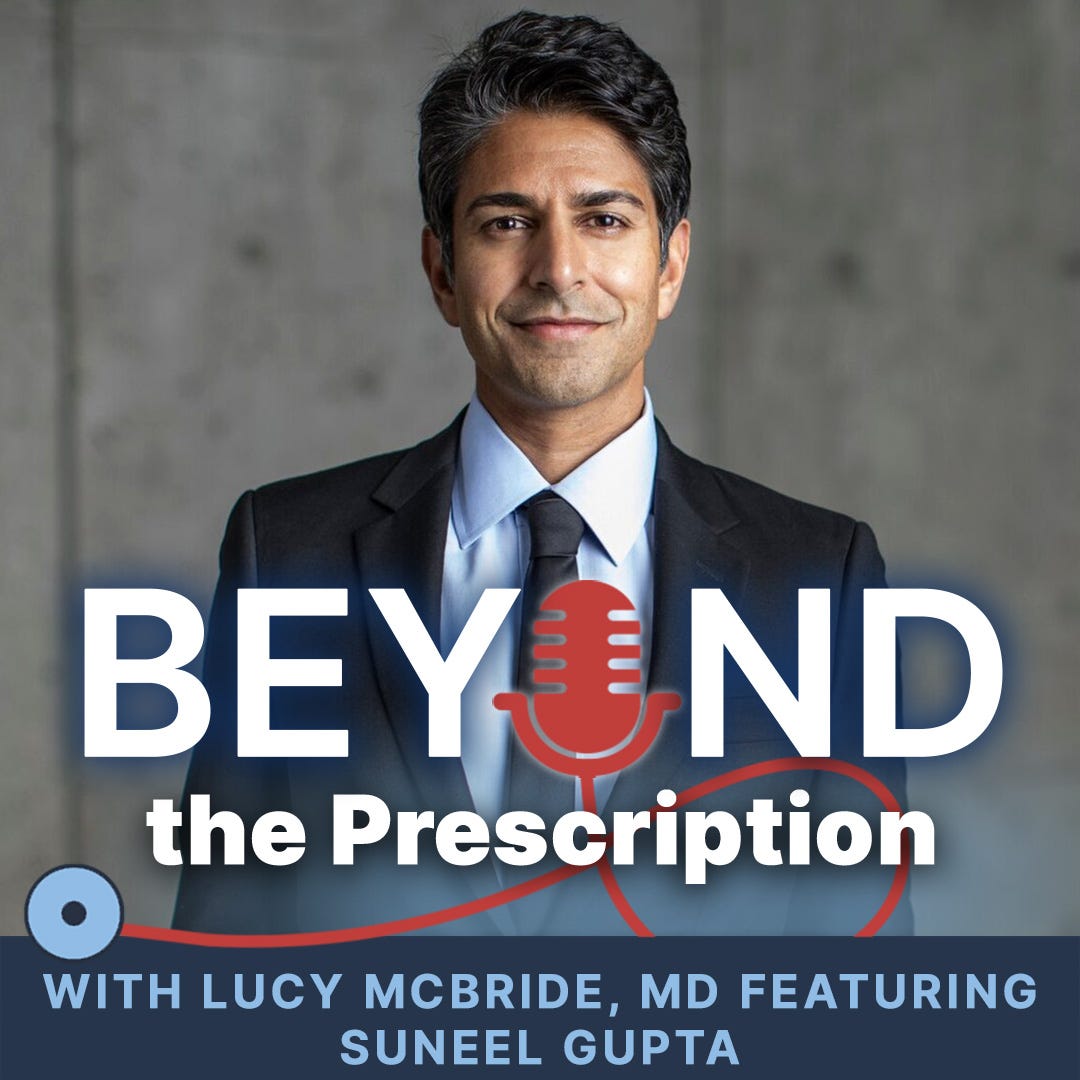
Suneel Gupta on Finding Your Dharma
from Beyond the Prescription Hosted by Dr. Lucy McBride
You can also listen to this episode on Spotify! What gives you meaning and purpose? How do you measure success? What does it mean to be healthy? Suneel Gupta is helping people grapple with these essential questions. His new book, Everyday Dharma: The Timeless Art of Finding Joy in What You Do, is about reconciling what we do with who we are. Gupta describes our “dharma” as our calling—or what Gupta’s grandfather called our “essence.” Gupta recognizes the central tension between outward markers of success and finding this internal sense of purpose. A successful entrepreneur and bestselling author, Gupta has also grappled with depression and self-doubt, fueled by the natural tendency to measure success with external metrics instead of asking ourselves the “Why?” On this episode of Beyond the Prescription, Gupta explores the harms of hyper-vigilance and the power of vulnerability. They discuss the “Arrival Fallacy,” the false assumption that once you reach a goal, you will experience enduring happiness. He shares parts of his own process of self-discovery that allowed him to pursue his inner purpose and help others do the same. Join Dr. McBride every other Monday for a new episode of Beyond the Prescription. You can subscribe on Apple Podcasts, Spotify, or on her Substack at https://lucymcbride.substack.com/podcast. You can sign up for her free weekly newsletter at lucymcbride.substack.com/welcome. Please be sure to like, rate, and review the show! The transcript of the show is here! [00:00:00] Dr. Lucy McBride: Hello, and welcome to my office. I'm Dr. Lucy McBride, and this is Beyond the Prescription, the show where I talk with my guests like I do my patients, pulling the curtain back on what it means to be healthy, redefining health as more than the absence of disease. As a primary care doctor, I've realized that patients are more than their cholesterol and their weight. [00:00:31] We are the integrated sum of complex parts. Our stories live in our bodies. I'm here to help people tell their story and for you to imagine and potentially get healthier from the inside out. You can subscribe to my free weekly newsletter at lucymcbride.substack.com and to the show on Apple Podcasts, Spotify, or wherever you get your podcasts. [00:00:57] So let's get into it and go Beyond The Prescription. My guest today is the ever dynamic. Suneel Gupta, who's passionate about helping people achieve success in a healthy, sustainable way. Suneel is a beloved speaker, a visiting scholar at Harvard Medical School, and best selling author of two books. His new book is just out. It's called, Everyday Dharma: The Timeless Art of Finding Joy in What You Do. It's really a practical guide to finding your dharma, your inner calling, and learning to integrate ambition, work, and well being to create a balanced life. The book combines Suneel's own stories with history science, Eastern philosophy, and Western methods. Suneel, thank you so much for joining me on the podcast today. [00:01:49] Suneel Gupta: Oh, Lucy, I'm so glad we were introduced and it's good to be here. [00:01:52] LM: So let's talk about Dharma. There's something about it that resonates with me as a physician who's in the constant quest tohelp patients pull the curtain back on their story. So what is Dharma? [00:02:04] SG: Yeah, I mean, I wrote this book really for the same reason. I think that we are experiencing an overwhelming sense of emptiness right now and society sort of speeding up. All right, we're using artificial intelligence, we're using automation to continue getting faster and more productive. But I think as individuals, we're kind of in a lot of ways moving in the opposite direction. [00:02:28] We are starting to feel like we are disassociating with our work, we are quietly quitting. And I think the result of all of it is that we are losing an emotional connection to what we do, which I think is a shame because we spend so much of our time either at a job or with the work that we do. [00:02:45] And to not feel that connection is, I think, I think it's devastating, right? It causes, I think, a lot of the symptoms that you talk about on this show. And so the reason that I wrote this book is because I wanted to to talk about how do we bring that emotional connection back to our work in a way that really feels real to us? And dharma is an age old philosophy really about that connection and one of the underpinnings of dharma is that while it may be tempting sometimes to try to find happiness and bliss outside of your work, there also is another path which is finding it through your work, right? [00:03:22] And Dharma is really the alignment of who you are and what you do, because when those two things are lined up, you feel creative, you feel energized. My grandfather called this your essence, right? And when you are expressing that essence, you're lit up, you're energized. But when you're not, you feel depleted, you feel burnt out. [00:03:43] And so I think the question for us is, how do we now start to come back to this essence, right? And it's something that's available to I think all of us. It's not the kind of thing that you get to luxuriate about when you've hit a certain level of status or wealth. I think it's it's available to every single one of us no matter where we are in our career the the challenge though is that most of us don't know what our Dharma is and even if we do understand to a certain degree, what our Dharma is, what our inner calling is, we don't necessarily feel like we have the time or the space or the money sometimes, or even the courage to pursue it. And I wanted to write this book because I wanted to go directly into those struggles. Not to write a book about what purpose is sitting behind a desk, but how do you take this thing that you feel that you need to express, right, it needs to speak, and how do you once and for all start to bring that into your everyday life? [00:04:39] LM: I love that I commonly talk with patients about this gap that exists in all of us between our best intentions and the execution of them. Meaning, like, we know we want to eat healthy. We want to exercise. We want to be more purposeful. We want to be more intentional. We want to put our phones down. We want to be happy and pursue things that are joyful, but there's that gap and the river is wide between the intentions and the execution. And you just said it, Suneel, sometimes the gap is filled with financial insecurity. Sometimes it's filled with logistical obstacles. Sometimes it's filled though, with fear and maybe even ambivalence, and then maybe even not knowing what your purpose is. So talk to me about how you might mind the gap. Those are my words, but how you kind of actualize and take control over your sort of sense of purpose and meaning. [00:05:37] SG: Yeah. So two different things that come together, right? Who I am and what I do, right? And I think the what I do is the execution. Who I am is really sort of getting into like, what it is I care about. Let's start with who I am because I think that's just a natural place where I think a lot of us, I think me, me included would skip over. And the reason I would skip it over is because I would look to what everybody else sort of had, right? I would look to people I saw with nice cars and nice homes and really nice sounding LinkedIn profiles and bios. And I'd say, let me go follow that. And what I found over time is that I was really walking somebody else's path, not my own. [00:06:12] And I think the work to sort of coming back to yourself and understanding what you want, it doesn't have to be something that you go on a huge meditation retreat. to do, right? I think it comes through starting to ask yourself certain questions. And in the book, I go through a list of sort of questions that really sort of helped me kind of get to this point. [00:06:31] I call these the chisels. And the reason I call these the chisels is because Michelangelo, when he would look at a … This is a public episode. If you'd like to discuss this with other subscribers or get access to bonus episodes, visit lucymcbride.substack.com/subscribe
Embed this episode
No transcript yet.