Sunlight in a Bottle: The Molecular Fuel That Stores Heat for 3 Years ☀️🧪 episode artwork

EPISODE · Feb 18, 2026 · 17 MIN

Sunlight in a Bottle: The Molecular Fuel That Stores Heat for 3 Years ☀️🧪

from The Deep Dive Lab: Unraveling Materials Science · host Son Hoang

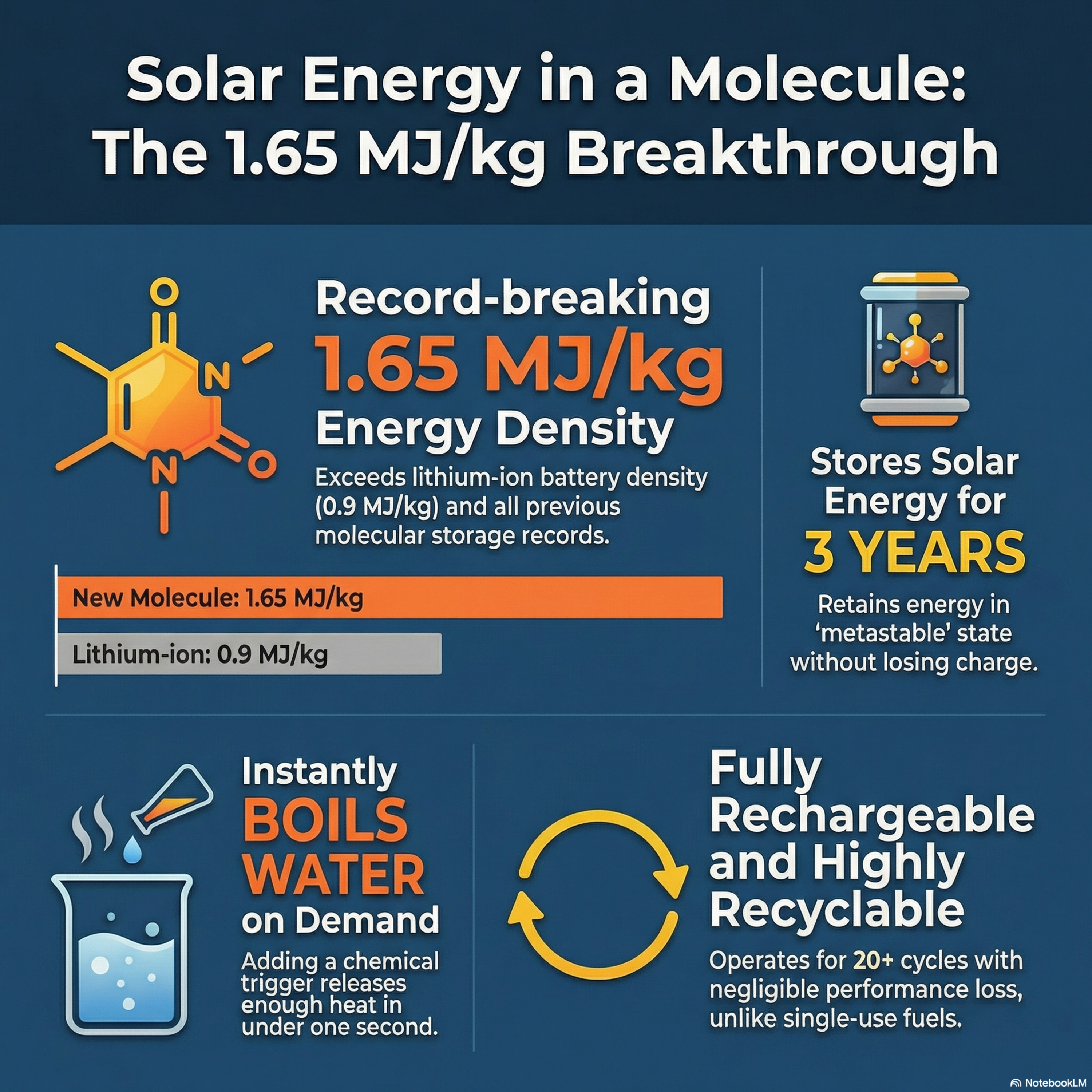
While solar panels dominate the renewable conversation, they solve only half the problem. Nearly 50% of global energy demand is heat, and two-thirds of that still comes from fossil fuels. Batteries store electricity — but what about warmth?In this episode, we explore a groundbreaking study published in Science (12 Feb 2026, First Release):“Molecular solar thermal energy storage in Dewar pyrimidone beyond 1.6 MJ/kg.”Researchers have developed a Molecular Solar Thermal (MOST) system based on engineered Dewar pyrimidone, capable of storing solar energy directly inside chemical bonds — like a rechargeable liquid fuel for heat.✨ Record energy density: 1.65 MJ/kg✨ Half-life up to 1,240 days (3.4 years)✨ Boils water in one second when triggered✨ Fully recyclable, closed-loop systemInspired by DNA photodamage and nature’s repair enzyme photolyase, scientists transformed a biological “error” into a high-efficiency solar heat battery. Unlike lithium-ion batteries (~0.9 MJ/kg), this system stores energy in strained chemical bonds that do not leak over time.Is this the future of decentralized heating?Could we charge heat in summer and release it three winters later?Let’s dive into the chemistry shaping a post-fossil-fuel future.📚 Source Paper:Molecular solar thermal energy storage in Dewar pyrimidone beyond 1.6 MJ/kg.Science, 12 Feb 2026 (First Release).

While solar panels dominate the renewable conversation, they solve only half the problem. Nearly 50% of global energy demand is heat, and two-thirds of that still comes from fossil fuels. Batteries store electricity — but what about warmth?In this episode, we explore a groundbreaking study published in Science (12 Feb 2026, First Release):“Molecular solar thermal energy storage in Dewar pyrimidone beyond 1.6 MJ/kg.”Researchers have developed a Molecular Solar Thermal (MOST) system based on engineered Dewar pyrimidone, capable of storing solar energy directly inside chemical bonds — like a rechargeable liquid fuel for heat.✨ Record energy density: 1.65 MJ/kg✨ Half-life up to 1,240 days (3.4 years)✨ Boils water in one second when triggered✨ Fully recyclable, closed-loop systemInspired by DNA photodamage and nature’s repair enzyme photolyase, scientists transformed a biological “error” into a high-efficiency solar heat battery. Unlike lithium-ion batteries (~0.9 MJ/kg), this system stores energy in strained chemical bonds that do not leak over time.Is this the future of decentralized heating?Could we charge heat in summer and release it three winters later?Let’s dive into the chemistry shaping a post-fossil-fuel future.📚 Source Paper:Molecular solar thermal energy storage in Dewar pyrimidone beyond 1.6 MJ/kg.Science, 12 Feb 2026 (First Release).

NOW PLAYING

Sunlight in a Bottle: The Molecular Fuel That Stores Heat for 3 Years ☀️🧪

0:00 17:08

No transcript for this episode yet

We transcribe on demand. Request one and we'll notify you when it's ready — usually under 10 minutes.

No similar episodes found.

No similar podcasts found.

Frequently Asked Questions

How long is this episode of The Deep Dive Lab: Unraveling Materials Science?

This episode is 17 minutes long.

When was this The Deep Dive Lab: Unraveling Materials Science episode published?

This episode was published on February 18, 2026.

What is this episode about?

While solar panels dominate the renewable conversation, they solve only half the problem. Nearly 50% of global energy demand is heat, and two-thirds of that still comes from fossil fuels. Batteries store electricity — but what about warmth?In this...

Can I download this The Deep Dive Lab: Unraveling Materials Science episode?

Yes, you can download this episode by clicking the download button on the episode player, or subscribe to the podcast in your preferred podcast app for automatic downloads.
URL copied to clipboard!