
Wait, you're listening to Radio Lab from WNYC. Hey, I'm Jad Abenrod. I'm Robert Krollich. This is Radio Lab.
And what we're going to do in this particular show is we're going to... This is one of my favorites. Yeah. It should be because you certainly gave it your all.
Exactly. I don't know. What do we need to say here? Well, this is a little bit of a tussle.
We sort of wanted to bring it back because you know, winter's approaching, things are kind of heavy right now. We could use a little lightness. So this begins with a very, very successful film editor with... well, you'll meet him in a moment.
Comes to us with an idea with Jad Loaves, I Hate, and things go from there. Perfect. Can you hear us now? Hello, hello.
It starts with Walter, my hero. Walter Murch, I'm a film editor and sound designer, and I've been working in film since the late 1960s. The rest of me includes... I'm going to make him an awfully good one.
The Godfather. Apocalypse now... I love the smell of great common in the morning. ...ton of other films.
The thing we're talking about, in case you know, is the one of the more spectacular stories I've ever heard. How did you bump into this? Well, I was in Lyon, in France. Doing a film?
...unbearable lightness of being. This is back in 1986. I was supposed to be there for a week, and it wound up, I was there for a month. And I ran out of things to read, so I went down the street from the hotel, and there was a bookstore, and I was interested in still am, in cosmology, so I picked up a book by the Carl Sagan of France, and named Hubert Reeves.
Hubert. Actually, he's French-Canadian. He translates as Carl Sagan. Anyway, Murch ends up buying Reeves's book, goes back to the hotel, finds a cozy spot.
So I was happily reading away, and he was trying to explain, with some difficulty, because it's a difficult topic. How did M were condensed out of the sort of cork soup that we believe happened right after the Big Bang? And he tried various attempts scientifically, but then he said, to give you a sense of the poetry of this moment, the best thing is the story that Malaparte tells. Who is Malaparte?
Well, he was a journalist, a poet, a diplomat, soldier, prisoner, film director, and somebody who got around. And speaking of getting around, in 1942, a Milanese newspaper. Cordillera de la Sera. St.
Malaparte. To report on the eastern and northern fronts of the war. Specifically, the Russian Finnish border. And he had a front row seat of the siege of Leningrad, the agony of the Nazi bombardment of that city.
And it's from there that Malaparte tells his story. So this one day, this was in the winter. Malaparte was posted to the Finnish army who were fighting along with the Nazis, and they were perched just north of Leningrad. On the shores of Lake Ladoga, which is this big lake about in the city.
And on this day, the Nazis bombarded an area around the lake. This started a forest fire. Everyone ran for cover. Soldiers ran every which way.
And in the middle of the forest, there were Soviet forces that were locked up in a stable. And the forces panicked and broke out of the stables. Under to them. And they just started running.
And they just started running. And they just started running. And they just started running. And they rushed him to get away from the fire.
So you have hundreds of forces bolting through this flaming forest. Heading towards the open space ahead, which was the lake. And all the ones that burst out of the forest and go barreling into the lake. Stamped eating one on top of the other, as they all get deeper and deeper.
Up to their heads. And it is at this moment when they enter the lake that according to the story, something very weird happens. In the blink of an eye. The lake snaps them shut.
It just freezes. Suddenly turns to ice. With a bang, it goes from water to ice with this violent snap. And suddenly the horses are in tune.
Melacarte writes that even the waves on the lake were gripped in the air and sort of suspended there. Fade out. The next morning, when Malaparte and the Finns woke up, they discovered the forest fire had burned itself out. And look at that.
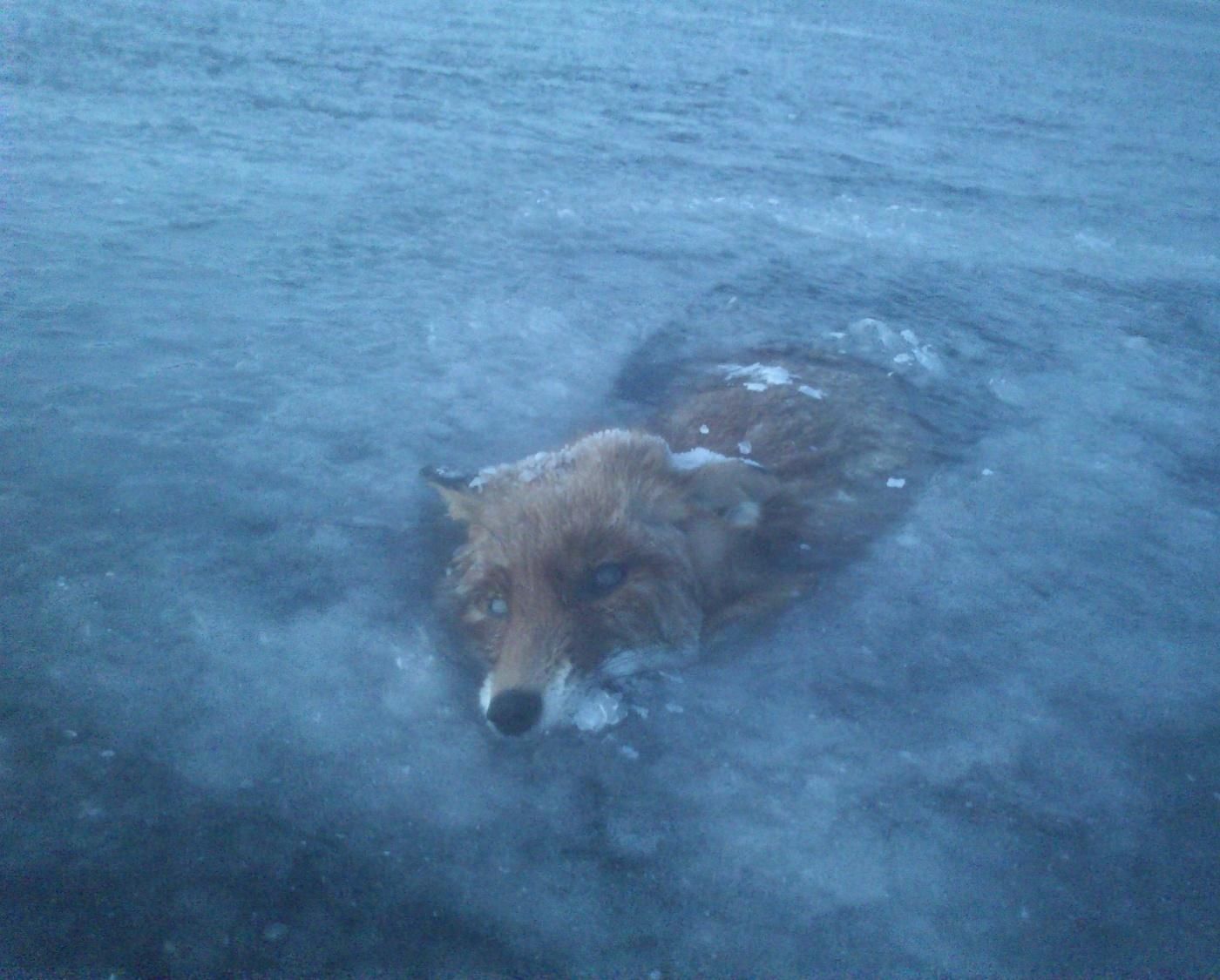
The lake has frozen solid overnight. And his Finnish friends said, yes, that sometimes happens. And then they look and see, what are those bumps on the ice over there? They go to investigate and I find themselves in this horrific sculpture garden of horses, heads sticking up out of this solid marble like floor of ice.
You said hundreds of horses. Hundreds of horses. These are not going to decay because it's freezing cold. Those horses stayed there all winter.
And Melacarte was there in that region of the world during that winter. And every so often, he and the other soldiers would go and have a smoke and they go into the sculpture garden and wander around looking at this miraculous thing. So the image of the horses frozen in this lake. This image, beautiful and strange and disturbing and profound in some way.
Made us wonder. Made me wonder, I should say. I told you at the time, don't trust this story. It's scientifically impossible.
And I, keeping an open heart, thought could this possibly be true? Could there be a grain, perhaps several grains, perhaps a lake's worth of grains of truth? Your heart's only, just your mind is like loose like a sin. Anyway, we've started about this for a year.
And you know what? We're going to reconstruct that argument right now and take this up town. Alright. Alright.
Let's do this. Do a real scientist. To a real scientist. Of course of our argument.
We ended up going up down to Rockefeller University to meet a couple of people who know about ice. So we're going to go play with some super cool ice. Among them, this fellow. I'm Alexander Petrov.
I'm the arraignment and Beverly Sackler fellow. Do you ever wonder who arraignment and Beverly Sackler? They occasionally almost show up and I almost meet them, but I never have. By the way, the Sackler family has recently come into a bit of controversy.
We all know that now. We didn't at the time. Alex, who must be said is an amazing dude, graciously agreed to demonstrate that you can, in fact, create the conditions of that massive lake inside a tiny little test tube. Can somebody hold this sort of in here and I'll get a tube set up?
You reach inside his freezer, grab his trusty falcon. Yeah, this is called a falcon tube. Just a blessing tube filled with water. Now, this is not normal water.
This is the really nice water. It's very, very pure water. No minerals, no dust in there. It's like super distilled.
And he says, when you take water like that and you cool it down, you can get it far below its freezing point and it won't freeze. Unless that is, you have an ava horse. You have a tiny horse here? We have a tiny horse.
And we are going to drop that into the falcon tube and do that. That's going to be awesome. So he handed us the tube. I'm holding a little vial of super cooled water.
What temperature do you think this is? Is that a minus 20? This is minus 20? Oh, let's see.
See, Celsius. When does water freeze and it's zero? So it's 20 degrees below freezing point and it's still water. But now for long, because we unscrew the cap.
Are you filming? We held the little plastic horse over the tube. Countdown or something. Okay, on the count of three, guilty.
Three, two, one. Point for Chad, because the moment that little plastic horse hit the water, the water slammed into ice. I got it. Suddenly that little guy was trapped in an ice cube.
Oh my god, his floors is frozen. That's amazing. Please remember the horse was plastic and the line was behind this experiment. It's honestly breathtaking, but it happens so fast.
Catastrophic ice formation, just like that. Did you hear that? See what Robert said again? Catastrophic.
This is Virginia Walker. And I'm in the Department of Biology, Queens University. Virginia was one of the many people that we called up to ask, like, what the hell? Like, why does this happen?
Shouldn't this water just freeze gradually the way that most water does? You know, 32 degrees Fahrenheit or whatever? No, actually. So you see, this is why we have to start at the beginning.
As Julie Andrews says, a very good place to start, right? All right, so the only reason that water freezes normally at zero Celsius and 32 Fahrenheit is that there's something there that makes it freeze. We call that a nucleator. Sounds like a superhero.
Yeah, all right. So it's a nucleator. A nucleator is like a seed, right? Didn't know this, but it turns out water almost always needs a seed in order to grow ice.
Because it turns out water by itself is not actually that good at remembering how to become ice. That is Aaron Pettit, she's a glaciologist. At the University of Alaska Fairbanks. And which it means is that when water cools down, the molecules start to slow their movement.
They get a little bit closer together. At that point, they want to all hold hands and become ice. But the water molecules don't quite remember very well how they're supposed to be organized. They're like, wait, do you stand here and I stand here?
How do we do this again? They need to be shown what combination of angles work the best to create a nice, stable structure. What they need is, say, a speck of dust. That's the nucleator.
If you throw in some dust into otherwise pure water, now they have a guide. Because ice can start to mimic whatever the shape of the dust particle is. But what happens is that the water molecules start to form a cage around the dust particle. The cage shape is very similar to the shape they need to make ice.
And suddenly they're like, oh, that's how we do it. So in a sense, the dust particle is reminding the water molecules how to freeze. Well, no, I don't think of it like that. Virginia says it's actually not quite so gentle.
Really what's happening is the dust particle is forcing the water molecules into the right shape around it. It's like a command. It's nothing about memory. It's a physical thing.
They just get jammed in it. Wow, that's just like Julie Andrews like a Nazi. So they need these ice. Well, let's start at the right minutes.
No, let's get it. No, let's get it. Doesn't this at least raise the possibility that that finish Russian Lake had reached a super-cooled state along come these horses and they were the nucleators. Maybe they had dust on their hair or whatever.
I don't know. Whatever it was, it started a chain reaction. Ice spread outward from these horses, shot across the entire lake, and froze the whole damn thing at once. No, if you'll excuse me for just a second because it's like a tereting impulse I have.
Excuse me. Now we can continue. Close your horses there. We're going to take a break and we'll continue this meaningless tassel in just a moment.
This is Alicia Bridges calling from Saskatoon in Saskatchewan. Radio Life is supported in part by the Alfred T. Sloane Foundation, enhancing public understanding of science and technology in the modern world. More information about Sloane at www.sloane.org.
Hi, Lulu here, and this episode is sponsored by BetterHelp. May is Mental Health Awareness Month, and as someone who reports on mental health, who likes talking to people about their mental health, and what they look to in science, in the natural world, in faith, in friendship, but wherever it may be to help guide them through the rough patches of life, we just wanted to take a moment to say what seems to help people turn corners, find relief, get out of ruts, and even flourish is having someone with you. As much as we can feel private about our mental health struggles, you do not have to go it alone. So this may, why not treat your mental health to a buddy?
And who better to talk to than a fully licensed mental health therapist? With over 30,000 therapists available, BetterHelp has someone you can talk to available at pretty much any time that's convenient for you at the push of a button, and because finding the help you need often depends on the therapist's client vibe, rest assured that there are help you can switch providers at any time. Remember, truly, your mental health matters and you don't have to go it alone. Find support you need at any time with BetterHelp.
Sign up and get 10% off at BetterHelp.com. That's BetterHELP.com. Each story you hear on Planet Money starts with a question. What happens if we refund tariffs?
Why are groceries so expensive? At NPR, we stand for your right to be curious, because the force in shaping our world can be hard to see. Follow NPR's Planet Money wherever you get your podcast and start seeing how the economy really works. Okay, so we've got Jad Robert, Radio Lab, before the break.
We posited what I thought was an interesting theory, Robert, not buying it. No. I'm going to get up to this in a moment, but I want to talk a little bit more about nucleators for a second, because when we were talking with Virginia, she told us something kind of cool. She said, we asked her, like, what else nucleates ice?
Like, we learned about dust, but what else can do it? Okay, so the best nucleator is ice itself. She says if a little bit of snow falls into some water or a little bit of ice forms in the water organically, the water molecules will rush around that and bam. If you don't have ice, what is the second best thing to nucleate this ice happens to be bacteria?
Turns out she says there are three different kinds of bacteria that can generate these special proteins. The big honkin protein that can instantly turn water into ice. In fact, when we were reporting the story of video started circulating on the internet, that showed a scientist taking a bottle of water, squirting a little bit of this bacteria in, and then the thing just shocked in the ice. And the cool thing is, these bacteria are actually plant pathogens.
Plant killers. So you've probably seen grass growing in your backyard or whatever, and it can be all covered with frost, but then, you know, the frost can melt and it's still green. Yeah. But if those bacteria are present, she says they'll spit out their proteins onto the plant, which generates these ice crystals.
The ice crystals. Then slice the plant open. And expose the inside of the plant. And the bacteria say, mmm, yummy, here's lunch, and the inside of the plant.
It's a good strategy, but that's not the cool part. Virginia said she has also found these proteins in bacteria that don't kill plants. So that made me think. I wonder why?
Like, why would they need to make ice? And that's when it occurred to her and a few other researchers. Maybe it's about transportation. Exactly.
What? Well, think about these bacteria just sitting on these plants. And what happens is the wind comes along, blows up these little bacteria into the upper atmosphere. Blows them literally up into the clouds.
They're not particularly cold hardy. So now they have a situation. They do not want to be all the way up there. They've got to get back down to the Earth.
And unless they hit you right on those horses that you keep talking about, they're so light, they might not come down to Earth. So what they do, she suspects, is they use the plant trick. They spit out these proteins into the cold, wet cloud, which galvanizes the water molecules around them to form a snowflake around their body. So now they've got this little hovercraft that they can use to coast on down.
If they make ice, they can get back down. And they can get back down in a different place and start a new colony of bacteria somewhere else. And so by this way, they get dispersed around the whole Earth. Think about that the next time it's winter and it snows.
Apparently, if you melt each snowflake, you'll find a little bacteria inside it. You're saying all of them? I haven't looked at every single snowflake. Of course.
But it makes perfect sense, doesn't it? That's a very, very cool idea. I suddenly like the bacteria movie a hell of a lot better than the horse movie. So at least I, you know, and at least it has a shot of being true.
Yeah, the horses. So when we were reporting this story and we were talking to Aaron Pettit and Virginia Walker and a bunch of other scientists. When we asked them, could an entire lake have flash frozen in an instant, trapping all those horses, uniformly the answer that we got was no. Did you hear her know there?
Did you hear her sound of it? Let me ask you a different way. Would you say absolutely not? Or is it just a kind of a gentle no?
I'd say that's an absolutely not. Because as Aaron told us, when you're talking about freezing an entire lake, well, you've got a lot of problems to consider first. The process of freezing actually is a source of heat itself. Because like when water molecules form bonds to make ice, that's a lot of activity.
And activity produces energy and now that's going to make things a little bit warmer. Not to mention the fact that horses are warm blooded animals, so they also would slow down the process of freezing. Right. Also the water would never have been pure enough to super cool in the first place.
Because there's too many things in the lake that would provide that initial nucleation. Plants, organisms, dirt, dammit. Did somebody actually see this? What is the actual evidence that?
No. Nobody saw any of this as it actually happens. When we told Walter Murch what the scientists told us, in typical Walter Murch fashion, he was icy calm. And he never told us it was true that Malaparte often mixed fact and fiction, and that the real reason he was attracted to this story was because it offered a metaphor for cosmology.
Right. The beginning of the universe. Really? I mean, if you'll excuse me, if you're small, then a skepticism.
Now Walter thinks it's true for the universe? Metaphor. Metaphor. Metaphor.
What does he mean? What does he mean? Here's what he means. And if you're a physicist listening right now, just turn off the radio.
So we're just talking among ourselves here. Right. So you can think of it in one of two ways, right? The first is that idea of super cooling that we saw at Rockefeller, where under the right circumstances, water can cool down way below its freezing point, not freeze, and then all of a sudden...
Oh my god! And he can suddenly do that, which we saw at Rockefeller in the test tube. Now according to Jenna Levin, Professor of Physics in astronomy, Barnard College at Columbia University. The Metaphor holds because that bizarro flash freezing phenomenon actually happened repeatedly, she says, in the moments after the Big Bang.
Yes. Super cooling is definitely something that happens in the early universe. She says right when the universe got it started. It was still small, like the size of a grapefruit.
Inside that grapefruit it was extremely hot. Back then it was probably a million trillion trillion. A million trillion trillion trillion trillion. Ten to the thirty two times hotter.
But as a little grapefruit began to expand, the temperature started to drop, and it dropped and dropped to a point where the universe should freeze, so to speak. But it didn't. And it's waiting. It's waiting.
It's freezing. It's happening. Why aren't you freezing then? Suddenly?
There it goes. Phase change. Go ahead. Okay.
I don't know exactly what you're saying to keep going. All I'm saying is that a lot of phase changes. Some of them are super cool. Don't worry about it.
Okay. So if you go back to the grapefruit. Okay. Inside is very, very hot.
You've got this wash of energy. And this energy is uniform, right? It's all the same thing. Spread evenly everywhere the same.
But then it's thing school. You begin to get these tiny fluctuations. Little variations of temperature and density. Where it's a little bit hotter and denser in one point.
Then another. We're talking about clumps. Like maybe we're here. There's a little bit more matter and heat than over there.
And these are our seeds. I don't think that you're describing seeds like I understand. These are little things. I don't think things that attract other stuff.
No, no, but these behave just like seeds. Because as the universe cools down and expands and begins to add all these new forces and all these new particles. Grabbing. Electron.
Otones. Atons. Those little bits of variation from the beginning are still there. And now they're growing bigger.
Now we've grabbed it, right? So little concentrations of stuff are now attracting more stuff. And then more stuff. And then more stuff.
And as the universe expands, they expand until ultimately those little blips have become these massive objects. Amazingly, the largest structures that we know about in the universe have their seeds in these tiny fluctuations. Does that mean when you go on a star wars kind of voyage? So you're in your spaceship and you're going at some incredibly high speed.
You're rushing through the universe and you see huge clouds of gas with nurseries for stars. And you leave them and you go to a galaxy and then another galaxy. There's a galaxy over here. You're saying these massive structures, walls of galaxies, neighborhoods of stars.
That's going to are reflections of a very early moment when something went whew, whew, whew. In the initial broil of stuff. These beautiful structures that you're describing are like the snowflakes around the little bit of dust. Does that mean that the empty spaces that we see when we gaze at the current universe are actually filled with something that hasn't cooled yet?
Or is it visible to us or is it working under different rules? Well, if I can hijack your question, I can say we might not have seen the last of the phase transitions. Our universe is absolutely continuing to cool. Is it really?
It's very cold right now. We have this dark energy driving the universe to expand at an ever accelerated rate. And it's conceivable that in the future that energy will endure some phase transition. And it will go away or decay to something else in this new state of matter, it might do something different to the evolution of the universe.
So we might have a phase transition in our future. Hm. Suddenly. Oh dear.
Okay. Yeah. Oh. Hello.
We have many people to thank who helped us on this particular podcast. Totally. Producers Matthew Keelty. Molly Wester.
Also Amanda Rance. Ateesh Bachja for sure. And Maureen Budo. These super cool people at Rockefeller University.
Jeannie Garino Philke. And of course, Alexander Petrov. Thanks also to Jeffers-Sansstrom. Inger Herberg.
Mark Martin. Mark Trufford. Mark Tuckerman. And Jason Wexler.
And sincere. Thanks to all of those from Facebook and Twitter who helped us translate Russian and Finnish books. Oh, and certainly last but not least, Walter Murch for being my hero. Jed loves you.
I love you. And more importantly, he released a book translating Malaparte from Italian to English, which is where we got the story of the horses falling in the lake. It's called The Bird that Swallowed its Cage, the Selected Writings of Curzio Malaparte. Alright.
That's us saying. Oh, wait. One more thing. One more thing.
Go to our website, radiolab.org. I'm Robert Kowad. Thanks for listening. This is Stephanie calling from Bushwick, Brooklyn.
Radiolab is created by Jat Abomrod and is produced by Soring Wheeler. Dylan Keefe is our director of sound design. Maria Matysar-Pedia is our managing director. Our staff includes Simon Adler, Becca Bresler, Rachel Kusick, David Gabel, Bethel Habte, Tracy Hunt, Matt Keilte, Robert Kowad, Annie McEwen, Latif Nasser, Melissa O'Donnell, Ariane Wack, Pat Walters and Molly Webster.
With help from Amanda Arenchek, Shima Oliai, David Fuchs, Nighar Fitali, Phoebe Wang and Katie Ferguson. Our fact checker is Michelle Harris.