Super-Modular Chiral Origami Metamaterials episode artwork

EPISODE · Feb 6, 2026 · 17 MIN

Super-Modular Chiral Origami Metamaterials

from CDFAM Computational Design Symposium · host Duann Scott

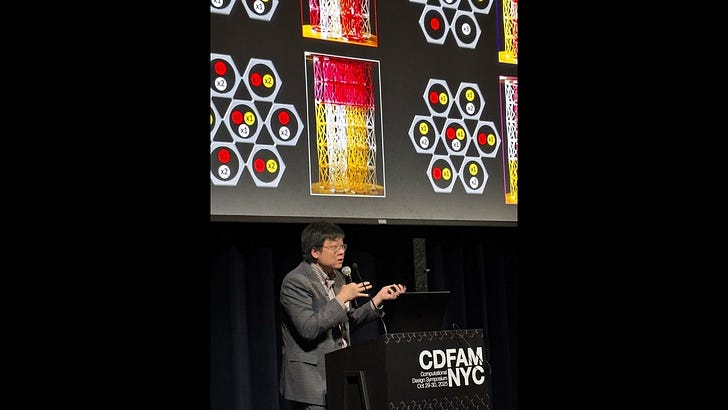
Recorded at CDFAM Computational Design Symposium, NYC, October 29-30, 2025https://cdfam.com/nyc-2025/OrganizationPrinceton UniversityPresenter:Tuo ZhaoSuper-Modular Chiral Origami MetamaterialsPresentation AbstractMetamaterials with multimodal deformation mechanisms resemble machines, especially when endowed with autonomous functionality. A representative architected assembly, with tunable chirality, converts linear motion into rotation (1). These chiral metamaterials with a machine-like dual modality have potential use in areas such as wave manipulation, optical activity related to circular polarization and chiral active fluids. However, the dual motions are essentially coupled and cannot be independently controlled. Moreover, they are restricted to small deformation, that is, strain ≤2%, which limits their applications. Here we establish modular chiral metamaterials (2), consisting of auxetic planar tessellations and origami-inspired columnar arrays, with decoupled actuation. Under single-degree-of-freedom actuation, the assembly twists between 0° and 90°, contracts in-plane up to 25% and shrinks out-of-plane more than 50%. Using experiments and simulations, we show that the deformation of the assembly involves in-plane twist and contraction dominated by the rotating-square tessellations and out-of-plane shrinkage dominated by the tubular Kresling origami arrays. Moreover, we demonstrate two distinct actuation conditions: twist with free translation and linear displacement with free rotation. Our metamaterial is built on a highly modular assembly, which enables reprogrammable instability, local chirality control, tunable loading capacity and scalability. Our concept provides routes towards multimodal, multistable and reprogrammable machines, with applications in robotic transformers, thermoregulation, mechanical memories in hysteresis loops, non-commutative state transition and plug-and-play functional assemblies for energy absorption and information encryption.References:(1) Frenzel, T., Kadic, M. & Wegener, M. Three-dimensional mechanical metamaterials with a twist. Science 358, 1072–1074 (2017).(2) Zhao, Tuo (presenter), Dang, X., Manos, K., Zang, S., Mandal, J., Chen, M., & Paulino, G. H. Modular chiral origami metamaterials. Nature, 640(8060), 931-940 (2025).Speaker BioTuo Zhao is a postdoctoral research associate at Princeton University. His expertise is in computational mechanics, nonlinear topology optimization, soft robotics, and mechanical metamaterials. Tuo is currently addressing the scalability challenge for developing useful metamaterials. By integrating an untethered actuation scheme (e.g., three-dimensional magnetic fields and micro-magnetic responsive materials), he designs micro-robotic machines with tunable properties on demand. This is a public episode. If you would like to discuss this with other subscribers or get access to bonus episodes, visit www.designforam.com

NOW PLAYING

Super-Modular Chiral Origami Metamaterials

0:00 17:50

No transcript for this episode yet

We transcribe on demand. Request one and we'll notify you when it's ready — usually under 10 minutes.

Take the Leap Colleen Biggs When was the last time you took a leap of faith trusting that everything is going to work out? Do you crave growth, or are you merely content with the status quo? If you want more out of your life, out of your career, and out of your relationships, you are in the right place. It's time for you to step into the Spotlight to expand your influence and attract the right clients. Your Host, Colleen Biggs, will expose the actions you need to take, through the experiences and interviews of our guests, so you no longer are sitting on the sidelines, but that you are finally taking an active role in defining the design of your life rather than living it by default. We will be interviewing elite leaders that will share their greatest regrets, successes, and how they did it! Week after week you will learn all about how you too can take the leap of faith, trust in yourself and stop living a life only by default. Talent Stacker Jonathan Mendonsa Data suggests that the average cost of college in 2019 was $122,000 while the entry-level salary for a college graduate at the same time period was 50,000. ROI is a distant memory.hopefully for that that $122,000 the student graduates with a degree and possibly some skills. The reality is, as most individuals approach graduation, they realize that ultimately what they have to prove to their employers that they actually have the skills and since you don't need a degree or permission to start building skills, let’s document the stories and best practices of individuals that crushed the game by focusing on building their skills and their talent stack. Maybe you feel like you don’t have a talent stack. What are the skills you need to be able to generate an above-median income and when paired with interest-led learning this talent stack will allow you to work towards financial independence and design your future?If you're up for this challenge to go from no Talent Stack to designing you API Intersection Stoplight Building a successful API requires more than just coding. It starts with collaborative design, focuses on creating a great developer experience, and ends with getting your company on board, maintaining consistency, and maximizing your API’s profitability.In the API Intersection, you’ll learn from experienced API practitioners who transformed their organizations, and get tangible advice to build quality APIs with collaborative API-first design.Jason Harmon brings over a decade of industry-recognized REST API experience to discuss topics around API design, governance, identity/auth versioning, and more.They’ll answer listener questions, and discuss best practices on API design (definition, modeling, grammar), Governance (multi-team design, reviewing new API’s), Platform Transformation (culture, internal education, versioning) and more.They’ll also chat with experienced API practitioners from a wide array of industries to draw out practical takeaways and insights you can use.H Epic: Silver Wing Realm EPIC is your new HQ for Realm’s exhilarating action and adventure stories, with new episodes dropping every Monday introduced by host Faith McQuinn.Embark on your greatest adventures yet, whether it’s crash landing on a desolate planet with only a cerebrally-embedded AI to guide you, or realizing that your latest game design is the only thing staving off total global annihilation. So unsheath those earbuds, clench that steering wheel, and buckle up because EPIC is about to take off.This month, we are featuring Silver Wing: On a desert planet in the far future, an old dragon hunter embarks on a desperate journey to save her estranged son. For centuries, the dragons have been sleeping. But in their rest, they provide a crucial energy source necessary to keep the planet Toon Flats habitable. Amphet Dahl is a diviner, gifted with the ability to sense the dragons’ dreams and memories and to the disappointment of her son, Afton, she uses this ability to

Frequently Asked Questions

How long is this episode of CDFAM Computational Design Symposium?

This episode is 17 minutes long.

When was this CDFAM Computational Design Symposium episode published?

This episode was published on February 6, 2026.

What is this episode about?

Recorded at CDFAM Computational Design Symposium, NYC, October 29-30, 2025https://cdfam.com/nyc-2025/OrganizationPrinceton UniversityPresenter:Tuo ZhaoSuper-Modular Chiral Origami MetamaterialsPresentation AbstractMetamaterials with multimodal...

Can I download this CDFAM Computational Design Symposium episode?

Yes, you can download this episode by clicking the download button on the episode player, or subscribe to the podcast in your preferred podcast app for automatic downloads.
URL copied to clipboard!