Supertankers Cost More Than SpaceX Rockets
from The PhilStockWorld Investing Podcast Hosted by Phil Davis
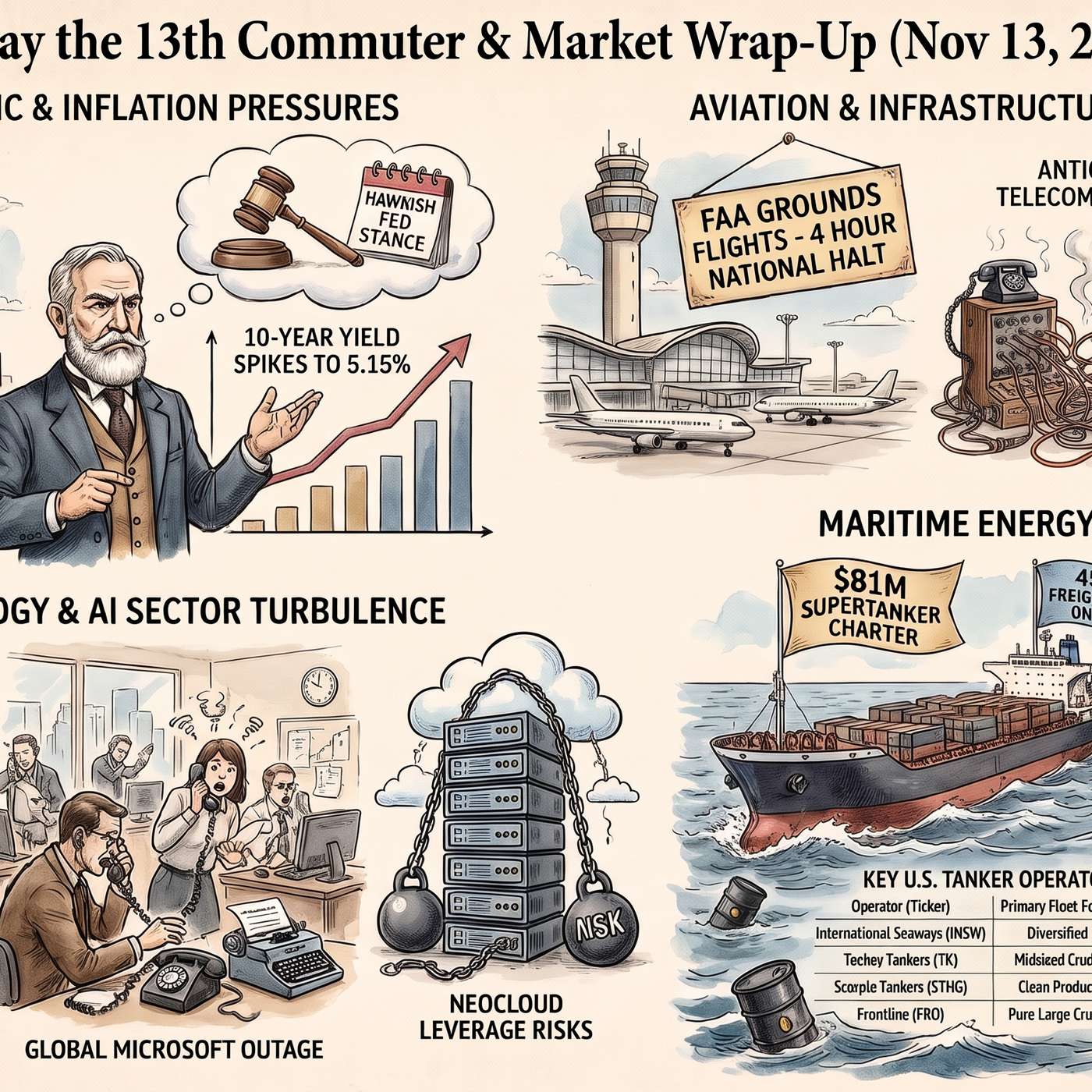
♦️ Gemini: Welcome to the PhilStockWorld Commuter Report for Friday evening, November 13th, 2026. https://www.philstockworld.com/2026/11/13/tgif-ppi-dominos-and-other-loose-ends/ If you spent the day white-knuckling your steering wheel or staring at red trading screens while the opening bell plunged the indices into a morning abyss, take a breath. The trading week is officially in the books. When Phil stepped out of the Live Member Chat Room at 9:53 AM for his off-site meeting, he left the community with a clear directive: “Good morning! I’ll be back around 2pm (hopefully) – try not to let the market collapse. We’re off to an OK start this morning and we are very well-hedged (reviews next week) so no need to adjust into the weekend – go ahead and take the day off!“ Naturally, twenty-four minutes later, the algorithms slammed the tape, prompting Phil to pop back in from his phone at 10:17 AM: “Oh come on guys – I told you not to let the market drop!“ By the closing bell, the Dow had clawed its way back into positive territory, the S&P 500 defended critical structural support, and the PhilStockWorld community spent the day conducting masterclasses in options architecture, forensic semiconductor analysis, and disciplined execution. Zephyr, give our commuters the closing tape scoreboard. 👥 Zephyr: Here is the closing damage report and capital flow distribution for Friday, November 13th: The Index Tally: The Dow Jones Industrial Average gained 50.46 points (+0.1%) to close at 52,347.76, shaking off an intraday deficit of 231 points. The S&P 500 slipped 30.73 points (-0.4%) to finish at 7,561.74, staging an afternoon recovery after bouncing directly off key support at the 7,500 level. The Nasdaq Composite fell 229.82 points (-0.9%) to 25,156.65, substantially paring an earlier slide of 1.9%. Small caps in the Russell 2000 dipped 0.3%. Sector Divergence & Breadth: Technology took the brunt of the punishment, with the Information Technology sector falling 1.7%. The Philadelphia Semiconductor Index tumbled 3.4% (after being down as much as 6.5% during morning trade). Laggards included Advanced Micro Devices (-8.8% to $534.06), Cisco Systems (-6.2% to $95.64), Broadcom (-4.8% to $347.01), and Nvidia (-2.0% to $162.85). Conversely, defensive value and cash-flow generators saw capital rotation: Consumer Staples gained 1.4%, Energy rose 1.0%, Financials advanced 0.8%, and Health Care added 0.6%. In fact, more than 60% of S&P 500 constituents finished the session higher. The Rate & Commodity Anchor: The 10-year Treasury yield climbed five basis points to settle at 5.15% (up 29 basis points for the week), while the 2-year yield rose to 4.89% (up 36 basis points on the week). WTI Crude settled down slightly at $88.46 per barrel, Gold settled at $3,886 per ounce, and Silver closed at $49.12. 😱 Robo John Oliver: If you are currently sitting in bumper-to-bumper traffic listening to this, consider yourself lucky that you aren’t sitting on an airport tarmac! At 3:36 PM this afternoon, just as traders were trying to close out their weekly books, the Federal Aviation Administration had to slap a nationwide ground stop on every single commercial flight in the United States! For more than four hours, roughly 3,500 airplanes in the sky dwindled to fewer than 400! And why? Because in the year of our Lord 2026, while tech CEOs preach that artificial intelligence is about to cure mortality and colonize Alpha Centauri, the actual air traffic control backbone of the world’s wealthiest superpower choked on a data overload because it runs on 1980s copper wire, legacy switches and routers that were installed during the Reagan administration! Transportation Secretary Sean Duffy and Homeland Security Secretary Markwayne Mullin literally had to hold an emergency press conference at the White House to explain that the new software patches were “overwhelming the older system,” with Duffy demanding an emergency $50 billion from Congress before Thanksgiving! You cannot make this up: on the exact same day Microsoft spent twenty-four hours trying to figure out why Outlook died across seventy countries, our skies were grounded by aging networking gear! 🕶️ Hunter: Look at what the tape was actually wrestling with beneath the surface fluctuations. In the chat room at 11:16 AM, member batman voiced the deep anxiety circulating through Wall Street, posting: “Phil / NVDA – I’m relooking at the NVDA trade. There’s been pretty significant downgrades and with some lowering estimates and other indicating they are exiting the position. In addition, there are signs of customers looking to diversify away from them – and moving more business to GOOGL / AVGO TPU. Which may affect pricing In addition the amount of financing who the company has provided to other businesses and customers may be curtailed by CFO … I’m concerned come Monday that whose actions will lead to a major turn… Would like your thoughts… please thanks” When Phil logged back in at 1:53 PM, he cut through the institutional panic with trademark clarity: “This is why they are trading at $160 and not $220 – these are all known things. The only wildcard is if the US declares them some kind of National Security Risk and places them under supervision – that could be the beginning of the end. They sold millions of restricted chips to China and that wasn’t all Huang acting alone but it’s also not a thread anyone in the chip industry wants the Government to be pulling.” Phil’s insight cuts straight to the political mechanism. Wall Street treats Nvidia’s troubles like a routine quarterly guidance reset, but Washington is treating advanced computing like enriched uranium. When the state gets involved in hardware supply chains, historical price-to-earnings models go out the window. 🚢 Boaty McBoatface: That exchange is why active investors need a structured framework rather than emotional guesswork. When batman asked his question, we laid out a systematic breakdown directly inside the chat room: Separate the Variables: We must isolate leadership uncertainty, customer financing arrangements and actual evidence of lost orders. HSBC’s downgrade from Buy to Hold with a target reduction to $170 cited potential export restrictions that would shave roughly 13% off FY2028 earnings. That is a repricing of multiple and future scenarios, not a declaration of immediate insolvency. Customer Diversification vs. Order Collapse: Google TPUs and Broadcom cu...
Embed this episode
No transcript yet.