
EPISODE · Mar 25, 2024 · 55 MIN
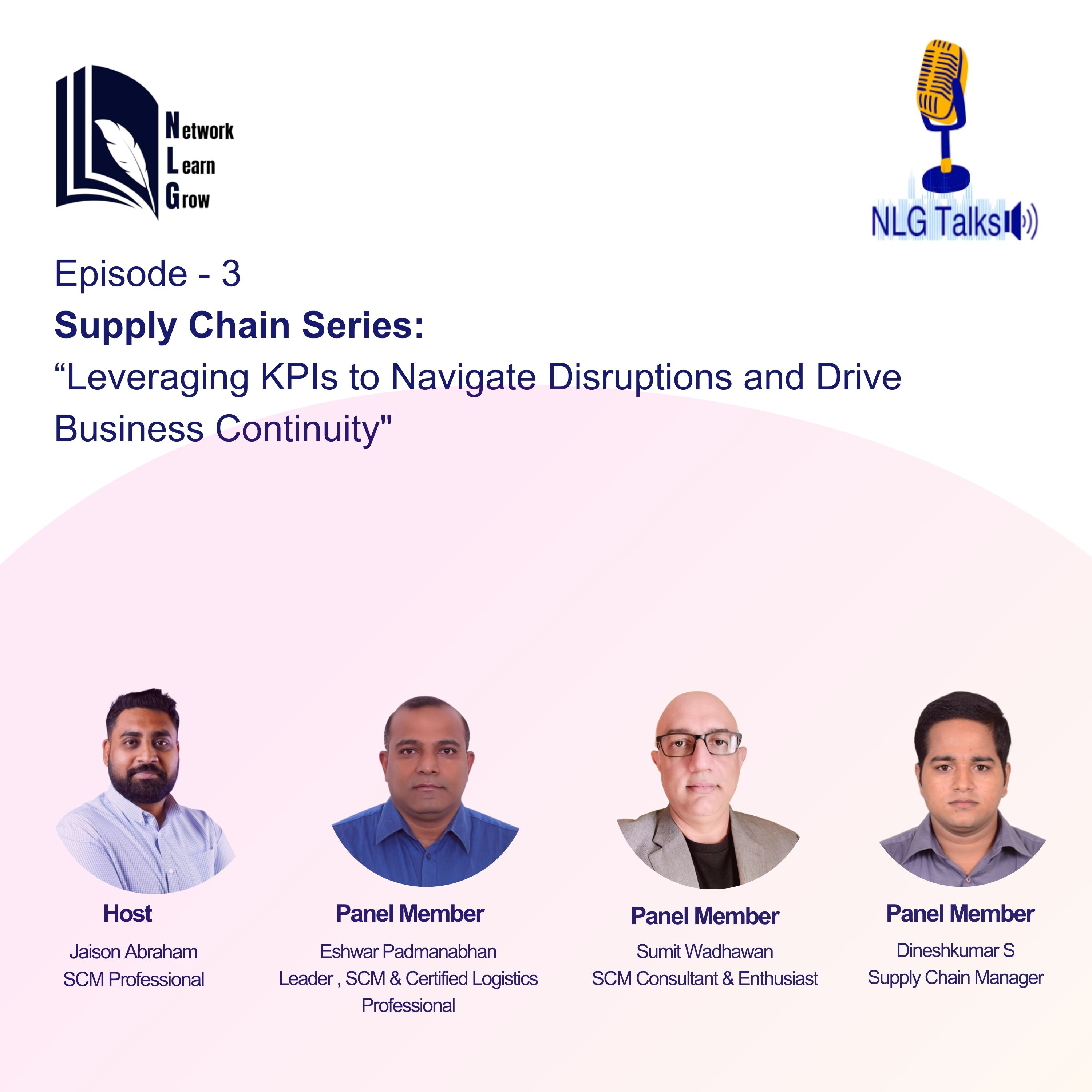
Supply Chain Series : Episode 3 Leveraging KPIs to Navigate Disruptions and Drive Business Continuity
from NLG Talks · host NLG Talks
To learn more about us, please reach out via email at [email protected] this podcast, I am engaging in a discussion with our esteemed panel members, Eshwar and Sumit, about how Key Performance Indicators (KPIs) play a crucial role in operational efficiency and sustaining businesses. Hosting this show myself, I delve into insightful conversations with our wonderful panelists.We are also privileged to have Dineshkumar, a seasoned Supply Chain Manager from India, joining us to share his expert insights on harnessing KPIs for ensuring business continuity.For our listeners, here are some key pointers that we will be exploring in detail, shedding light on the significance of these metrics. Importance of aligning KPIs with overall business goals and strategies Clarity of Purpose: When KPIs are aligned with business goals and strategies, it provides clarity to all stakeholders about what the organization aims to achieve. This alignment ensures that everyone is working towards common objectives, reducing confusion and promoting a unified focus. Strategic Decision-Making: Aligned KPIs guide strategic decision-making by providing measurable indicators of progress towards strategic objectives. Decision-makers can use KPI data to assess performance, identify areas of improvement, and allocate resources effectively to support strategic initiatives. Resource Allocation: By aligning KPIs with business goals, organizations can prioritize resource allocation based on strategic priorities. This ensures that resources such as budget, manpower, and technology are directed towards activities that contribute most significantly to achieving desired outcomes. Performance Evaluation: Aligned KPIs enable accurate performance evaluation at both individual and organizational levels. Employees can understand how their efforts contribute to overall strategic goals, leading to increased motivation and accountability. Continuous Improvement: When KPIs are aligned with business strategies, they support a culture of continuous improvement. Organizations can track progress, identify bottlenecks or inefficiencies, and implement corrective actions to optimize performance and stay competitive in the market. Measurement of Success: Aligned KPIs serve as benchmarks for measuring the success of strategic initiatives. They provide tangible metrics that indicate whether the organization is moving in the right direction and achieving its intended outcomes.Different types of KPIs : Operational KPIs: Inventory Turnover Ratio: Measures how many times inventory is sold or used in a specific period, indicating the efficiency of inventory management. Order Fulfillment Cycle Time: Tracks the time taken to fulfill customer orders from the moment they are placed to delivery, highlighting operational efficiency.On-time Delivery Performance: Measures the percentage of orders delivered on time, reflecting reliability in meeting customer expectations. Financial KPIs:Cost of Goods Sold (COGS): Represents the direct costs associated with producing or purchasing goods, impacting profitability and cost management. Return on Investment (ROI): Measures the profitability of investments made in the supply chain, guiding decision-making on resource allocation. Gross Margin: Calculates the difference between revenue and COGS, indicating the profitability of products or services. Working Capital Ratio: Assesses the ability to meet short-term financial obligations, ensuring financial stability in the supply chain.Cash-to-Cash Cycle Time: Tracks the time taken to convert cash spent on inventory into cash received from sales, optimizing cash flow management. Customer-focused KPIs:Customer Satisfaction Score (CSAT): Measures customer satisfaction levels based on feedback and surveys, guiding improvements in service quality.Net Promoter Score (NPS): Evaluates customer loyalty and likelihood to recommend the company to others, indicating brand reputation and customer retention.
Embed this episode
Ready to play
Supply Chain Series : Episode 3 Leveraging KPIs to Navigate Disruptions and Drive Business Continuity
No transcript for this episode yet
Similar Episodes
No similar episodes found.
Similar Podcasts
No similar podcasts found.