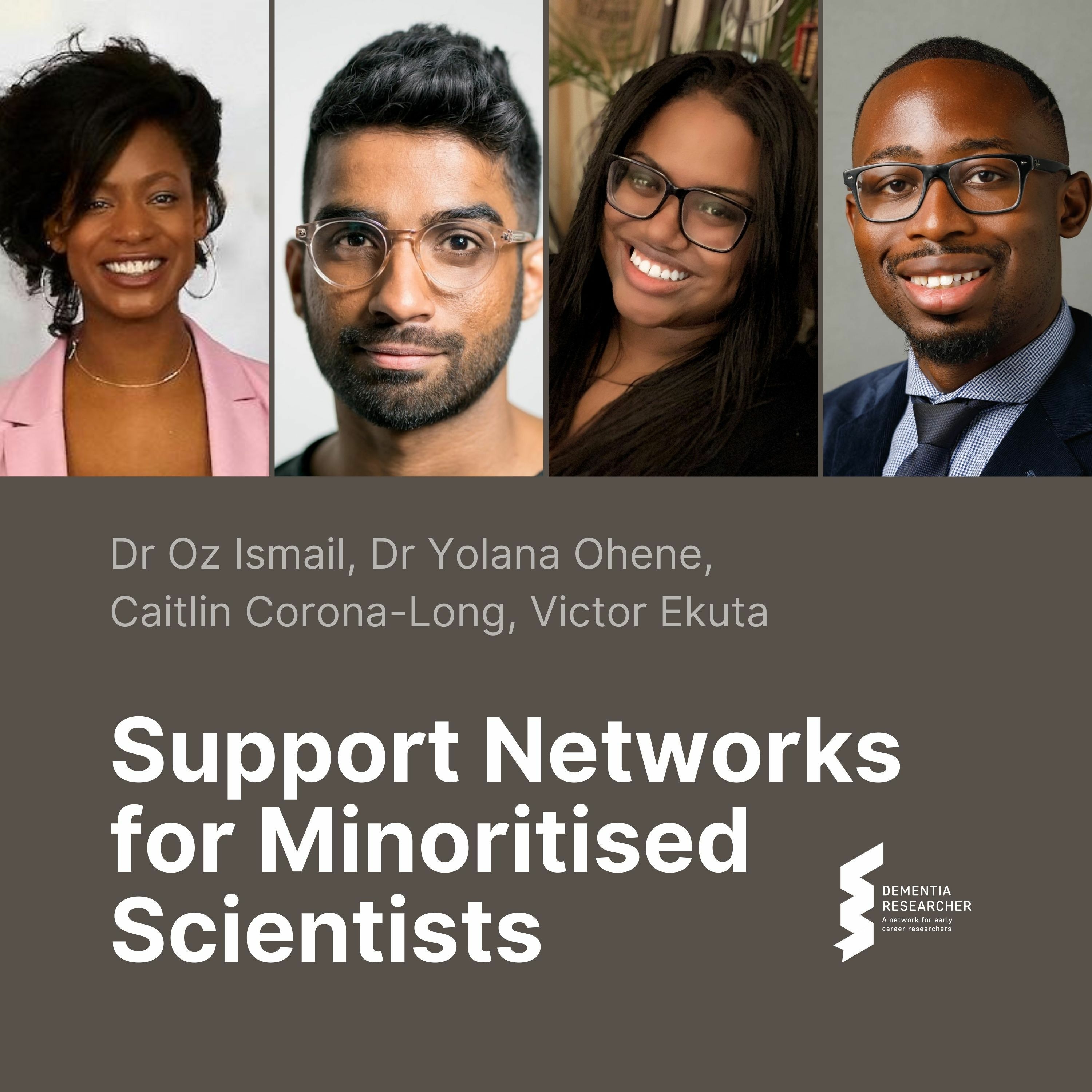
Support Networks for Minoritised Scientists
from Dementia Researcher Vodcast
In this week’s podcast Dr Oz Ismail talks with three dementia researchers who have made in their business to build supportive communities that celebrate and empower Black and minoritised scientists and dementia researchers. In the UK, around 7 per cent of undergraduate students are black, matching the percentage of black people aged 18 to 24. But the number plummets when you look at PhD students. For the past five years, the proportion of black PhD students at Russell Group universities – seen as the UK’s most prestigious – has stagnated at around 2 per cent. The story is similar in the US, where African Americans make up nearly 13 per cent of the population, but win only 6.5 per cent of doctorates earned. Our guests discuss, what needs to be done, and what inspired them to act both personally and professional to support others from similar backgrounds – to follow their paths into science, and support them to remain. They go on to discuss just a few of the amazing resources and services are out there to support Black and minoritised researchers and scientists working in dementia and other diseases. Meet the guests... Dr Oz Ismail is a Postdoctoral Scholar in the Mishra Lab, Oregon Health & Science University, USA. He studies the links between small stroke events and the onset of Alzheimer’s pathology later in life. He also occasionally performs stand-up comedy, drawing upon his experiences as a millennial, immigrant, and scientist. Dr Yolanda Ohene, is a Biophysicist and Postdoctoral Research Associate at The University of Manchester. Yolanda is developing new MRI techniques to measure blood-brain barrier dysfunction in Alzheimer’s Disease. Her top tips for ECRs? Remember to write down as many details as possible in your lab book! She is also passionate about encouraging others from diverse cultural backgrounds to work in science. Victor Ekuta is a linQ Catalyst Fellow and MD Candidate at Massachusetts Institute of Technology. He is researching Alzheimer’s Disease Biomarkers (he is also an awesome dancer: Hip hop, popping, and shuffling). In his spare time, he has led multiple outreach programs and neuroscience courses for underrepresented students – he is also a member of Black in Neuro. Caitlin Corona-Long is a PhD Student at Johns Hopkins University, researching structural, functional, and fluid biomarkers of amnestic mild cognitive impairment. As a first generation PhD student born to a Sierra Leonean father and an American mother, Caitlin has been involved in a number of programmes to support black scientists and to support and encourage improved diversity – she also happens to be related to two Presidents. You can find out more about our guests, and access a full transcript of this podcast on our website at: www.dementiaresearcher.nihr.ac.uk/podcast Register on our website to receive your weekly bulletin, and to access more great content – blogs, science, career support + much more www.dementiaresearcher.nihr.ac.uk This podcast is brought to you in association with Alzheimer's Research UK and Alzheimer's Society, who we thank for their ongoing support.
Embed this episode
No transcript yet.