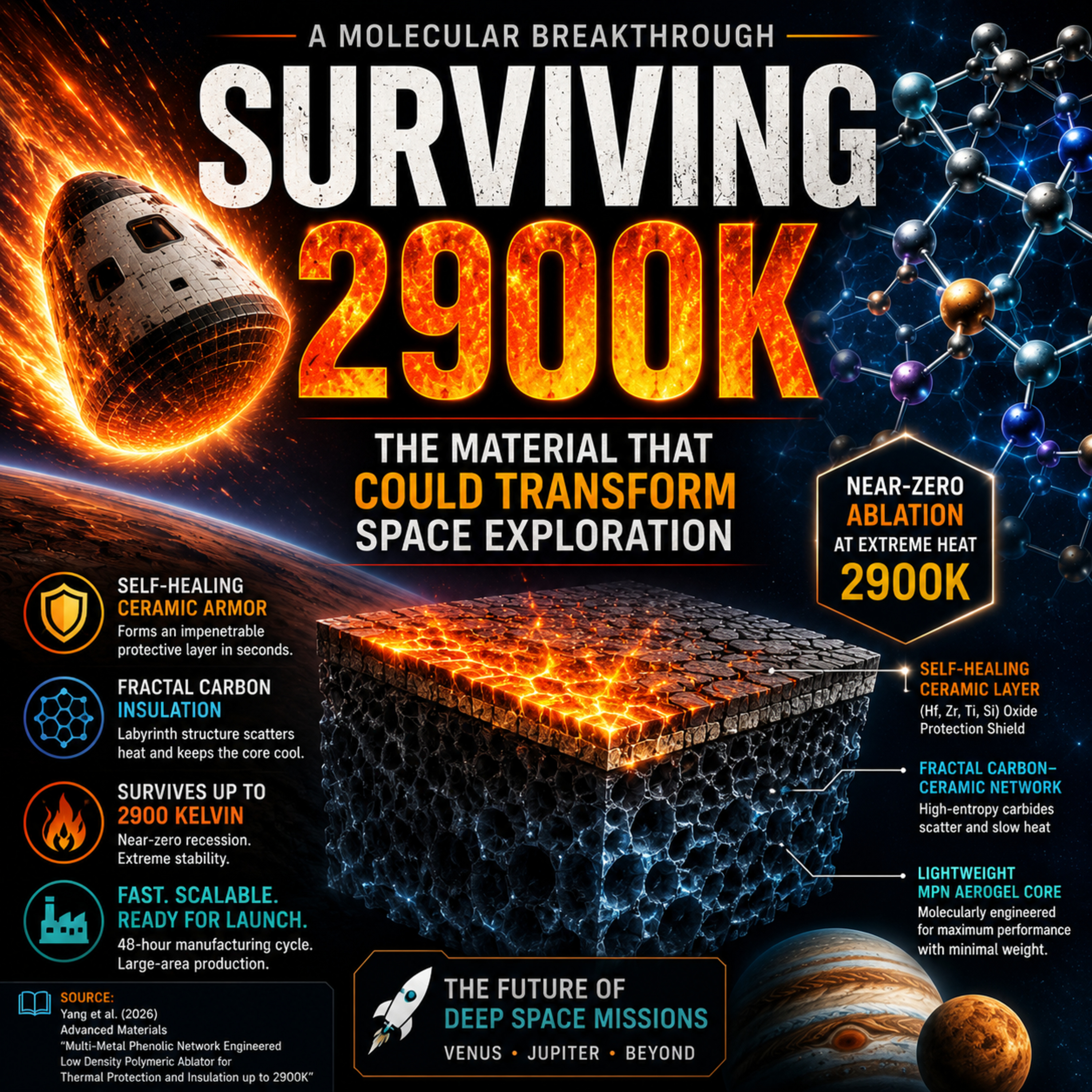
🔥 Surviving 2900K: The Molecular Breakthrough That Could Revolutionize Space Exploration episode artwork

EPISODE · Jun 15, 2026 · 17 MIN

🔥 Surviving 2900K: The Molecular Breakthrough That Could Revolutionize Space Exploration

from The Deep Dive Lab: Unraveling Materials Science · host Son Hoang

🚀 How do you protect a spacecraft from temperatures hotter than molten lava, faster than a meteor, and more hostile than Earth's atmosphere?In this episode, we explore a groundbreaking materials science breakthrough that could transform the future of space exploration. Scientists have developed a revolutionary Metal-Phenolic Network (MPN) thermal protection system capable of surviving temperatures up to 2900 Kelvin while exhibiting near-zero ablation—something previously thought impossible for lightweight materials.Discover how molecular engineering, self-healing ceramic surfaces, fractal carbon structures, and high-entropy carbides combine to create a heat shield that behaves like an aerogel during manufacturing but transforms into a ceramic fortress during atmospheric entry.Could this technology enable future missions to Venus, Jupiter, and beyond?🔬 Topics: Space Exploration, Aerospace Engineering, Heat Shields, Materials Science, NASA, Deep Space Missions, Thermal Protection Systems, Advanced Materials📚 Source: Yang et al. (2026), Advanced Materials, "Multi-Metal Phenolic Network Engineered Low Density Polymeric Ablator for Thermal Protection and Insulation up to 2900K."#SpaceExploration #MaterialsScience #NASA #Engineering #Aerospace #SciencePodcast #FutureTech #SpaceTechnology #DeepSpace #Physics

🚀 How do you protect a spacecraft from temperatures hotter than molten lava, faster than a meteor, and more hostile than Earth's atmosphere?In this episode, we explore a groundbreaking materials science breakthrough that could transform the future of space exploration. Scientists have developed a revolutionary Metal-Phenolic Network (MPN) thermal protection system capable of surviving temperatures up to 2900 Kelvin while exhibiting near-zero ablation—something previously thought impossible for lightweight materials.Discover how molecular engineering, self-healing ceramic surfaces, fractal carbon structures, and high-entropy carbides combine to create a heat shield that behaves like an aerogel during manufacturing but transforms into a ceramic fortress during atmospheric entry.Could this technology enable future missions to Venus, Jupiter, and beyond?🔬 Topics: Space Exploration, Aerospace Engineering, Heat Shields, Materials Science, NASA, Deep Space Missions, Thermal Protection Systems, Advanced Materials📚 Source: Yang et al. (2026), Advanced Materials, "Multi-Metal Phenolic Network Engineered Low Density Polymeric Ablator for Thermal Protection and Insulation up to 2900K."#SpaceExploration #MaterialsScience #NASA #Engineering #Aerospace #SciencePodcast #FutureTech #SpaceTechnology #DeepSpace #Physics

NOW PLAYING

🔥 Surviving 2900K: The Molecular Breakthrough That Could Revolutionize Space Exploration

0:00 17:53

No transcript for this episode yet

We transcribe on demand. Request one and we'll notify you when it's ready — usually under 10 minutes.

No similar episodes found.

No similar podcasts found.

Frequently Asked Questions

How long is this episode of The Deep Dive Lab: Unraveling Materials Science?

This episode is 17 minutes long.

When was this The Deep Dive Lab: Unraveling Materials Science episode published?

This episode was published on June 15, 2026.

What is this episode about?

🚀 How do you protect a spacecraft from temperatures hotter than molten lava, faster than a meteor, and more hostile than Earth's atmosphere?In this episode, we explore a groundbreaking materials science breakthrough that could transform the future...

Can I download this The Deep Dive Lab: Unraveling Materials Science episode?

Yes, you can download this episode by clicking the download button on the episode player, or subscribe to the podcast in your preferred podcast app for automatic downloads.
URL copied to clipboard!