
EPISODE · Dec 11, 2012 · 44 MIN
Syriac Infancy Gospel
from BDJ's Cellar Full of Remixes · host BDJ
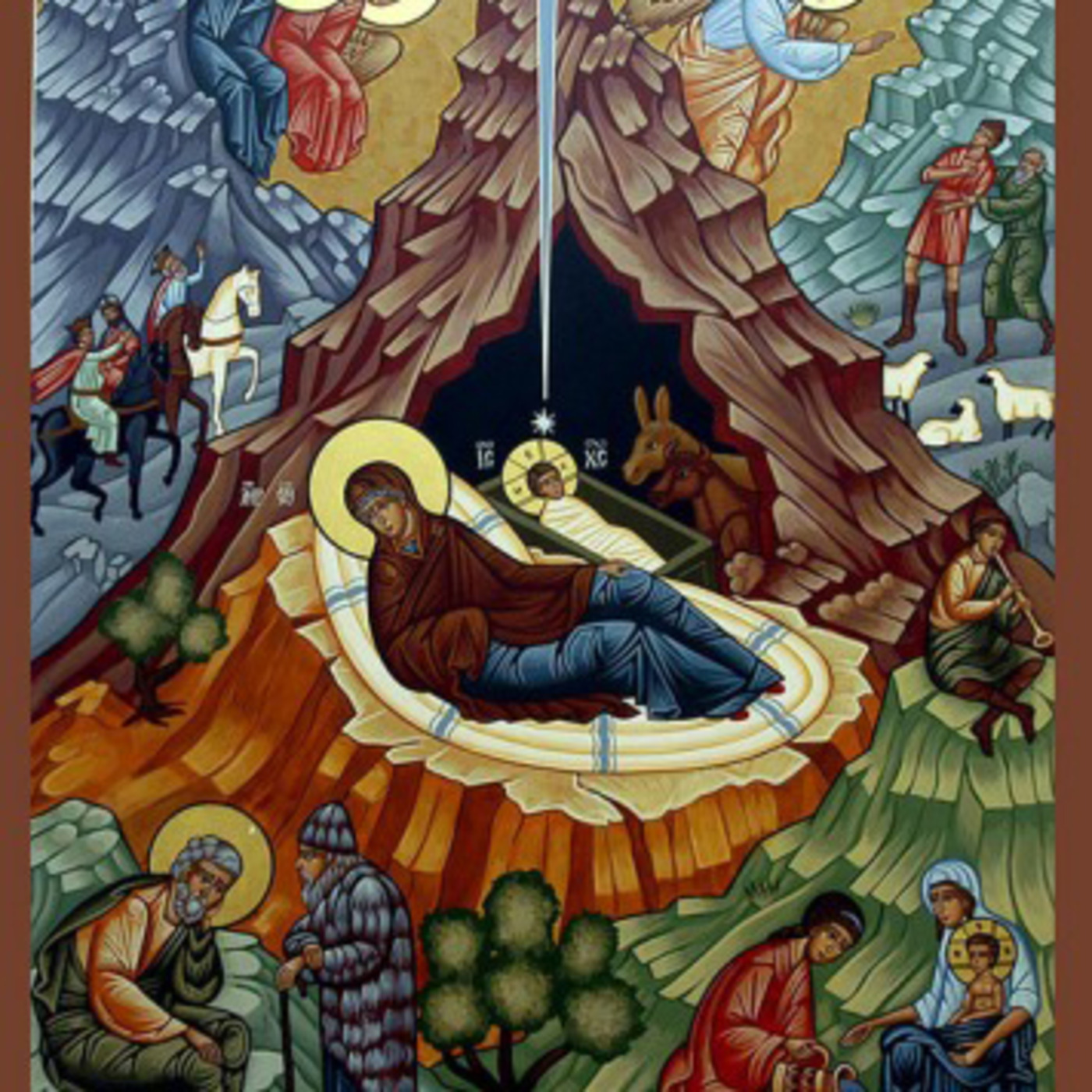
A great void in the early life of Jesus is filled up by The Syriac Infancy Gospel (also called Arabic Gospel of the Infancy of the Savior (AGIS)), dating from the 4-5th century. In none of the gospels in the New Testament is any mention made of the childhood of Jesus. The Gospels of Matthew, Mark, Luke, and John, more rapidly than satisfactorily, pass over the period intervening between His birth and ministry.The non-canonical Infancy Gospel of Thomas tells about the deeds of Jesus in his early childoood, and is set to music in BDJ's cellar here (http://bdj.podomatic.com/entry/2011-12-09T11_37_24-08_00). We think it likely that AGIS refers to a combination of the Infancy Gospel of Thomas and the Gospel of James when it speaks about the 'Gospel of the Infancy'. The Gospel of James provides much of the details of the nativity scenes and Mary's deeds.The Gospel of Perfection is mentioned as well, but is not extant today. Judging by the text of the AGIS, its authors probably used a 'Gospel of Perfection' that harmonised the gospels of Matthew and Luke (both set to music in BDJ's Cellar), since we find no traces of Mark or John.Although the AGIS was not included in the new testament, it remained a popular text throughout the ages and continues to exert its influence. The stories about Jesus in Egypt inspired artists into the Middle-ages and are represented in numerous paintings. The veneration of Mary could aslo find its roots in this text.Obviously, there is so much to say about AGIS that surpasses the scope of this text in BDJ's Cellar. However, we couldn't resist to make a few observations to make your listening even more enjoyable, without pretending to be particularly knowledgeable in this domain, of course !A) Remarkable clarifications of the gospels in The Arabic Gospel of the Infancy of the Savior (AGIS):1) In the AGIS, Caiphas relates that Jesus, when in his cradle, informed his mother that he was the Son of God. Joseph, son of Caiaphas, in the New Testament, was the Roman-appointed Jewish high priest who is said to have organized the plot to kill Jesus. Here, we learn details of the accusation that Caiphas made against Jesus, namely that he claimed to be the son of God. The gospel of Matthew tells us that Jesus did neither confim or deny this accusation during his trial: this silence may have troubled early Christians; why didn't Jesus comfirm in public that he was the Son of God ? In a brillant turn of events in the AGIS, the claim is rendered true by Caiphas stating that these words were actually spoken by the baby Jesus ! Let's not ponder too much that Caiphas was only appointed as high priest around 20 years after Jesus was born.......2) the Nativity: Where was Jesus born ?The gospels of Luke and Matthew speak about the Nativity, Mark and John are silent. They both agree with AGIS that Jesus was born in Bethlehem, but the 3 disagree on the excact location.Overall, the AGIS seems to lean more on Luke than Matthew in the circumstances of Jesus' birth, but there are significant differences:a) In Luke, Mary gives birth to Jesus and, having found no place for themselves in the inn, places the newborn in a manger. Later tradition places the manger in a stable, but perhaps this was not the case in these days, when animals were kept inside the houses. It is interesting that the Gospel of James gives a reason for which Mary wrapped Jesus in swaddling cloths and put him in a manger: to hide him from the child-murderers sent by Herod.b) In Matthew, Joseph and Mary are in a house in Bethlehem when the 'wise men' come to visit them.c) According to the AGIS, Jesus was born in a cave near Bethlehem. It is somewhat surprising that the AGIS dares to deviate so strongly with Luke and Matthew. AGIS follows the Gospel of James, which says that Joseph chose a cave and did not enter the city, since he was ashamed that Mary (whom he had just married) was 9 months pregnant. I suppose the author understood that Jesus was bron in a cave, and that Joseph and Mary later lived in a house by the time the wise men came and Herod sent his murderers out to kill all 2-year old boys.3) When was Jesus born ? AGIS mentions "In the three hundred and ninth year of the era of Alexander". This is remarkable on 2 accounts:- why count years based on the era of Alexander ? The known world belonged to the Roman empire, Alexander's empire was long gone. I assume therefore that the author of the AGIS lived in area of the Roman empire that used be at the core of Alexander's empire. This clearly sets it apart from the Christian tradition in Rome itself, whose doctrines eventually (in the fourth century) prevailed over the traditions of the eastern churches.- the date is nowhere near the date we base on Luke and Matthew (who differ by a decade or so amongst themselves). This inaccuracy may also be caused by the 'provincial' rather than Roman background of the author, who apparently could not match the Roman calendar with the Greek tradition.4) Circumcision: In Luke, Mary and Joseph take Jesus to Jerusalem to be circumcised, before returning to their home in Nazareth. This story is expanded in AGIS by the recounting that the foreskin was placed in a box; the AGIS says that this is the box that Mary used when she annointed Jesus. Foreskin relics began appearing in Europe during the Middle Ages. The earliest recorded sighting came on December 25, 800, when Charlemagne gave it to Pope Leo III when the latter crowned the former Emperor. The Pope placed it into the Sanctum sanctorum in the Lateran basilica in Rome with other relics. In addition to the Holy Foreskin in Rome, other claimants included the Cathedral of Le Puy-en-Velay, Santiago de Compostela, the city of Antwerp, Coulombs in the diocese of Chartres, France as well as Chartres itself, and churches in Besançon, Newport, Metz, Hildesheim, Charroux, Conques, Langres, Fécamp, Puy-en-Velay, Stoke on Trent, Calcata, and two in Auvergne.5) Women: the AGIS appears to be populated by strong and/or virtuous women. This already starts at the birth of Christ, where Mary is elevated to almost divine stature :" As there is not any child like to my son, so neither is there any woman like to his mother". We may very well take this to be the motto of much of the remainder of the AGIS. It is Mary who makes all decisions (Joseph has no say in any matter), Mary decides to save people, Mary conducts miracles using Jesus' sweat or swaddling clothes. Actually, the men make a rather pathetic or comic impression: some are turned into mules, others are impotent on their wedding day, Satan flees in the form of young man. Could the AGIS have been written by a woman ?6) Magic. The four Gospels record many examples of Christ’s magic during his wanderings, noting that he performed 6 exorcisms, 17 healings, and 8 nature miracles. Jesus never touched individuals who were possessed by demons, driving them out with gestures and authoritative commands. He did, however, touch those who were suffering from illness.Magic is even more widespread in the AGIS, and taken very seriously; it is not only seen as an aspect of religion, it is a part of everyday life. Magicians, sorcerers, prophets, demons, even Satan appear everywhere.It is a matter of perspective whether we label events as 'miracles' or 'magic'. To modern readers, miracles are acceptable and magic is seen as a form of superstition; in early Chritianity, that distinction was apparently not made. The exampes of magic / miracles are too numerous to mention all. Some themes may be distilled from the AGIS:- use of relics of Jesus having magic powers: this is already seen at the start, where Jesus' swaddling clothes are recognised by Mary as important relics.Luke says that an angel tells some shepherds that they will find a child wrapped in bands of cloth and lying in a manger; the AGIS also speaks about these bands of cloth and assigns magical powers to them. It is not Mary who performs these miracles, the powere are clearly vested in te cloth itself: The AGIS tells us what happened to the wise men when they returned to their own country; they came to the east (obviously a pagan area) and Jesus' cloth performed miracles there to aid conversion of those countries to Christianity.- the miracles performed by sprinkling water: well known in Christian rites, the AGIS appears to suggest that is derived from sprinkling water used to wash Jesus, thus containing his sweat.- excorcisms are used to cure mental disorders. Several of those disorders appear to have a sexual component, such as the impotent bridegroom, the bride who goes dumb at her wedding, the woman roaming the streets naked - throwing stones at men -, another woman is visited by a snake (who 'lies upon her') every night etc. Perhaps Freud was right after all ? In AGIS, the demons and Satan are described in vivid detail (crows, serpents, dragons etc.). The New Testament Gospels never depict demons in any form.7) The Egypt connection.The middle section of the AGIS deals with the events in Egypt, and Mary (with Jesus) performs many miracls there, defeats idols and demons. This is much more information than we find in the four Gospels: only Matthew mentions the stay in Egypt, but Matthew gives little detail about Jesus' family's time there.One of the more common accusations against early christians was that Christ had spent time in Egypt where he gained knowledge of Egyptian magical practices. The attempt to discredit this accusation, may explain why the story of Jesus’ flight to Egypt occurs only in the gospel of Matthew. Matthew thus admits that Jesus had gone to Egypt but had done so as an infant, making the charge that he had learned Egyptian magic there unlikely.The AGIS paints a different picture, and Jesus appears to have stayed in Egypt for a considerable time, several years at least. Even after recounting a number of miracles in various cities, the AGIS says that they journeyed to Memphis (in Egypt), "and abode three years in Egypt", before returning to Judea. We can now say that Jesus must have been at least 5 years old when he left Egypt: Herod killed all boys younger than 2 years after meeting with the wise men form the east. Hence, Jesus may have been 2 years old when he was taken to Egypt, then stayed there for at least 3 years.The last section of AGIS, the infancy story (where Jesus acts himself, rather than Mary being the central figure), mentions that Jesus was seven years old. Hence, we can say on the basis of the AGIS that Jesus was between 3 and 5 years in Egypt. Since he could already speak upon his birth, he may well have picked up Egyptian traditions at 5 - 7 years old !It can be speculated that the stay in Egypt actually was known by the earliest Christians; why would Matthew mention such an embarrising episode, if it wasn't already common knowledge ? In fact, within the period of Christ’s lifetime, history has left us several historical examples of the magicians of northern Israel, including a man known only as “the Egyptian,” who gathered several thousand followers at the Mount of Olives in expectation of the Messiah’s arrival before being arrested by the Romans.The influence of Egyptian magic upon Christianity is - in any case - seen in early Christianity when Christian “holy men” performed some of the same magical feats as Egyptian magicians but in the name of Christ. Early texts note events strikingly similar to those in the AGIS, could they have followed the example ? Macarius changed a woman who had been turned into a mare back again by sprinkling holy water upon her: compare with the man turned into a mule. Paul the Simple, an early monk, was said to have cast out a devil that had taken the form of a “mighty dragon 70 cubits long.” Compare with the girl persecuted by a dragon. And one Petarpemotis was said to have made a dead man speak. Compare Jesus making the boy speak who had fallen from the roof.8) Early adulthood (12-30 years old). The four Gospels are silent about the first 12 years of Christ’s life. After his birth we do not encounter him again until he is found, as Luke says, “teaching in the synagogue” at 12 years of age. In the modern era we are used to thinking of a 12-year-old as still very much of a child. But in antiquity a 12-year-old was already an adult. It was the age at which a boy was permitted full participation in Jewish religious rituals. The story in AGIS follows Luke's acccount and expands on it: Jesus was not only a religious leader, he was also a scientist, philosopher and medical doctor. Nowadays, science is often contrasted with religion; the AGIS considers both to be of the same nature.
Embed this episode
What this episode covers
A great void in the early life of Jesus is filled up by The Syriac Infancy Gospel (also called Arabic Gospel of the Infancy of the Savior (AGIS)), dating from the 4-5th century. In none of the gospels in the New Testament is any mention made of the childhood of Jesus. The Gospels of Matthew, Mark, Luke, and John, more rapidly than satisfactorily, pass over the period intervening between His birth and ministry. The non-canonical Infancy Gospel of Thomas tells about the deeds of Jesus in his early childoood, and is set to music in BDJ's cellar here (http://bdj.podomatic.com/entry/2011-12-09T11_37_24-08_00). We think it likely that AGIS refers to a combination of the Infancy Gospel of Thomas and the Gospel of James when it speaks about the 'Gospel of the Infancy'. The Gospel of James provides much of the details of the nativity scenes and Mary's deeds. The Gospel of Perfection is mentioned as well, but is not extant today. Judging by the text of the AGIS, its authors probably used a 'Gospel of Perfection' that harmonised the gospels of Matthew and Luke (both set to music in BDJ's Cellar), since we find no traces of Mark or John. Although the AGIS was not included in the new testament, it remained a popular text throughout the ages and continues to exert its influence. The stories about Jesus in Egypt inspired artists into the Middle-ages and are represented in numerous paintings. The veneration of Mary could aslo find its roots in this text. Obviously, there is so much to say about AGIS that surpasses the scope of this text in BDJ's Cellar. However, we couldn't resist to make a few observations to make your listening even more enjoyable, without pretending to be particularly knowledgeable in this domain, of course ! A) Remarkable clarifications of the gospels in The Arabic Gospel of the Infancy of the Savior (AGIS): 1) In the AGIS, Caiphas relates that Jesus, when in his cradle, informed his mother that he was the Son of God. Joseph, son of Caiaphas, in the New Testament, was the Roman-appointed Jewish high priest who is said to have organized the plot to kill Jesus. Here, we learn details of the accusation that Caiphas made against Jesus, namely that he claimed to be the son of God. The gospel of Matthew tells us that Jesus did neither confim or deny this accusation during his trial: this silence may have troubled early Christians; why didn't Jesus comfirm in public that he was the Son of God ? In a brillant turn of events in the AGIS, the claim is rendered true by Caiphas stating that these words were actually spoken by the baby Jesus ! Let's not ponder too much that Caiphas was only appointed as high priest around 20 years after Jesus was born....... 2) the Nativity: Where was Jesus born ? The gospels of Luke and Matthew speak about the Nativity, Mark and John are silent. They both agree with AGIS that Jesus was born in Bethlehem, but the 3 disagree on the excact location. Overall, the AGIS seems to lean more on Luke than Matthew in the circumstances of Jesus' birth, but there are significant differences: a) In Luke, Mary gives birth to Jesus and, having found no place for themselves in the inn, places the newborn in a manger. Later tradition places the manger in a stable, but perhaps this was not the case in these days, when animals were kept inside the houses. It is interesting that the Gospel of James gives a reason for which Mary wrapped Jesus in swaddling cloths and put him in a manger: to hide him from the child-murderers sent by Herod. b) In Matthew, Joseph and Mary are in a house in Bethlehem when the 'wise men' come to visit them. c) According to the AGIS, Jesus was born in a cave near Bethlehem. It is somewhat surprising that the AGIS dares to deviate so strongly with Luke and Matthew. AGIS follows the Gospel of James, which says that Joseph chose a cave and did not enter the city, since he was ashamed that Mary (whom he had just married) was 9 months pregnant. I suppose the author (continued)
NOW PLAYING
Syriac Infancy Gospel
No transcript for this episode yet
Similar Episodes
No similar episodes found.
Similar Podcasts
No similar podcasts found.