
EPISODE · Apr 29, 2026 · 21 MIN
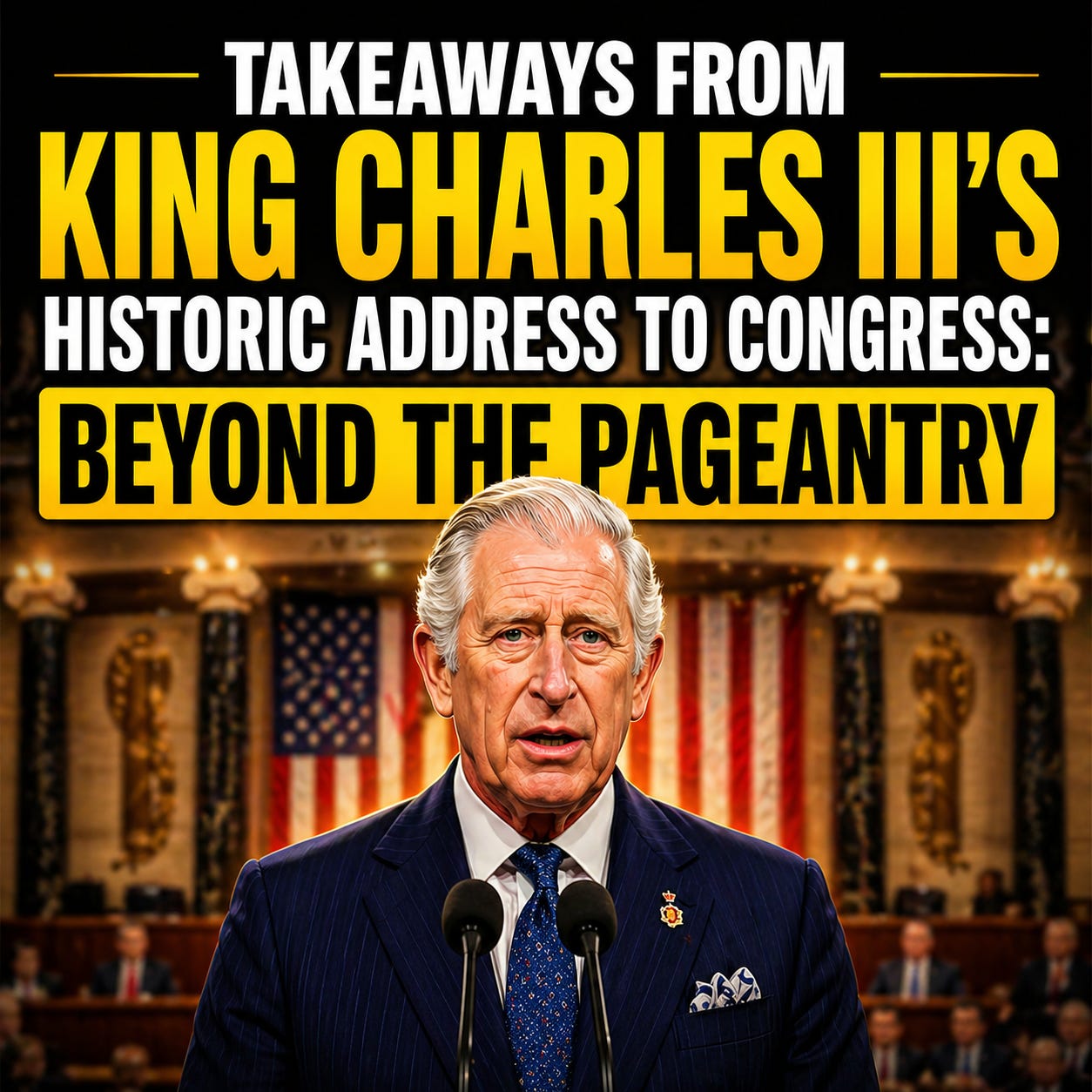
Takeaways from King Charles III’s Historic Address to Congress:
from The Experience of Adoption · host Thoughtless Delineation
The state visit of King Charles III to the United States in April 2026 was never merely a ceremonial junket; it was an exercise in architectural diplomacy. Arriving during the “semi-quincentennial”—the 250th anniversary of the Declaration of Independence—the King was tasked with a singular rhetorical feat: celebrating the very revolution that dismantled his ancestor’s empire. Set against the recent tremor of a security incident near the Capitol and a global landscape of “great uncertainty,” the address sought to reconcile a fractured past with an indispensable future.Beneath the choreographed diplomacy lies a more complex architecture of shared grievances and structural paradoxes. Here are the five most significant takeaways from this historic moment.A Tale of Two Georges: Redefining the 1776 SplitThe King navigated the ghosts of 1776 by framing the American Revolution as a “tale of two Georges,” contrasting the first President, George Washington, with his five-times great-grandfather, King George III. In a sophisticated stroke of cultural historiography, he argued that the “no taxation without representation” principle was not a rejection of Britishness, but rather a shared democratic value inherited from the British Enlightenment, English Common Law, and the Magna Carta.Most notably, the King pointed to the Declaration of Rights of 1689—the bedrock of the British constitutional monarchy—as the primary source for the American Bill of Rights, noting that many principles were adopted almost verbatim. By characterizing the 1776 schism as a “partnership born out of dispute,” he echoed the stakes of his grandfather King George VI’s 1939 visit, reminding Congress that their common legal DNA is what allows the alliance to endure. He punctuated this historical bridge with a rare moment of royal levity:“King George, as you know, never set foot in America. And please rest assured, ladies and gentlemen, I am not here as part of some cunning rearguard action.”YOUTUBEThe “Social Ills” Heard ‘Round the WorldThe most heavily scrutinized line of the address concerned the “collective strength” of free societies to support “victims of some of the ills that so tragically exist in both our societies today.” While the Crown typically retreats into “woolly allusions” to maintain nonpartisanship, the geopolitical context surrounding this line was surgically precise.Commentators viewed this as a veiled acknowledgment of the Jeffrey Epstein scandal, which has persistently haunted the House of Windsor via the King’s brother, Prince Andrew. This interpretation was galvanized by the fact that, simultaneously on Capitol Hill, U.S. Representative Ro Khanna was hosting a survivor roundtable featuring the siblings of Virginia Roberts Giuffre. The presence of the Giuffre family at the Capitol during the King’s visit underscored a growing tension: while the King wields “soft power” to acknowledge societal suffering, there is an intensifying public demand for direct accountability that the “citadel of democracy” is increasingly forced to confront.Deep Roots: The Prehistoric Union of Scotland and AppalachiaIn a departure from standard environmental platitudes, the King invoked a striking geological fact: millennia before national borders were conceived, the mountains of Scotland and Appalachia formed a single, continuous range forged in a prehistoric continental collision. This was not merely a poetic flourish; it was a call to recognize “nature’s own economy” as the foundation of national security.The King linked this “glorious heritage”—a phrase he borrowed from Theodore Roosevelt—to the modern necessity of shared resilience. He grounded this environmental plea in modern defense realities, referencing his own service in the Royal Navy fifty years ago and the contemporary AUKUS submarine program. By connecting ancient geography to future security, he framed the protection of natural systems as a prerequisite for the continued “joint prosperity” of the Atlantic partnership.A Shared Legacy of Broken FamiliesPerhaps the most jarring disconnect in the address was the King’s inadvertent invocation of “administrative violence.” While praising the “vibrant, diverse, and free societies” of both nations, his rhetoric sat in uncomfortable proximity to a centuries-long legacy of state-sanctioned child removal.The historical parallels are grim. Analysts were quick to compare the “British Home Children” program—which saw up to 150,000 children exported from the UK for imperial labor—to the more recent “Zero Tolerance” border policies in the U.S. that resulted in systemic family separations. For advocacy groups, the King’s celebration of kinship felt like a profound hypocrisy when contrasted with the historical reality of states treating “undesirable” families as disposable.“This, I believe, is the special ingredient in our relationship. As President Trump himself observed during his state visit to Britain last autumn, the bond of kinship and identity between America and the United Kingdom is priceless and eternal.”This “special ingredient” of kinship rings hollow for those whose families were fractured by the very administrative apparatus the King now praises as a beacon of liberty.The Citizenship Loophole Affecting ThousandsThe King’s exhortation for legislators to reject “inward-looking” policies highlighted a specific, ongoing legislative failure: the “legal limbo” of intercountry adoptees. This centers on the Child Citizenship Act (CCA) of 2000, which failed to grant automatic citizenship to foreign-born children adopted by U.S. citizens if they were already 18 on the day the act took effect in 2001.This oversight has left thousands of adult adoptees—individuals who have lived as Americans for decades—facing detention and deportation. The King’s call to “value all people” serves as a silent rebuke to the gridlock currently facing H.R. 5492 and S. 2923 (the Protect Adoptees and American Families Act). These bills seek to close the CCA loophole, yet they remain stalled in the 119th Congress, leaving families caught in a system that claims to honor the “sanctity of the family” while actively denying its legal recognition.--------------------------------------------------------------------------------The Final Word: A Future Built on Action, Not Just OratoryAs the Anglo-American alliance pivots toward a future defined by AI, nuclear fusion, and the defense of Ukraine, the King’s address signaled a shift from “past achievements” to an “indispensable partnership.” Borrowing from Abraham Lincoln’s Gettysburg Address, he reminded the assembled lawmakers that the world will “never forget what we do.”The pageantry of the Crown provides a veneer of stability, but the true measure of the next 250 years will not be found in the eloquence of the oratory. It will be found in whether these two nations possess the courage to address the systemic “ills” and historical grievances that still haunt their shared legacy. As we look toward the future, we must ask: will the “special relationship” be defined by the rituals of the past, or by the active dismantling of the institutional injustices that continue to separate “all people”?This Substack is reader-supported. To receive new posts and support my work, consider becoming a free or paid subscriber.Full Analysis This is a public episode. If you'd like to discuss this with other subscribers or get access to bonus episodes, visit thoughtlessdel.substack.com/subscribe
Embed this episode
NOW PLAYING
Takeaways from King Charles III’s Historic Address to Congress:
No transcript for this episode yet
Similar Episodes
No similar episodes found.
Similar Podcasts
No similar podcasts found.