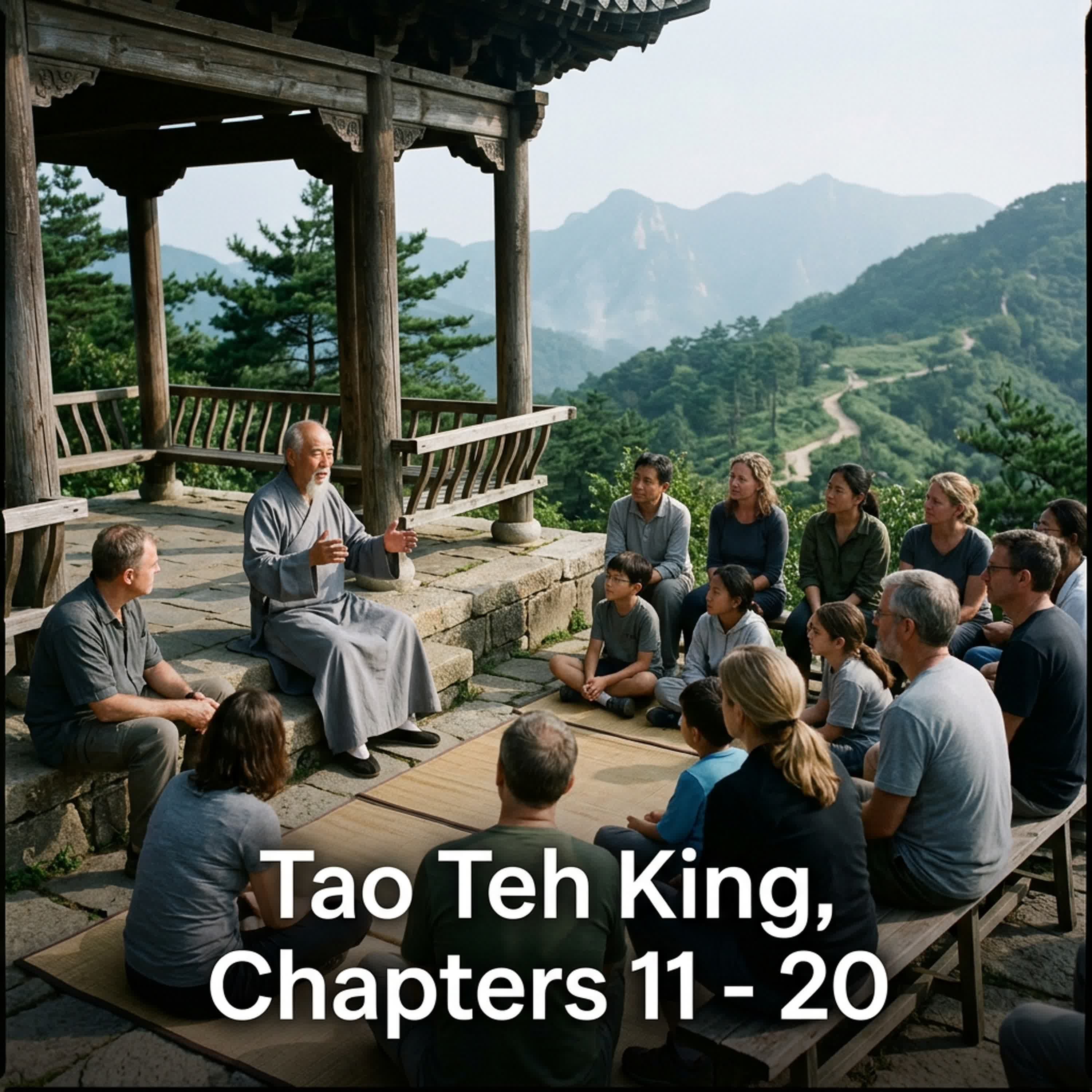
Tao Te Ching - 2 - Chapters 11-20
from Wisdom for the Present: Eastern Wisdom Literature Hosted by Kanu Emeruwa
What happens when we treat our daily lives as an exhausting theatrical performance, constantly adding more characters, plots, and props to a stage that is already overcrowded? In this episode of Wisdom for the Present, we explore chapters 11–20 of the ancient Chinese text, the Tao Te Ching, treating its teachings on human nature and desires as a profound psychological drama. Much like a play's characters struggling on a chaotic stage, we modern individuals are plagued by the pressure to perform, but this timeless work offers a radical challenge: true utility and peace are found not in what we accumulate on stage, but in the empty spaces we so aggressively try to fill. The opening "act" of our thematic breakdown centers on the fundamental conflict of human existence: our struggle with the void. Drawing on the classic, physical imagery of Chapter 11, we examine how a wheel only functions because of the empty space for its axle, and how a clay vessel’s utility depends entirely on its empty hollowness. When we translate these ancient physical mechanics into our modern realities, we confront our collective "horror vacui"—the deep psychological anxiety that arises when we stare at a blank calendar or face an unscheduled hour. This central conflict highlights how our obsession with constant action and "positive existence" actually destroys our capacity for creative, meaningful lives. Digging deeper into the drama of the human ego, we analyze how our desires are actively manipulated by external forces and digital algorithms. The text draws a sharp, visceral contrast between the "belly" (our finite, natural physical needs) and the "eyes" (our infinite, abstract desires for status and comparison). Today, this insatiable longing of the eyes is perfectly exploited by the endless scroll of social media feeds, where algorithms are designed to ensure we never reach a stopping point. When we tie our identity entirely to "favor and disgrace"—seeking public approval and professional titles—we hand over our agency and become puppets to our own egos, caught in an exhausting cycle of performance and anxiety. This constant demand to perform inevitably leads to an internal state of chaos, a mental "storm" where our minds resemble highly agitated, muddy water. In our culture, when faced with cognitive overload and stress, our instinct is to intervene aggressively: we download productivity apps, seek out more self-help content, and even turn meditation into a competitive, effort-driven sport. But the text warns that any action we take to manually force clarity only stirs the muddy water further. To overcome this logic breakdown, we must realize that true mental stillness cannot be forced; we must cease our desperate intervention and let the silt settle naturally. Reclaiming our agency ultimately requires us to step off the societal treadmill and embrace the quiet, counter-cultural role of the "rude borderer". By practicing "strategic idleness" and dismantling performative, "artful contrivances"—much like removing the empty corporate posters of "core values" from a toxic workplace—we allow genuine, unforced empathy to organically reemerge. Although choosing this path of stillness may make us look dull, confused, or isolated to a world gorging itself on the superficial banquet of hustle culture, it is the only way to remain deeply nourished by the foundational reality of the Tao. It takes immense courage to be the empty hub of the wheel in a society that only values the spinning spokes. In This Episode * The Utility of the Void: True usefulness comes from empty space, whether it is the axle-hole of a wheel, the hollow of a clay cup, or an unallocated block of time on your calendar. * The Horror Vacui: Modern society suffers from a psychological fear of empty spaces, leading us to overpack our schedules and minds with "positive existence". * Belly vs. Eyes: While satisfying the physical needs of the "belly" has a natural stopping point, the abstract "longing of the eyes" (comparisons, status, digital feeds) is completely insatiable. * The Danger of Favor and Disgrace: Chasing praise (favor) and fearing failure (disgrace) are two sides of the same coin, both stemming from complete identification with the ego. * The Pitfalls of Performative Virtue: Explicitly mandating or celebrating virtue (like corporate value posters or public virtue signaling) often indicates that the natural, harmonious balance has already been lost. * Settling the Muddy Water: You cannot clear a chaotic mind by taking more action; true mental clarity only arises when you allow yourself to be completely still and let the silt settle on its own. * Embracing the "Rude Borderer": Stepping off the societal treadmill of constant growth and striving will make you feel alienated and "dull," but it connects you to a much deeper, genuine source of nourishment. Practical Reflection What is one noisy or full activity you can completely remove from your routine this week, not to replace it with something productive, but simply to let the empty space exist? Are you pursuing knowledge and wisdom to truly understand yourself and the world, or are you acquiring it to feel superior to others? When you perform acts of kindness or post about social causes, is it flowing naturally from your character, or are you driven by a fear of being seen as unrighteous by your peers? Suggested Substack Excerpt We live in a world obsessed with accumulation, but ancient wisdom suggests that our fixation on fullness completely blinds us to where actual utility and peace come from. Discover why protecting the "empty space" in your life is the ultimate key to reclaiming your mind and your agency. AI Disclosure This episode was created using Google NotebookLM Audio Overview, based on human-curated source material, structured guidance, and editorial review. AI is used as a tool for clarity and delivery, not as a replacement for thoughtful study or engagement with the original texts. Copyright © 2026 Wisdom for the Present / Kamashcu Production Studios. All rights reserved. This is a public episode. If you would like to discuss this with other subscribers or get access to bonus episodes, visit wisdomforthepresent.substack.com
Embed this episode
No transcript yet.