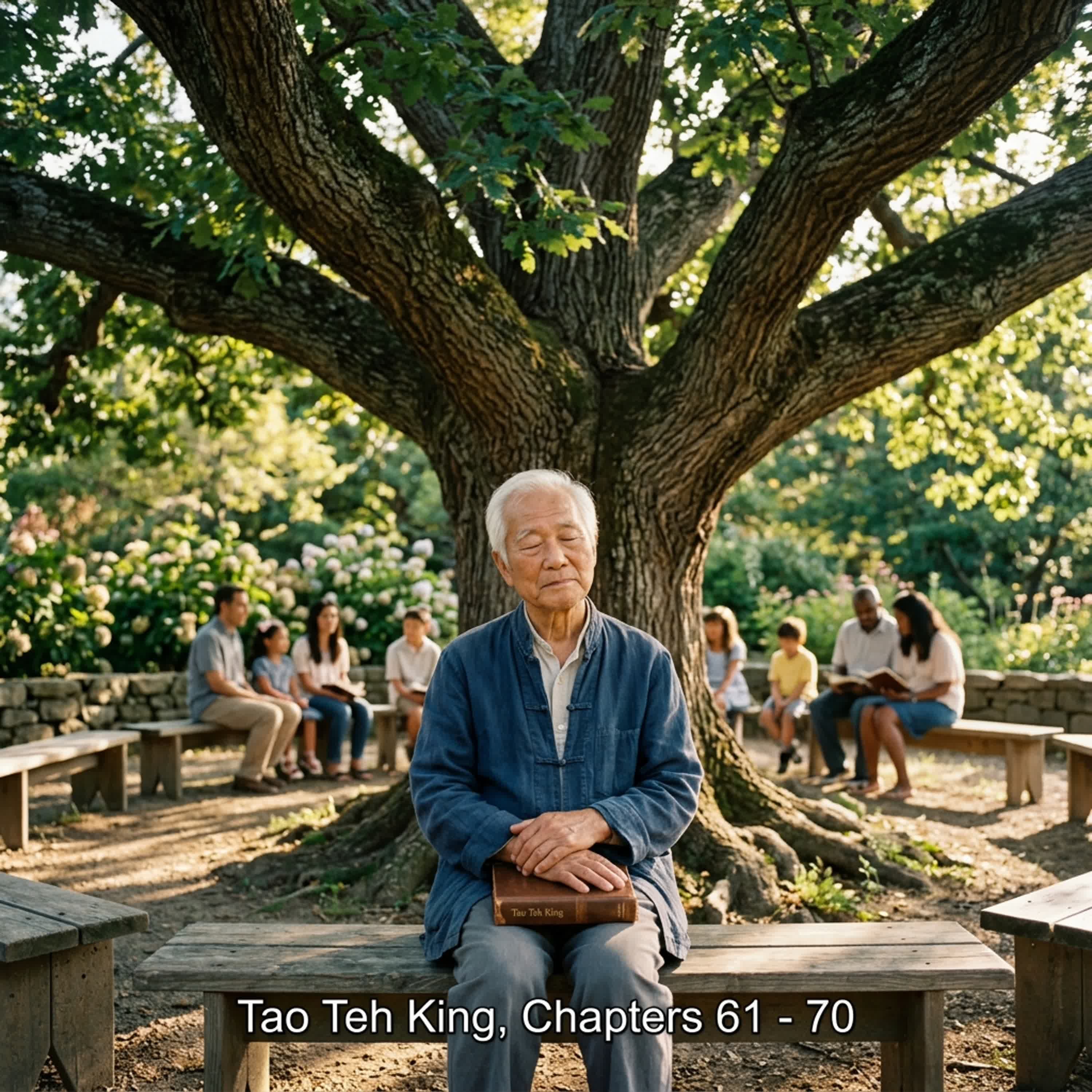
Tao Te Ching - 7 - Chapters 61-70
from Wisdom for the Present: Eastern Wisdom Literature Hosted by Kanu Emeruwa
In a hyper-connected, high-status world that rewards the loudest voice, we are constantly fighting for dominance. But what if true, enduring power doesn't come from climbing to the top, but from going low? This episode explores Lao Tzu's ancient classic, the Tao Te Ching (chapters 61–70), translating its 2,500-year-old wisdom on stillness, yielding, and natural alignment into a powerful psychological manual for navigating modern burnout, corporate striving, and personal exhaustion. The TaoTehKing introduces a central, beautiful paradox: the power of the lowest point. Rather than portraying strength as an impenetrable fortress, it compares a great state or a wise leader to a low-lying, down-flowing stream. By positioning ourselves at the bottom of the valley, we allow the natural forces of the universe—much like gravity—to deliver opportunities and people to us. This radical inversion of the active "yang" and the yielding "yin" challenges our constant, frantic need to initiate, control, and dominate. We translate this ancient text's warning against "much knowledge" into today's culture of social algorithms, bureaucratic loopholes, and constant digital optimization. When we over-intellectualize our lives, we act like someone trying to swim by reading textbooks on fluid dynamics—only to drown from pure mental paralysis. Our egos push us to game the system with cunning wisdom, but the text reminds us that stripping away this anxious complexity allows us to return to our innate natural buoyancy and simple, adult trust. How do we navigate unavoidable conflict and the storms of interpersonal friction? The TaoTehKing offers the concept of the reluctant warrior and the tactical shift from "host" to "guest". Using the modern automotive analogy of a car's "crumple zone," we see how rigid, aggressive structures break under pressure, whereas gentle, yielding structures absorb and dissipate hostile force safely. When we refuse to play the "host"—reclaiming our energy and retiring a foot—we leave the aggressor swinging at empty air, forcing them to bear the awkward weight of their own hostility. Reclaiming our agency requires us to embrace Lao Tzu's three precious treasures: gentleness, economy of energy, and shrinking from precedence. It means finding the "sprout"—addressing minor discrepancies and difficult conversations early, while they are still easy to manage—and maintaining meticulous care during the last 1% of a project when dopamine levels crash. Ultimately, it invites us to wear the scratchy peasant's haircloth of low-status outward appearance while carrying the precious, quiet jade of inner integrity in our bosoms, anchoring ourselves in intrinsic worth rather than the exhausting performance of modern success. In This Episode * The Power of the Valley: True, enduring influence is cultivated not by dominating others, but by positioning yourself low, listening deeply, and allowing natural alignment to draw people to you. * The Crumple Zone of Gentleness: Meeting aggression with rigid defense shatters your peace; practicing yielding gentleness allows hostile energy to safely pass or dissipate without touching your core. * Addressing the Sprout: Prevail over massive crises by managing them when they are small and easy, rather than letting tiny warnings grow into raging forest fires. * The 99% Danger Zone: Human nature is prone to coasting at the finish line due to a dopamine crash; true mastery means bringing the same reverence to the final 1% of an endeavor as we did to the first. * Economy of Life Force: Strictly conserve your mental and emotional energy by avoiding petty conflicts, saving your reserves to deploy generously when it truly matters. * Cunning vs. Buoyancy: Complex rules and bureaucratic "wisdom" act as a scourge that breeds evasion; simplicity and transparent modeling foster genuine trust and responsibility. * Haircloth and Jade: Disconnect your self-worth from outward status symbols, choosing instead to live with quiet, internal virtue that does not require public validation. Practical Reflection Where in your life or work are you acting like a rigid "host" trying to force an outcome, and how could you shift to being a receptive "guest" instead? What is the "sprout" in your personal or professional life—the tiny, ignored warning sign or difficult conversation—that you are avoiding, and how can you address it today? How can you practice "wearing the haircloth while carrying the jade" by prioritizing your intrinsic inner peace over the exhausting curation of your public image? Suggested Substack Excerpt Explore the radical power of the low valley. In this episode, we unpack Lao Tzu's TaoTehKing (chapters 61–70) to discover why yielding, simplicity, and conserving your energy are the ultimate keys to enduring influence and peace in a burnout-inducing world. AI Disclosure This episode was created using Google NotebookLM Audio Overview, based on human-curated source material, structured guidance, and editorial review. AI is used as a tool for clarity and delivery, not as a replacement for thoughtful study or engagement with the original texts. Copyright © 2026 Wisdom for the Present / Kamashcu Production Studios. All rights reserved. This is a public episode. If you would like to discuss this with other subscribers or get access to bonus episodes, visit wisdomforthepresent.substack.com
Embed this episode
No transcript yet.