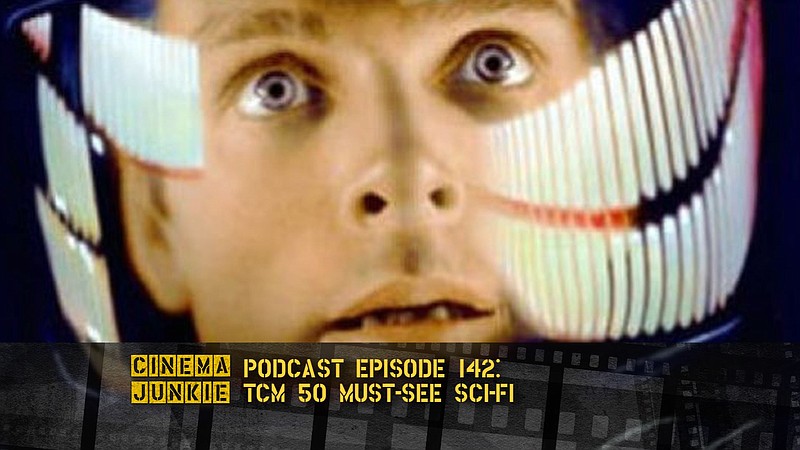
KPBS On Demand is supported by the Museum of Photographic Arts at the San Diego Museum of Art, presenting Cecil Beaton's Fashionable World through January 10. Spending the 1920s through 1950s, the exhibition includes fashion photography for Vogue, portraits of Hollywood stars, and more. Welcome back to another edition of listener-supported KPBS Cinema Junkie Podcast. I'm Beth Accomando. Have you ever been asked to make a list of your favorite films? It's a bitch. First, reducing your favorites down to a finite number is impossible. And then, how do you define favorite or best?
Author Sloane DeForest faced the task of coming up with a list of 50 must-see sci-fi films for a new book published by Turner Classic Movies. As with any list, people will applaud some choices, criticize others, and complain about what's missing. But on a certain level, isn't that what a list is supposed to do? It starts a conversation. So today, I'm going to have a conversation with Sloane to determine what makes a must-see sci-fi film and what did and did not make her list. I began by asking her to give us a little background about herself, because she's not just an author, she's also worked in the industry.
I have. Actually, I started acting about, oh gosh, I'm afraid to date myself by saying how long ago it was. But I'm thinking it was close to 15 years at least I started acting. So yeah, I've been on many a film set as an actor. So where do you trace back your love for film? Because to put together a book like this, you must have a bit of a passion for film.
I do. My mother did have a passion for film. She found escape in the movies a lot as a kid growing up in a small town in Texas. And I'm sure that she passed it on to me. But it's also in my blood and my father's side because my great-great-grandfather's nephew was Lee DeForest, who invented the sound-on-film process, the first sound-on-film process, phono film, in 1923. And he was working on that in Hollywood, and he worked in the film industry a lot as well.
Now, one of the things you listed, I think it's on your website in the description for the book, is that you've seen over 3,000 films in your life. So did you start watching film very early or did you kind of cram for this book later on? Well, both. I started watching films pretty early, but I don't know that I consciously realized that I was a cinephile or anything like that. I think it gained momentum as I got older and I realized that I really appreciated films. And then when you got into the late 80s and the 90s and beyond, there was some...
Some eras there when I was growing up that I was dissatisfied, shall we say, with the current output Hollywood was turning out. And so I think I started to revisit or to visit and discover classic films that were made before I was born. And I found that I liked them typically better than I liked the current film. So you have this new book out called Must See Sci-Fi, 50 Movies That Are Out of This World. So whenever you're doing something where you're dealing with a genre or dealing with a list, there's always that moment where you have to kind of define what it is that you're looking at. And you said that this genre has been called the impossible genre. So how did you go about kind of defining the requirements for what might fit into this list? Yeah, good question. It was really kind of an eye-opening process for me because...
I had never really questioned that much before. You know, what makes a science fiction movie? And when I started actually asking that question, I found myself spiraling down a rabbit hole. You know, wow, what is science fiction? So I think that's why I put that in the introduction, because that was my experience, and maybe other people have had that experience as well. When you start trying to really define it, it almost escapes definition. I worked on the list with Turner Classic Movies, so it wasn't just me by myself coming up with a list of 50. It was with other various input as well, but it was still difficult to narrow it down and to say, okay, well, you know, at one point...
They didn't want me to write. TCM thought maybe I shouldn't include A Clockwork Orange because it wasn't pure sci-fi. But then we included Eternal Sunshine of the Spotless Mind, and a lot of people don't think of that as science fiction either. So I sort of pulled that argument on them, and we ended up getting A Clockwork Orange back in the book. So it's really subjective. You know, a lot of films just have science fiction elements woven in, but does that make them pure sci-fi? But then is Frankenstein? That's a classic sci-fi. It's also horror. You know, there's a lot of crossover, which I found interesting. Before I show you the results of my trifling experiments, I would like to drink to our partnership. Do you like gin? It is my only weakness.
to a new world of gods and monsters. Creation of life is enthralling. Distinctly enthralling, is it not? I cannot account precisely for all that I am going to show you. But perhaps now that you are my partner, you can. Were there any particular qualities that you felt you wanted to make sure were in each of these 50 films or some sort of element that you felt binds these together?
I guess just their impact on cinema. I think that's what we were really looking at. Maybe important is not even the right word, but how big an influence did this film have in our culture and on the art form itself? In some cases, it's something more obscure but maybe has a lingering effect, like La Jetée, for example. A lot of people have never seen that film or heard of it. I actually, to be honest, hadn't seen it until we started researching the book. And then once I saw it, I realized, oh, this has to go in the book because, you know, I see...
12 monkeys, I see the Terminator, I see Looper, I see so many things that came later in this one 28-minute film. So it was really, I guess, about how big an impact did the film have. Now you bring up Le Jete, which is not an American film. And TCM is most closely kind of connected to American cinema. So was there a point where you were debating, do you include foreign films at all? Because you also have Gojira and Alphaville. Right. I think TCM always wanted to include foreign films. You're right. Their mainstay is more American cinema. But they have an interest in foreign as well. And also they wanted diversity in it, as all of us wanted some diversity. And we didn't want to create a book that was...
you know, the 50 top American Hollywood science fiction movies that are completely predictable. We wanted to have a few surprises in there and maybe take it in some unexpected directions. So that's what makes it exciting. So you mentioned surprises. What would you point out in the book that is a film maybe that people would not expect to see, aside from maybe Le Jeté is one of them, but is there another one that you think is something that people might open it up and go like, oh, I didn't think of that? Yeah, I mean, there are a couple. I think...
For me, These Are the Damned was one that I really enjoyed, that, again, I wasn't that familiar with until we started the book. That's also, that's a British film, so that's another export. Animals dressed as human beings. Smash, smash, smash! A game for the wild ones, played with the passion of the damned. Shut up! Don't ever do that again, Johnny. I'll do what I like, King. Do you think I'll let a man put his dirty hands on you? People fleeing for their lives, leaving one hell for another.
Escaping from what? From whom? What goes on behind these barbed wires? Who and what do these ferocious dogs guard? And who are these children? Where do they come from? To whom do they belong? Before you get yourself excited, King, touch the little boy's face. Fear is so real that you can touch it. Terror is so sinister that it makes the flesh creep. There's 20,000 leagues under the sea. I don't know if other people would be surprised by that, but I was a little surprised at first because I sort of thought, where's the science fiction in this?
The motion picture screen explodes with unprecedented power as the two masters of imagination, Jules Verne and Walt Disney, join to bring you a shattering new experience in entertainment. James Mason is Captain Nemo, who held the destiny of the world in his hands. The real story of the ocean depths begins where you left off. Wonders that defy my powers of description. The secrets that are mine alone. The most vivid scenes from the novel become unforgettable on the screen. The luxurious interior of the submarine. The revelation of the hidden mysteries of the deep. We do our hunting and farming here. Underwater? The sea supplies all my wants. And to stay in your memory, as the most thrilling sequence ever photographed in motion picture history, the terrifying battle with the giant squid.
And I think maybe a lot of people in contemporary times, younger people certainly who see it, may have the same reaction initially. Where's the science fiction? Well, it was so ahead of its time that what was considered science fiction when it was written in the 1800s now has been science fact for so long that it almost doesn't seem like a science fiction. I was surprised and happy to see Brazil in there. Because that is, I don't think, something that people readily jump to as going like, yeah, that's a sci-fi film. Right. That's another one. That's another good example. It's more dystopian.
And that's sort of what TCM said about A Clockwork Orange. It's dystopian, but does that make it science fiction? So there's so many weighty concepts, you know, you can weigh. And ultimately, it boils down to, I guess, it's science fiction enough. It's science fiction enough, and it's a good enough film, and it's an impactful enough film. Yeah, so Brazil is, is it science fiction? I don't know. A Clockwork Orange, to me, is science fiction, because it has a real undercurrent of sci-fi. All of the Ludovico technique that they do on Alex.
That's pure science fiction, but we don't see it, really. We just sort of see it through his eyes as it's being done to him. I just need to show you some films. You mean like going to the pictures? Something like that. Well, that's good. I like to video the old films now and again. So the science fiction maybe is a little bit cloaked, more hidden in films like A Clockwork Orange or Brazil or Eternal Sunshine of the Spotless Mind, but it's there. Let's go to the beginning of your book and just tell us what your first, it's in chronological order, but kind of tell us where the book starts and why it's important kind of to start with the film you chose. Yeah.
I think it's really important to start with A Trip to the Moon. I think we always wanted to start with A Trip to the Moon because it's really the first science fiction film. And people, I think, are more familiar with it now because of Martin Scorsese's Hugo. But that was one that a lot of people might not have seen because it's just so early cinema. So that's...
But as I said in the book, when Georges Méliès launched his rocket into the eye of the moon, he really launched the genre of science fiction. So it's really important to honor that. And then it skips ahead to Metropolis because, I mean, there really weren't a lot of important science fiction silent films made. You know, really, Metropolis is it, kind of the granddaddy. Explain to people kind of the format of the book in the sense of you're not just doing here's a synopsis of what the film is. You're kind of bringing in a lot of different elements, sometimes talking about literature, sometimes giving behind the scenes. So kind of give us a feel for what you wanted these kind of descriptions of these films to be like. Yeah.
I wanted them to feel not like synopses because that's sort of why we have a little one-sentence synopsis, you know, on the header page of each title to give people, in case they haven't seen the film, at least an overview, or if they haven't seen it in a while, a reminder of the plot. So then we don't have to really do a plot, you know, a scene-by-scene discussion of the film. And that freed me up to talk about things that are more interesting to me. I guess I'm always interested in the origins of things. Where did the origin, where did this idea originate? So I like digging into that and kind of...
finding some treasures that people may not know. I tried to really balance the text in the book for each film and make it so that people who maybe were just coming into science fiction, who had a passing interest in it and hadn't seen a lot of films or didn't have a lot of knowledge of it, could learn some things and find the book engaging. And also people who were maybe hardcore science fiction fanatics. I really tried to dig deep and tried to put a few nuggets that they may not know in there as well. So I kind of tried to tailor it to something for everybody. And I hope I succeeded.
Well, is part of it, too, that did you want these, I mean, each one is kind of a little analysis of the film. And did you hope that people might pick this book up and just be inspired to go seek something out based on how you talked about a film? Yes, absolutely. I think that's always in the back of my mind when I write about film is I want to excite people into saying, oh, I have to see this movie or, oh, I have to rewatch this movie. It's something, maybe discuss something that reignites their interest in it. Absolutely. And how did you feel about Roger Corman doing the introduction for the book?
Well, I was so excited. I mean, he's just such a seminal figure in science fiction. I mean, my goodness, from his first movie, you know, since the 50s, you know, he's just a legend in the genre. And even films that he hasn't directed or produced, he's often had a hand in. You know, he's just, he's had a hand in a lot of films over the years. So he's been an influential figure and just a nice guy. I mean, I wish I would have worked with, would have had a chance to work with him more closely on his foreword. We just basically sort of communicated by email. I hope to meet him in person.
Well, and I liked how the introduction was very much him in the sense of, you know, he's somebody who is a producer who has his eye on the bottom line. So part of what he addresses is kind of this financial history of science fiction, as well as, you know, what the content was. But it was kind of a nice, very personal look at science fiction through his eyes. Yeah, I loved reading his foreword and also doing some research on him as well, you know, watching the documentary about him reading his autobiography. It was fascinating to me to hear his journey. It was really a blessing to get his sort of encapsulated brief version of his journey in my book. So I was happy to hear that because the first film he saw was a matinee of Things to Come in 1936. He's really seen it all.
One of the things you have is kind of a little sidebar for each of the films where you list what you call either mind-blowing moments or far-out facts. So what were you kind of looking for in terms of those little footnotes? I guess I was looking for things that people might not know off the top of their heads. And I don't know, you know, again, how successful I was, because there are some passionate people about science fiction out there, and they just know everything. So it was a real challenge for me, especially in a movie like Star Wars. I mean, what kind of factoids am I going to find out about Star Wars that the Star Wars fans who've seen it 200 times don't already know, unless I get a personal interview with George Lucas, which I wasn't fortunate enough to get. I was looking for intriguing little details, fun little details, and again, maybe not common knowledge.
And you bring up Star Wars, which sometimes raises issues for sci-fi fans in the sense of they go, that's not science fiction, that's fantasy. So is that one of the debates you had also when you were kind of like putting this list together, that sci-fi versus science fiction fantasy? Yes, absolutely. There was someone at TCM who sort of put up the red flag at Star Wars and said, that's not really science fiction. It's more of a fantasy. And we thought, yes, we all agree with that, but it has to go in the book. How can you do a book on science fiction cinema and not include Star Wars? Again, as I said earlier, I think it's sci-fi enough. It's science fiction enough because it's fictional science is more about, you know, it's just used. It's tools used to tell a story, an age-old kind of story, and it uses spaceships and robots.
do that um so i can see that argument but we had to include star wars it's just such a groundbreaking classic somewhere in space this may all be happening right now 20th century fox and george lucas the man who brought you american graffiti now bring you an adventure unlike anything on your planet star wars here they come the story of a boy a girl and a universe Well, I think the thing about Star Wars also is that although it may not be classically science fiction, I feel like there's a generation of people who saw that and got inspired to kind of go into science just because it ignited their imagination. Good point.
I agree, and I also think that there's a generation of people, there's a generation of filmmakers who saw Star Wars and were inspired. And I think that its impact on cinema, again, its impact on science fiction genre films is huge, even if it itself, it could be argued, is not science fiction. It changed the whole tone of science fiction. After it was released, suddenly Spielberg could do Close Encounters, and there could be E.T., and there could be these positive sci-fi films, because really, sci-fi kind of dwindled into sort of negative, dystopian, and really kind of fizzled out. before Star Wars came along. So I think that, again, its impact on filmmaking and filmmakers and on science fiction is undeniable. Well, and it's interesting, and you do include George Lucas's earlier film, which is THX 1138, which is more kind of pure science fiction versus what he did in Star Wars. So it's interesting to see how he went from kind of one to the other.
Yeah, I found that really interesting as well. He does THX, his first film, his first feature film, and then he does American Graffiti. I mean, to me, that's just wow. That's incredible, that kind of leap into completely different territory. And then Star Wars. So it's almost like you see this negative dystopian, very sci-fi THX, and then you see this nostalgic, personal.
journey with, maybe not journey is the right word, but a very personal film with American graffiti that's more heartwarming, I guess, and more upbeat. And then you see Star Wars, which sort of combines the two almost in a strange way. So it's a fascinating set of three films for a filmmaker, three first films. Well, George Lucas is one of those filmmakers who I saw his work when I was a teenager. I was like 16 and 17 and just on the brink of going to film school. And so he had a real impact on me. But I've always wondered, like, if Star Wars hadn't been a success, would he have gone back to do more kind of THX movies as opposed to kind of the bigger blockbuster films?
Yeah, I wonder that too. That's a good question because I feel like Star Wars may be the blessing and a curse. How do you live that down ever? Some of the cast members as well and for Lucas himself. He created the monster, but it's just become... I can't imagine that anyone could have predicted that we would still be living in a Star Wars-dominated world 40 years later.
Now, one thing that you also have in each section is keep watching. So was this kind of a little bit of a way for you to sneak some more titles in there because you had to stop the list at 50? Yes, you got it. You guessed it. That's exactly right. There are so many movies that I wish that could have been included in here. So I thought at least we can do two. I mean, we ended up calling it keep watching as sort of a takeoff on the famous line from the thing, but two recommendations.
for each film to absolutely, to sneak in some more titles and to do, also to branch off into a few more obscure titles because, you know, we really wanted movies. Again, we have some more obscure ones in here, but really it's more popular films. So this way we could sneak in some of those B movies and some things we couldn't fit in like Galaxy Quest. I wanted to write about Galaxy Quest as an example, but there just wasn't room. Well, and you also kind of...
Add in, when you have something like The Thing from Another World, you mention the John Carpenter remake. And I think there was another one, too, where there was a remake done. So you kind of added those films in without actually having to make a separate entry. So you kind of covered both ends of that. Yes, exactly. And that was TCM's suggestion. I think initially I had created a list, a suggested list for them, that included The Empire Strikes Back, for example, and John Carpenter's The Thing, as well as the 1951 The Thing. But they said, no, let's just do the originals. Let's not do remakes. Let's not do sequels. We can mention those.
when we talk about the original. So that's what we ended up doing is, you know, I tried to, again, as you said about the recommendations, I tried to squeeze in some more because I loved, for example, Philip Kaufman's 1978 version of Invasion of the Body Snatchers. Right. It's a classic. And I really wanted to write a separate one about that. In fact, I believe I did. I think before I realized it was going to be cut, I wrote an entire piece on the 1978 version. And then I realized that I had to cut it. So I tried to fit in as much of the 1978 version into the 1956 Don Segal Invasion of the Body Snatchers entry. So that's a little bit long. Now, you brought up Galaxy Quest, which you didn't officially include, but you do include Sleeper. So you do bring in at least one of the kind of science fiction comedy. Was that important for you to kind of have that represented?
Definitely. Well, if I'm a fan of Galaxy Quest, obviously I like science fiction comedy. I just like comedy in general. I tend to prefer the movies that have a sense of humor. So, yes, Sleeper was one that we thought we had to include, or that we wanted to include, because it is classic sci-fi. I think a lot of people forget that. And it's also a sci-fi parody, and it's also a seminal film kind of in Woody Allen's career. Excuse me, Mr. Allen? Is that your new movie you're working on? Yes, no. I'm a clarinet player in 1973. I go into the hospital for a lousy operation. I wake up 200 years later, and I'm Flash Gordon.
What's the name of the film? The name of the film is Sleeper. Basically, it's an intellectual film. Most of the scenes in it are of a cerebral, almost didactic nature, and there's very little overt comedy in the film. Woody Allen and Diane Keaton in Sleeper, a love story about two people who hate each other 200 years in the future. And it's another one that, you know, people need to kind of wipe the dust off of and rediscover, maybe. So that was fun to include that one.
One thing that's always nice about books like this is this one in particular is very lavishly illustrated. You get some poster art, which they don't do quite as well now, and photos. Was that something that you were involved with or was that something that you pushed to make sure that there were a good set of illustrations to go with this? Definitely. It was definitely important to me to have some amazing photography. And I was very fortunate because I was able to work with a friend of mine, Manoa Bowman, who has a really incredible photo archive, as well as David DelVal, who has an also incredible photo archive of monster movies and sci-fi movies and horror movies are kind of his specialty. But he's been collecting for years, decades. So I had access to both of their collections. And I worked with David DelVal to really pick the best of the best or the most appropriate photos and sort of fit as many as we could in there.
We had to cut some, again, because there just wasn't room. And I found that the photos were getting so small. If there's not room for them, they just shrink them down. So we cut a few. And anyway, it was as difficult a process, you know, as figuring out what movies to cut and which movies to keep. You know, you have to go through the whole thing again when it's time to illustrate the book, figuring out which photos to keep and which ones to cut. But I'm happy that we got in some amazing pictures in there. And I hope a few of them are rare. And I mean, with film, I think it's really important because I think that can be an entry point. I mean, you can thumb through your book and an image can just grab you and go like, wow, what's that from?
you get sucked into the film. Yes, exactly. That's why it's so important. I mean, an image, you know, it's corny, but a picture's worth a thousand words. So, you know, a picture can say so much more than text can. Sometimes it was a question of, okay, we didn't really have time to discuss this character or this, you know, in the text. So I wanted to be sure to add certain pictures. For example, in Blade Runner, there just wasn't a chance for me to discuss Daryl Hannah's character. So I want to include a really amazing picture of Daryl Hannah in there and at least have her mentioned in the caption, if nothing else.
Well, and especially, too, with science fiction, I feel like so much of these films is tied in with their production design and being able to see what someone is imagining as the future, whether it's kind of a mundane future like in Alphaville, which looks kind of like our world, or if it's something outlandish like Brazil. But those images, I think, are so important. Yes, you're right. Particularly to sci-fi, visuals are key. So, yes, that's why it was difficult to find the most amazing photos and the ones that really...
capture some of these effects. I mean, again, I wish, you know, there's always regrets. I'm as happy as I am with the book, you know, I wish there could have been a whole fold-out section on, you know, how they did certain effects, because there just wasn't room to show all the behind-the-scenes stuff, but there's just, that, it would be lamentable to me to have not had a lot of pictures in this book, you know, just have a text, because you can't really describe certain visuals in sci-fi. You just have to show them. Now, I'm curious about one film that's not in the book, because you talked about how these films are ones that have impact, but Plan 9 from Outer Space is something that's so kind of iconic. What was the discussion on that? Actually, now that you mention it, I think Plan 9 from Outer Space did make it on my original list.
I think I wanted to write about the Ed Wood film. I have a passion for bad cinema, I have to admit. Well, let's not say bad. Perhaps that's unfair. Let's say low-budget science fiction cinema and B movies. Because actually, I think my interest in science fiction started in high school when I started watching Mystery Science Theater 3000. Remember that one? And they showed nothing but the kind of corny B movies that they would make fun of.
That's sort of my roots. I feel like that's my background in science fiction, is the B movies and the really low-budget movies. So I would have had a blast talking about Plan 9 from outer space, but I think it ended up getting cut because there were just so many more films that we felt were better appreciated and more impactful and more important. But it has had a huge impact on our world, certainly, Plan 9. They come from the bowels of hell, a transformed race of walking dead, zombies guided by a master plan for complete domination of the Earth. Plan 9 from outer space.
Is there any film that really hurt to not include in this list? Yes, I was, I was... hurts when I've turned in the book, I believe, in September and then went to see Blade Runner 2049 in October because the book was written and I couldn't write about it. I really would have loved for that to be included. I mean, I did mention it, but I really hadn't seen it yet because it hadn't been released yet when I finished writing the text, so I couldn't discuss it in detail. That would have been interesting to include that one because I think it's just gorgeous. I'm kind of fascinated by it. But c'est la vie. Again, like you said, maybe next time. Maybe we'll do a sequel.
Well, the problem is the pool of films you're looking to is going to constantly grow as we move forward. It does, too. It's been growing by leaps and bounds. I mean, sci-fi is really hot right now, so there's a lot of films and a lot of television, too, as well. And was there any film that you got on this list that you were really glad that you kind of put up the fight for? Yes. I would say, well, there were three films that I sort of had to...
cajole TCM into adding, I already mentioned the Clockwork Orange, which they conceded to easily. But then the other two that they wanted to cut were Alphaville and Barbarella. And I fought to get those back in. I had not seen Barbarella in years. It was a favorite of mine. Again, like when I was in high school, when I was in my 20s, I thought it was very kooky and retro and so glam. And it was one that I watched over and over again on videotape years ago, but I hadn't seen it in years. And so I fought to get it back on there because it was just a favorite of mine. And then I had to actually watch it. And I had this moment of horror thinking, oh my gosh, what if it turned out to be a horrible embarrassment? And I'm embarrassed that I put it back in the book.
That was very satisfying to rewatch that movie and see. Oh, well, it is kooky. It is, you know, sometimes the effects are a little bit low budget, shall we say. But I was happy. I was really happy that I got Barbarella back in there because watching it through more mature eyes, I really found a lot to like about it and a lot of merit in it that I think it's kind of been overlooked a little bit and dismissed. Because it was, I mean, it's been criticized a lot by feminists for having her kind of be victimized and just sort of be a sex symbol. Jane Fonda, that is, and Barbarella. But, you know, I saw it.
I saw some redeeming qualities in it that, for example, you know, she's allowed to sort of be sexually free, you know, with whoever she wants to, and it's kind of not judged. And for 1968, I thought that was kind of a stride forward in a strange way. She's considered a paragon of purity. She's considered, everybody talks about how pure and how innocent she is, and yet she's definitely not virginal. So I felt that was maybe a stride forward. Also in the end, you know, she triumphed. She saved the day. So she is a hero. Meet the most beautiful creature of the future.
Her name is Barbarella, and she makes science fiction something else. Jane Fonda is Barbarella. Barbarella is a five-star, double-rated astro-navigatrix Earth girl whose specialty is... Love! Shall I tell you what I would like? I think I know. Her top-secret mission is a real wing-dinger.
I just had the fortunate opportunity to see it on the big screen again because Landmark Theatre has brought it back as part of their Classics Week. And, yeah, and I mean, yes, you know, I can totally get it. You can criticize it for all sorts of things. But at the very least, visually, it's amazing. Just the costume changes alone. Right? I know. The Paco Rabanne costumes. And even I was noticing the costumes on the background extras are incredible. If you reframe it, you know, and really look in the background, the set design, there's nothing else like it.
in cinema. You're right. It's one of a kind visually. So it had to be in there. Yeah. And the production design was amazing because it didn't have, I mean, that's one of the things about science fiction also that I fall in love with is that you do find these films with lower budgets and they manage to turn nothing into something spectacular. And there were so many scenes in that film where you're going like, how did they manage to like make that ship that glides across the ice or whatever it was? That was just amazing. Right, right. Yeah. They had to, Roger Vadim had to get very creative and I always applaud that. It's the same principle as Ed Wood with a plan nine with his cardboard.
spaceships on strings, you know, but he, he was out there doing it and making it work. And I think it works in Barbarella. And was there, did you say there were three films that you, were those all three? Oh yeah, Alphaville. Alphaville was the other, yes. And I was happy to get that in there too because it's, again, there are things you can criticize about it and it certainly was, it was Godard pulling an Ed Wood in a sense and really having no money, no budget. And he did amazing things with the camera and with black and white film and with having, you know, let me caution, drive his Ford Galaxy and that was supposed to be a spaceship. That's how he gets across from one planet to another is just driving his car.
And also the merging, what I found most influential that I mentioned in the book is the merging of sort of 40s and 50s noir with futuristic science fiction. I don't know that that had ever been done before. It possibly could have in somewhere, some film I'm not familiar with. That's the first time I've seen it. Well, and also that reminds you, I think, a film like that where so much of it seems of our everyday world. And yet it's like you can still have these science fiction ideas going on, even if the world looks pretty much like ours.
Right. Exactly. And I think that's what Godard was doing, really. I mean, there's a quote I have in the book where he says, I said it in the future, but it's really about the present. The menace is already with us.
So, you know, yes, it was a budgetary necessity to set it in a city of Paris that looks like the present, that was the present-day city of Paris then, but it's also a social commentary. You're right. I mean, that's what makes it interesting is because, I mean, science fiction is famous for, you know, placing something that's maybe taboo or too difficult to talk about or confront in our society on another planet and using that as a metaphor. But it's even more interesting and even more close to home when you place it in contemporary society. Now, were there any of these films that you felt was a real discovery for you, something that, you know, you made your list and you had a lot of films that, you know, you were already familiar with, but was there one that you got introduced to and it was like, wow, where was this the whole time? Actually, yes. Surprisingly, it was Godzilla for me.
Because I had, and people will probably, villagers will be at my doorstep with torches burning me for this, but I had only seen Godzilla, King of the Monsters. You know, the 1956 version, the Americanized version with Raymond Burr. I had seen that years ago, and that just turned me off of the whole idea of Godzilla, frankly, because I thought. And it's not a terrible movie. In fact, I appreciate it more, understanding how it was made. You know, they took the original 1954 Japanese film and sort of shot new scenes with Raymond Burr and inserted them carefully into the film. So that's kind of...
I applaud that craftsmanship right there. But I had only seen that version. I thought, oh, this is weird. I don't really get it. It's kind of bizarre. Godzilla, king of the monsters. Incredible titan of terror. Wiping out a city of six million in a holocaust of flame. Jet flame cannot destroy it. Bombs cannot kill it. All modern weapons fail. Is this the end of our civilization?
So I had never seen the 1954 Japanese version until I started researching this book, and that was a revelation to me. I was really impressed with just learning about it and understanding it and understanding that it was a metaphor for the atomic bombings, you know, in Japan. And it took on a whole new quality to me before I just saw it as kind of a silly monster movie, maybe. But seeing the real original version with the music that's so sort of disturbing and unsettling, it paints this whole... picture of post-war Japan and it sets this whole tone that is really kind of disturbing more so than just being a monster you know a typical monster movie it really had an impact on me I was impressed with that film Yeah, seeing it in its original form, it really feels like an epic tragedy. Like, there's such sadness at the end. It does, yes. And the scenes of the children in the hospital who've been orphaned by Godzilla's rampages, it's really surprisingly touching. I mean, maybe not surprisingly to people who are familiar with it, but it was a surprise to me. Yeah, it was tragic, it was touching, and it was so much more than I had considered it. I mean, it was so much more than I thought it was.
And in writing these, was there one that was a particular challenge? Did you get down to sit down to write one of them and just go like, I don't know where to begin or like there's so much I want to cover or just like I'm not sure how to tackle this one? Yeah, actually. Star Wars was probably the one that was the most daunting because, again, like I said earlier, what can I tell anybody about Star Wars that people that fans don't already know? I was really intimidated to do Star Wars. It was difficult for me. I think I researched it a lot, and I finally just overloaded myself on information. I mean, I couldn't absorb all the information out there. So what I ended up doing was going back to the origins, and I went and I found clippings from the original Star Wars and interviews with George Lucas from 1977.
And I really focus on the first film and kind of its story, again, its origin story and how difficult it was to get made and its impact once it did finally get made and how surprising that was. I mean, that was the story I kind of opted to go with rather than to try to tackle, you know, every aspect of it. Was 2001 another one that was tough to tackle? Yeah, that one was daunting as well because it's so revered and it's so famous. And it's also so, it can be puzzling. You know, it can be intimidating to write with authority about that film when maybe you have to watch it several times to understand it, you know, or certain scenes. And you have to really read about it and think about it to understand it. So I wanted to make sure that I understood it fully before I wrote about it. And in researching it, I realized, you know, I don't know that anyone really understands it fully. So, you know, I think, and I think that's fine. Open the pod bay doors, Hal. I'm sorry, Dave. I'm afraid I can't do that. What's the problem?
I think you know what the problem is just as well as I do. What are you talking about, Hal? This mission is too important for me to allow you to jeopardize it. I don't know what you're talking about, Hal. I know that you and Frank were planning to disconnect me. And I'm afraid that's something I cannot allow to happen.
As I said at the end, I think it's a film that can be enjoyed without being completely understood. And that's what's so brilliant about it in a strange way. You see something new every time you watch it. And there's so much to think about, you know, especially toward the end. I think Kubrick, the story goes that he intended to show as an extraterrestrial at the end, but he ran out of time and money to create the effect. That may be true or it may not be true, but what it ends up being is something that you almost have to fill in the blank with your imagination. And that really triggers the imagination. I mean, if you don't use drugs, I think just watching the movie really can ignite the imagination.
So, yeah, that one was easier once I sort of got into it and understood that. Well, I remember seeing that film with my dad, who was a teacher. He taught math. But I think I was like eight years old when I saw it. And I remember coming out being completely baffled and asking like, what does this mean? What does this mean? And my dad, being a teacher, was like, well, I'm not going to tell you. You have to think about it. So what do you think that monolith meant? I was like, I don't know. And then it's like, what does it look like? I don't know. It kind of looks like those things in the computer. You know, and I just remember being grilled outside the theater. It always fascinated me, that film, because I was so confused when I first saw it. I can imagine at eight.
But that's great that your dad really sort of made you, sort of forced you to think about it. Yes. I think that's good. That probably created a sci-fi fan in you, right? Oh, he's the one who made me a movie fan from the time I was like, I think, three years old. He's the one who showed me my first, you know, King Kong when I was like three or four, and I was hooked from that moment on. Oh, wonderful. That's great. I like that story. Do you have any plans to do other books like this? Well, as a matter of fact, I am working on one right now for TCM as well and running press. It's going to be called Dynamic Dames, and it's 50 of the most sort of strong and empowered women in film. Oh, great.
So, yeah, it's different from sci-fi, of course. Maybe Barbrella will make that. Right. Jane Fonda is definitely in Dynamic Games. So that's what I'm working on now. Are you going to approach it as 50 women or 50 films?
Well, we're actually doing, I actually wanted to do characters. So, for example, we will have Joan Crawford, you know, we'll have Mildred Pierce. Joan Crawford has Mildred Pierce in Mildred Pierce, 1945. And that will be, I'll discuss why Mildred Pierce is an empowered character. And then we'll also go into Joan Crawford a little bit and touch on, you know, her incredible reign as a movie star for so many years and her willpower and her determination. So we talk about, it focuses on each character.
in a film, but we talk about the women also who embody the character, and we also mention if there's a female screenwriter, a female producer, the women who brought it to the screen. So I'm really excited about that book, because as I was doing sci-fi, really, I felt incredibly lucky to have a chance to write about science fiction movies, because it's usually, these kind of books are typically written by men. So I sort of, I wouldn't say I put any kind of feminist spin on the sci-fi book, but I think maybe you can tell it's written by a woman in certain places, because I did make certain observations and notice. It's impossible not to notice the progression in the evolution of women in science fiction movies when you're a woman writing about it. In a sense, this next book is kind of not too far removed from the topics I was thinking about in the sci-fi book. Well, great. I want to thank you very much for taking some time, and you're going to be out here in San Diego so people can actually meet you. Yes, I'm going to be at Mysterious Galaxy Bookstore on May 18th, and it's going to be exciting. It's at 7.30 p.m., and I look forward to being there.
Well, great. Well, thank you very much for taking some time and for putting together this list of films that can be a great little companion piece whenever you go out and start looking for a film to watch. Yeah, well, I appreciate that, Beth, and I've really enjoyed talking with you about it. That was author Sloane DeForest. Her new book is called Turner Classic Movies, Must-See Sci-Fi, 50 Movies That Are Out of This World. She'll be in San Diego at Mysterious Galaxy Bookstore on May 18th if you want to question her yourself about the films that did and did not make her list. Thanks for listening to another episode of KPBS Cinema Junkie Podcast. If you enjoyed the show, then please subscribe to the podcast on iTunes and leave a review. The podcast comes out every other Friday, or at least I make an effort to get it out every other Friday. Coming up soon will be a podcast all about witches and witchcraft on film. So till our next film fix, I'm Beth Accomando, your resident cinema junkie.
KPBS On Demand is supported by the Museum of Photographic Arts at the San Diego Museum of Art, presenting Cecil Beaton's Fashionable World through January 10. Spanning the 1920s through 1950s, the exhibition includes fashion photography for Vogue, portraits of Hollywood stars, and more.