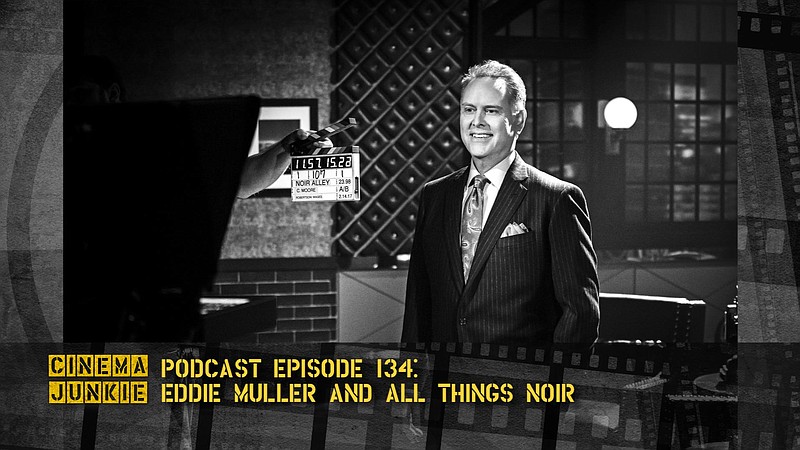
KPBS On Demand is supported by San Diego County Toyota Dealers. The Toyota Tacoma is a midsize pickup truck designed for work and recreation with up to 326 horsepower and 465 pound-feet of torque. Visit your Toyota dealer or toyota.com. We make it easy. Welcome back to another edition of listener-supported KPBS Cinema Junkie Podcast. I'm Beth Accomando. Today, we're going to talk about all things noir, and here's a little something to put you in the mood. It was a hot afternoon, and I can still remember the smell of honeysuckle all along that street. How could I have known that murder can sometimes smell like honeysuckle? That don't sound like you.
No, no, all I can see is the frame. A black pool opened up at my feet. I dived in. It had no bottom. So you're a private detective. I didn't know they existed except in books or else they were greasy little men snooping around hotel corridors. I thought detectives were heavy drinkers. Oh, well, some of them are. Some of them just encourage other people to drink. You should tell me it wasn't great on that angle. Here's my name. As for instance. Phyllis. Stalling, honey. What do I call you besides stupid? Stupid will do if you don't bruise easily. Otherwise you might try Danny. Can't you even feel sorry for me? I'm not going to try. Jeff. Well, just get out, will you?
I have to sleep in this room. Don't ever change, Titan. I don't think I'd like you with a heart. Keep asking for it and you're going to get it. Plenty. I told you to shove off. Shove off. People lose teeth talking like that. If you want to hang around, you'll be polite. That evens us. Now fold your hands or I'll fold them for you. You talk big, mister. I tell you right out, I'm a man who likes talking to a man who likes to talk. Well, will we talk about the blackbird? You just sit and stay inside yourself. You wait for me to talk. I like that. I never found out much listening to myself. I'm afraid I don't like your manner. I've had complaints about it, but it keeps getting worse.
I don't mind if you don't like my manners. I don't like myself. They're pretty bad. I grieve over them long winter evenings. And I don't mind you ritzing me or drinking your lunch out of a bottle. But don't waste your time trying to cross-examine me. Hold tight to that cheap cigar of yours, Gaze. I killed Dietrichsen. Yes, I killed him. I killed him for money. For a woman. I didn't get the money and I didn't get the woman.
Since I'm co-presenting a year of noir in San Diego at the Digital Gym Cinema called Noir on the Boulevard, I wanted to devote an entire podcast to film noir. And there's no better person on earth to speak to than Eddie Muller. So I'm thrilled to have as my guest a man who's known as the czar of noir. He's also the host of TCM's Noir Alley, author of numerous books, including Gun Crazy, The Origin of Outlaw Cinema, founder and president of the Noir Foundation, and he oversees and hosts Noir City, which is enjoying its 16th year and will kick off on January 26th. So welcome, Eddie. Well, thank you for having me, Beth. I'm going to tell you right off the bat, I'm a little jealous. Noir on the Boulevard.
I mean, that's pretty, that's pretty Tony. I mean, we're just Noir Alley at TCM. You know, you got the whole boulevard. That's pretty good. Well, our cinema is located on El Cajon Boulevard and they brand it as the boulevard. So it was kind of an easy one to pick for a title. And I want to stress in your, thank you for that lovely introduction. And the Noir City Festival that you refer to is taking place in San Francisco. Be clear about that. Yes. And we're going to talk about your film festival in a little more detail coming up. But first, I wanted to start with a clip from Gun Crazy because Peggy Cummins, the star of that film, just passed away. When are you going to begin to live? Four years in reform school, then the army?
I just think they don't use something for a change. What's it got you being so particular? Look, let's not argue. I'll hock my guns. Give us enough dough to make another start. There isn't enough money in those guns for the kind of start I want. Bart, I want things, a lot of things, big things. I don't want to be afraid of life or anything else. I want a guy with spirit and guts. A guy who can laugh at anything, who will do anything. A guy who can kick over the traces and win the world for me. Look, I don't want to look in that mirror and see nothing but a stick-up man staring back at me. You better kiss me goodbye, Bart. Because I won't be here when you get back.
Let's finish it the way we started it, on the level. You knew her well. You wrote a book about the impact of the film that she so memorably starred in. What was her impact on noir, and what's kind of her legacy? Well, it's probably one of the great performances in all of film noir, certainly when it comes to female roles, I'd say. I mean, I've described that character.
and Peggy's performance is the most ferocious femme fatale in film noir. And I think that pretty much sums it up. And it is sad. This is actually the first time I've talked publicly about it since Peggy passed away. I had just seen her in November. My wife and I took a trip to London, and we visited with Peggy, and she was in great. We were making plans to do more of our travel to various festivals around the world, introducing a new generation of people to this film, and Peggy was always a part of that. So that is her cinema legacy, really.
And she's not alone in being one of those actresses that sort of the legacy will all revolve around this one. I mean, she made a lot of other really good films, but it's this one that stands out. But for me personally, when we go to London, we'd stay in her flat and she'd cook and charming. It'd be more about just life and how to age gracefully, since the movies don't necessarily teach you, but fortunate to know her.
You mentioned the word ferocious in defining her performance, which I think is really accurate. What was it about her that kind of made her just leap off the screen in that role? I think she just gave it her all, really. I mean, she was so not that person. The character as written was described as a delicate prairie flower. That was written in every iteration of the script. There was that term. The whole crux of it was that there was this tiny little woman who loved her tight arms and wasn't afraid to, you know, she wanted action. And I think a big part of why Kate was able to give so much is that she had left Hollywood.
Zanuck at 20th Century Fox to be the star of this big production, Forever Amber. They started making the movie, and then he pulled the rug out from under her and said, there are various stories about why she was removed, because she was too young, she was doing on screen, which would get the film in trouble with the Legion of Decency, or she just wasn't sexy enough, in Zanuck's opinion. And so she had left and gone back to England. At the last minute, the King brothers, who produced Gun Crazy, said, yeah, Peggy Cummins, we'll get her to play the part, because they didn't have an actress for this. Back to England, she wasn't sure that she was going to continue acting. I think she just turned it all loose.
back. It's like I'm giving it everything. Well, I want to backtrack a little bit to talk about noir in kind of broader terms, just in case there are any people out there who are not familiar with it or want to learn a little bit more about it. But for you, what are the elements that really define noir? What are the things that a film really needs to have to be classified as noir?
Well, that's an interesting way of looking at it, and a lot of people approach it that way. Like, you know, stylistically there has to be, you know, it takes place at night, there's rainy streets, guys have to be wearing hats, you know, there's got to be a femme fatale lurking around somewhere. You know, to me, that's all window dressing. The real essence of it is that film noir was an artistic movement in Hollywood. And a lot of it had to do with the business having gone through the Depression and then immediately World War II. And the movies had to do their part. They had to be uplifting and have a moral to the story that was for the public. And in reality, there were all of these artists who wanted to write more realistic stories who were sort of kept from doing that in the movie business during the 30s and 40s. I'm going to say like 1934 to 1944. That's the movie business, right? And I think that the film noir was really born of the artists themselves saying, well, now can we finally...
present an alternative to happily ever after. And the place they were able to do that most comfortably and conveniently was in crime films, because there were genre pictures. They weren't all B movies, but the moral watchdogs in Hollywood didn't pay as much attention to genre pictures as they did to the big A movies that had the higher budgets and got all the attention and the awards and all that stuff. So this whole movement of films began that reflected this alternative, a much darker, more cynical, more menacing view world, and it was reflected in...
The scripts, the direction, the cinematography, the acting, big stars would say, well, I want to play the bad guy for a change. It changed careers. It changed the look of films. It ate away at the production code so that movies sort of grew up. You know, it's not going to always end well. So that's really what significance of film noir and the importance of film noir. And I really believe that these films stay relevant today because cynical audience today, in many respects, act at these films.
You talk about window dressing separate from kind of what defines it for you. But I think that what you're addressing is this kind of this notion of the tone and the themes. And those are the things that I think really do define noir. I mean, to me, it's kind of like that gray area. It's always about, you know, things that are not clear cut. There's so much of this gray area in those films and moral ambiguity. And that's what I found so fascinating about them. And also the other thing about that, I was looking at your list of films that you've got coming up for Noir City.
I think, I'm not sure if there's any other genre, maybe horror, but that has just the titles alone are just so wonderful. I mean, you've got I Wake Up Screaming, Among the Living, This Gun for Hire, Quietly. That's two movies, by the way. I Wake Up Screaming and Among the Living, not I Wake Up Screaming Among the Living. Although that would be an interesting one. Well, sometimes I pair movies as a double bill just to see them on the marquee. But the titles are great. And they seem to, whether or not they tie directly into what the plot or the story is about, hearing these titles. And if you look at some of the posters, reading some of the taglines, it's absolutely irresistible. I mean, how can you not want to see these films? Well, yeah, you totally get it, Beth. I mean, they knew what they were doing. And, you know, honestly, that is a major part of the appeal, is that style.
draws people. You know, there's so many artists today, visual artists, musicians, that are all drawn to noir for those very reasons. The fabulous language in these movies, the slang, all of this stuff has never lost its appeal. It just, it refuses to go out of style, you know. Yeah, you hit it right on the head. Now, a lot of noir is very rooted, or noir itself is kind of very rooted in literature. There's this whole kind of hard-boiled crime fiction where a lot of these films kind of have their roots. How did that impact it?
of you to recognize that, because I really do believe that the movement itself really kind of happened in the late 20s and the 1930s, but when Hollywood asserted the production code in 1934, it was always there, but they didn't really enforce it until 1934, and they said, well, we're not going to show these things on the screen. It kept a lot of the literary works that were the underpinnings of noir from reaching the screen. I mean, a classic case in point would be The Postman Always Rings Twice, which James M. Cain wrote in 1934, and MGM bought the book. in 1935, but it took them 11 years to get it onto the screen because it was just too tough and too sexy and too raw. And it's like, we can't make a movie out of that. But there are a lot of books like that. And so these writers were, the writers who were extremely influential in the 30s, the Dashiell Hammett and the James M. Canes and the McCoys and these people, they had done their work in advance of the movement happening in Hollywood. And then when they sort of cross-pollinated that developed, thanks to a lot of expats and directors who came to this country who sort of had the...
And then you even had writers like Raymond Chandler writing screenplays as well. Mm-hmm. Lou Dahlia, that was his really great screenwriter. I read his original screenplay for The Lady in the Lake, and it's bizarre. It's like, wow, this guy is just refusing to write a screenplay. He's the secretary, and then he gets to the point of the scene in page nine. I'm sure the check was for the same amount of money, but wow, he was wasting a lot of time.
One of the things we're doing with our film series is we're focusing on films that do specifically have literary roots, films that were adapted from books. And two of them were by women, which is not that common. But there were some women noir writers. More common than you would think. And I'm glad you're doing that. If you take a really close look at the lineup of films that I'm presenting at the Noir City Festival in San Francisco, there are a lot of...
women involved in the creation of these movies, either as the writers of the source novels, as writers of the screenplay, writers of the stories upon which the films are based. It might be a magazine thing. Yeah, it's something that I've really taken a very keen interest in. I've sort of discovered that over the years, to put this in quotes, scholars are entirely driven by men. And so the idea of what is far, that's all been set up and just not the scholars would sneak in. But it was as if these guys were saying, well, if a woman is the lead, it's not really noir. Because we know that films...
is about men being destroyed by evil women. That's the point of it, right? And I could not disagree more. And with movies, you know, no man ever, sorry, wrong number, the file on Thelma Jordan, those Crawford pictures like Mildred Pierce and Sudden Fear and Flamingo Road and Damn, Don't Cry, and lots of others. The picture that I restored called Woman on the Run with Ann Sheridan in the lead. You know, that's a terrific film that was very overlooked. And yeah, I think women played a much bigger role in this than people realize. And in the industry in general, they played a huge Rory position that kind of where it makes sense. This woman, Joan Harrison,
Alfred Hitchcock's protege, became a writer and producer, made some terrific noir films in the 1940s, and then producing Alfred Hitchcock's television show. I mean, that's somebody who had a major role who really knows about Joan Harrison at all. Well, I have to say that it's the women in noir that pulled me in because I grew up in the 60s and I remember being so frustrated with like these Doris Day films and stuff that I was being told was like, oh, you know, this is what female role models should be like. And I'm like, they were so repulsive to me. And I was. That's strong. Don't say that about Doris Day. I'm sorry. I know. But it was tough as a kid. So to me, it was like I was I loved characters like I love the Bond films with, you know, like Pussy Galore and then noir because the women noir I always.
got this, people would, you know, push back and say like, oh, but aren't those films so misogynistic and women look so bad? And I was like, but they're in control sometimes. They may make bad choices and they may meet bad ends. And, you know, the films may not hold them up as role models, but these were women who frequently operated like men who like were driving the plot for good or for bad. And I just was riveted by them. You know, people like Barbara Stanwyck and Double Indemnity and Jane Greer and Out of the Past and Lana Turner and Postman Always Rings Twice. I mean, my dad was a movie buff. And so he took me to these films when I was like a little kid. And those films just.
I felt like it was such a different view that I was seeing, and it was great, and it totally sucked me in through those characters. Yes, I couldn't agree more. And they continue to exert that thrall over audiences today. I mean, my audiences for the Noir City Festivals are completely mixed in terms of gender. I mean, at times I'm almost convinced there are more women in the audience than there are guys. And it's certainly true. I found this to certainly be true the younger the audience is. I've gone out and spoken at the Noir City Festivals. I'll frequently go to the Noir City Festivals.
colleges and sometimes even high schools. And invariably, it is the young women who are taken by these films and show a real interest where it doesn't really develop for the guys until a lot later. I mean, it's true. And I find that there is a very, very hardcore female audience for these films based on exactly what you just described, right? Somehow the new term for this, I don't know where this came from, but now you can't read about any of this without seeing it, is female agency. I don't know where agency suddenly developed. It's like the go-to word for this, right?
But that's exactly what Stanwyck and Joan Crawford and Rita Hayworth and Gloria Graham, it's agency, I guess, is what they say now. That's a far less sexy term, though. You know, they have power. Yes. You know, that's what they have. They have the power to control men, if not themselves. But, you know, that's a certain type of character in film noir that is eternally popular. But also, when you watch enough of these films, and people who come to your series, they'll certainly come away with this.
is, you know, that's not all that's in these movies in terms of the women. It's not just the femme fatale. I mean, in these movies, it is clearly stated that the only hope the guy has, the white woman is always shown in these movies, saying career woman makes the mistake, using the gold digger, the second digger instead, and very subversive. They were telling people at that time, you know, you're better off letting women be independent and liberated and self-reliant because they're going to be more... The woman in this movie that is...
Well, and there's some interesting twists on it that you're highlighting in this festival, too. There's a film that I saw recently that I hadn't been familiar with, Wicked Woman, with Beverly Michaels. Why is a wicked woman? How about having a drink of it? Can, it's against the rules. You've broken the rules before. He was reaching for something and slipped. She has everything. And every man wants what she's got. You will hate every vicious bone in her body.
She is a fascinating character because she's kind of the femme fatale, but she's kind of a victim, and she doesn't necessarily have to get punished for her behavior exactly. And she's very striking, but she's an interesting kind of twist on what people may think of as the conventional femme fatale. I totally agree. It's kind of a goofy movie in some respects, but what you're referring to is... I don't want to...
Yes, it plays with the conventions of the femme fatale. And I would suggest that the femme fatale is this evil character. Look at some of the classic examples in movies, like Gilding. She's just trying to survive the craziness of these two men who were in love with her. Or one of my favorite characters did everything up, and she says, you know, I can't help it if you don't know how to take care of yourself. I didn't ask you to do this stuff for me. I have to get away. You don't know what you've done bringing him here. I have to pack. I have to hurry. You're going away? You're going to leave me? Here? How far can I get with you?
What kind of a chance would we have? You can't move. You couldn't last a day. Don't you understand? You need help. Doctors. You could never make it. What do you want me to do? Let him get us both? Would that make you feel happier? Does that make sense to you? No. There'd be more. Why did you have to come here in the first place? Why? Why? It was all working out. Everything was fine. Paper said you'd be in the hospital for weeks. All those things you said to me.
You aren't lying. You meant it. I know you meant it. You love me. Love, love. You have to watch out for yourself. That's the way it is. I'm sorry. What do you want me to do? Throw away all this money? You always have to do what's best for yourself. I had that trouble with you. It always was from the beginning. You just don't know what kind of a world it is.
Well, I'll know better next time. Well, people get hurt. I can't help it. I can't help it if people don't know how to take care of themselves. I'm sorry I can't be like you. I'm not like you. I wasn't born that way. It's fantastic. It's one of my favorite scenes in film noir. And yet people will still review that film and say, oh, it's about a woman who destroys these men. And it's like, the movie I'm watching is the opposite. It's a movie about men who destroy this woman who just was trying to get on with her life. Well, I think sometimes people go in with a certain set of expectations and don't see beyond that.
To me, noir has always been this place where there seems to be so many layers to what's going on. And that's another reason why I think they hold up so well now is because you can see just the surface of what might have made them popular when they came out. And then you can read more into it and kind of dig beneath. And they just seem to hold up well because we can keep finding new things in them. I totally agree with you. And it's interesting because I've been doing this for a lot of years now. And it's fascinating that...
As a researcher and a writer, one of the things that makes the subject so interesting is, exactly as you described, when you learn about the political climate of the time these movies were made, what was actually going on in Hollywood, the lives of the people making these films, all of this plays a part in the individual films and the noir movement in general, right? And so there's endlessly fascinating stuff that you can read into the movies or learn in the movies. But then here we are decades later, and you can just watch the movies as these fabulous entertainments. And it's fascinating because these movies were born of a very complex, difficult, almost a time of crisis in the country and in the movie business. And yet today people watch these as companies. Like, I love these movies. You know, it's so great to not have to, you know, I can just escape into these movies. And it's like the people who made it weren't really escaping. But that's how a lot of people interpret them today. And the truth is, Beth, you can have it both ways. I mean, when I introduce the movies, you know, I'll sometimes go into the back story of a film like The Prowler and explain politically how everybody who made this movie is going to be out of the way.
are like, wow, that's fascinating. Other people are like, shut up and show the movie. Now, in talking about kind of the things that went into making these films at the time they were made, do you feel that true noir has to be rooted in a certain time period? Are the films that are classic noirs from a certain period and are contemporary noir somehow different or in kind of a separate category? You know, that's...
I don't, here's my answer to that. I do believe that there was, as I've described, a movement, an artistic movement, right? And you can equate this to any kind of art form. You know, there's the bebop movement, or there's the cubist movement, or the dadaist movement, you know? And because of the movement, we clearly identify it as like, well, here's the starting point, and here's probably the end point. But that doesn't mean that it vanishes into the ether when the movement ends. I mean, it's going, that's the purpose of art, right? It's going to influence people. It's going to affect people. It's going to, you know, you can't imagine that when Robert Towne wrote...
Chinatown, he wasn't thinking of films. He was thinking of Raymond Chandler. He was thinking of that whole period, and he did his extension of it. That's how I look at it. People do extensions of it. When I watch David Lynch movies, I see so much stuff. I think it's like, this guy has definitely seen Laurie. He's making reference to Gilda in Mulholland Drive. I really respect the contemporary filmmakers who I can see that they've watched these movies, they've absorbed the movies, and then what they make are comments on or extensions of...
What was it that made you fall in love with noir in the first place? Do you remember, like, how you got introduced to it? Yeah, cutting school. Staying home and watching movies on TV instead of going to school. See, kids, it pays off in the end. I didn't say that. I was just fascinated with the period. It was the time period that really interested me because it was so different from the era in which I grew up. I mean, I was, come on, I came of age in San Francisco during the late 60s, early 70s, you know. Summer of Love and hippies and all that stuff. And yet my dad, who was a sports writer,
His career was chronicled. I mean, there was a visual. I'm looking at all these pictures of guys in suits and overcoats and fedoras walking around on Market Street. It's like, what was this world? So that was definitely where I wanted to pay attention. And then when I found these movies, I've said a hundred times, it was like when I was a young kid, it was like I was watching my dad's home movies. But that was it. I mean, and my dad, because he was in the boxing game, he had stuff and they were like right out of a film noir. Did that love for noir lead you to founding the Noir Foundation? Well, the foundation was really successful. We made a ton of money.
Then I had it. But I never felt like this money was mine. I really felt like the need to do with this is we've been doing it for going on 12 years now that the foundation has existed. And, you know, we've restored and or preserved like 20 movies. Show the film the money that we make. We find a film that we haven't been able to show or that's at risk of being lost. We restore it. Then we show that one the next year. And then, you know, and it perpetuates itself. And it's been a fabulous experience.
And you have some films that you're screening this year that are rare gems, films that you can't just find on DVD. Can you highlight the ones that you're showing this year? Well, the restoration we did is a movie called The Man Who Cheated Himself that we're showing. But we try to find unities. And our theme this year is we want to do genuine A and B double bills because I have found that over the years a lot of people have had it somehow a pejorative, like, oh, well, that's just a B film. It has something to do with the quality or something, which isn't really true.
They were shorter movies made by the studios specifically for the purpose of filling out the bottom half of a double bill. And they're going to be a Western or a crime movie or some kind of inexpensive adventure yarn or something at the bottom half of the double bill. We wanted to put, you know, and they're never, like, more than 75 minutes long. Stuff like Quiet, Please Murder, which is a great fox bee. From Columbia, there's an amazing film called Address Unknown, which really isn't a true bee. It's 75 minutes long. Again, written by a woman, Catherine Taylor, who wrote under the name of Cressman. So many women. Great movie about the Nazis in a very, very creative way.
There's a movie called Jealousy that is one of the few Hollywood films by Gustav Machady, who is famous for making the film Ecstasy with Hedy Lamarr in the early 1930s. A film that we restored called High Tide. It's just fantastic. It's so inventive. I love it. Anyway, we really go to find and show these films that either have disappeared and we hunt them down and restore them, or they're buried deep in the vaults at the studios, and it's like, thank you, Hedy. Nobody's ever asked for that movie before.
And you mentioned in the subtitle for your festival this year, it says Film Noir A to B, so that's representing your A and B movies? Correct. Now, in programming these, how hard is it to make the decision of what to show? I mean, when we were doing it, we had 12 slots to fill, and it was agonizing because you're torn between wanting to show stuff that people probably have never seen as well as kind of showing some of the stuff that's so deliciously good that people are familiar with that is so much fun to see again on the big screen. Have you, well, I mean, welcome to the world.
Is this the first time you've programmed a series? No, I've gone through the agony many times. Okay, so you know what it's all about. Yeah, I mean, the thing is, when you've gone, you know, it's 16 years for me in San Francisco, but it will be 20 years in April in Los Angeles, where I've shown at the Egyptian Theater in Hollywood for 20 years this April. And the trick to the programming is it's all balance. To me, it's all about balance. I have found, see, the A&B show is a perfect way to put a more well-known A picture out there.
and then pair it with something that is a real rarity. And if it's not like the greatest film ever made, I say to people, don't worry, it's only 65 minutes long, right? You'll live. But not that they aren't all interesting to me. But what I've discovered that's really fascinating is some programmers, I think, they're programming for themselves or they're programming for other programs. So they obsessively want to find the most esoteric thing and say, nobody's ever shown this before, right? And then 14 people come to the theater and it's like those 14 people get to feel like they're the smartest people in the world for the length of the show, right? All well and good.
The reality is the audience cycles. I mean, I kind of consider when I watch the crowd come in, I look and I say, who's the youngest person in here? Are we getting any 15-year-olds in here? And what you have to realize is that 10 years from then, they're going to be 25 years old, right? I mean, I've been doing this for 20 years now. So I literally have had people come to my screenings when they were 13, right? And now they're 33. They're 33 years old.
there's a lot of movie going in there. And I have found that it's always worth showing Mildred Pierce again. It's okay to show Double Indemnity again because there's somebody who's seen it for the first time. Or maybe they've seen it, but they've never seen it on a movie screen before. And so, you know, you can't just focus on the rarities and be that super discriminating programmer who says, I found a film that nobody's seen before. So I like to, you know, put something like a Blue Dahlia or Double Indemnity or Mildred Pierce on a bill with a movie that nobody's seen.
Yeah, well, in looking at your schedule, the double bills are great because it seems like it has something more familiar that can entice someone in who maybe is not a hardcore noir fan and will get them to stay for the second one, which is possibly that rare gem that they'll never see anywhere else. Believe me, Beth, I didn't think up this strategy. This is the way the movie business worked forever. Oh, claim the credit. You kick off the series, your festival this year, with I Wake Up Screaming. And Victor Mature stars in this. His daughter lives here in San Diego, and she's going to be coming when we screen it here in San Diego. And we were starting our series with Maltese Falcon, which a lot of people look to as kind of kicking off the noir cycle. And she goes like, no, no, no, maybe you should consider my dad's film as the first one. And she sent me an article about it. So you're kicking off your series with that. Are you going to be addressing that kind of idea in any way? Well, Victoria's going to be at my screening. Yes, she's getting around. She's working pretty good on her dad's behalf. That's not bad. Good going, Victoria.
I mean, she did not consult with me before I did this, but she saw it and said, wow, this is great. Can I come? She will be at the screening in San Francisco as well. She's delightful. Yes, she is. And are you addressing in any way whether or not the dispute or the debate between I Wake Up Screaming and Maltese Falcon? There is no dispute.
The reality is, you know, a movement has to gain traction, right? So more than one film has to be made, right? I mean, I Wake Up Screaming looks much more like a film noir than The Maltese Falcon. But The Maltese Falcon was the huge success. And Humphrey Bogart, his attitude in that film is what set the tone for the entire film noir movement. I mean, it's that character of Sam Spade is what the American public responds to. That's legendary. There's really nothing about I Wake Up Screaming that's legendary. But it certainly had the feel of... I Wake Up Screaming was a huge... The novel was a huge...
influence on Vera Kaspari and happens. And I'm much more interested in saying the first one, obviously, and anybody who doesn't think so is stupid. You know, I can go back to the cave paintings and find the first example of noir on the cave. And you're ending the festival with a film I love, which is Big Heat. And there's so much good stuff in this film. You've got Gloria Graham, you've got a young Lee Marvin. What is it about this film that you particularly enjoy? I enjoy the story.
William P. McGivern was the guy who wrote this. He was a crime reporter turned novelist, and he wrote a really tight, brilliantly structured revenge drama that is like, I've always referred to it as the Dirty Harry of the Eisenhower era. And that's really what it is. I think Glenn Ford is perfect in this film. And the combination of his really eye on a mission, that character contrasted with Gloria Graham's sort of...
dopey, funny, but just as wounded character. It's great. And she's fantastic. And it's obviously one of Fritz Lang's best films that he made in America. This is the first time I've shown it in San Francisco at a noir festival. So it finally was the perfect time. And you're also showing a Hitchcock film, The Shadow of the Doubt. And, you know, a lot of people, I think, kind of pigeonhole Hitchcock as master of suspense and think of him in a very particular way. But he really has done some quality noir films. Well, I certainly think so.
And I know there are people who say, well, it can't, you know, Hitchcock's his own thing. You can't classify him as film noir. But, I don't know, Shadow of a Doubt, Strangers on a Train, I Confess, The Wrong Man. These all strike me as being stories that are completely, and of Chris Highsmith, woman, thank you very much. And, of course, my favorite film of all time, In a Lonely Place, based on a novel written by Dorothy Hughes, a woman, thank you very much. So, you know, I just, with the Hitchcock thing, a lot of his scripts, of course, worked on by his wife, Alma Revel. I have no qualms saying that a lot of the darker...
Even Vertigo, I will put on the list, is a film that to me seems to be very much a noir, as opposed to things like North by Northwest and the kind of adventurous, fun Hitchcock movie. I'll even go so far as to argue that in my book, Dark City, I ended it with Psycho, saying that Psycho to me symbolically represented the end of the noir era, because the movie starts out as a film noir and it ends up as a horror movie. And it's like, at a certain point, the psychology trips over into... this psychopathology thing that was beyond anything that noir was ever about. And then it becomes horror. The start of that film with Marion Crane deciding she's going to rob the thing and escape it. I mean, that's a classic noir setup, and it goes along feeling just like a film noir until she takes that shower. And then it becomes something else. And, of course, as a writer, you're always looking for, like, the moment, the pivotal moment. And it's like, there it is, when cinema changed. You know, it changed in that shower. And who knows, maybe.
So your festival, Noir City, is going to be running January 26th to February 4th at the Castro Theater in San Francisco. So if people can't get to the festival, which is a little bit of a haul sometimes, but they can enjoy noir with you every Sunday on TCM. So tell us about that. Yes. I mean, I've had a long, I guess I can say that now, I've had a long, lovely relationship with Turner Classic Movies going back to the early days of this century. And I was just thrilled when they finally said, well, how would you just like to do your own show? And it's been...
greater than I ever expected. You know, they built me my own set. Absolutely fantastic. You work very, very hard theater and get like a thousand people and then you, uh, TCM and you realize you're reaching like tons of people. Of course, I'm watching it on my couch at home and realizing, wow, a lot of people are looking at this right now. But it's great. And you know, it's, it's fun to be part of what TCM is doing because, uh, as it has turned out, uh, the network is sort of the, I also take it quite serious. There just aren't the number of rep cinemas that existed when I was growing up. I had to go on, you know, TV pre-cable. And now,
to do is just watch DCM, and it's like, this is fantastic. You know, ask me to do this, and I'm having a ball, and it seems that people are enjoying it very much. Well, it always gives me great pleasure to wake up Sunday morning and see Noir Alley trending on Twitter. Isn't that something? Yes. Old movies trending on Twitter. I love that. And it's so appropriate that it's on a Sunday, because it feels like church, you know? You can just go in and worship. Well, I'm glad you say that, because, you know, some people wonder, like, why Sunday morning? Why Sunday morning? It makes sense to me.
I think that the audience that I really would love to reach are people who are more likely to watch on a Sunday morning, to be quite honest. So it always made sense to me. Well, what better time? You can be a little hungover from Saturday night. You can be maybe contemplating sins and moral transgressions and perfect for a Sunday morning. Some of these movies are just like your Sunday sermon.
Well, I want to thank you very much for taking time to talk to me, and hopefully we're going to get you down here for one of our films to introduce them. That will happen. I'm certain that will happen. I think it might be this gun for hire, so in March, so hopefully we'll be seeing you down here, and you can chat with our lovely fans. Our group is called Film Geeks San Diego, and we do year-long programming at this little micro-cinema, so we're a little nerdy about our films. That's good. Sounds great. I look forward to meeting you and seeing you then. All right. Well, thanks very much. And also, let people know where they can. You're very accessible on social media, so where can people find you?
do they find at Noir Alley is Eddie Muller. I mean, it's funny when you say, how do they find it? It's like, I don't know. I guess you type in my name. I think that's really how you do it, either on Facebook or Twitter, or you can do that at Noir Alley, or you can do it at the Film Noir Foundation. No aliases with me. I don't hide on social media. I'm not anonymous on social media. So if you want to find me, it's really, really easy. And where can people find information about the film festival if they want to get a ticket? Noircity.com. All right. It's as simple as that.
Well, thank you again. It's been wonderful talking about noir, which is a genre or style. There's that argument, too. Yeah, good. You caught yourself there, Beth. Yes, that opens up a whole other can of worms. I know, that's a whole other can of worms. We can talk about that another time. Okay. But it's something that I adore, and I'm so glad that I had a chance to speak with you. It was entirely my pleasure. Thank you so much. Thanks for listening to another edition of listener-supported KPBS Cinema Junkie Podcast. Once again, I want to thank my guest, Eddie Muller. You can find him every Sunday morning on TCM's Noir Alley, and his film festival, Noir City, will kick off January 26th in San Francisco.
And I'm excited to announce that the noir series that I've been working on with Film Geeks SD will kick off on January 28th at the Digital Gym Cinema. For that series, there will be a noir one Sunday a month, and those will be kind of classic noir. And then every other month, we'll be showcasing a contemporary noir on a Monday night. So if you want more information, go to the Film Geeks SD page on Facebook. Till our next film fix, I'm Beth Accomando, your resident cinema junkie.
Here in Southern California, we know all too well the devastation wildfires can cause. That's why our mission is to stop the next one before it starts. I'm Brian D'Agostino, leader of SDG&E's wildfire and climate science team, and we've built one of the most advanced wildfire prevention programs in the country with a team of world-class meteorologists using artificial intelligence and real-time weather data, all to help keep our communities safe. We're also building a stronger grid and using public safety power shutoff when necessary, because believe me, I've seen firsthand how unpredictable wildfires can be. But here at SDG&E, we face that uncertainty head-on to help keep you safe. Learn more at sdge.com slash wildfiresafety.