Teaching Machines Uncertainty: Inside the Bayesian Electronics Revolution episode artwork

EPISODE · Dec 15, 2025 · 15 MIN

Teaching Machines Uncertainty: Inside the Bayesian Electronics Revolution

from The Deep Dive Lab: Unraveling Materials Science · host Son Hoang

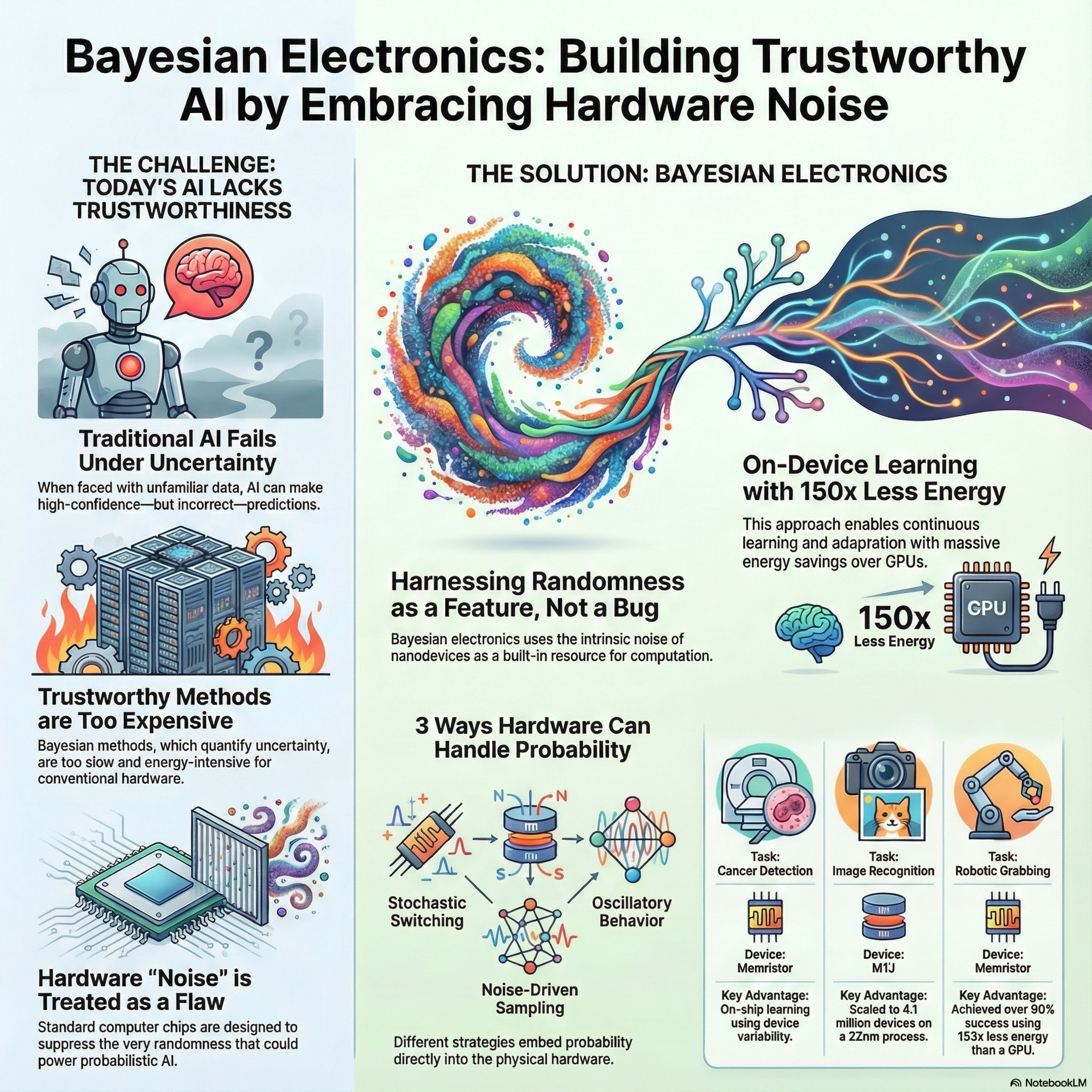
Modern AI can outperform humans — yet it often fails in the most dangerous way: it remains confident even when it’s wrong. In medicine, robotics, or autonomous systems, this confidence can lead to serious real-world consequences.A new research frontier known as Bayesian electronics proposes a radical shift — not by refining algorithms alone, but by redesigning the hardware itself. Instead of suppressing noise and randomness, researchers are learning to embrace them as a computational feature.Emerging nanodevices such as memristors naturally fluctuate. Remarkably, this physical randomness can directly encode probability, enabling AI systems to quantify uncertainty natively in hardware. The result is AI that doesn’t just predict — it knows how sure it is.This approach promises energy-efficient, adaptive, and fundamentally trustworthy AI, especially for edge devices like wearables, sensors, and autonomous robots.📄 Source paper:Bayesian electronics for trustworthy artificial intelligenceNature Reviews Electrical Engineering, Volume 2, Pages 846–855 (2025)#BayesianElectronics #TrustworthyAI #UncertaintyAwareAI #AIHardware#EdgeAI #Memristors #FutureOfComputing

Modern AI can outperform humans — yet it often fails in the most dangerous way: it remains confident even when it’s wrong. In medicine, robotics, or autonomous systems, this confidence can lead to serious real-world consequences.A new research frontier known as Bayesian electronics proposes a radical shift — not by refining algorithms alone, but by redesigning the hardware itself. Instead of suppressing noise and randomness, researchers are learning to embrace them as a computational feature.Emerging nanodevices such as memristors naturally fluctuate. Remarkably, this physical randomness can directly encode probability, enabling AI systems to quantify uncertainty natively in hardware. The result is AI that doesn’t just predict — it knows how sure it is.This approach promises energy-efficient, adaptive, and fundamentally trustworthy AI, especially for edge devices like wearables, sensors, and autonomous robots.📄 Source paper:Bayesian electronics for trustworthy artificial intelligenceNature Reviews Electrical Engineering, Volume 2, Pages 846–855 (2025)#BayesianElectronics #TrustworthyAI #UncertaintyAwareAI #AIHardware#EdgeAI #Memristors #FutureOfComputing

NOW PLAYING

Teaching Machines Uncertainty: Inside the Bayesian Electronics Revolution

0:00 15:37

No transcript for this episode yet

We transcribe on demand. Request one and we'll notify you when it's ready — usually under 10 minutes.

No similar episodes found.

No similar podcasts found.

Frequently Asked Questions

How long is this episode of The Deep Dive Lab: Unraveling Materials Science?

This episode is 15 minutes long.

When was this The Deep Dive Lab: Unraveling Materials Science episode published?

This episode was published on December 15, 2025.

What is this episode about?

Modern AI can outperform humans — yet it often fails in the most dangerous way: it remains confident even when it’s wrong. In medicine, robotics, or autonomous systems, this confidence can lead to serious real-world consequences.A new research...

Can I download this The Deep Dive Lab: Unraveling Materials Science episode?

Yes, you can download this episode by clicking the download button on the episode player, or subscribe to the podcast in your preferred podcast app for automatic downloads.
URL copied to clipboard!