
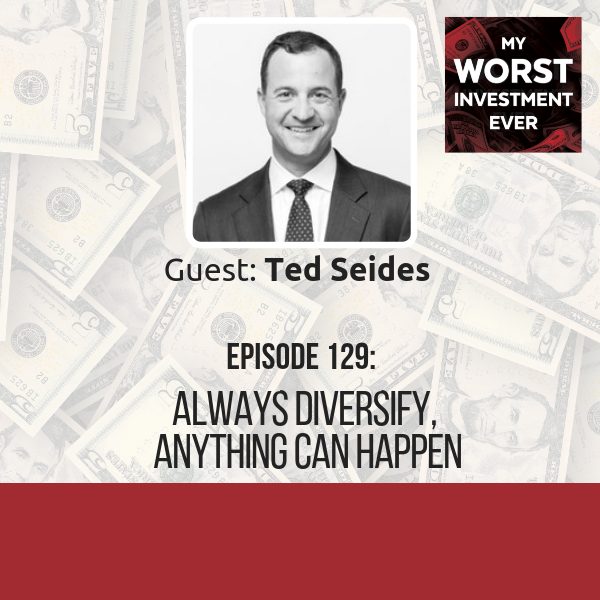
EPISODE · Aug 8, 2019 · 22 MIN
Ted Seides - Always Diversify, Anything Can Happen
from My Worst Investment Ever Podcast
Ted Seides, CFA, is the son of a teacher and a psychiatrist. Perhaps by genetic disposition, he is passionate about sharing his insights and investing in people. He is the chief investment officer of Perch Bay Group, a single-family office he joined in 2017 to manage a diversified portfolio of direct and fund investments across asset classes. Ted produces and hosts the Capital Allocators Podcast, which by the by the end of 2018 had reached one million downloads. From 2002 to 2015, Ted was a founder of Protégé Partners and served as president and co-chief investment officer. Protégé was a leading multibillion-dollar alternative investment firm that invested in and seeded small hedge funds. Ted built the firm’s investment process and managed the sourcing, research, and due diligence of its portfolios. In 2010, Larry Kochard and Cathleen Ritterheiser profiled Ted in Top Hedge Fund Investors: Stories, Strategies, and Advice. Sharing the lessons from his experience, Ted authored So You Want to Start a Hedge Fund: Lessons for Managers and Allocators in February 2016. He began his career in 1992 under the guidance of David Swensen at the Yale University Investments Office. During his five years at Yale, Ted focused on external public equity managers and internal fixed-income portfolio management. Following business school, he spent two years investing directly at private equity firms, Stonebridge Partners and J.H. Whitney & Company. With aspirations to demonstrate the salutary benefits of hedge funds on institutional portfolios to a broad audience, Ted made a non-profitable wager with Warren Buffett that pitted the 10-year performance of the S&P 500 against a selection of five hedge fund of funds from 2008-2017. Ted is a columnist for Institutional Investor, wrote a blog for the CFA Institute’s Enterprising Investor, and wrote guest publications for the late Peter L. Bernstein’s Economics and Portfolio Strategy newsletter. He is also a trustee and member of the investment committee at the Wenner-Gren Foundation, an active participant in the Hero’s Journey Foundation, and is a decade rider with Cycle for Survival. He previously served as a trustee and head of the programming committee for the Greenwich Roundtable and as a board member of Citizen Schools-New York. Ted holds a BA in economics and political science, Cum Laude, from Yale University and an MBA from Harvard Business School. “It was one of those examples that the market can stay rational longer than you can stay solvent, and that really anything can happen. There was nothing about the fundamentals of these assets that would have told you that this could have happened.” Ted Seides Support our sponsor Today’s episode is sponsored by the Women Building Wealth membership group, the complete proven step-by-step course to guide women from novice to competent investor. To learn more, visit: WomenBuildingWealth.net. Worst investment ever Ted chose one of his worst investments ever based on its outcome. In 2002, during his early years at Protégé Partners around the launch of that fund, one of the core investments they were making was in a multi-manager hedge fund portfolio. Within that portfolio, one of the core investments was in a relative-value arbitrage hedge fund called Parkcentral Global Hub. Principled fund group included Perot family It was a group that had spun out of or was included in the family office of the late Ross Perot. And the group had been managing its strategy for a long time very successfully in a kind of value-oriented, relative-value manner with a very long time horizon. There was a tremendous amount of co-investment (a minority investment made directly into an operating company alongside a financial sponsor or other private equity investor, in a leveraged buyout, recapitalization or growth capital transaction). Perot had put around US$500 million into the fund and there were highly skilled people running it. Seides said it was a rare case of an investment management organization run with great business principles. Fund launches in 2002 and grows to nearly 3bn in assets The fund launched to outside investors in July 2002, growing to US$2-3 billion in assets until they closed it to new investors. It continued to progress well under the goal of making 10%-12% a year with relatively low volatility. And they had done that historically. They found new structures and strategies, were very insightful and had good communcations enabling investors to know exactly what was going on. Few blips in Spring 2008 but nothing major But, heading into Spring 2008 the situation became shaky for them. A few things went wrong, but they were within the bounds of their understanding of risk and in the summer and into the fall, they would come by the office and said their largest position was a relative-value trade in the commercial mortgage-backed space. Out of the 2008 crisis, most people remember that subprime residential mortgages blew sky high. But in the commercial mortgage space, if considering the fundamentals, there were apparently few problems in the economy. Serious concerns aroused after fund loses 13% by September’s end But strange things were happening in the capital markets because of the turmoil, especially in September. The fund survived the Lehman bankruptcy in October, but going into November, they had a particular trade where they were going long in some senior debt – commercial mortgage-backed securities. The senior debt was priced as if something like 40% of the underlying commercial real estate would have to default with no recovery at all. And all because of the turmoil that was happening in the markets. It was so bad that the fund managers said it no longer made sense to continue to hedge with the junior debt because it had gone down so much that it was not really hedging anything, so they let all the clients know what was happening. By the end of the month, Parkcentral Global Hub had lost 13% of its value, in part because of commercial mortgage-backed securities, an affidavit from the Bermuda liquidators now says. October takes another 26% out, reducing net-asset value to under US$1.5bn In October, the fund lost an additional 26% of its value, reducing the fund’s net assets to just under $1.5 billion. November darker As November rolled in, the situation got worse. Losses continued early in the month and accelerated...
Embed this episode
Ready to play
Ted Seides - Always Diversify, Anything Can Happen
No transcript for this episode yet
Similar Episodes
No similar episodes found.