
EPISODE · Oct 1, 2025 · 11 MIN
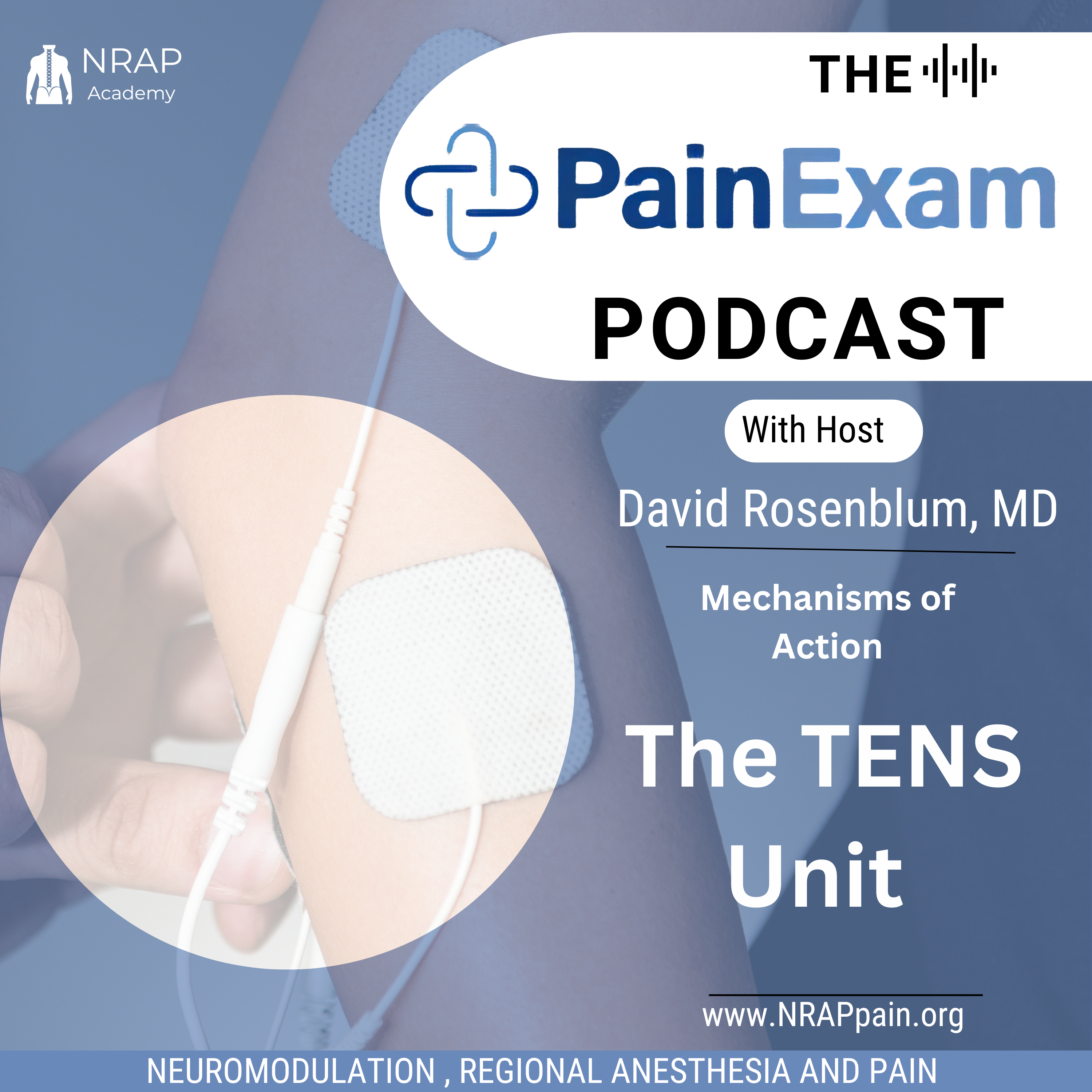
TENS for the Boards: Mechanism, Evidence, Controversy and more!
from PainExam Podcast · host David Rosenblum, MD
Project Sync / Status Update Summary Podcast Episode Overview The host discussed Transcutaneous Electrical Nerve Stimulation (TENS) as a recurring pain board topic and reviewed mechanisms, efficacy, and clinical considerations. Emphasis that TENS appears on pain boards annually and is a foundational topic from early podcast episodes. Board Prep and NRAP Community at PainExam.com or NRAPpain.org ABA ABPM ABIPP FIPP Pain Management Board prep, Question Banks, and Virtual Pain Fellowship Educational Offerings and Events Training and Courses: Monthly ultrasound courses in New York and upcoming courses in Detroit covering ultrasound-guided regional anesthesia and chronic pain. Ultrasound Guided Acute and Chronic Pain course in November near Hollywood/Fort Lauderdale with venue pending confirmation. Multiple instructors to offer diverse perspectives; registration via the CME calendar at nrappain.org. Conferences and Teaching: New York–New Jersey Pain Conference in November (hosted by Soudir Duwan). ISPN conference in London next week, with ultrasound teaching participation by the host. Community and Coaching: Private coaching and shadowing opportunities available; contact via newsletter replies. Access to the NRAP community forum upon signup at nrappain.org for discussions on neuromodulation, regional anesthesia, and pain. TENS: Mechanisms and Parameters Device and Parameters: TENS delivers adjustable pulse frequency and intensity; configurations include low (50–100+ Hz), and mixed frequencies. Mechanisms of Analgesia: Activation of large-diameter, non-noxious A-beta afferent fibers in the periphery, driving descending inhibitory pathways and reducing hyperalgesia. Board-relevant point: selective activation of A-beta fibers is frequently tested. Central effects: Reduces central excitability and nociceptive dorsal horn neuron activity in uninjured and injured models. Frequency-dependent opioid receptor mediation: High-frequency analgesia blocked by delta receptor antagonists. Low-frequency analgesia blocked by mu receptor antagonists (spinal cord and rostral ventral medulla). Additional receptor involvement: muscarinic M1/M3, GABA-A, and cannabinoid (CB1) receptors; blockade reduces or prevents TENS analgesia depending on frequency. Peripheral effects: High-frequency TENS reduces injury-related increases in substance P in DRG neurons. Blockade of peripheral opioid and CB1 receptors can prevent analgesia from both low- and high-frequency TENS. Clinical dosing considerations: Adequate dosing (timing, frequency of use, intensity achieving strong but non-painful paresthesia) influences efficacy. Analgesia has rapid onset/offset and may require repeated administration throughout the day for sustained relief. Evidence and Efficacy Summary Systematic Review Findings: Cochrane umbrella review of 9 systematic reviews (51 trials; n=2,895) comparing active TENS with sham/usual care found uncertain efficacy due to: Very low-quality evidence (risk of bias, small samples, methodological limitations). Inconsistent adverse event reporting. Heterogeneity in TENS parameters and comparators. Authors note uncertainty may be confounded by inadequate dosing not being an inclusion metric. Practical Interpretation: TENS is inexpensive, low-risk, self-administered, and titratable; commonly used by patients and physical therapists. Clinical experience suggests potential adjunctive benefit for acute pain, but systematic reviews are conflicting; more rigorous studies are needed. For board preparation, the critical takeaway is A-beta fiber activation. Key Takeaways for Board Prep TENS targets large-diameter non-noxious A-beta afferents to reduce nociceptive signaling. High-frequency TENS: analgesia mediated via delta opioid receptors; blocked by delta antagonists. Low-frequency TENS: analgesia mediated via mu opioid receptors; blocked by mu antagonists in spinal cord and RVM. Additional receptor systems influencing TENS efficacy include muscarinic (M1/M3), GABA-A, and CB1. Action Items Review TENS mechanisms with emphasis on A-beta fiber activation for board prep. Verify and publish final venue details for the November Florida ultrasound course. Share registration links and schedules for Detroit and New York ultrasound and chronic pain courses via CME calendar. Prepare teaching materials for ISPN London ultrasound sessions next week. Update board prep resources on painexam.com and nrappain.org with current TENS evidence and dosing guidance. Promote NRAP community forum access and private coaching/shadowing opportunities through the newsletter. David Rosenblum, MD, currently serves as the Director of Pain Management at Maimonides Medical Center and AABP Integrative Pain Care. As a member of the Department of Anesthesiology, he is involved in teaching, research, CME activities, and was key faculty in developing the anesthesiology residency's regional anesthesia block rotation, as well as institutional wide acute and chronic pain management protocols to ensure safe and effective pain management. He currently is a managing partner in a multi-physician private pain practice, AABP Integrative Pain Care, located in Brooklyn, NY. He is one of the earliest interventional pain physicians to integrate ultrasound guidance to improve the safety and accuracy of interventional pain procedures. Patients can go to www.AABPpain.com or call 718 436 7246 Awards New York Magazine: Top Doctors: 2016, 2017, 2018, 2021, 2022, 2023, 2024, 2025 Schneps Media: 2015, 2016, 2017, 2019, 2020 Top Doctors New York Metro Area (digital guide): 2016, 2017, 2018, 2019, 2020, 2021, 2022, 2023 2025 Schneps Media - Brooklyn Courier Life: 2021, 2022, 2023 References Johnson M. Transcutaneous Electrical Nerve Stimulation: Mechanisms, Clinical Application and Evidence. Rev Pain. 2007 Aug;1(1):7-11. doi: 10.1177/204946370700100103. PMID: 26526976; PMCID: PMC4589923. Vance, C.G.T.; Dailey, D.L.; Chimenti, R.L.; Van Gorp, B.J.; Crofford, L.J.; Sluka, K.A. Using TENS for Pain Control: Update on the State of the Evidence. Medicina 2022, 58, 1332. https://doi.org/10.3390/medicina58101332 #painnyc #painbrooklyn #prpbrooklyn #prpspine #regionalanesthsia #pccwindsor #paincareclinicswindsor #painwindsorontario #paindocwindsorontarior #paincareclinics #prpwindsorontario #prp
Embed this episode
NOW PLAYING
TENS for the Boards: Mechanism, Evidence, Controversy and more!
No transcript for this episode yet
Similar Episodes
No similar episodes found.
Similar Podcasts
No similar podcasts found.