Welcome to episode 260 of Shane Plays Geek Talk. Thanks so much for pressing play. I'm your host, Shane Stacks. This week, we're talking with David Roach of TerrainTronics. David...
Doesn't just want to make cool gaming terrain. He wants to help DMs and GMs bring delight to their players with easy do-it-yourself game terrain electronics. So we'll explain more of what that is in the episode, but trust me, I've seen it in person and it's super cool stuff and also easy to do. So I think you'll enjoy this. We also get into game terrain as part of storytelling, theatrical D&D, the no solder wire wrapping technique, which is good enough for NASA.
Pretty soldering jobs versus ugly soldering jobs. Smart ways to compete with big business as a small business. I do my usual thing and get a little bit into the business reality behind the creativity because I think that's always interesting to help people learn about. TerrainTronics products are open source. We talk about that. I don't know how we get all this, but do horses really go to the glue factory? What chain of events had to happen for many of the inventions and innovation and inventions and innovations in human history? Think mushrooms. And a minor tangent, the casinos, pit bosses, and getting calm to casinos, plus a whole lot more.
I want to remind people the last episode, episode 259, was Grindhouse Cinema with Levi Combs of Planet X Games. So if you're a movie buff, especially a Grindhouse or B-movie movie buff, go check that one out. And Levi also does cool stuff with Planet X Games as an RPG publisher of modules and gaming resources and zines and that stuff. So anyway, with no further ado. Why, yes, I believe we shall. Oh, I got a live one here.
Getting geeky all up in your podcast. It's Shane Plays Geek Talk, a journey into the things we live. I'm your host, Shane Stacks. Thanks so much for pressing play. As always, got a very cool show this week. This one, I've never had a topic like this before, so I'm excited to have it on. It's definitely gaming and tabletop RPG adjacent, but you could probably have other applications to it, including making stop-motion miniature films. I don't know. You could use this stuff for a lot of things. But my guest is David Roach.
of TerrainTronics, who I met at the most recent North Texas RPG Con. And Daphid, welcome to the show. Thank you very much. Thank you for having me. I really appreciate the opportunity. Glad to have you. I enjoyed meeting you at North Texas. I made a point of coming by your table more than once. I was taking pictures of your stuff and putting it out on the North Texas RPG Con Facebook saying, hey, go check this out. And this happens when you're a vendor. Sometimes you get in a room that doesn't get...
the main foot traffic. So I was really like, Hey, you got to go check this guy out. So, and I mean, I know people were seeing your stuff, but I was, I was kind of trying to be a town crier a little bit. I appreciated that very much. Yeah, you're welcome.
And then I went to, oh, Stefan Pokorny from Dwarven Forge. And I was like, this is a marriage made in heaven. You guys need to talk. Yeah, he stopped by later on. We had a great, great job. We're now connected on Instagram and text messaging back and forth, swapping ideas. That was a great connection, which I'm very grateful to you for. Yeah, well, one, I mean, you both seem like cool guys. Stefan's a nut. He's just, he's so enthusiastic. I don't know if you've ever seen the Dwarvenod. He's got a documentary out there about him. I almost paid for it. You know, the only way you can watch it right now is to buy it online. I was like, okay.
I can't force the wife to watch this. Yeah. Well, it's worth watching if you ever get a chance. He's such a unique guy. But anyway, he makes great dungeon terrain and your stuff is like a perfect match made in heaven, in my opinion. So why don't you tell, I already know, but tell me, and you're really telling the listeners, you know, what is TerrainTronics? What is this all about? Sure. So I make electronics and so on for tabletop.
terrain essentially and for people who do cosplay and things like this so the idea is you know i i was looking at a lot of the stuff that um the guys make big train sets uh make right you know the lights all over the place uh and the the you know the little crossings and things but you know the luxury those guys have is space right most of that stuff is in fixed installation it's hidden under the table big control boxes and things like that whereas when you're making terrain and especially as a tabletop rpg you know you're moving stuff onto the table you're moving stuff off the table and so a lot of this stuff has to be miniaturized in such a way that you can that you can really um that you can really fit it in this part of the terrain. And then on top of that, right, we have to look at how do we control such things, right? You know, your average railway diorama person has a big control panel, right? They put on their little hat and they pretend to be the controller, right? You don't want to do that as a DM. As a DM, you kind of want to hide and be sly and just have the table do it itself or make it look like the table's doing it itself.
So, yeah, that's where all this came from. And so far, it's been a lot of fun. You know, I started off playing 40K 25 years ago, right? So was that your entry into gaming? Or did you come in from Tabletop Wargaming? No, yeah, I came in from Tabletop Wargaming. And I started off doing Terrain Tronics. Really, initially, it was for 40K players and so on, right? Because I was thinking LEDs on the terrain, you know, all this kind of cool-looking futuristic cyber stuff.
And what I discovered, and I don't mean this in a disparaging way against 40k players, is that terrain for wargaming tends to be much more line of sight blocking. terrain doesn't tell a story it's not part of a of the story right it's just a you know you could use a can of beans or you could use a silo right they may they may put some effort into it for atmosphere but it's like i said it's a game mechanic the terrain is a game mechanic right right right it's not part of the narrative and so i very quickly discovered um what people were doing in dnd and you know other other um role-playing games and so on i discovered that the terrain is much more of a narrative it really tells a story uh and you know if you can you know either you know whether it's I don't know, simple lamps outside a home or a tavern or something, you know, that tells you, hey, it's evening right now because these lamps are on, right? You know, little things like that. Or whether it's a trap, you know, with spikes on it that gets fired, you know, when players take the wrong turn. You can tell a lot more. You can really sell that, what's the word I'm looking for? You know, being part of the story, right? You know, you're seeing it, you're hearing it, you're in some cases even feeling it with vibrations in the table, almost like an Xbox controller. You know, you're selling that concept of being part of the story and really being there.
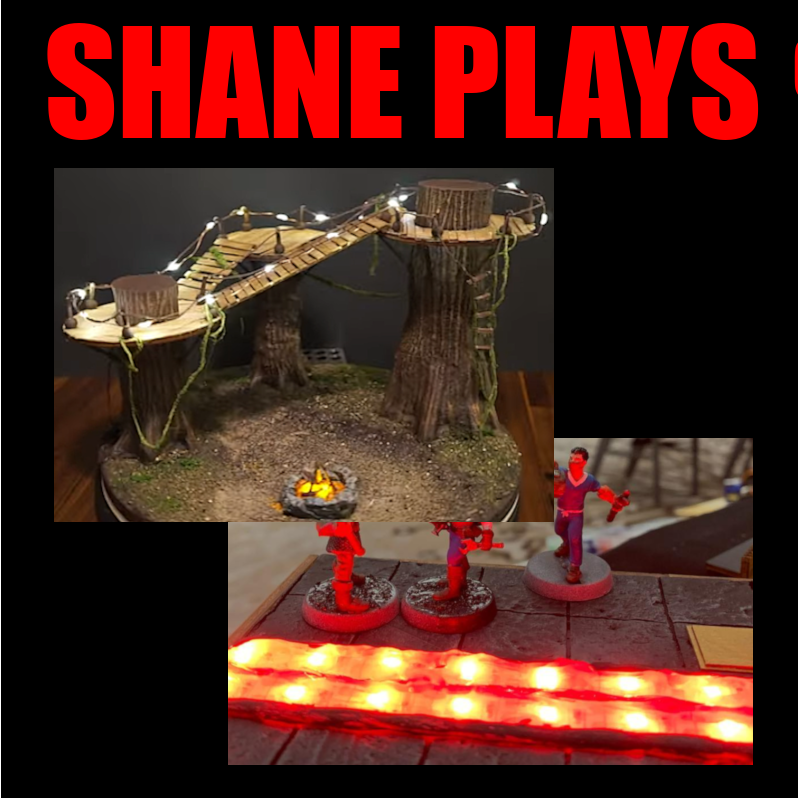
It doesn't take much. The brain fills in a lot of gaps. It does. So, you know, I want to kind of touch on a couple of things you mentioned there. One, you know, I went and got my son and brought him back down to your setup. And he literally, so you had a little, you had multiple things set up. You had a forest village. You could call it an Ewok village if you want, but it could be used for a lot more than little platforms in the trees and little flickering lanterns and a fire pit. There was a...
a room uh that the lighting would change like like the guys walking through and it was kind of soothing lighting but as soon as the boss comes out the lighting turned red it was like now we're in the it's dangerous fight um there was another setup where uh it literally the terrain was actually part of the gameplay where there were pressure plates uh i think you did some cool little wizardry stuff with magnets that depending on where somebody was standing uh it would activate other stuff in the room to allow navigating to the room I think maybe it was a lava. You had to get a barrel to get out some lava or something similar to that. You had an old thing. It was a hallway.
And I definitely want to touch on this. You mentioned the traps. So you had this little minifig, you're going down the hallway and spikes shot out of the wall and got the minifig or the miniature, not a Lego minifig. It was a miniature. And my son actually gasped and clapped his hands in delight. So yeah, he loved that. So, you know, players will eat that up. So, and then you had, like I said, you know, you've got other stuff and there's in the show notes that people go to the show notes at ShanePlays.com, you know, and of course I'll let, I'll let you give out your YouTube and other stuff as well, David.
But in the show notes, I'm going to link to the video of your forest village, your quote unquote indoor Ewok village. You know, and it's, you know, it gives it one thing I like about that video when it shows off quality of your work. But you don't just this impress me. You don't just say, hey, here's this neat thing I made. Go to Traintronics.com and buy all this stuff. You you spend about 90 percent of the video showing people how to make it. And then if you're like, oh, and if by the way, if you want.
Some of what I used, you can get it here. And you weren't always referring to your own stuff. Sometimes you were referring to other vendors who were giving credit to other electronic engineers. So I was very impressed with that. Oh, I appreciate that. Yeah, it wasn't a commercial disguised as a video. An infomercial, right? Yeah, yeah. You can cut a tin can and then slice a tomato with them, yeah. And so I was impressed with that. It was a very interesting video. I've got some background in electronics. I was an electronics technician in the Air Force.
But you obviously know your stuff, the way that you so confidently talk about stuff. It's obvious that you enjoy this. You like playing with it. So I'm guessing this is one of those hobbies that you started doing stuff. And you're like, well, you know what? Let's see if I can maybe help other people or make a little money or something. I know you said you came out of Wargaming. But what actually led you to go? Where was the jump into TerrainTronics? So let's talk about the motivation. I think that's what we're really going with here.
So I have a day job in electronics and clearly, you know, that takes care of the healthcare plan and that takes care of the 401k and so on. So, you know, starting TerrainTronics was never about, you know, this will make me a millionaire and put my son through college one day and all that kind of thing. It's more about how can I help people delight the players when they sit around the table? If I can be three to 5% of your terrain build that, you know, when you unleash it on your players, they go, whoa, that for me gives me warm and fuzzies. Like deep down in my core, it's given me warm and fuzzies that just to think that I'm helping somebody create that wow at the table.
And so, you know, there's many ways we can do that, right? I started off just with, you know, how can we make things look pretty and tell a story? Again, lamps outside a cottage, right? And then came, you know, the concept of, you know, how can I make the Dungeon Master into the Uber Master, if you will, with a remote control? So, you know, he or she can, you know, change how the table is behaving with a slightly hidden remote control in their hand. And then, yeah, the last thing was, you know, how can we make the table...
drive itself. So the DM just sits there with a grin on his or her face, watching all of this happen on the table. And, you know, he walked through a few of the demos I put together for North Texas RPG Con. The Endor Forest, if you want to call it that, that's an aesthetic narrative. Look, it's lights around the terrain. It was the largest piece of rechargeable terrain I've ever seen. It's the only one I've ever seen, but the largest one. It's rechargeable. That's another thing. Like when you were talking about, you could plug a USB into it and recharge it before you store it away. Or even charge it on the shelf, right? If you've got some IKEA Billy shelves, run your little USB.
charges on the wall into it and so on um yeah we'll come back to that one because that's a whole kind of different path i've taken more recently um so you know that's that's the aesthetically looking nice one and then we did one which was you discussed the dungeon where you know the big bad guy turns up and with a push of a remote control the lights change from you know candle flickering on the wall to boss fight you know which was nice i mean that was a that was a I mean, players would love that, right? Because you're, like you said, that's telling part of the story. It's like music and lighting in a movie, right? Yes, exactly. Think of it like this, right? I've played a few games of D&D myself now at a place here in Dallas. And I've watched it, you know.
A few episodes of Critical Role, that's a bit much for me, but I've watched a few of those and a few of the others streaming on Twitch and so on. And everybody loves the words, roll for initiative. It's almost as if the DM doesn't even say, get ready, guys, you're about to fight. They just say, roll for initiative. And everyone goes, yay! Well, imagine if you've got a town of terrain around all these buildings and in the middle of the pieta, whatever you want to call it, the middle of the square, suddenly you put down a bad guy or something like that. And instead of saying, roll for initiative, every light on the terrain turns red.
And my dream sequence here is that the light in the room that you have above your head also turns red as well. So if you could synchronize them all together, it would almost be like that sound effect you hear in Marvel movies, like a slow motion, a boom or something like that, right? That's the effect. That's what I want, right? Because I think people would just go ape for that. They would just go, what?
yeah, you know, throw their dice down to roll for initiative. So, you know, that's that. And then finally, sorry, I got a little excited there. Finally, the last one is, you saw I do puzzle rooms, right, which are a small six by six array room. And it's all the wood, all the plastics, all the electronics, everything you need, where you can, using read switches, which detect the presence of magnets. So you put magnets underneath your players. By using read switches, you can set up logic to change lights and so on, right? And just to clarify for the...
five percent that might get confused by that under the mini not the player itself you don't you don't have to magnify yeah right that's the only way to get the full effect That's a whole style of D&D that I'm probably not going to do a show on. Yeah, that's more cosplay, right? No, no. You're going to get me in trouble. All right, back to the mini. Minis and magnets. Minis and magnets. So the idea behind the puzzle rooms was more like, how do I make a miniature escape room? I'm not sure if you've tried one of these escape rooms, but there's typically many puzzles one after the other. And one of the ones I developed for the Tip Top RPG, North Texas RPG, sorry, was a lava room. It's a river of lava. And when you stand on the right place, it switches the light off.
And all that is, is a switch, a magnetic switch that is triggered by the mini with a magnet underneath. But, you know, when you couple that kind of mechanic with a little bit of storytelling and everything else, right, it really pulls people together. It moves D&D away from walk, fight, walk, fight, walk, fight to, you know, walk, fight, solve a puzzle together, right? And then, you know, move on and replenish and get to a fight and so on. It just changes the dynamic a little bit. And that's what I was trying to do. The other thing is that the DM isn't even involved in that, in a way, right? The DM can actually sit back and watch the players solve the puzzle together. I love that idea.
Right. You know, one of the things I've seen is often the DM is the bad guy. Whereas, you know, with a lot of stuff I'm building, the mechanics are built into the table itself. And the DM is just keeping everyone, you know, following rules, if you will. Right. Yeah. Playing goalie. Just keeping them within bounds or something. The referee, the linesman, right? Yeah, exactly. So, yeah, it's almost like the DM is insert or the GM or the narrator, depending on what game you're playing. There are games where you're literally called the referee. It's almost like in the terrain, you've inserted a mini game.
So instead of saying, okay, give me an intelligence check or, you know, whatever, you just sit back and let the players actually physically manipulate their minis and figure out the track or the traps or the puzzle or whatever. You know, and that doesn't mean that if, you know, the wonderful thing about a tabletop role-playing game is the GM can manipulate it however he wants. So if he sees that the people are struggling, he could go, all right, you give me an intelligence check. And you go, you know, you might want to think about looking for a pressure plate or, you know what I mean? Just something like that. So you could either make it a blend or of styles or whatever. So one thing that I liked about
your presentation at your table was you were saying all you were showing all the little you're like okay so this thing uses these components and yeah you could do some wire wrapping that was good enough for NASA to go to the moon and all this stuff so without without being at your table can you walk through some can you give me some of that that great I don't I don't mean this in a bad way I mean it in an impressive way it was like it was like a a ringleader at a circus or a carny, like giving a really great spiel. And I don't mean that negatively. No, no, no, I don't take it negatively. It's fun for me that you actually remembered some of the messaging, right? So, you know, one of the biggest roadblocks, right, that stop people getting into electronics. There's two of them, right? One, what if I break it and I can't fix it? And then I've wasted all my money, right? So step one, you have to make whatever you sell indestructible. But step two, a lot of people don't want to solder, right? They don't want to sit there with a soldering iron and learn how to solder. It's a whole other hobby. They don't want to learn. They just want to assemble and get going.
And in my day job, about two, three years ago, I visited a big electronics manufacturer. And we had samples of our parts or something. And this lady says to me, oh, you know, can I wire it into my existing system? And I said, oh, well, you know, you haven't got a soldering iron here. She goes, oh, I don't need one of them. And she reached for something that looks like a screwdriver. And I said, what's that? And she goes, ah, you know, she's the one that told me that this is the technology that took NASA to the moon in the 60s.
And so I'm almost copying word for word here. This is a, this is, you can't say it because this is a verbal podcast, but a wire app tool. And essentially it takes very, very narrow wire that you buy from Amazon, right? The last time I bought some from Amazon, I bought in for $10, I bought enough that I'll probably have some leftover to pass onto my son, right? That's how much wire you get, right? And the wire app tool itself, and it essentially wraps the wires really tightly around, around pins on a circuit board. So when you buy, for instance, a circuit board from Ferentronics, the simplest one we sell.
It comes ready to go. You plug USB in, and then you have to connect LEDs to it. And the way we connect LEDs, you can either use wires which already have connectors built into them and some hot glue. Some electronics people are turning in their graves thinking that you'd use hot glue near connectors and things, but if the Chinese can do it, so can I. Well, I mean, if it works, it works. I mean, does the signal conduct? Does it conduct reliably? It works. Right, right, right. And that's the thing, whereas...
And so most of the time those wires are great and they're great for prototyping. I use them for prototyping all the time. In fact, I'll show a little later. But wire wrapping, it's incredibly fast. And so what it allows you to do is, you need a wire that is three feet, two inches long. Fine, no problem, right? Because it's just on one continuous reel. You cut it to the length you want. And the wire wrapping tool looks like a screwdriver. You insert the wire in a certain place and you just wrap it around the pin and it's strong. You can tug on the darn thing and it won't come off.
So when I tried that for the first time at this customer I was visiting and I was pulling on the wire, I was thinking, dang, she's right, NASA really could have taken this technology to the moon. Because you think of the vibration in a rocket taking off in a Saturn V rocket, right? That's intense. And so, yeah, the message is one of the biggest, we'll call it a differentiator, a thing that I want to be different from everybody else with, is that soldering is kept to a minimum. And the worst soldering you'll have to do is maybe soldering the pins into the board itself when you first get it, which is pretty easy compared to some of the micro soldering type stuff that's out there. As my chemistry teacher would have said, it's bucket soldering. A basic solder is not...
and I've got some experience with it, you know, learn how to solder in the air force. It's, it's really not that hard. Uh, you know, and it doesn't have to be perfect and pretty. And I know people that, I mean, they would do these beautiful soldering jobs and it's like, nobody's ever going to see that. I mean, I'm glad you're proud of it and you put the time into it and take pride in your work, but ugly solder over here is going to conduct signal. I do like the idea of a wire wrap tool though, because I do think that it's a,
it lowers the barrier to entry. I think people thinking about, oh, I can just grab something. Plus, you do occasionally, especially if somebody's not super used to soldering, you can get a cold solder and create an open. Yeah, exactly. And you don't have to de-solder. Like, oh, I've got it. You get it wrong, you just rub it the other way and it comes off. The other thing is really nice, actually, is being able to sit there on a Saturday morning with your son or your daughter assembling. And there's no soldering required, right? You're just...
wire wrapping away and seeing if the lights light up. It's a really nice way of, you know, quality focused time with your kids as well. That is, that's a good idea. Yeah. I need to do one of these projects with my son. He's the right age. He's eight. So this would be perfect. Yeah. Perfect. You know, I focus for half an hour, 45 minutes. You know, you can't expect more from an eight to 10 year old. Right. But if you get half an hour of, you know, tongue sticking out to the side, you know, kind of trying to solder these things together. It's a really nice bonding experience. Yeah. I love it. And I, you know, I want to, this is a good opportunity to mention this will be in the show notes, but people can also, you know, search for Terrain Tronics, Terrain just like Terrain.
tronics like electronics but tronics uh and on your website that looks like tindy.com but people just search for terrain tronics it'll take you there or go to the show notes for this episode at shankplays.com you actually sell that wire wrap tool um and and you know as well as multiple other components and pieces and stuff like that um now i do get some listeners outside of the US. And on your video, you mentioned you, is it Etsy for the European? Europe has this wonderful law now for shipping anything into Europe. You have to be registered with the European government to pay tax for import tax and so on. And so Etsy has already done that for me. So for European orders, you just go into Etsy and search TerrainTronics. And then for US, just go to TerrainTronics.com. The pricing is the same. It's just made easier. But the first stop for everybody really should be the YouTube channel.
frankly uh you know learn about the product um there's a whole bunch of collaborators i've worked with a lot of folks on youtube as well people who make terrain mainly um and uh yeah they really enjoyed the products really really you know and you know it's funny people start off with just one little board four lights around the place and then before i know it they're asking for you know four boards because they want 16 lights around the product all flickering all flashing all all singing and dancing right so do you get i mean your online store your website is more focused on individual components that you can bring together and build whatever you want. Lights, you've got flickering LEDs, you've got string lights, you've got terrain kits that aren't even electronic. I mean, you've got all this stuff, remote controls, LED drivers, like a circuit board to control LEDs and whatnot. Are you getting a lot of requests that people want you to build something for them? And do you go for that? Only one person has asked me to build for them. I'm surprised.
That was Stephen Pokorny. He's like, oh, I like this stuff. Clearly he wants custom stuff, right? Because when DMs, he wants it to stand out. Well, and he does. Actually, sorry to interrupt you, but that touches on, this is where the Venn diagram of TerrainTronics and Stephen Pokorny overlap. He's into what he calls a theatrical D&D. So he builds these elaborate. So what you do is you help people create.
theatrical D&D boards and presentations to add atmosphere to the play. So, but I have to admit, I'm surprised that he's the only one that's asked you for anything custom. I figured that'd be the automatic thing. Like, oh, I love what you did there. Can you build me one of those? Yeah, and you know, the answer is no. I'm not, I don't consider myself very good with card foam and glue and paint. It's a, I'm good enough to get by, right? You know, the five demos you saw at North Texas, I mean, that took me a long time to put those together. There's a whole row of ones that look terrible. And so, you know, there's a lot more skills out there in paint and glue than there are.
in electronics, right? And so I try to focus my time on making the electronic side as easy as possible. So talking about the foam and this and that and the other, what was the software you showed in your video about the indoor forest? It was 3D rendering, but it let you foam everything out like you were working. What was that? That was so cool. Yeah, so I have a VR headset, and there's a piece of software called Adobe Medium, which you can run and connect to your PC, and you can essentially model in 3D with the goggles on.
so you can pick up the model you can pick up the object rotate it in your hand turn it around look underneath it look over it spin it around and uh what i was trying to make was a fire pit so a bunch of rocks you know in a circle and the uh the software has a bunch of stencils built into it and one of the stencils was rocks different rocks you know kind of you know square ones triangular ones and all this kind of thing and you in one hand you're holding the you know the last block you just put down and in the other hand you literally it feels it feels like you're playing with expanding foam you know the stuff used to fill a hole in your wall you know like you split it and expands it feels like that so you know you grab a rock you put your controller next to it and you pull the trigger you know it blows up the next rock next to it and you just move things around another rock another rock another rock and you know within about half an hour 45 minutes which is probably slow compared to experts in this i hardly consider myself an expert um i had a ring of rocks Perfect. So I exported that into the 3D printer software, set the size appropriately, and off it went. So that, and then I do a lot of modeling of lamps and so on. So for instance, one of the things you noticed on the shop earlier, I sell flickering LEDs, right? The candle-like flickering LEDs. Amazon's going to hammer me on pricing for that, right? There's no way I can compete with Amazon. But when you buy LEDs from me, I give you...
access to those stls for all those models i've built so whenever i build something for myself a copy of the file goes into a special dropbox directory and so when people buy leds for me because i know amazon could hammer me amazon won't give you free stls like that or they won't give you you know the stuff that is relevant to 28 millimeter tabletop rpg And let me just say, one, that's very smart. One, that's nice of you because you're wanting people. You said earlier that your ultimate goal is you want people to be delighted at the game table. But when you say Amazon's hammering you, you're not charging an arm and a leg. I mean, I'm looking at these flickering LEDs. $2.95 for 10 flickering LEDs.
In my opinion, you're not, I mean, yeah, Amazon's working on bulk, but that's not an outrageous price to begin with. And then you've got, like I said, you're offering those STL files and all that. So that's really cool. It's just a little sweet, a little thank you. It's nice to support small businesses, right? Well, you've got it. And this isn't apples to apples, but it's kind of similar thinking.
when you run a small business set next to Walmart, you have to compete. Let me, this, I'm just coming at, this is, so I have a family that they own a long established drugstore and pharmacy in a small town. And, you know, in a small town, at least in the South of America, anyway, the drugstore, quote unquote, drugstore is like a local, it just, you know, you can go in. hit the soda fountain or you can get, uh, pick up gifts or like, yeah, well, it's not just that. It's also like you could get cool gifts that you can't get anywhere else. And then it's also a pharmacy and it's, it's just, you know, kind of a destination point in a downtown and, and then in comes Walmart like 20 years ago or something. Right. So, uh, they started delivery.
We will deliver your pharmacy to you. Guess what? Walmart won't do. So you've got to add that something. You've got to be willing to do something. They won't. Even if your prices are the same as Walmart, people are already going to Walmart to buy 800. So you've got to do something to set yourself apart. Anyway, that's a tangent, but it kind of touches philosophically a little bit on what you're doing. It's like, I'm going to give you something that you can't get at Amazon. And it's something specific. It shows I understand.
what people are going to be using this for. Amazon doesn't care when they sell you LEDs what you're going to use them for. Amazon doesn't care. It's an entity, right? Whereas, you know, what I'm trying to do with this and everything else I sell is make it applicable to your build, to your story that you're trying to tell on your table. And so, yeah. So if you had any fun, I know you've had the people come back asking, oh, I want to build this now. I want to build this now. Does a story stick out to you? Like maybe somebody shared with you something that they did at their table that they were pleased with? So the main ones these days.
You know, with every box that goes out the door, I put a sticker and a note in there that says, you know, please share photographs of what you build, you know, share them with me. And people tend to be quite private, I think, in that regard. But, you know, people who do share, you know, are your Instagrammers and your YouTubers and so on. I've seen some fantastic builds with that. There's a channel called Tabletop Witchcraft, which I've done a few different builds with. And he started off, he did a build where he put magnetic sensors under a table of, randomly placed under a 4x4 grid. And what he did on one side of the 4x4 grid, he had what looked like crossbows.
And then on the other side, on the other wall, he put LEDs in that wall. So it looked like when an LED came up, a crossbow had been shot across the room. And it was one of those kind of, you know, can you put your foot down on the right spot? Can you cross across this path without triggering the crossbows to shoot you and so on? And that was the first of the videos that went out using these magnetic sensors, these read switches. And very soon afterwards, another channel called Nat One Videos. Michael, the guy over there, he built, I'm not sure if I'm saying it correctly, Balin's Tomb from Lord of the Rings. Right.
And, you know, he had the sarcophagus, the coffin, the stone coffin in the middle of the room. And when you put the mini on top of that, a spotlight switches on from behind and shines down over the coffin. Which is perfect because that's, you know, they built that tomb. I'm talking about like it's a real thing. Tolkien to me is very real. I just finished reading The Silmorellian and I love Tolkien.
Yeah, they made it so that sunlight would pour in like a spotlight just on that tomb. Yeah, so that's perfect. The wonderful thing was, you know, I didn't even know this guy over at Nat1 Minis at the time. And months later, I was talking to him, finally, you know, got in contact with him. And he said, oh, yeah, I built that Balin's tomb after I saw John's video, Tabletop Witchcraft. And I was like, what? He goes, yeah, I saw John using these magnetic sensors. And I thought, oh, I can do that. And so I did. And I was like, yes, yes. Again, that's the thrill, right? If I can be three to five percent of someone's build. Right. And it can cause delight. I'm thrilled. I'm over the moon. Well, the funny thing is.
And the same thing happens with movies, TV, animated stuff, even some songs and music. That three to five percent can pack a far stronger punch than that three to five percent. Right. Just the right color, just the right something, just the right illumination. So, yeah, having like you could look at that Balan's tomb and it's not Balan with a big book. He's in a tomb.
So you could have that, and it looks great. You could be totally impressed with it. But then that little spotlight comes down, and then it's magical. And certainly people are talking about it, right? Did you see this? Did you see that? It's so cool. Yeah, that is cool. I'm going to add links to the Tabletop Witchcraft YouTube channel and also the Nat1 Minis. Nat1 Videos, yeah. Is it Nat1 Minis? No, Nat1 Videos. Okay, Nat1 Videos. I'll send you links offline. Okay, yeah, I'll add them to the show notes. Folks, go to ShanePlays.com. Check out the show notes for this episode. But yeah, actually, you mentioned Tabletop Witchcraft. When I first walked up to your booth, you had a...
a monitor, like a computer monitor, and it said tabletop witchcraft on it. So at first, I thought that was the name of your endeavor. No, no. He was one of the first YouTubes I worked with. And he did an even better job than I do of showing how easy it is to hook this stuff together. When I first started talking to him, he said, yeah, I have a soldering iron, but I've destroyed it burning foam. He used to use it to burn foam. Oh, he used it as a tool, a sculpting tool. Right, exactly. And I was like, OK, we've got a long way to go here. I've never heard of somebody using a soldering iron that way. Never.
And so, yeah, but, you know, he's a massive believer in the wire app tool and just, you know, wiring things up so easily and not being scared of breaking it. Not being scared of breaking it. Just try it. And, you know, if it doesn't work, take it off and scratch your head and try again. Right. So speaking of, you were talking about, you know, making stuff easy to do, et cetera.
So if somebody's interested, it's like, I would really like to try this out, but my comfort level on electronics is low. What project would you recommend to them to build their confidence right out of the gate? So the gateway drug is, and you'll see it. So all my projects on Traintronics.com, they're all named after Welsh castles. I'm from Wales originally. There's 600 castles in Wales. That's enough projects to keep me from now until retirement. And so the one to really look at to get people hooked is the Conway Castle. Conway Castle is a USB in. So you take a USB power bank if you like, or you can use a little coin battery thing. But I like USB power banks because everybody has them. They last a really long time and they're really easy to use. So it takes USB in and it gives you four LED outputs with a brightness control.
so you hook in four leds one two three four no need for any extra parts right you wire wrap them on or you just use a little jumper wire and if it doesn't work the first time you just turn the wires around and it works that way and then you sit there with a little screwdriver literally changing the brightness until you get what you want It just works. Nice. So you saw the cottage I built at the North Texas RPG Con, right? I had a cottage with four lamps outside on brackets. Yes, yes. That's just a Conway board. Yeah, that's one I didn't even mention. That looks so cozy. Come on in, adventurers. It's so cozy. Is it Conway Castle? Conway Castle, which is not a castle. It's a small circuit board. It's a small circuit board the size of the top joint of your thumb. Yeah. They are tiny. And so that can be hidden in the building. It can be hidden in the base.
You saw the Endor Forest that I built. That was a Conway Castle board. I had a rechargeable battery in there and a Conway Castle board. And that was it. There's a Conway Castle. There was one of the output channels connected up to string lights in the trees, which I got 20 sets of string lights for 10 bucks on Amazon, I think. Again, I don't...
if i'm not going to fight with amazon i'll send business their way right and then again that's something that impressed me in your video you're like go to this person for this part or you know order this from them you know you weren't trying to hog everything so well what am i going to do you know if i'm going to try and sell something right i mean i'm going to have to you know owning a shop 101 you double almost whatever you buy something in that if i buy something for a dollar to make even worthwhile selling i have to sell it for two if it's something i'm not touching in any way if it's not something i'm adding value to and so yeah i mean why why you know, why buy from Amazon to resell to somebody else and double the price? I mean, it may as well just send them to Amazon in the first place. Well, let me, let me interject there if you don't mind. I always try to do this with people that I have on, no matter how creative the endeavor, you touched on something that is very important. And I always try to stress to people, you said running a shop 101 or owning a shop 101. There's a business side to this stuff. And, you know, the artists, the creators, the writers, whatever that I talk to,
that at least break even if not, uh, if you're doing it as a hobby, you're hoping you're at least breaking even. Exactly. Exactly. If you're making a run at it to be your livelihood, you want to do more than break even, but there's a business behind. I always try to stress this, but the war, man, it sounds mean, but the world doesn't care about your dreams. It sounds terrible because that's so against everyone's like, follow your heart, do this and do that and chase your dreams. Yes. Chase your dreams. Like doing this podcast for me is something I love to do. So I put time into it.
but there is a reality to it. Like you've got to, I used to work with a guy who owned a business. We called it covering the nut. You got to cover the nut. And I guess maybe that means a squirrel storing up nuts for winter. I don't know. I don't even know where that term came from.
you, you, if you go into it purely on dreams and I feel excited about this, you'll get, you will get pilloried. So yeah, please chase your dreams, but also have a plan, know what you're getting into. All right. And there is that 1% of people out there that will just charge into it, not knowing what they're doing and succeed. Yeah. And good for them and good for them, but that's not a plan. That's it just happened to work out. So anyway, all right.
No, no, I'm glad you touched on that because, you know, yeah, D&D like this, this is not the place to make a living, right? I mean, you can go into my Tindy store today and it tells you this store has had, I think it's 153 orders since it was started last year, right? You know, you do the math on that. If you said the average product on that is 15 bucks, right? You could do some back of a napkin math and work out that I'm not sending my son to college on that. And so you need a far bigger market. But it sounds like you haven't lost money either.
Right? Hopefully. Not yet. Not yet. Not yet. Not yet. Not yet. Not yet. Yeah, it's coming along. It's coming along. There's still a long ways to go. One of the big things I decided very early on was that everything I do is going to be open source.
And so some people think that being open source is dangerous for a small business, right? Because you're giving away your secrets. For me, open source means all the schematics for my boards, all the code that I write, everything is open source. You can go online, you can find it, you can modify it, you can tweak it. But I also came to the conclusion, early on, I was still trying to decide, is this going to be something I'm going to be doing in five years? Is this something I'm going to be doing in 10 years?
Right. Longevity is a challenge, right? In a small business that you're starting, you have to be prepared. If it's not working after two or three years to take it out back and, you know, send it to live on the farm. Right. You know, it's, it's, you know, whether you put a bullet in it or not. And I decided at the beginning, I said, okay, I'm going to make this open source so that, you know, either people can adopt it quickly and easily. They can see my working. I don't need to support them all the way. Right. You know, schematics being open mean that if somebody can read schematics, they can understand how this, how the board works rather than asking me and pulling me away from, you know, my nine till five to do that as well. Right. Cause you're trying to customize that one little thing. Right. Or change the color, change the colors of the LEDs and so on.
Right. So yeah, being open source was very, very, very important to me. And it was driven by both A, a passion, but B, business sense these days. Yep. Well, so what...
What is your ultimate hope? Like, you know, you said you got your exit point. And that's another good point, which I've done stuff where I haven't followed this advice and I've gotten myself into trouble. You've got to know when you say I'm out. No matter how much I love this. Oh, when I start losing money, that'll be my out. For now, I'm breaking even. The money I make pays for new circuit boards to be developed and sent off to China, right? And then, you know, the parts come back and I manufacture them here in my garage. And yeah, if I ever start to get to the point where I'm losing money and like month after month, I'm like, oh crap, I'm losing a couple of hundred bucks a month or maybe even more. Then it'll be okay. Everything is open to you guys.
Here's the designs at a local China manufacturer if you want them. And I'll let it set sail from there. So that's when the horse goes to the glue factory. Right. That's when you take it out back and shoot it. Did they ever really make... Where did that phrase come from? Do horses ever really get turned into glue? Have you ever heard that phrase? Yeah. I'm not sure they still do anymore, but they were, right? It was the marrow in the bones. They used that to make glue.
Life is bizarre, man. I just want to know who came and discovered that in the first place. Right, how does this stuff happen? Well, it's like, you remember Fight Club, right? Did you ever see Fight Club? Yeah, yeah, yeah. Where they turn the fat into... Yeah, so they came into, you know, it's like, how do they figure out fat? I mean, is that real? Did they make it up for the movie? But there's so many inventions and innovations in human history. It's like, what chain of events could have possibly...
Well, no, no, no. The one is like poisonous mushrooms, right? The poor guy who discovered that these mushrooms are poisonous, but these ones are okay. Hey, Dave, it's your turn to eat the mushrooms again. Fuck no. Like, screw you, man. I don't need seasoning. I ate the mushrooms last time and all I could see was stars for a while. Oh, man. Yeah, it's like learning what's edible. And there's another corollary, the human behavior. They're like, you know, because Neanderthals and Homo sapiens are not the same species, but they're close. But yet there's Neanderthal DNA in human.
some human DNA, which leads to the inevitable conclusion. Somebody went, I wonder if I can, that's such a human trait, right? It's a Saturday night. There's monkey people over there. It's two o'clock in the morning. I got my beer goggles on. The last song of the night's playing. How about that one? Who discovered beer? Who discovered that you could ferment stuff? And when you drank it, it made you feel kind of funny. This is exactly what I'm talking about. There's so many. What chain of either accidents or purposeful human stupidity and recklessness led to all this stuff, man? Purposeful human stupidity. That sounds like the name of a bad band, doesn't it? They were a prog rock band.
There's just a bunch of hold my beer moments in human history that led to wonderful innovations. So anyway, all right. So getting this back on topic. So you were saying that your intro drug project is- Is a colony board. Yeah. Okay. It's a colony board. And I've got, so I'm a member of a few different discords.
there's the tabletop crafters union and a few of the you know channel specific ones like nat1 videos has a good discord that's a patreon only one um and uh a tabletop witchcraft again um and you know a lot of those guys uh one of the guys was asking me about doing a prison with a number of cells in it right for some kind of arkham horror type uh diorama and you know i i said well you know you could you know just get you know one big circuit board and all this or you could just go buy two three of these things two three colony boards and just wire them up in parallel next to each other and he goes oh that's easy that's the easiest thing for you to do just get it done right You know, just it doesn't have to be difficult. You know, you can do some pretty smart stuff with the bare basics of technology. So colonies are great for that. The nice thing about colonies is, you know, you can't burn out parts. You can't put them in the wrong way around. If you do, the light just doesn't switch on, at which point you turn the part around and connect it up again. And the light comes on, right? I mean, it's pretty difficult to screw up. And so, you know, if you do want that kind of, I wonder if I can do this type experience, that's a great way to start. It kind of reminds me.
Man, I remember talking about no solder and easy, and it either works or it doesn't. I remember one of my favorite things to play with that made me feel smart when I was, I don't know, junior high, elementary school, something like that, is you could take a battery. I think it was like a C battery, a D battery. Maybe a 9-volt would work. But if you had the right wire, you could run wire from the negative to the positive and then run it to a light bulb, and then the light bulb would light up. And it was super easy. And you either did it right or you didn't. There was no...
you know, there wasn't a lot of troubleshooting involved. I started off years ago with those, do you remember those boards used to get with like springs in them and all the parts were kind of stuck down and you had wires that you could connect to. You pull the spring back and you basically jammed the wire into where the spring was and then you attached it somewhere else. You had a battery over here with a pair of springs. push the wire down, bend the spring back so it catches the wire. And then, you know, there's a light bulb over there. You bring the wire over, pull the spring back over there. And you could, you know, build a little radio. Yeah, yeah, it was great stuff. That was great stuff. That was the gateway for me years ago. I'm not sure what the kids are doing these days. Probably playing with Raspberry Pis or something complex. Raspberry Pis are cool. I mean, I could see I've got a little Raspberry Pi here that I bought just because they're too neat. I mean, one, I like to play with Linux, but two, there's too many cool applications. I mean, you can do all kinds of stuff. I've used one here for...
So I have a lot of prototypes that never see the light of day because I'm still teaching people how to solder one pin to another pin or how to wire wrap, right? I've got one ecosystem of people who I just learned to wire wrap and I've got other people going, how do I do this and this and this and this? But I had the overhead light at the beginning I was talking about, right? And being able to control that. And I had the access cards used, like when you work for a big business to get in through the front door, you swiped those, acting as inventory items. So I had one with a bottle of grog on it, right? And when you swiped it across the right place.
The PC went glug, glug, glug, glug, glug, glug. Oh, what a great idea. And the lights went dim, right? Yeah, because really all those little access cards are little magnetic strips with data encoded on them. So you just, yeah, this has the series of numbers that equals grog or mead or wine. Right, right, exactly, exactly. Oh, I love that. I love that so much. The reader was trained. The reader, I actually put it in a, so I went to.
dollar tree. And I bought a notebook that was covered in leather. It wasn't leather. And I, you know, kind of burnt the words inventory into it. Right. I put a battery inside it, put a little Wi-Fi doodad and one of these readers all inside the book. And the idea was you'd give the book to whoever wanted to use the piece of inventory that they had picked up and they would swipe the card.
right to use the inventory so you know you want to drink down this magical potion swipe and from the speakers you'd hear see that's so great yeah there's so many applications here and you could also you could also have a whole setup where you're like okay i'm ready for the lights to turn red swipe the card and it happens or you know i mean you could do all this stuff you know you'd have to engineer it and all that but I think a lot of people that would appeal to them like, oh, which switch? No, I don't even have to remember which switch or button to hit. I just swipe a card and it does work. What I see a lot of people starting to deal with now, do you know what a stream deck is? Have you seen one of these things? A lot of the YouTube streamers are using them now. Sorry, the Twitch streamers. It's a little control panel that's got, the one I have is three buttons up by five. So it's 15 buttons with a graphic behind them that can change. So they can, right. Yeah, I know the kind of thing you're talking about. Right. And so that can be used to do stuff with your terrain as well.
Yeah, hit this button and all the lights turn red. Hit that button and you get a sound effect, right? It's all for your friendly GM to dream bigger. Right, I love it. I had a lovely welcome at North Texas RPG Con, but I found a lot of the folks there were... It was interesting. I came to North Texas RPG Con thinking, I'm going to sell $10 here, $10 there. It's going to be like lots of little sales. What I discovered was it was more like a casino. I had a couple of big fish that came along that said, I want one of everything. I get it. I'm having the aha moment. And then a lot of other people who came in and went, that's cool, but I can't do that.
Yeah. And that was an interesting moment. That was a real eye-opener. I was wondering to myself if it was just the audience, you know, would I have a different experience, for instance, at Gen Con's way too big, but, you know, a newer convention where there's a more diversity? Well, I mean, we can say, yeah, I mean, you know, there are younger people at North Texas RPG Con, but it's also a bunch of, and I include myself in this mix, like veteran grognard type people. So I don't know. That's an interesting thought. I mean, I know that you have a marketing focus in your life, so.
It doesn't surprise me that you're analyzing it from that perspective. I think the biggest difference was that was caught off guard. Well, at least you had a couple of big wells that came along. Yeah, that's true. If people don't know, well just means one person who buys a lot of stuff. It's not meant pejoratively. Some people might use it that way. I don't. Comic book shops, in a lot of ways, are getting supported by wells. There are some people that will buy one of everything, and thank goodness for them.
so yeah there's people who come in dump 500 bucks worth on comics and so on right you know every other week right and those are the ones which pay the rent right exactly so yeah i definitely don't mean it uh i think where did that term come from i don't know it's a casino thing right it's a casino thing oh is that okay bro yeah well i know that there's like stockbroker movies where they get somebody on the line and they're like this guy's a whale but in that movie they meant it bad because they were um it was boiler room that movie boiler room where they uh they were selling like Illegal stocks. Penny stocks, right? Penny stocks, I think it was. It was like in that, they meant a rube. They meant somebody who, you know, we've got an idiot on the line. But anyway, moving on. I'm thinking of Casino. You remember the movie Casino? Yeah, of course I remember Casino. And they talk about like, you know, the Japanese whale, you know, like the guy who comes in, you know, you comp him everything and he just loses a ton of money in your casino every time he comes. I've actually been with friends and then after this, I got to wrap this up. I remember I went to a casino one time and one of the guys we were with lost, for us, in our average middle-class life, he lost a lot of money.
To the casino, it probably wasn't a whole lot. But they comped us like free meals in a room. And it makes you feel good. It doesn't equal out against the amount of money that you lost. Because I got technical in the shorts. But they'll do that. Here's another tip. It never hurts to ask in a casino, ever. Hey, can you comp us? You know, you get up from a table and say, hey, can you comp us a meal? A lot of times, the pit boss will comp you stuff. So it never hurts to ask. Well, it's probably the next time I go. Yeah. It never hurts. The worst they're going to do is say, no, I can't do that. But at least used to. Now, it's been a long time since I've been into a casino. But used to. I'd go every now and then.
A friend of mine was like, I'm going to see if I can get a room comp or I'm going to see if I can get a meal comp. It's like, you're just going to annoy the guy. But the guy's like, yeah, that's fine. Whatever. And like gave him a piece of paper. So anyway, there's a bit, the pit boss is who you have to ask because I know this is mad. We're way off on a tangent, but so if you go to let, let, for example, say you go sit down at a blackjack table, there's usually like five or six blackjack tables. You got all the dealers and then behind them in the behind them, you'll see somebody walking around, keeping an eye out. That's the pit boss. That's the person who's got the power. So anyway, all right, well, I got to wrap this up.
David, it's been great. You know, I really appreciate it. I hope to stay in touch with you and definitely run into you some more. I'm probably going to order some of this stuff to work on with my son. I think that, and I can use it with my D&D, weekly D&D game too. So I love the idea of it. And I like that you're, I like your approach is obviously you can try if you make some money, but your approach is you want to spread the light and I dig that. Spread the light. I like that. I like that. I'm going to borrow that. Spread the light with Terrain Tronics. Yeah. So yeah, do it. Yeah. I'll only take 1% royalties. Yeah.
No, I'm just joking, obviously. But anyway, I have to do this to you. I do it to everybody. I do the bad joke of the week, which is misappropriate. It's not appropriately named because I used to be a weekly show, but I'm not anymore. But I still keep it of the week because that just has a nice ring to it, right? Okay. Bad joke of the show just doesn't have the same ring to it. So bad joke of the week, right? Okay. All right.
And I'm going to put the pictures on the show notes. I'm going to put the pictures I took at North Texas up there so people can see some of the stuff. I should have mentioned that. I may put a footnote at the beginning of the show, like, hey, the stuff I'm talking about, describing what you write and go look at. All right. Anyway, so here goes. What happened when the hot dog made a movie?
This is like a really bad dad joke, isn't it? Oh, yeah. No, it's terrible. Yeah, it's a bad joke. It became an Oscar wiener. Oh, gee. Shay, that's awful. It's supposed to be. Yeah. Ooh, that's terrible. I can't wait to use it. That's awful. How can you do that? You know, it's summer. Summer. Celebrating summer. I've got another. Let me see. I've got another bad hot dog joke. I can drop it on you. Hold on. I literally... Did you Google hot dog jokes? No, but when I hear good jokes, I write them down. Okay.
All right, here's another one. Why did the vegan hot dog cross the road? Oh, it's got to be, wait, wait. It's got to be a joke about it. Did it tell you about it? It's got to be something along those lines. No, no, it's not. No, I'll save you. It's not. It didn't go out of its way. Yeah, to prove he wasn't chicken. Oh. Yeah, okay. Those are two dad jokes. My son's away at camp this week, but as soon as he gets back, he's getting those two. Double barrel.
Thank you again, Shane. I really appreciate it. Yeah, David, it's been a pleasure having you. Folks, again, that's TerrainTronics. Go to TerrainTronics.com. Go to show notes at ShanePlays.com. Check it out. There's stuff. Go to TerrainTronics.com. Check out TerrainTronics on YouTube. Definitely watch the video for the Indoor Tree Platform Lighted Forest Camp Diorama Tutorial. And then check out Tabletop Witchcraft and that one videos as well. And David might be sending me some more links to add. We'll see. So anyway, we'll catch you next time on ShanePlaysGeekTalk.
Thanks so much for listening to Shame Plays Geek Talk. I certainly hope you enjoyed this journey into the things we love. For your convenience, show notes with helpful links for each episode can always be found at shameplays.com. You can catch the podcast in several places, including on the blog at shameplays.com, iTunes, Google Play Music, Stitcher, Podbean, Amazon Music, Verbal, YouTube, and more. If you like what you hear and would like to support Shame Plays Geek Talk, you can do so for as little as $1 per episode on Patreon at patreon.com slash shameplays. Thanks again for listening, and we'll see you next time. Stay geeky, my friends.