
EPISODE · Sep 6, 2026 · 56 MIN
The 1950's
from Disturbing History · host Disturbing History-True Stories
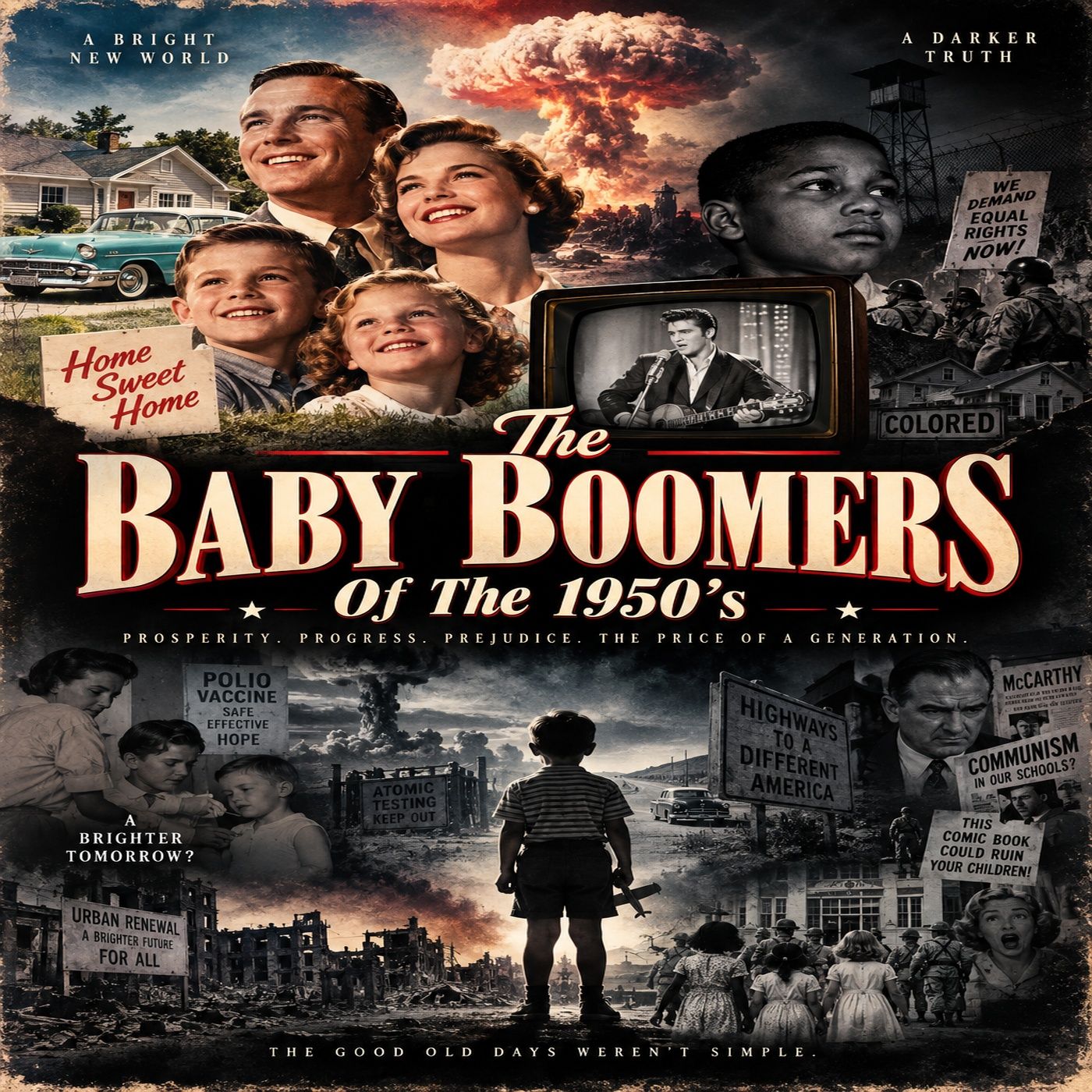
Everybody carries a version of the 1950s around in their head, and the strange thing is that a surprising amount of it is true. For millions of American families, one paycheck really could support a house, a car, and children. Homeownership climbed from roughly 44 percent before World War II to about 62 percent by 1960.Television went from a novelty to a fixture in nearly nine out of ten homes, Elvis Presley drew an audience of roughly 60 million people on The Ed Sullivan Show, and when the polio vaccine was declared safe and effective in 1955, church bells rang across the country.For a large group of mostly white, married, union-wage families, the 1950s delivered a level of prosperity and security their parents could scarcely have imagined. That part of the picture is real.But this episode turns the photograph over. In the first installment of The Good Old Lie, Disturbing History looks at what existed alongside that prosperity: whites-only housing restrictions, redlining, discrimination in GI Bill benefits, and the violent reaction that greeted Black families who attempted to move into newly built suburbs. It follows urban renewal and the interstate highway system through neighborhoods such as Rondo, Overtown, and Black Bottom, communities cut apart after their residents had already been excluded from much of the suburban boom.It also confronts the murder of 14-year-old Emmett Till in 1955, the open casket his mother insisted the world see, the acquittal of the men accused of killing him, and the confession they later sold to a national magazine.Then there was the danger falling from the sky. The episode examines the aboveground nuclear tests conducted at the Nevada Test Site, the downwind communities of southern Utah, the radioactive fallout that entered the food supply, the atomic soldiers placed near nuclear detonations, Castle Bravo and the crew of the Lucky Dragon No. 5, and the Saint Louis baby-tooth survey that helped demonstrate how radioactive strontium was entering children's bodies. It also explores the remarkable arrangement that gave Eastman Kodak advance warning about fallout capable of damaging photographic film while nearby families received no comparable protection.The hazards of everyday life were often far less dramatic but no less real. Cigarettes were promoted with doctors' endorsements. Shoe stores used X-ray machines to fit children's feet. DDT fog trucks rolled through neighborhoods. Lead paint was sold for homes and nurseries. Automobile deaths remained staggering.Medicine brought miracles and disasters at the same time. The polio vaccine helped conquer one of the most feared diseases in America, while the Cutter Incident exposed roughly 200,000 children to improperly manufactured vaccine. DES was prescribed to pregnant women before its consequences appeared years later in their daughters. Tranquilizers such as Miltown became a chemical answer to domestic unhappiness.The episode also examines the legal and social structures surrounding women, LGBTQ Americans, people with disabilities, psychiatric patients, and the poor. Married women could still face enormous barriers to obtaining credit in their own names. Marital rape remained legal nationwide.During the Baby Scoop Era, enormous numbers of unmarried mothers were pressured or coerced into surrendering their children for adoption.Homosexuality was classified as a psychiatric disorder, while the Lavender Scare destroyed thousands of federal careers. State mental hospitals held more than half a million people at the decade's peak. Institutions such as Willowbrook became symbols of neglect and abuse. Walter Freeman continued performing lobotomies, and compulsory sterilization programs remained active in states including North Carolina.Some of the decade's darkest experimentation—Tuskegee, Fernald, Henrietta Lacks, and MKULTRA—has been covered elsewhere on Disturbing History, so this episode concentrates instead on abuses carried out openly as government policy: Operation Wetback, federal Indian termination and relocation programs, and the destruction of the community at Chavez Ravine.And then there was fear.Joseph McCarthy, the Hollywood blacklist, the Rosenberg executions, and the Red Scare unfolded alongside a national panic over teenagers, comic books, and rock and roll.Congress investigated juvenile delinquency. Fredric Wertham blamed comics for corrupting children. The Comics Code reshaped an entire industry. Elvis Presley became dangerous enough that television cameras were instructed to avoid showing too much of his hips.Yet the children supposedly being corrupted by the 1950s were also the generation coming of age during Brown v. Board of Education, the 381-day Montgomery Bus Boycott, and the confrontation at Central High School in Little Rock, where nine Black teenagers walked through an angry crowd under the protection of the 101st Airborne Division.That contradiction is the heart of The Good Old Lie.Every generation remembers the progress it inherited and tends to forget the price someone else paid for it. Every decade produces extraordinary achievements alongside extraordinary damage, and every generation eventually looks at the one coming behind it and wonders where everything went wrong.This is Episode One of a new Disturbing History series moving decade by decade from the 1950s toward the present.This episode includes discussion of racial violence, the murder of a child, nuclear fallout, medical harm, institutional abuse, forced sterilization, and suicide.Follow Disturbing History, leave a rating or review, and send this episode to somebody who is absolutely certain the good old days were simpler.Email BrianJoin Our FREE NewsletterGet Brian's Books Leave Us A VoicemailVisit Our WebsiteHave a forgotten historical mystery, disturbing event, unsolved crime, or hidden conspiracy you think deserves investigation?Send your suggestions to [email protected] History is a dark history podcast exploring unsolved mysteries, secret societies, historical conspiracies, lost civilizations, and the shadowy stories buried beneath the surface of the past.Follow the show and enable automatic downloads so you never miss a deep dive into history’s most unsettling secrets.Because sometimes the truth is darker than fiction.
Embed this episode
What this episode covers
Everybody carries a version of the 1950s around in their head, and the strange thing is that a surprising amount of it is true. For millions of American families, one paycheck really could support a house, a car, and children. Homeownership climbed from roughly 44 percent before World War II to about 62 percent by 1960. Television went from a novelty to a fixture in nearly nine out of ten homes, Elvis Presley drew an audience of roughly 60 million people on The Ed Sullivan Show, and when the polio vaccine was declared safe and effective in 1955, church bells rang across the country. For a large group of mostly white, married, union-wage families, the 1950s delivered a level of prosperity and security their parents could scarcely have imagined. That part of the picture is real. But this episode turns the photograph over. In the first installment of The Good Old Lie, Disturbing History looks at what existed alongside that prosperity: whites-only housing restrictions, redlining, discrimination in GI Bill benefits, and the violent reaction that greeted Black families who attempted to move into newly built suburbs. It follows urban renewal and the interstate highway system through neighborhoods such as Rondo, Overtown, and Black Bottom, communities cut apart after their residents had already been excluded from much of the suburban boom.It also confronts the murder of 14-year-old Emmett Till in 1955, the open casket his mother insisted the world see, the acquittal of the men accused of killing him, and the confession they later sold to a national magazine. Then there was the danger falling from the sky. The episode examines the aboveground nuclear tests conducted at the Nevada Test Site, the downwind communities of southern Utah, the radioactive fallout that entered the food supply, the atomic soldiers placed near nuclear detonations, Castle Bravo and the crew of the Lucky Dragon No. 5, and the Saint Louis baby-tooth survey that helped demonstrate how radioactive strontium was entering children's bodies. It also explores the remarkable arrangement that gave Eastman Kodak advance warning about fallout capable of damaging photographic film while nearby families received no comparable protection. The hazards of everyday life were often far less dramatic but no less real. Cigarettes were promoted with doctors' endorsements. Shoe stores used X-ray machines to fit children's feet. DDT fog trucks rolled through neighborhoods. Lead paint was sold for homes and nurseries. Automobile deaths remained staggering. Medicine brought miracles and disasters at the same time. The polio vaccine helped conquer one of the most feared diseases in America, while the Cutter Incident exposed roughly 200,000 children to improperly manufactured vaccine. DES was prescribed to pregnant women before its consequences appeared years later in their daughters. Tranquilizers such as Miltown became a chemical answer to domestic unhappiness. The episode also examines the legal and social structures surrounding women, LGBTQ Americans, people with disabilities, psychiatric patients, and the poor. Married women could still face enormous barriers to obtaining credit in their own names. Marital rape remained legal nationwide. During the Baby Scoop Era, enormous numbers of unmarried mothers were pressured or coerced into surrendering their children for adoption.Homosexuality was classified as a psychiatric disorder, while the Lavender Scare destroyed thousands of federal careers. State mental hospitals held more than half a million people at the decade's peak. Institutions such as Willowbrook became symbols of neglect and abuse. Walter Freeman continued performing lobotomies, and compulsory sterilization programs remained active in states including North Carolina.Some of the decade's darkest experimentation—Tuskegee, Fernald, Henrietta Lacks, and...
Ready to play
The 1950's
No transcript for this episode yet
Similar Episodes
No similar episodes found.