
EPISODE · Jul 13, 2026 · 20 MIN
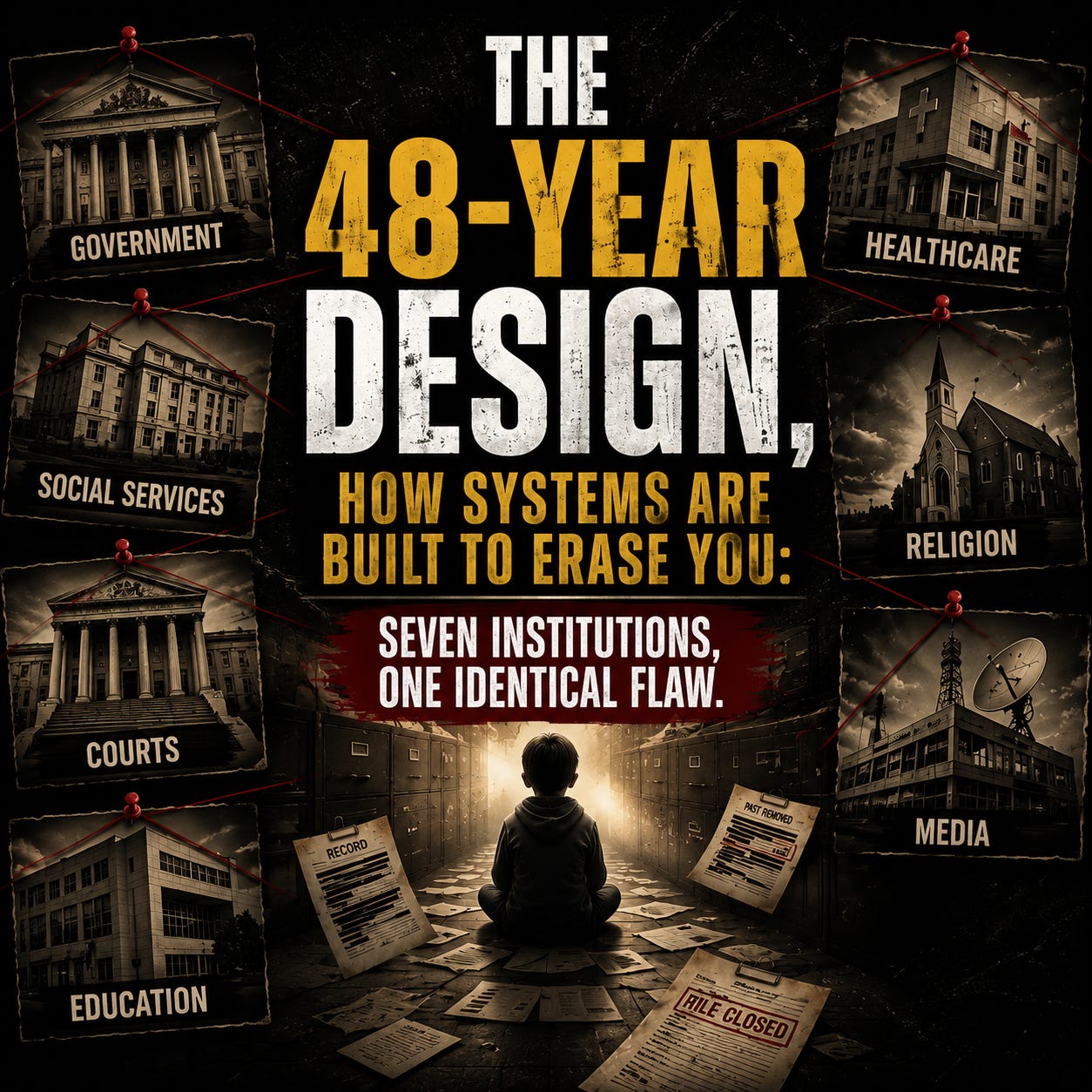
The 48-Year Design, How Systems Are Built to Erase You:
from The Experience of Adoption · host Thoughtless Delineation
You have been reading these as separate stories. A government database. A state inquiry. A deportation policy. An AI company’s ethics document. A UN convention. A data breach. A birth certificate. A regulator’s own resume.They are the same story, told by institutions that have never had to answer to each other.Every one of them is the same act, performed by a different hand: a system built to see a population, and built — not by accident, by specification — to not see the person inside it. Once you can name that architecture, you cannot find one of these institutions innocent of it. Not the ones that seal records. Not the ones that score ethics. Not the ones that build AI. Not the ones that write international law. All of them, when you check the schema instead of the mission statement, come back with the same missing field.The evidence, laid side by sideThe federal record (ep45, “Schema as Confession: Inside the US Federal Adoption Database”, published 11 July 2026). AFCARS, the only comprehensive US federal record of adoption, holds roughly 186 data points on every child processed through it — the date parental rights were severed, the date the adoption was finalised, a scatter of demographics. Not one field for the child’s original name. The agency’s own rulemaking admits it strips identifying data because that data could reveal who the child is. Built, on the record, to never give it back.The state seal that completes it (ep45, same piece). Every US state replaces the original birth certificate with an amended one naming the adoptive parents as if they had given birth. In thirty-three states and DC, an adult still needs a court’s permission to see their own beginning. The federal system erases the record; the state buries what’s left.The exfiltration (ep13, “The State Sealed the Record. The Market Got the Data.”). The one database that does hold the biological parentage the states sealed — the SSA Numident, via its dual-entry SS-5 architecture — was allegedly taken out the back door by a DOGE-linked operative en route to a defence contractor. The channel that might have held your original identity was not opened to you. It may have been opened to Leidos. The forensic methodology built for that episode — using the adoptee-specific multi-entry signature as a fingerprint for exfiltrated data — remains, as far as TD’s research established, the only technique in public discourse that could test the claim independent of the contractor’s own findings.The state government that knew and didn’t move (ep22, ep28). Queensland’s Anastassiou Commission delivered 1,384 pages and 52 recommendations on the state’s child-safety failures. The minister responsible for acting on them, Amanda Camm. A previous minister, Deb Frecklington, is documented rolling back adoptee information access and reversing the rollback only under public pressure. The $500,000 figure in EP22’s title is the state’s own costing of a child in its care — a number attached to a person with no number attached to their name.The deportation (ep29, “Operation True Parent”). Adoptees brought to the US as children, raised as citizens in every way that mattered, discover in adulthood that the paperwork finishing their citizenship was never completed — because the same institutional apparatus that processed their adoption failed, or declined, to close the loop. At least 49 cases surfaced by early 2026. Some face deportation to countries where who they’ve become — their faith, their identity — is criminalised. The amended birth certificate and the missing citizenship paperwork are not two failures. They are the same decision, decades apart, about whose paperwork is worth finishing.The AI company (ep30, “The Good Guys Problem”). Anthropic’s constitutional framework for Claude — twenty-three thousand words on how the model should reason about ethics — does not contain the word “adoption.” Anthropic’s own research demonstrated that community input reduces model bias; the in-house constitution remains the operative document anyway. Its even-handedness doctrine produces “balance” as a default output regardless of whether a domain has a legitimate other side — including, structurally, domains involving documented institutional harm to children. A company built on the premise of careful ethical reasoning has a blind spot shaped exactly like the one AFCARS has, expressed in constitutional philosophy instead of database schema.The international law (ep33, “I Built a Tool That Scores Governance Frameworks. Then I Pointed It at the UN.”). The UNCRC, ratified by 196 countries, scores 62 out of 100 on the OMISSION Platform’s governance-visibility instrument. Recomputed with every named right actually weighted for whether the institutions bound by it can see it, the honest score is 26. The 36-point gap is not spread evenly. It collapses in exactly three domains: Consent (Consent 2.66), Agency (ORI 1.40), Self-Determination (ORI 3.03) — the three domains that would require the child’s own participation to function.The most-ratified human rights instrument in the world was not built to see the rights that require the child to speak for themself.The regulator who was always the industry — a 48-year arc, not one appointment. In 1978, an adoption agency called the Edna Gladney Home funded the founding of a new organisation: the National Council For Adoption. Its purpose was not disguised even at the time — sealed records were coming under pressure, and the industry needed a body to defend them. NCFA’s president for the next twenty years, William L. Pierce, personally lobbied Senators John Tower and Jeremiah Denton to strip open-records provisions from Jimmy Carter’s Model State Adoption Act, and later drove the Uniform Adoption Act through state legislatures in the 1990s — the legal architecture, in large part, that every administration since has simply inherited and maintained. The industry did not respond to federal adoption policy. It built the organisation that helped write it.Forty-eight years later, the arc closes. In early 2026, Ryan Hanlon — who had spent the prior three years as President and CEO of that same organisation, after running an adoption agency before that — was appointed Associate Commissioner of the Children’s Bureau, the federal office that administers AFCARS, sets national child welfare policy, and oversees roughly $12 billion in annual child welfare financing. The appointment is confirmed on ACF’s own staff page. In 1978, the industry needed a lobbyist to work the regulator from outside. By 2026, it no longer needs one. Its own former president simply is the regulator.This is not an accusation of a backroom deal. It is simpler and more durable than that: no one had to bribe their way into the chair. They only had to wait, across five decades, for the door to be held open by the ordinary, entirely legal mechanism of a presidential appointment that requires no Senate confirmation at all. The access ran in both directions the whole time. The Congressional Coalition on Adoption Institute — an explicitly bipartisan caucus of 163 members of Congress — has spent decades handing out its “Angels in Adoption” award to sitting legislators nominated by adoption and foster agencies in their own districts. Hanlon received that award himself, in 2022, while running NCFA. The industry and the Congress that funds it have had a formal, public handshake in place for years. Pierce worked the outside of the door for twenty. Hanlon walked through it.Why this is one architecture and not seven — now eight — coincidencesLook at what repeats, not what differs.Every one of these systems is comprehensive on paper and structurally blind at exactly the point where the person would need to be present as a person rather than a record. Every one of them can be defended, sincerely, as doing exactly what it was designed to do — and that defence is the confession, not the alibi. A federal database that counts populations. A state government that manages a portfolio. A convention that governs on behalf of. A company that reasons about ethics in the abstract. None of them had to conspire with each other. They didn’t need to. They were all handed the same design brief — see the population, manage the category, keep the ledger — and every one of them solved it the same way: by making the individual optional.That is what the Architecture of Silence means when it stops being a metaphor. It is not one villain’s cover-up. It is a design pattern, reproduced independently across a federal records system, a state child-safety apparatus, an international convention, a frontier AI lab, and — most plainly of all — a regulator’s own appointment letter, because it is the default answer to “how do we govern people at scale” whenever no one is forced to ask “and what happens to the one person this doesn’t fit.”What “waking up” actually requiresNot outrage at eight institutions. Outrage is what each of them can absorb one at a time — a lawsuit here, a bad news cycle there, a rule delayed and reissued. What none of them can absorb is the same finding, run against them with the same method, published in the same week, showing the same missing field.That is the actual weapon this body of work has built, across eight investigations that were never planned as a set: a repeatable forensic method — schema audit, foreseeability timeline, governance scoring, provenance-of-appointment — that returns the identical verdict no matter which institution it is pointed at. The OMISSION Platform can score any framework. The provenance-forensics method can audit any record, or any resume. The foreseeability memo can be run against any agency’s own rulemaking history. This is not seven anecdotes and a footnote. It is one falsifiable claim about how modern institutions govern people, tested eight times, and confirmed eight times.Run it on the ninth. Point it at whatever institution you were told was different. It will not come back clean, because the blindness was never about the subject matter. It was always about whether the person was allowed to be more than a data point in the system built to manage them.That is the thing to wake up to. Not that eight institutions failed adoptees. That every institution built to govern people at scale will fail them the same way, in the same place, for the same structural reason — until someone runs the audit and makes them answer for the schema, or the appointment letter, instead of the mission statement.PresentationSource noteDrawn from: ep13 (DOGE/Numident exfiltration forensic methodology), ep22 (”The $500,000 Child,” Queensland OOHC), ep28 (Queensland/Anastassiou Commission policy-capture investigation), ep29 (”Operation True Parent,” US adoptee deportation), ep30 (”The Good Guys Problem,” Anthropic constitutional AI critique), ep33 (”I Built a Tool That Scores Governance Frameworks,” OMISSION Platform / UNCRC), ep45 (“Schema as Confession: Inside the US Federal Adoption Database”, published 11 July 2026 — AFCARS system-design dossier, state OBC access map, foreseeability memo), a prior TD forensic investigation into NCFA’s founding and William L. Pierce’s lobbying record (B*****d Nation archive; University of Minnesota NCFA records collection — sourced in that investigation’s own dossier, not re-verified against primary archives in this session), and the Ryan Hanlon / Children’s Bureau exhibit built directly in this piece. Specific figures for ep13/22/28/29/30/33 are drawn from session records of those episodes’ production, not re-verified against the published texts in this session — confirm exact wording against the live Substack posts before quoting this synthesis publicly. ep45’s findings are primary-source verified, and the piece itself is now live at the link above. The Hanlon appointment and the Congressional Coalition on Adoption Institute’s “Angels in Adoption” award are both primary-source verified: acf.gov’s own staff biography page confirms Hanlon’s appointment and NCFA tenure; his 2022 Angel in Adoption award is corroborated by The Imprint’s coverage of the appointment. The Pierce/NCFA founding narrative (Edna Gladney Home funding, the lobbying of Senators Tower and Denton, the Model State Adoption Act and Uniform Adoption Act history) is drawn from a prior TD investigation’s own sourcing and was not independently re-verified against primary archives in this session — treat as high-confidence given TD’s prior sourcing discipline, but confirm against the original archive citations before publishing if this is the first time it’s appearing in print. The broader “shadow lobbying” framing (donor-advised funds, faith-based mobilisation infrastructure) drawn from a separate secondary source, “The Lobby That Buys Children,” is a lead worth further verification, not an independently confirmed finding, and is deliberately not quoted or asserted as fact anywhere in the article body above. This is a public episode. If you'd like to discuss this with other subscribers or get access to bonus episodes, visit thoughtlessdel.substack.com/subscribe
Embed this episode
NOW PLAYING
The 48-Year Design, How Systems Are Built to Erase You:
No transcript for this episode yet
Similar Episodes
No similar episodes found.
Similar Podcasts
No similar podcasts found.