
EPISODE · Jun 4, 2026 · 40 MIN
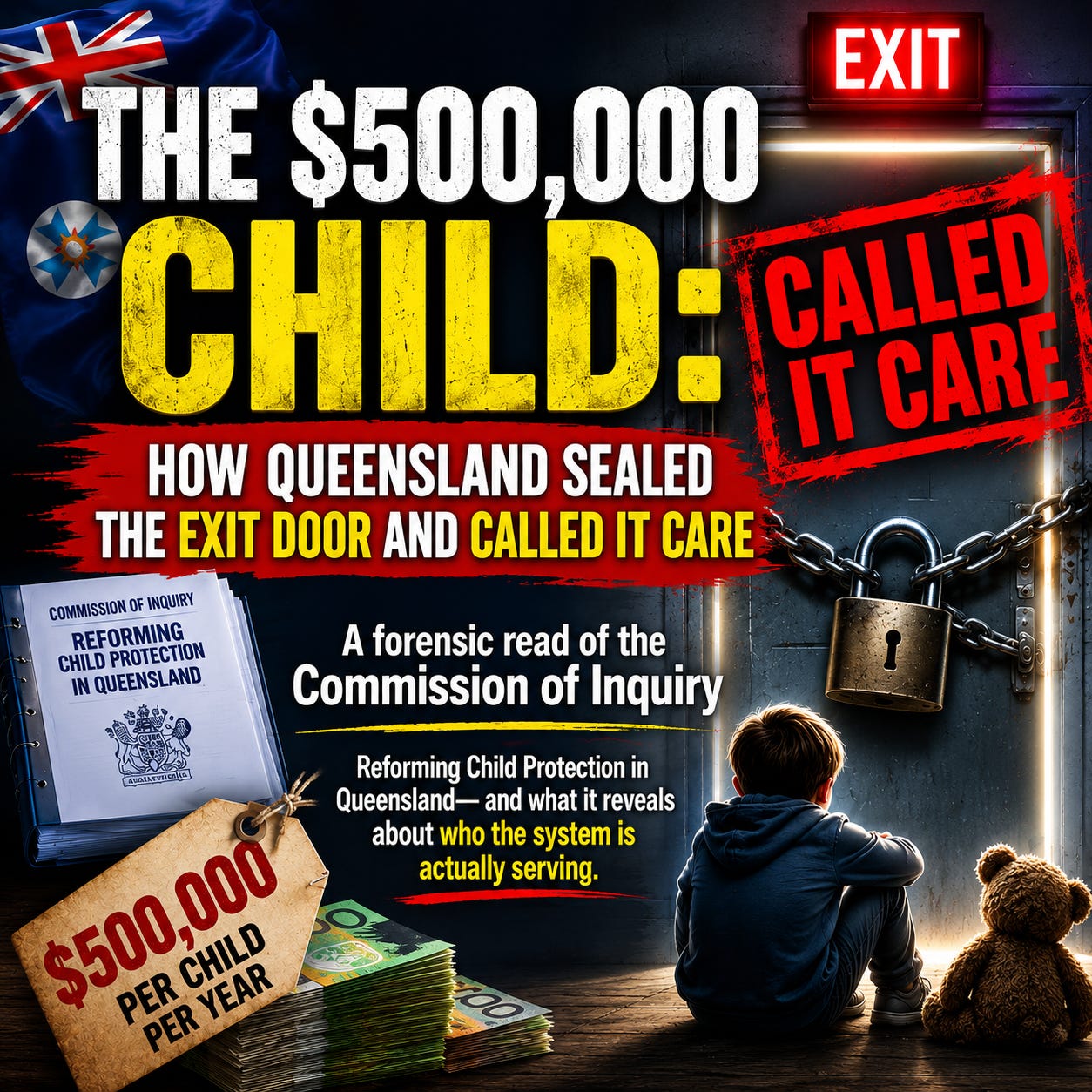
The $500,000 Child: How Queensland Sealed the Exit Door and Called It Care
from The Experience of Adoption · host Thoughtless Delineation
The Letter and the TimelineIn August 2025, I wrote to the Honourable Amanda Camm MP, Queensland’s Minister for Child Safety. I raised concerns about the state’s child protection system. I did not expect a fast reply. I got a slow one — four months later, dated 17 December 2025, reference number MIN ID 25-02776.The letter was precise and well-managed. It told me the Department was “committed to ensuring the safety, wellbeing and best interests of all Queenslanders.” It said the Commission of Inquiry would deliver its final report “in late November 2026.” It encouraged me to make a submission. It noted the Adoption Act 2009 was within the Inquiry’s scope.It did not answer the argument I had made.On 22 May 2026 — six months ahead of the Minister’s stated timeline — Commissioner Paul Anastassiou KC delivered his final report to the Queensland Government. All 1,384 pages of it.I want to sit with that timeline. The Minister’s office told me, in writing, the findings would arrive in late 2026. They arrived in May. That acceleration is not a bureaucratic footnote. It is a signal that the evidence was conclusive enough that the Commission saw no reason to wait. And what that evidence confirmed was the structural argument I had raised in a letter that took four months to receive a reply — and that the reply had not addressed.The Money and the MechanismThere is a number that should end careers. In Queensland, $500,000 is spent per child per year to keep 2,258 children in residential care. Not to reunite them with their families. Not to give them permanent new ones. To keep them in shift-staffed institutional facilities, cycling through strangers, while their legal status remains suspended and their futures remain unbillable to any particular adult.In the same period, not a single child has been adopted from Queensland state care. Not in seven years.Read those two figures together and the system’s actual operating logic becomes visible. Not the declared logic — “safety,” “family preservation,” “therapeutic support” — but the structural logic: the one that determines where the money flows, who benefits, and what never changes.The Anastassiou Commission of Inquiry documents, in meticulous detail, a child protection system that has undergone a specific kind of transformation. It began as a protective framework. It became a market.The System Is Not BrokenI want to be careful here, because “the system is broken” is the easy read. The system is not broken. It is working precisely as the financial incentives have shaped it to work. That distinction matters — because a broken system can be repaired, but a system operating according to its actual incentive structure requires something harder: dismantling.Here is the mechanism. A standard four-bed residential care facility, funded at the Queensland rate, generates approximately $2 million per year in state funding. That funding is attached to the bed. Not the child. Not the outcome. The bed. If a child leaves to live with kin, if a long-term guardian is found, if adoption is granted — the bed empties. The funding stops. The operator loses revenue.The commercial residential sector is economically penalised every time a child achieves permanency. The system has been structured to make permanency unprofitable.This is what the Anastassiou report calls, in bureaucratic language, a “misalignment of funding incentives.” In plainer terms: the commercial residential sector is economically penalised every time a child achieves permanency. The system has been structured to make permanency unprofitable.The $500,000 per child does not fund therapy, education support, or family reconnection. It funds overheads, real estate, and labour hire. The residential care workforce is predominantly casual, recruited through third-party agencies, with high turnover. These are the adults who are supposed to be providing care to children who have already lost their primary attachment relationships. What they are actually doing is shift work. That is not a criticism of the workers — it is a description of the system they are embedded in.The Committed Department and the 67% FigureMinister Camm’s letter assured me that the Department “is committed to ensuring the safety, wellbeing and best interests of all Queenslanders.” That sentence is doing a very specific kind of work. It is not false, exactly. It is a declaration of intent that functions as a shield against accountability — because intent, stated in the passive institutional voice, cannot be interrogated the way outcomes can.The Anastassiou findings are outcomes. They are not allegations.67% of all reported sexual abuse of children in state care in Queensland occurs within residential care facilities. I want to hold that number plainly, without qualification, because it is the number the system produced, and the system’s declared commitment to safety is what produced it.Organised exploitation networks do not target residential care facilities because they are careless. They target them because they are optimal. High youth vulnerability. Low-authority oversight. Constant staff rotation that prevents the formation of trusted adult relationships. Predictable blind spots in the monitoring infrastructure. The architecture of the residential care sector — the one that the commercial funding model created and sustained — is also an architecture of predatory opportunity.That is not an accusation against any individual worker, carer, or department employee. It is a forensic observation about what happens when you concentrate highly traumatised, legally unmoored young people in institutional settings with structural incentives to minimise therapeutic intervention and maximise bed occupancy.The In Plain Sight report from the Child Death Review Board confirms the other end of this pipeline. Children who cycle through multiple placement breakdowns — accelerated by the peer contagion effects of grouping high-trauma adolescents together without specialised support — emerge from care without legal identity, without stable attachment, and without the neurological architecture of felt safety that most people take for granted.The Word “Former”Minister Camm’s letter mentioned she had “met with people affected by former forced adoption practices” and listened to “the profound impact those past practices have had on adoptees, mothers, fathers, and other relatives.” She noted she looked forward to meeting with the Post Adoption Stakeholder Group.I note that she used the word “former.” Past tense. As if the machinery that severs children from biological identity is a historical artefact rather than an active operating system.The Anastassiou report was delivered five months later. It documented 2,258 children currently held in an institutional environment that concentrates harm, forecloses permanency, and generates $2 million per four-bed facility per year for commercial operators. The Adoption Act 2009 — which Camm’s letter confirmed is within the Inquiry’s scope — exists within a jurisdiction that has not granted a single adoption from state care in seven years.There is nothing former about this.The Identity Gravity WellThere is a concept in the theoretical work behind this publication called the Identity Gravity Well. Identity is not static — it is a dynamic field of force. When the external scaffolding of constructed selfhood fails, the individual is pulled toward the unresolved truth of their origins. That pull produces what gets diagnosed, in clinical settings, as crisis. What it actually is, is a reorientation toward biological truth.What the Queensland system has produced, at scale, is an Identity Gravity Well with no resolution available. These 2,258 children are not held in care because their biological families have been given intensive support and that support has failed. They are held in care because the legal and financial architecture of the system makes exit more expensive than containment. The pull toward origins — toward permanency, toward belonging, toward a legal identity that will survive into adulthood — has nowhere to go. The exit door has been sealed.The seven-year zero-adoption metric is the most forensic expression of this. I want to be precise: adoption carries its own complex, often harmful history. The forced adoption era in Australia — the one I have written about from the inside — was its own machinery of erasure. I am not advocating for adoption as a universal solution. What I am noting is that zero adoptions in seven years, in a jurisdiction with 2,258 children in residential care, is not a principled position. It is a blockade. And the bureaucratic preference for “ongoing case management” that produces this blockade is not child-centred. It is institution-centred. It keeps children as billable units within a system that profits from their legal suspension.But there is a second dimension to the Identity Gravity Well that the Queensland data alone does not capture. The pull toward biological truth does not stop when a young person turns eighteen. It intensifies. Adult adoptees, care leavers, and natural mothers face the same unresolved gravity — toward records, toward origin, toward reconnection — without any unified national mechanism to support or track that resolution. The state terminates its official accountability precisely at the moment the Identity Gravity Well’s force becomes most acute.This is not an accident. It is the logical endpoint of a system that defines “permanency” as a legal event rather than a relational one — and then stops counting once the legal clock runs out.The Round-Table and the ProposalEarlier this year, Minister Camm convened a round-table on adoption-related issues. It was, by all accounts, the first such gathering in Queensland’s history — bringing together those directly affected by past and present adoption policies to be heard by a minister with actual power to act.My mother, Leslie Mitchell, was present.I wrote to Minister Camm again after that round-table. I noted what the gathering represented: a willingness to listen not only to policy experts but to lived experience. I also noted what it did not yet represent: a mechanism. Listening is the first step. Structural continuity must be the second.The structural gap I described in that letter is documented in my analysis of intersecting commissioner roles, which I had been developing as a parallel body of work. The analysis maps a national accountability vacuum that Queensland’s crisis exemplifies but does not contain. No existing federal commissioner possesses the mandate to oversee both historical forced adoption redress and contemporary out-of-home care outcomes simultaneously. The National Children’s Commissioner’s authority ends at eighteen. The Aboriginal and Torres Strait Islander Social Justice Commissioner addresses Indigenous populations only — essential, but insufficient as the sole framework for a crisis affecting non-Indigenous Australians as well. Information and Privacy Commissioners are structurally constrained by state-level secrecy legislation that was designed, under the “clean break” theory, to make adoptee identity inaccessible by default. In Victoria, the Adoption Act 1984 explicitly prohibits general access to adoption records — a Right to Information application will almost certainly fail if administrative access has already been denied.The result is a system in which the right to identity — guaranteed under Article 8 of the UN Convention on the Rights of the Child, which Australia has ratified — is subordinated to archaic secrecy models across every jurisdiction, with no single federal authority empowered to challenge that subordination.This is not a gap in the bureaucratic furniture. It is an accountability vacuum at the scale of a national human rights failure. Analysis of over 3,000 recommendations from 61 Royal Commissions and inquiries between 2010 and 2022 found that consistent systems-level failures — poor governance, limited oversight, inadequate investment — remain unaddressed across the board. The Anastassiou report is Commission 62. The findings are not new. The mechanism that allows them to recur is the absence of a unified authority with the statutory power to enforce change across a full human lifespan.The proposal I put to Minister Camm — a National Social Justice Commissioner for Family Separation and Reconnection — is not a duplication of existing roles. It is a bridge across the gaps those roles leave open: historical forced adoption, Stolen Generations, contemporary OOHC, adult identity restoration, reconnection tracking, and the repeal of secrecy legislation that currently treats the right to know one’s origins as an administrative inconvenience rather than a fundamental human right.The Leverage PointsCommissioner Anastassiou’s 52 recommendations are serious. The “Under-5 Directive” — banning children under five from residential care — is the right first move. But without an immediate and massive transfer of funding from commercial residential operators to family-based foster carers and kinship networks, it is a directive that lands in a vacuum. The placement infrastructure to receive those children does not exist because the funding model spent the last decade cannibalising it. Foster carers have been leaving the sector for years, driven out by under-resourcing and institutional neglect, while the commercial residential sector expanded.Rebuilding that capacity is not a reform task. It is a defunding task. The commercial residential sector will not relinquish the $2 million per facility per year without structural pressure. The post-tragic position — the one that holds the harm clearly and then works from where there is leverage — is to name that pressure point precisely and apply it there.The leverage points are three:1. The Funding PipelineTransition the $500,000 per-child allocation, systematically and on a fixed schedule, away from commercial residential infrastructure and toward professionalised foster care and kinship support. Attach funding to developmental outcomes, not bed occupancy.2. The Permanency CourtsA dedicated, fast-tracked legal pipeline within the Children’s Court with a mandatory 12-to-18-month window for permanency determination from the date a child enters care. End the administrative slow-walk that allows children to age out of the system before their legal status is resolved.3. The Independent InspectorateRemove all child safety auditing from departmental control. A fully independent, well-resourced body with the power to access placement data, follow the funding, and refer systemic failures directly to law enforcement.And at the national level: a Social Justice Commissioner for Family Separation and Reconnection, with the statutory power to review and recommend repeal of secrecy legislation, mandate a national data strategy that tracks lifelong outcomes and reconnection efficacy, establish consistent redress standards across all groups affected by historical and contemporary state separation, and coordinate across federal and state portfolios in the way that no existing commissioner currently can.What Changes NowThe Architecture of Silence operates by keeping knowledge fragmented, localised, and deniable. A four-month delayed ministerial response is one expression of that architecture. A 1,384-page Commission of Inquiry is another — the volume of documented evidence required before the pattern is too large to manage into silence.I wrote to the Minister in August 2025. I received a letter in December that told me the system was taking my concerns seriously and the final report would arrive in late 2026. The report arrived in May, six months early, confirming the mechanism I had described. I attended, through my mother’s presence, a round-table that had never happened before in this state’s history. I wrote again, proposing a structural mechanism that does not yet exist.The system does not need to be surprised by what the Anastassiou report found. The people inside the system have known this for years. The carers who left, the workers who burned out, the children who aged out without a legal identity — they knew. The natural mothers who sat in that round-table and named what was done to them — they have always known.What changes now is the size of the documented record. The pattern is no longer deniable. The financial logic is named. The harm concentration is measured. The permanency blockade is documented. The national gap — the absence of a unified, lifelong accountability mechanism — is on the record.What happens next depends entirely on whether the reconstruction pressure is sustained beyond the news cycle. Systems that profit from inertia are very good at waiting for attention to move on.The 2,258 children in Queensland residential care cannot wait. Neither can the adults who were those children, decades ago, and are still waiting for a system that can see them.Primary Sources:* From Pressure to Purpose: Reforming Child Protection in Queensland (Anastassiou Commission of Inquiry, 22 May 2026)* Child Death Review Board, In Plain Sight* Shane Bouel, “Systemic Fragmentation and the Lifelong Impact of Separation: An Analysis of Intersecting Commissioner Roles and the Imperative for a National Commissioner for Family Separation and Reconnection” (2025)* Ministerial correspondence: Shane Bouel to Hon Amanda Camm MP, August 2025* Ministerial correspondence: Hon Amanda Camm MP to Shane Bouel, 17 December 2025 (ref: MIN ID 25-02776; DFSDSCS 05579-2025)LETTERS SENT & RESPONSESREPORTS AND REFFERENCE This is a public episode. If you'd like to discuss this with other subscribers or get access to bonus episodes, visit thoughtlessdel.substack.com/subscribe
Embed this episode
NOW PLAYING
The $500,000 Child: How Queensland Sealed the Exit Door and Called It Care
No transcript for this episode yet
Similar Episodes
No similar episodes found.
Similar Podcasts
No similar podcasts found.