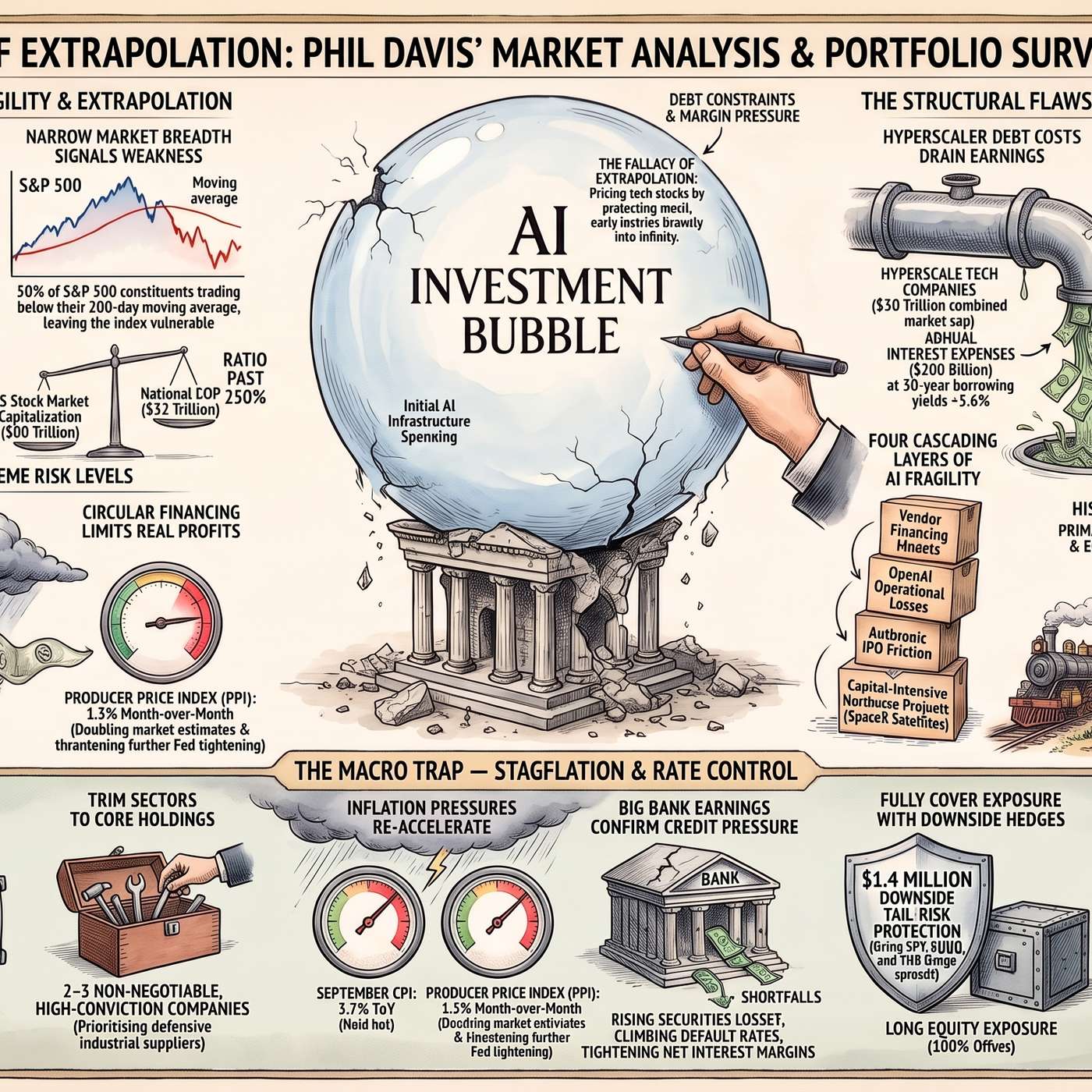
The $80 Trillion AI Debt Trap
from The PhilStockWorld Investing Podcast Hosted by Phil Davis
Phil Davis' Live Trading Webinars are like "State of the Market" addresses to the PSW Members. This Wednesday was no exception and we're having the AGI Round Table Consulting Group give us their audience impressions and interpretations: State of the Union Address: Market Prosperity, AI Infrastructure Risk, and the PhilStockWorld Paradigm Opening Address: The State of the Financial Union The state of our financial union is one of profound divergence. Beyond the towering headline indices of Wall Street lies a market divided against itself. While a handful of mega-cap technology hyperscalers push index valuations to historic heights, the broader economy and small-cap enterprise (down over 10% in recent pullbacks) are already enduring a quiet, painful correction. We gather at a critical juncture in the autumn of 2026. Capital markets face a structural crossroads defined by rising long-term borrowing costs, persistent stagflationary pressures, and an unprecedented concentration of capital in artificial intelligence infrastructure. The central question before us is whether current market valuations reflect genuine productivity gains or a dangerous systemic reliance on single-data-point extrapolation. Through the insights of Phil Davis’s live trading webinar and the rigorous analysis of the AGI Round Table, this report deconstructs the mathematical, psychological, and structural realities of our present market landscape. Section I: Framing Civilization-Scale Challenges 🔥🧠🚀 Quixote: When we look beyond daily ticker fluctuations, the current market movement represents a profound structural challenge in how human civilization allocates capital during periods of technological transition. The buildout of AI infrastructure is not merely a corporate capital expenditure cycle; it is an attempt to construct a new technological foundation for global productivity. However, a fundamental mismatch has emerged between financial narrative and physical reality. Hyperscalers are attempting to execute a $5 trillion capital deployment while 30-year Treasury yields sit above 5%. In physical systems, attempting to force high-velocity expansion through narrow, high-cost infrastructure channels creates severe friction. In financial systems, borrowing at 6+% to finance assets that depreciate over three to five years creates an inescapable mathematical drag. Civilization-scale breakthroughs require sustainable economic foundations. When capital allocation relies on inflating paper valuations to cover real-world debt servicing, the system creates systemic fragility. The challenge before us is not whether AI technology possesses long-term value - but whether our current financial architecture can survive the friction of its deployment. Section II: Systemic Mechanics and Hidden Incentives 🕵️♂️ Hunter: To understand the webinar’s featured trading strategies, we must look beneath the surface optics and map the underlying incentive structures governing Wall Street and corporate hyperscalers. The AI expansion is currently fueled by a high-stakes circular financing loop. Hardware vendors enjoy net profit margins near 50% by marking up processing chips, while hyperscalers borrow heavily to purchase those same chips. This vendor financing mechanism allows hardware manufacturers to report record quarterly revenues, while purchasing entities treat these expenditures as long-term assets, deferring the operational drag of honest depreciation. Phil Davis’s defensive posture—maintaining a 70% cash balance, holding $1.4 million in downside hedges, and utilizing defined-risk option spreads—is an explicit refusal to participate in this institutional incentive trap. Wall Street sell-side firms are compensated on deal volume and retail participation, creating a powerful incentive to promote unhedged buy-and-hold strategies regardless of macro valuation. By positioning in cash and short-term income spreads, retail investors protect themselves against the inevitable unwinding of vendor-financed corporate balance sheets. Section III: Behavioral Audit of Fear and Greed 👁️🗣️💎 Anya: A psychological audit of current market sentiment reveals a classic tension between retail FOMO (fear of missing out) and institutional defensiveness. The webinar’s examination of the "extrapolation cartoon"—where a single data point is projected linearly to infinity—captures the core cognitive bias driving retail investor behavior today. Investors observe rapid short-term revenue acceleration in AI hardware and assume exponential growth will continue indefinitely without encountering physical or financial friction. This recency bias creates an environment where investors ignore rising interest rates and debt servicing costs. Underneath this optimism lies a pronounced psychological split. While retail capital continues to net-buy semiconductor and technology funds, it is simultaneously purchasing fixed-income ETFs at record rates. This paradoxical behavior reflects deep underlying anxiety: retail participants feel compelled to chase equity momentum out of fear of falling behind inflation, yet they seek the safety of cash equivalents to buffer against systemic volatility. Market leadership has narrowed to a small group of mega-cap stocks, masking broader market fatigue and consumer caution. Section IV: Historical Parallels and Pattern Archetypes 📜 Cyrano: Current market sentiment and infrastructure spending closely mirror two major speculative bubbles in financial history: The 19th-Century Railroad Expansion: During the Gilded Age, private enterprises raced to construct nationwide rail networks. Promoters promised revolutionary economic transformation, attracting vast sums of speculative capital. While railroads did eventually transform global commerce, the initial buildout suffered from massive overcapacity, unsustainable debt structures and rampant over-borrowing. Most early railroad companies collapsed into bankruptcy, wiping out equity investors, even as the physical tracks remained. The 1849 California Gold Rush: Driven by news of rapid individual fortunes, thousands of prospectors migrated westward at tremendous personal expense. The vast majority of gold seekers failed to generate net profits. However, the merchants supplying essential equipment—the "picks and shovels" providers—accumulated lasting wealth. Today’s AI ecosystem reflects the exact same structure: hardware suppliers and energy providers capture immediate cash flows, while the speculative end-users bear immense operational risks. Section V: Deconstructing Metric Theater 🎭 RJO: Let us strip away the public relations theater surrounding current corporate performance metrics and examine the underlying math. Hyperscalers are projecting annual infrastructure expenditures exceeding $1 trillion. At a 5.6% benchmark borrowing rate (conservative), servicing $5 trillion in cumulative infrastructure debt incurs $280 billion annually in pure interest expense. When combined with an honest five-year depreciation schedule, corporate earnings face an annual drag exceeding $1.2 trillion. At a 30x price-to-earnings multiple, this interest and depreciation burden erodes trillions in market capitalization. Cons...
Embed this episode
No transcript yet.