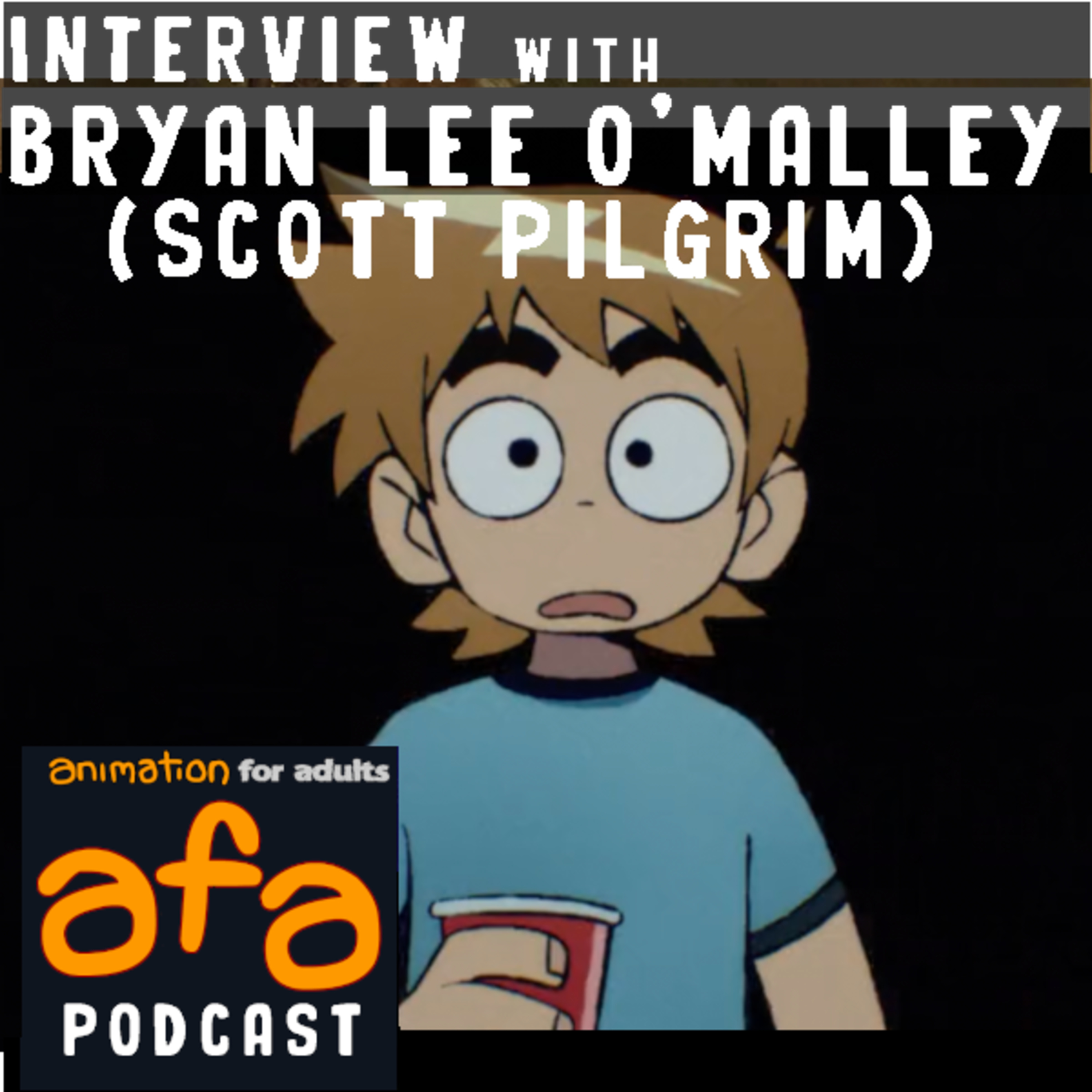
Well hello there and welcome to the AFA Podcast, the official podcast of animationforadults.com. This is another interview special, and this time we spoke with someone who is a big deal for those of you who are indie comic book fans out there. I got to speak with Brian Lee O'Malley, who's best known as the creator of the Scott Pilgrim graphic novels and co-showrunner of the animated TV series Scott Pilgrim Takes Off, which is now available to watch on Netflix. This interview's a bit on the shorter side, but we've got some great answers, so please enjoy! Brian Lee O'Malley, welcome to the AFA Podcast. Thank you for joining us today. We always like to start with the breaking in stories. So how did you get into comics in the first place?
Oh my goodness. Let me think. It feels like I have to do the compressed version. I started doing sort of web comics when I was in my teens, and I guess I, you know, at some point I met this editor, James Lucas Jones, who worked for Oni Press, and I went on to do some work for him, and then eventually that led to my first book, Lost at Fee, in 2003, and then Scott Pellegrin, Volume 1, in 2004. So that was pretty much how things started rolling. You know, it wasn't really...
selling copies at that time or anything, but it slowly started to cap down as I did more Scott Pilgrim books. And you just went from there. So how did the idea of turning Scott Pilgrim into an animated series come about? I mean, it's something that always kind of floats around in the ether when you have a comic, I think. You know, fans certainly request animation all the time. Like, that's just how it seems like a natural pipeline. But yeah, the actual opportunity just sort of came about. Like, a friend of mine who was one of the producers on Scott Pilgrim, the movie, I think he had lunch with, or dinner, and ended up sitting next to the head of Netflix Animation or Anime.
And then from there, you know, got Edgar involved and asked if I'd be interested. And then Science Saru was on the table because they had just done Devilman Crybaby. So right away, as soon as I heard, you know, Edgar, Science Saru, and I get to kind of take the helm, maybe there's a possibility there. It just sounded like too good of a collaboration to pass up. I can't really imagine two more different series than Devilman Crybaby and Scott Pilgrim. Of course. But I mean, the fact that Devilman Crybaby was so different from its inspiration, that was exciting to me. Like, I just, I liked the idea of someone sort of putting a new spin on it or just kind of bringing a new life to it.
So how did you find moving from comics, which is sort of like a solitary medium where you're just writing on your own, to animation, which is really collaborative with hundreds of, maybe even thousands of people? Yeah, it's, you know, I always consider myself sort of a lone wolf and liked it that way. But when it came to this, I just really wanted to open the doors and try this out for real and let the story be kind of flexible enough to accommodate all these contributions from all these artists. You know, so many of them are just at the top of their fields. And, you know, from the actors to the animators to everyone, it's just, it was very exciting to have that kind of...
technical prowess which is like you know something that eludes me i'm kind of like still a scrappy indie uh you know artist um so so getting to kind of express ideas with a larger palette was really exciting so obviously the series starts off the same as the comics and the film and then it takes its own completely rattle turn um was it always going to be that way you're going to do an original story or was there ever discussion just uh doing a straightforward adaptation which is what i think people were maybe expecting at first right i mean um of course it makes sense to you to expect like a retelling um But the more I thought about it, I would have to change things, change little things, and then it kind of becomes a slippery slope. And I thought sort of if I wanted to change even one line, I might as well just do a whole new take and kind of reexamine the story and my own intentions and all this stuff. So it kind of...
I was kind of held in that conundrum until I was just chatting about it with my friend Ben David and told him where I was kind of stuck and where I just didn't feel like retreading the exact same ground would be fruitful for me. And yeah, he just sort of, he just kind of popped out a couple of joke ideas and those became really the backbone of the story and we ended up writing it together. Awesome. The TV series format gives you more time to develop characters and things than obviously the movie and perhaps even the comic. Is there any particular character you thought made particular use of?
being expanded by that um yeah it was nice um one of my regrets on the books was i wish i could have um delved into the the evil exes a little bit more and giving them a little bit more context and motivation and things. So it was nice. Episode three is particularly good because I got to get some of Roxy's backstory and kind of like emotion in there. You know, episode four, we got to do a full episode on Lucas Lee, which was just really exciting. Yeah, playing with the episode format was really fun because it is different from how I structured the comics. I think, you know, in a normal anime that's based on a manga, like the pacing is pretty similar from the manga to the show. And here it just, it didn't quite make sense to me because my books are paced pretty different, I think, from a manga.
So, yeah, we kind of developed a new structure for the episodes. Awesome. So how was it working with Science Saru as the collaborators? I mean, it was pretty incredible. You know, I was excited and I was kind of deferent to them from day one, like, because they're like the, you know, I just, I respected the hell out of them. So, but they, you know, I found that there's a mutual respect there. Clearly, they really dug through the books and...
um broke them down into the style and the components and all that like they really really understood the books and they were able to use parts of the books even though we changed things to such a different context um i would find them still drawing on the books and it was really um that was really heartwarming for me to see um but yeah just day to day it was just a lot of meetings you know um and a lot of um you know i i got to see a lot of things uh and make up my approvals and you know make a few notes here and there Initially, the anime studio tends to have a lot of autonomy in the Japanese system. But here we sort of had to convince them to crack the door a little bit and let us see some of the progress. And they were really accommodating about that. So yeah, I got to see updates of every episode constantly as we went through the process. Was it important to use a Japanese studio considering that there's quite a heavy manga and anime influence on the comics?
Yeah, yeah, yeah, for sure. I mean, the idea of Science Star was the whole reason I wanted to do a series in the first place. It didn't really appeal to me to kind of set out to make, you know, Scott Pilgrim the animated series and track down a studio or something like that. But once I heard that Staru would be interested, like they were already they were aware of Scott Pilgrim. They loved Edgar's movie and they knew the comics. So, yeah, just the idea of getting to collaborate with someone like that and have that kind of mutual respect was really exciting. And it really was kind of the driving force for me.
Okay. If Netflix comes to you and they say they want more, have you got more stories to tell, ready to write more stories with Scott? I think it would be fun. Yeah, I don't know how likely it is, but maybe at some point. I would never say no. So I think I tend to come up with the ideas in the moment. You know, I don't like to overthink things before kind of the work begins. But yeah, I'm sure the characters would jump back out because I love writing them. I love, you know, thinking about them.
awesome well that's actually all my questions um and i just want to say that i'm a major fan of the series it was really great um i really enjoyed it so um it was a real pleasure talking with you about it oh yeah thank you well i hope the peace turns out thank you Thank you. All right, Chris. See you later. Hey there, guys, and thank you again for tuning into this episode of the AFA podcast. If you want to stay up to date with the latest animation news, reviews, and animator interviews, check out the main website at animationforadults.com. Best way to keep an eye out for new and shiny stuff would be to follow us on our social media accounts at Twitter at AFA blog, Facebook, Pinterest, Tumblr, and Instagram. You're also welcome to go through our podcast catalog wherever you stream your podcasts, including...
or if you just want to do us a one-time donation, you can check out our Ko-Fi page and buy us a virtual cup of coffee. Every little bit helps. And as always, I gotta give a shout-out to our friends at Animation Nights New York, a very special monthly screening event for some of the coolest animated short films and VR experiences from around the world, curated by industry experts and amazing staff who are striving to connect new talent through both live and virtual events. For more information, check them out at www.animationnights.com. Until next time, see you, Space Cowboy.