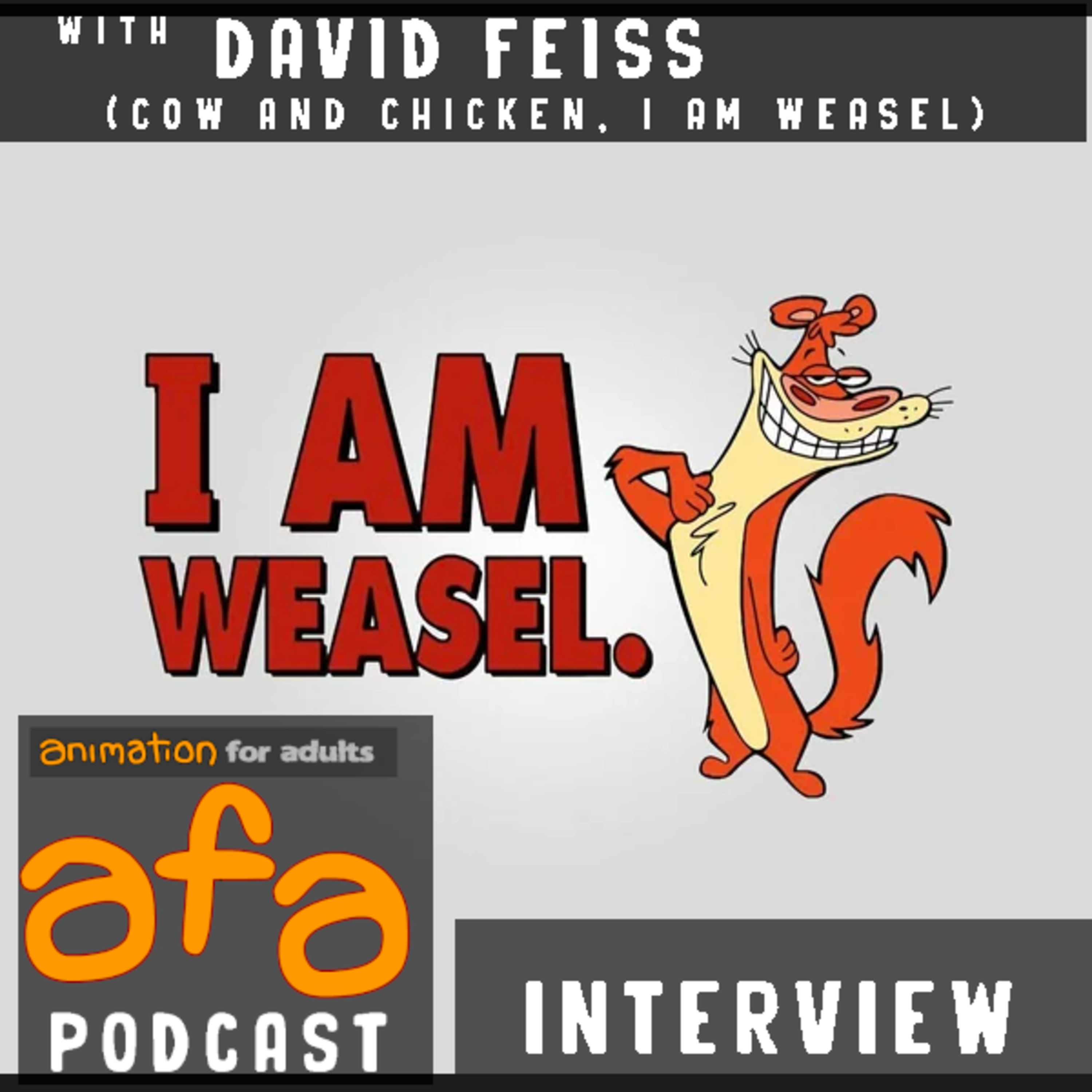
Well, hello there, and welcome once again to the AFA Podcast, the official podcast of AnimationForAdults.com. This is another interview special where we spoke with David Feist. David is an animation legend best known for creating the Cartoon Network series, Cow and Chicken and I Am Weasel. His new series, Armasaurs, is now streaming on Disney+. So without any further ado, here is the interview. Hi, David Feist. Welcome to the AFA Podcast. Thank you. Glad to be here.
And we always like to start with pretty much the same question, which is, how did you get started in animation? How did I get started? Yeah. I started at age 19. I got very fortunate. I've been making like eight millimeter movies as a teenager. And when I was my last year in high school, I decided I'm going to make a sound cartoon and use it to get into the studios. So I animated a Beatles song, Maxwell Silverhammer, and I made arrangements to bring my projector down to Hanna-Barbera. I got an interview and projected the film against the wall and they hired me. And so that was, it doesn't always happen that way. And I realized in my career, like later on, that was.
kind of like the timing was just right. But that's when I started at 19. I was thrilled to be working at Hanna-Barbera. What was the experience like working at Hanna-Barbera at that time? It was 1978. And so at that time, the studio was in full production, many productions, and they had animators, were older people, who were the veterans that had started animation. Like they were like ones that worked in Fleischer cartoons and all the MGA, you know.
like the MGM, working with Bill Hanna and Joe Barbera back in the 40s and the 50s. So these were the veterans and the ones I remember the credits from all the cartoons that I was watching growing up. And so I got to work with them and some of them taught me techniques that I carry through to today. Amazing. One of the earliest shows you worked on was Ren and Stimpy. How did that compare to working at Hanna-Barbera? Was it a very different environment? Oh, yeah. Yeah. I always tell people that John Chris Felicity's Ren and Stimpy actually opened the door for shows like my show with Cow and Chicken. Without Ren and Stimpy, I don't think that those shows would have ever gotten on the air. And yeah, so it was totally different. It was like just super creative. Like a studio system like at Hanna-Barbera, you get a supervisor would give you scenes and you animate.
you know, like your desk. But with John, it was more like we're always there together. And it was just real collaborative. Story about Ren and Stimpy, I knew John back in 1985. We were both in Taipei, Taiwan as supervisors on a reboot of the Jetsons TV series. He was a layout supervisor. I was the animation supervisor. And we shared an apartment. And I remember he had his drawing tablet with Ren and Stimpy drawings all over it. And he said, Ren and Stimpy, we're going to do this film. I'm going to sell it. You're going to animate on it. All his buddies, he had put their names down. These are the people who are going to work on it. And it came to pass, like within about six years.
when Stimpy was sold to Nickelodeon. All the people that we talked about, including myself, worked on that pilot. And how did you come to create your pilot, No Smoking? Right. Okay, so that was like 1994. I got a call from the people at Hanna-Ribera. I was working, I think, I can't remember where I was working. I think I might be at MGM at that point working on All Dogs Go to Heaven.
And I got a call that they're in the shorts program. And did I have any ideas I wanted to pitch? And it just so happened, I had just written like a children's book based on like a bedtime story I told my daughter who was six at the time. And so I just freshly done this thing. I said, yeah, actually I have a couple ideas. And so I met this person that was actually from the New Cartoon Network.
which she worked with in Hanna-Barbera. And I was living up in Northern California, and she was in San Francisco. We met at a coffee shop, and I pitched these ideas, including Cow and Chicken. And she really latched onto Cow and Chicken. She said, you know, we really like that. And within a couple of days, I said, we'd like you to do a storyboard. So I storyboarded it out, and I said, OK, we want to go pilot on this one. So that's how that kind of happened. What was it that inspired the creation of Cow and Chicken and Iron Weasel?
Well, again, it was a bedtime story I told my daughter because she was six and I would read at night to her. And there was one night that I was, I just didn't want to turn the light on. I just didn't want to read. So I just sat there and I came up with the story of Cow and Chicken. And I just made the story up. And at the time, they were not brother and sister. They were like friends that went to school together and they knew each other. And then in high school, they went separate ways and then they come back together.
So that's how that one came about. And Nine Weasel came about once I did the pilot for Cow and Chicken and they already tested it and said, okay, we want to go to series on Cow and Chicken, but we want to have a format where it's a seven minute cartoon with a middle cartoon and then another Cow and Chicken. So Cow and Chicken, middle cartoon, Cow and Chicken. And asked if I had any other additional ideas. And so I sat down at my desk one day and the first drawing I did was a weasel in a very heroic pose, which kind of like evoked a different kind of a character than the classic sneaky knighting weasel. And I thought it would be fun if he had a heroic weasel with a big booming voice.
So that was the impetus of that. And then it just took a couple of thoughts to, well, Monkey and the Weasel, that kind of let, you know, that whole song. And so that's why I thought, well, baboons are really funny. So I added this baboon because I remember my kids would laugh at the red-butted baboon at the zoo. So that's how that came about.
What were the big influences on Cameron Chicken and Dying Weasel? Biggest influences? Always my biggest influences was like really mad magazine, like funny drawings. So what I was going for, my style is kind of based a lot on that. Like I was influenced by Sergio Rodriguez and Mark Drucker, Jack Davis.
Yeah, the influences are many, stylistically, humor-wise. I grew up a big Monty Python fan, so that type of humor was there. And also, nod to John Cussellucci, the looseness of the humor could be anything. So I kept that in my, it was always in my forefront. And still to this day, that's how I approach what I do. You work as an animator, but also you work quite a lot as a storyboard artist. Do you have a preference for either discipline?
Storyboarding is basically what is out there right now. There's not much call for 2D animation. But I can say that when I board, I use all the skills that I used as an animator. So I still really do animate while I do storyboard because I do multiple panels. I'm planning storyboards as if I was going to animate them. And so I do, in a way, miss animation. But in other ways, I like storyboarding because you can do an entire film. You're doing a blueprint for that film. And so I think it's just kind of like expanding your mask a little bit more and being able to control the look of something.
You've also worked a lot in television, but you've also worked quite a bit in features. How is it different working between the two? Yeah, that's a good question. I mean, there is a lot of crossover. It's the same exact process. Just in features, you have one story that you're working on for about 18 months through two years, as opposed to television, which is you've got one idea, but like a TV series, you've got individual stories. So it's a little bit more...
i don't know like television it's just a lot of fun like the vitality of having different ideas and having certain deadlines especially like in the show like my own where where the schedule was i had to come up with four or eight news stories a week and then they would choose like four and then we whittle it down to two so you had to like you know for challenge chicken it was 102 episodes i think there was at least 800 ideas written out so there's a lot of different stories so that the vitality of having to do that and calling upon your memories of being a kid what made you laugh when you're little or what you're observing my own kids or So I enjoyed television quite a bit. And another question was like, how is it different? So the feature, you know, there's a, again, it takes a long time. So you're actually, you know, having to, you know, it's like, it's one long thing. So to stop from getting bored, because you can, is like, I mean, you're working with a team too. And because of feature film, there's like many people. So you have your own sequences. But I don't know, it's a different animal, but the actual drawing is exactly the same.
Awesome. So tell us about the new series, Armasaurus. Armasaurus, yeah. Yeah, that's like one of the most different things I've ever done, too. And I got into it with one of my business partners from Palooza Animation, Connie Kwak. She brought me in. She was working at this company called MGA. That's a toy company. They had acquired the rights to this Korean show that was pre-existing. It was called Armored Saurus in Korean, the translation. And some really cool animation. It was all Korean actors, live action, but with CG dinosaurs. And so the MGA had the rights to this. And she brought me in. And I was working in pre-production.
And they had another director already in line, but he fell out. And it was like, you know, because I've been working on it and I had a lot of experience directing animation, it was like, well, can you direct it? And it was a great opportunity. Went to Korea, spent almost three months on a soundstage outside of Seoul. Great cast. Loved it. All young people. They all, I mean, they went on set. Everybody got together. They're all thrown together and they liked each other. And I could tell that we're going to have an easy production. Like the synergy that was happening between them. So yeah, that's how that, that was the genesis of that. And I had a great time on set and had a great time the year after that, working in post-production. I just delivered the last show mid-December and it premiered last night on Disney+. How different is it working with live action and animation combined? Working just from directing animation? Yeah, well, it's different.
An ideal situation would be that you would have storyboards ahead of time while you're shooting the live action. We didn't have that luxury. There was a film schedule was set in stone that we have the soundstage for 52 days or whatever it was. And the scripts were late. So I had my writer come with me to Korea and he was writing just a couple of steps ahead of us shooting. So a lot of what was happening on set, I was actually storyboarding on set. A lot of shots where you have another thing about shooting this animation in live action, we were shooting on a green screen where the actors didn't even have a background to look at.
as, you know, not to mention, no dinosaurs to look at. So they had to imagine a lot. So I had to like be able to draw and explain or even, you know, explain what they're looking at. You're looking at a pteranodon. It flies over your head and lands on a cliff over here about 50 feet up in the air. You know what I mean? So I have to get them up to imagine that. Sometimes I draw out the panels. I did a lot of that, actually. I did storyboard a lot that helped the cinematographer choose angles. So yeah, you're pre-planning. Actors are going to be talking to something that's going to be animated, you know, months later.
Can you tell us anything about what you're working on next? Is it more dinosaurs? No, I actually have a number of projects. Like my day job, I work with the Sony, Sony Animation Storyboard. But I also have another Korean project that I've been kind of like directing at night for a company called Alimoli. And they have studios in Seoul and a studio in Suncheon, which is south of Seoul. And we're doing a show called Astro Station. It's a brand new TV show that they created, but I got involved through some connections. And I'm really enjoying that. It's a CG show for kids being animated in India. First season has been bought by the Korean broadcasting system, KBS, and it starts broadcasting in May.
I'm with my business partner at Palooza, Connie Kwok. I'm developing a feature right now, too, the one that brought me into MGA to do armistilers. So the other bit, I'm busy. Well, thanks very much for talking with us today. That's all my questions. It's been a really good conversation. Well, I appreciate it, Chris. Thanks for the interview.
Thanks for listening and if you want to catch up with everything we're doing, visit us at animationforadults.com for the latest animation news, reviews and stuff. On social media you can find us on Twitter at afablog, you can find us on Facebook, Pinterest, Tumblr, Instagram and more coming soon. If you'd like to help us out you can visit us at patreon.com slash animationforadults or make a donation via PayPal or buy us a virtual coffee. Thanks again for listening and stay tuned for more!