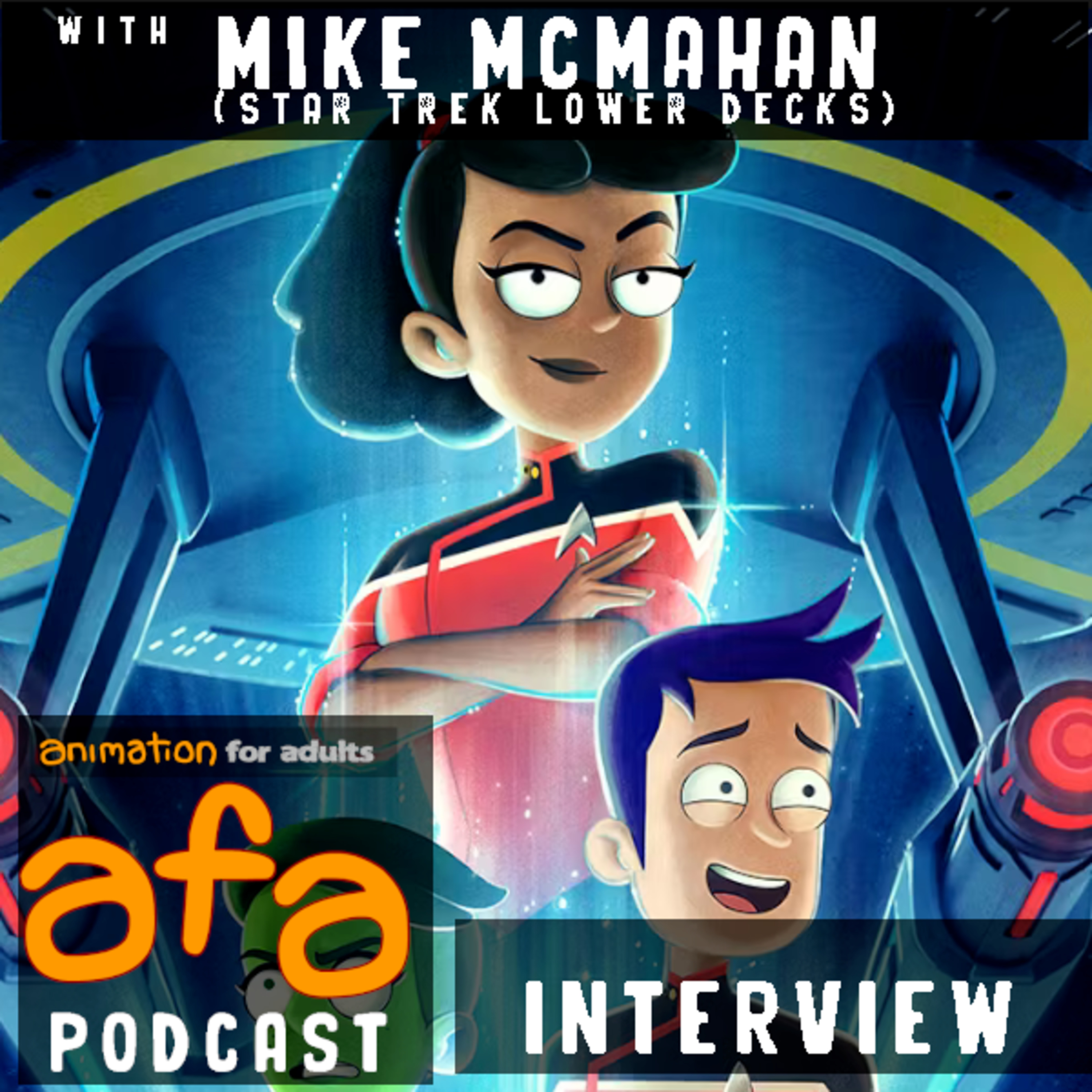
Well hello there and welcome to the AFA Podcast, the official podcast of AnimationAboutAdults.com, and this is another interview special. This time I spoke with Mike McMullen, the creator of Star Trek Lower Decks, which comes to its finale on December 19th on Paramount+. Interview's a bit on the shorter side, but there's some really good stuff in there, so enjoy! What's your animation origin story? How did you get into animation in the first place? So I always grew up loving animation. I grew up being one of those kids that ran home and watched two episodes of The Simpsons before I did my homework, which is probably why I got married. And when I first moved to Los Angeles, I was working on writing. I was taking any job I could. And one of the jobs I took was on a show called Drawn Together on Comedy Central. And that was my introduction to animation. And from there, I ended up becoming a production assistant on South Park for a couple of years.
I ended up at 20th Century Fox as an assistant in the animation department, reading everything that they were doing for Simpsons and Futurama and King of the Hill and American Dad and Bob's Burgers and Family Guy. And then at the same time, writing my own stuff and meeting all of these creators, like getting to know them and talk to them. And from there, I ended up as a writer's assistant on Rick and Morty. And four years later, I was showrunner on Rick and Morty. And then I left because I sold Solar Opposites and Star Trek Lower Decks. And that's the whole story. That's how it happened.
So you come more from a writer's background rather than an artist's background. I do. I know. I love shows created by artists because they're just so vibrant. And that's why I surround myself with amazing artists because I can draw and people get the point, but the artists will literally make fun of me when I'm trying to draw something and make shirts out of it. Like, and they're not wrong. Like, my drawing is not great, but I love animation. I love telling stories that utilize animation and I love working with artists. How did you convince Paramount that you make a show like Lower Decks?
Kurtzman convinced Paramount I went in for a regular meeting I was not pitching a show and he was a big fan of my work on Rick and Morty and he said if you could do any adult animated Star Trek, what would you do? And I just, I hadn't thought of it like that because I didn't think it could ever happen. So I just told him I'd want to do a show that was funny, but also beautiful. I'd want to do a show that had characters that were lower decks officers that weren't the bridge crew, but that they're still great at what they do. Their heart is in the right place. Even if they aren't there yet, that we're not making fun of Star Trek, that we're making Star Trek, that that'll be the surprise. And by the end of that meeting, he was like, I think we should make the show. And usually that was like a thing where you had to like put together a formal pitch with agents and stuff. And this was just me going into chat. And I remember driving home and I called my wife and I was like,
So they told me they're going to make the Star Trek show, but that can't be right. It doesn't work like this. Now, five seasons later, I kind of can't believe it still. What do you think is the secret of balancing the comedy with what makes it really a Star Trek show? I think you have to love both parties. You have to love and know when you've gone too far and it stops feeling like Star Trek. And you have to also know the tone of the show, that if you're just doing Star Trek, it's going to just read like fan fiction, and that the DNA of the show is the personality of these leads, and these are funny characters. So making sure that...
there's almost a thousand episodes of star trek right the animated comedy doesn't have to be one of the serious ones we can dip into that and we can have the stakes be meaningful for the characters within their world that was a big that was a big you know edict for me is like even if the stakes the sci-fi stakes that come in they can't just be dismissible by our characters those have to be real stakes for them you know and so getting to tell stories that are both funny with characters that make you laugh that also fit into star trek in general to me that's just like we all deal with the same stuff in life that's hard with family and medical stuff and rent and work and traffic and what have you and some people treat it with a sense of humor and some people treat it with anger and it's like they're gonna be these star trek folks are gonna be dealing with the same thing anybody might have to on star trek shows but we're these are funny joke tellers these are They deal with this stuff with jokes, and that's going to help with the balance of it. Awesome. How much oversight did you get from the Trek authorities, I suppose? How much freedom did you have to create new species and planets and concepts? We kind of, in that regard, made us pretty quickly in season one. They understood what a massive Star Trek fan I was. And I think that once they realized that I had not only seen every Star Trek, but had really internalized sort of...
you know, not just me, but my team as well, the team I put together, then, you know, for the most part, we can do whatever we wanted. I often would call the franchise leadership like John Van Sinters and Dayton Ward and say, hey guys, you've worked on a million Star Trek episodes. I want to do, I want to do this thing in this episode where a Vulcan uses a transfer of Katra to take on the sentience of Trill, symbion. Is that something that we've done in Star Trek before? And would that break any rules? And have a good conversation about that with them. Because I always, following the rules of Trek and then expanding on them and building out the world.
is part of the goal of the show. That's part of the fun of the show. So like breaking the rules and changing stuff, it would just take you out of it. Like it would kind of hurt the comedy and the stakes of it. So following the rules and building everything, like getting to see more of Orion, everybody was fine with that because nobody else was doing that. And like understanding Orion's war or seeing a Klingon farmer or having a Starfleet officer who's a child of Tama. You know what I mean? Like, you know, like Lieutenant Keishon, like that stuff all felt like a natural expansion of these existing things. So they were, I really never got any pushback. Like it was more conversations about does this character story make sense? You know, like.
Are we learning something about this? Are we moving forward? What is the goal here? That kind of stuff. I think they're very different shows. Do you think that your time show running on Rick and Morty has helped how you approach level decks?
It definitely did because something, a good habit that I took from Dan Harmon is that when you're breaking a story, you're always breaking two stories. You're breaking the plot and you're breaking the emotional story. And that there should never be an episode where you're not being thoughtful about what the characters are learning, what they think they know, what they're finding out about themselves. Like, I do really think that he is a genius. The way he structures how he writes and the way he thinks. And coming into Lower Decks, Lower Decks is a really challenging show to write because you don't just go, oh, here's a funny idea. We'll find character stuff as we go. We map out everything that's happening in every episode in two and a half minute bursts of like.
What does the character know here? What are they finding out? What are they not being truthful about? What are they going to reveal here? You know, and then all the jokes and then all the plots. So for me, you know, I didn't bring a lot of the DNA of Rick and Morty in because Rick and Morty is so singular, but also so is Star Trek. Like you can't just smush those two things together or else it will feel like, like, look, I like the Family Guy Star Wars parodies, but they don't, they feel more like Family Guy than they do like Star Wars, right? Like they're very fun. That's kind of not what I was going for. I wanted to do something a little different where it was like.
this could be a funny person retelling Star Trek episodes. And if you took all the comedy out, there would be a great Star Trek show. And if you took all the Star Trek out, there'd be a really fun comedy sci-fi show. Where do we find Mariner and Boyla and the others headed into the finale? Headed into the finale or headed out of the finale? Yeah, headed into.
Heading into the finale, you've got Voimler looking at this international pad. He's cribbing tips about trying to become a better version of himself. You've got Rutherford, who's mad at the Cerritos for the first time in the series because it's not working well with his implant. You've got Tendi's a little competitive because she spent all this time as a Ryan Pirate at the beginning of the season. And that competitiveness and that drive has kind of leaked in a little bit more than usual to being a senior science officer with Talin. And you've got Meritor, who had kind of addressed a lot of the stuff this season before and is...
trying to find who she is, who she defines herself as an officer when she's not trying to break the system, when she's working within it and guiding people below her. So everybody's coming into it with, you know, these new attitudes and these new lives and these new paths. And ultimately at the end of the finale, you're seeing them kind of come together as a friend group and support each other and like kind of have clear eyes about all of it. Have you got any ideas for further adventures for the characters in another form, such as a movie or a spinoff or even a comic? The comics we already have and I love. I get to read all the scripts and look at all the art and give little notes, but they don't need me. They're doing, like, right off the bat, they started doing such a great job. And I think a lot of that is the stewardship of this author, Ryan North, who really gets the show, who writes the comics. And then, yeah, I have tons of ideas. I have tons of movie ideas. I have tons of spin-off ideas. I have a ton more season ideas for this show. I have live-action spin-off ideas. And for me, it's kind of all or nothing. Like, just doing an animated movie doesn't feel like the promise of what Lord Index is compared to getting to do more seasons and movies and doing a little live-action spin-off that takes place in the same era.
i i have a lot more stories to tell but i'm really happy with what we accomplished this season well i hope you get to tell more um because i really enjoyed the series um it's been a real delight um thanks for talking to us today it's been really fascinating and uh good luck with the finale thank you very much yeah thank you chris Hey there, guys, and thank you again for tuning in to this episode of the AFA Podcast. If you want to stay up to date with the latest animation news, reviews, and animator interviews, check out the main website at animationforadults.com. Best way to keep an eye out for new and shiny stuff would be to follow us on our social media accounts at Twitter at AFA Blog, Facebook, Pinterest, Tumblr, and Instagram. You're also welcome to go through our podcast catalog wherever you stream your podcasts, including...
Or if you just want to do us a one-time donation, you can check out our Ko-Fi page and buy us a virtual cup of coffee. Every little bit helps. And as always, I gotta give a shout-out to our friends at Animation Nights New York, a very special monthly screening event for some of the coolest animated short films and VR experiences from around the world, curated by industry experts and amazing staff who are striving to connect new talent through both live and virtual events. For more information, check them out at www.animationnights.com. Until next time, see you, Space Cowboy.