We like to start asking people how to get started in animation, but it's interesting in your case because you come from a live action background. So instead, how did you get started in film? Well, I'm from Bilbao, the city of the north of Spain. The weather is a rainy part of Spain. So when I grew up, I was surrounded by cinemas. Next to my house, it was a cinema. I couldn't even hear the movies. So movies became like an obsession, an addiction. And it came a moment when I was around 18 that my uncle gave me a Super 8 camera and lights and a tripod and splicers. So I started making Super 8s in the, I think, around the early 80s. And that was the beginning of everything, you know, by making short films. But there was no film schools in Spain. So I have an engineering.
degree. And then I went to study a master in film in NYU in the early 90s with a scholarship from the government. And then NYU, I lived 10 years in New York. And then I came back to Spain to make films in the late 90s. After 10 years in New York, I came back to Spain. And that's when my film career started.
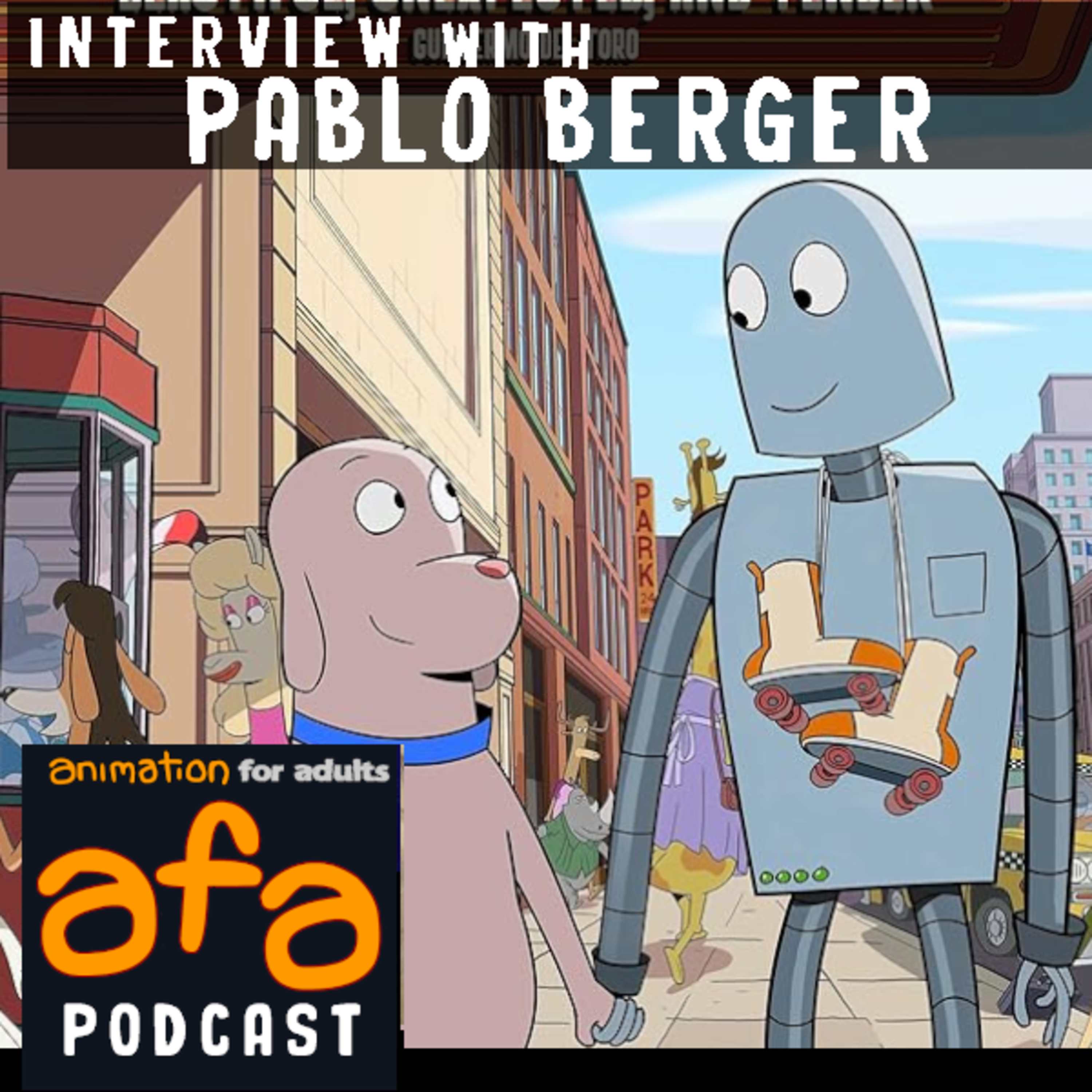
But how did it come about that you decided to move into animation? Was it a case of you came across Robot Dreams as a concept? Or did you decide you wanted to make an animated film specifically? I had never thought about making an animation film in my life, although I always loved animation. And even when Silent Sound magazine asked me my top 10 films, I included Chihito Spirit Away. So I think favourite directors of my favourite films, I could include many animated films.
But to actually make an animation film, it has to do with when I found this graphic novel. The only reason is that I found Robert Dreams, a graphic novel, by Sarah Barron. And when I read it, I just fell in love with the story. I thought it was original, fun, surreal. But especially, I found it moving. And I'm talking about the end of the book. I find it one of the most brilliant endings I have read in any kind of media. So when I finished the book, I thought...
If I want to tell this story, the protagonist is a dog, anthropomorphic, and a robot, and it takes place in the world with anthropomorphic. If I really want to do it, I have to get into this crazy world of animation. And all my films, they're always like one step forward in a different direction. If I have a trademark as a live action director, it's that every film, in a formal way, they're very different between them. And I like to take risks.
I decided, and I have, my producers have been supporting my career from the start and always pushed me to go further. So I knew that my producers were not going to be surprised if I would go with an animation film. So that's what happened. I went to my producer with a script and the idea of making an animated film and they just raised the money to make it. Was it always going to be dialogue-free? I guess that comes from the graphic novel originally. The story, if I go into detail, would be that I collect wireless books. This book has no words.
I have a collection of, you know, almost 200 of them. And when my little, my big daughter now, or my daughter is 20, but when she was two or three, I wanted to experience reading books. And I found books that had no words, so they didn't know how to read. So that's the beginning of everything. I bought this book for my collection and I read it in 2010. I made two films, Blanca Nieves and Abracadabra. And only then I thought about making the film without dialogue. Also it's connected. I made a film called Blanca Nieves that has no words either. It's a wordless film. It has no dialogue.
And it was such a great experience in every single aspect for me and for my career as well that I was waiting to find a project that was connected to Blanca Nieves, but at the same time, very different from Blanca Nieves. So when I came up with the idea of making an animated film with no dialogue, I knew I could make a sister film of Blanca Nieves, but in a very different way. So when you were producing the film, did you have a classical script or was it all just done from storyboards because of having no dialogue? There was a classical script, written the final draft and you have the description. Or, you know, as I told Blanca Nieves also, he had a classical script. The thing is that the structure and the actions is really the cake of the script.
The dialogue is just the cream. So when you make a dialogue-free film, it doesn't mean that you don't need a script because you really need a script, mainly because the script is a way to communicate with the producers, with the crew, to raise the money to make a film. But what I can say that, you know, you write a script in a traditional way, but then if the script is the treasure map, in an animation film, the treasure map is the storyboard, of course. So I worked for one year on the storyboard, or what in Spain we call it animatic. I don't know, in the UK, the...
It's a storyboard, but animated storyboard. Oh, yeah, they call it animatic in the UK. For one year, I was working with an art director, with a storyboard artist. I was working with a music editor, and I was working with an editor. So the five of us, for one year, we created an extremely detailed and carefully done animatic. And obviously, that was the final script, to put it that way. And then, once we had that, we started the production. You know, to put the studios, to get the animators, get all the artists.
So definitely the script in animated film, it's very connected to the animatic itself. The film's got a very specific setting in time and space, like in the 80s New York. It's interesting that you said you lived in New York, so you're drawing on that personally, your time living in New York. And was there a lot of research done towards creating this specific setting? Well, definitely. It's funny. I'm a writer-director. Before a director, I'm a writer. And after Robot Dreams, all my films were original scripts. This is the first time I do an adaptation. But it's curious that I think it's probably my most personal film. Because I was able to grab the story. I was able to make it mine. In the graphic novel, it doesn't appear in New York itself. I don't know if you've seen the graphic novel. It's a very...
simple graphics, you know, the film, the city is a very detailed background, but the backgrounds in the graphic novel, they're really very basic. My one idea that I had is like, what if the protagonist of Robot Dreams, apart from dog and robot, is New York? So that was a big change, a big proposal, because I really wanted this film to be my love letter to New York, you know, the city that I lived for 10 years. And as I said, my connection with dogs is very deep because I was that lonely dog in New York. I live in this village.
I fell in love in New York. My heart was broken in New York. I fell in love again. I met friends. I lost friends. And even I left the city. So there's some element of nostalgia with this film. Although I'm not a nostalgic person, I always think that my best film is going to be the following. I'm always looking forward. But for the first time in my career, I made a film that has an element of nostalgia of a New York that doesn't exist anymore. How did you decide how faithful to be to the source material? I mean, did you ever get any pressure from anyone to change the ending, for example?
The good thing about the project is that the first thing I did, even before talking with my producers, is to meet Sarah Barron, the author of the graphic novel. I was invited to be jury at the Chicago Film Festival and I made a layover in New York because at that time she was living in New York, Sarah Barron. We had a coffee and I said, I love your graphic novel. I want to make a 2D film of it. She had seen my film Blanca Nieves, which is wordless as well.
Right away, she said yes, that she would love to. But also she told me, look, I made the graphic novel. Now you make the film. So she gave me carte blanche. She was not involved in the creative decisions, either on the script, either on the visuals of the film. So what I told her is that I love the film, the theme. I love the soul of Robert Dreams. I was going to protect the soul of Robert Dreams above anything. But it's very different. A graphic novel, one artist, one year, hundreds of artists, four years in an animated film. So it's a different scope.
So definitely the film is very different and much more complex in many aspects. But, for example, I will show you the first page of the graphic novel. The first page of the graphic novel is just dog at the window, waiting for the postman. that they bring the box with a robot. For me, I couldn't start a film like that. I had to introduce the setting, New York. I had to introduce the character. I had to create a character dog that was a lonely dog. He plays along punk video games, sees the neighbors are having fun. He's very sad eating his TV dinner and then appears on TV a commercial of a robot. So things like that are everywhere in the film. Like there's a big new scenes, new characters. For example, the end of the graphic novel is just these two pages. No more. But...
With these two pages, it really got my juices going, and I made eight minutes, many things. But without doing the spoilers, what happened at the end, to some extent, it has the same connection. I'm a spoiled director by my producers. All the films that I made up to now, therefore, I have made them with freedom, and I have told the stories the way I wanted to tell the story. I had final cut. I was able to put my crew together, and I was not...
I was able to make the film that I wanted to make. So yeah, we didn't want to change anything just because it could be more commercial. Because nobody knows what is commercial, honestly. Nobody knows anything about cinema. And that's one of the beauties about this medium. Did you ever think of keeping the main characters, Robot and Dog, together more at the beginning for longer? Well, the thing is that I encourage people to look at the graphic novel.
In the graphic novel, they really spend much, much less time together. And they do many, many, you know, lessons together. For example, they go to the library, they rent a video, they watch a video, and then they just go to the beach. But for me, I had to establish in the first act that they really become BFF. They really go to do so many things. And also, Robert had to discover the world. What is to be, like, Robert is born, thanks to Doug that put it together.
It was very important that the first act, you feel like they're really, really, really close. So it's different, but it's the same, as I said before. I need to be wrapping up about now. But just one more question. Would you say that you're a convert to animation now? Do you reckon that you make more animated films in the future? Or is it a one-off? No, I'm a convert. Guillermo del Toro, he's our leader. I met him in ANSI.
animation is not a genre. I did open and I encouraged other live action directors to try this media, this way to tell stories. I'm fascinated by animation now. Now that I have tried it, I'm sure I will make more. I will continue making live action films. But it depends on the story. For example, I would tell you, thank God to animation, I was able to make a homage to Busby Berkeley with thousands and thousands of tap dancers. I couldn't have that with a European budget.
Thank God for animation, I was able to make a scene that, an action scene in this late race that a James Bond movie would love to have. So I was able to make a big budget action scene that I couldn't have done it with. So it opens up to new stories. So I'm definitely, I love animation. It was a wonderful experience for me. Wonderful, wonderful, amazing.
I look at the career of this film now. It started in Cannes, went to Annecy, got the European Film Award. Now we got two Goya's Best Animated Film, Best Script, and now we're in the Oscars. I'm in Elena right now. So how could I, a film that brought me so many things, of course I would love to repeat. Brilliant. I look forward to more films from you, more animation, because I haven't mentioned it, but I love the film. I'm a romantic guy. I love to talk, when I talk with the media, with the press, I love to feel if they're connected with the story of Robert and Dove.
Yeah, totally. It's a wonderful film. Thanks so much for talking with us today. Thank you, Bruce. And best of luck for the Oscars. Yes. Thank you. Hey there, guys, and thank you again for tuning into this episode of the AFA Podcast. If you want to stay up to date with the latest animation news, reviews, and animator interviews, check out the main website at animationforadults.com. Best way to keep an eye out for new and shiny stuff would be to follow us on our social media accounts at Twitter at AFA Blog, Facebook, Pinterest, Tumblr, and Instagram. You're also welcome to go through our podcast catalog wherever you stream your podcasts, including...
Or if you just want to do us a one-time donation, you can check out our Ko-Fi page and buy us a virtual cup of coffee. Every little bit helps. And as always, I gotta give a shout-out to our friends at Animation Nights New York, a very special monthly screening event for some of the coolest animated short films and VR experiences from around the world, curated by industry experts and amazing staff who are striving to connect new talent through both live and virtual events. For more information, check them out at www.animationnights.com. Until next time, see you, Space Cowboy.