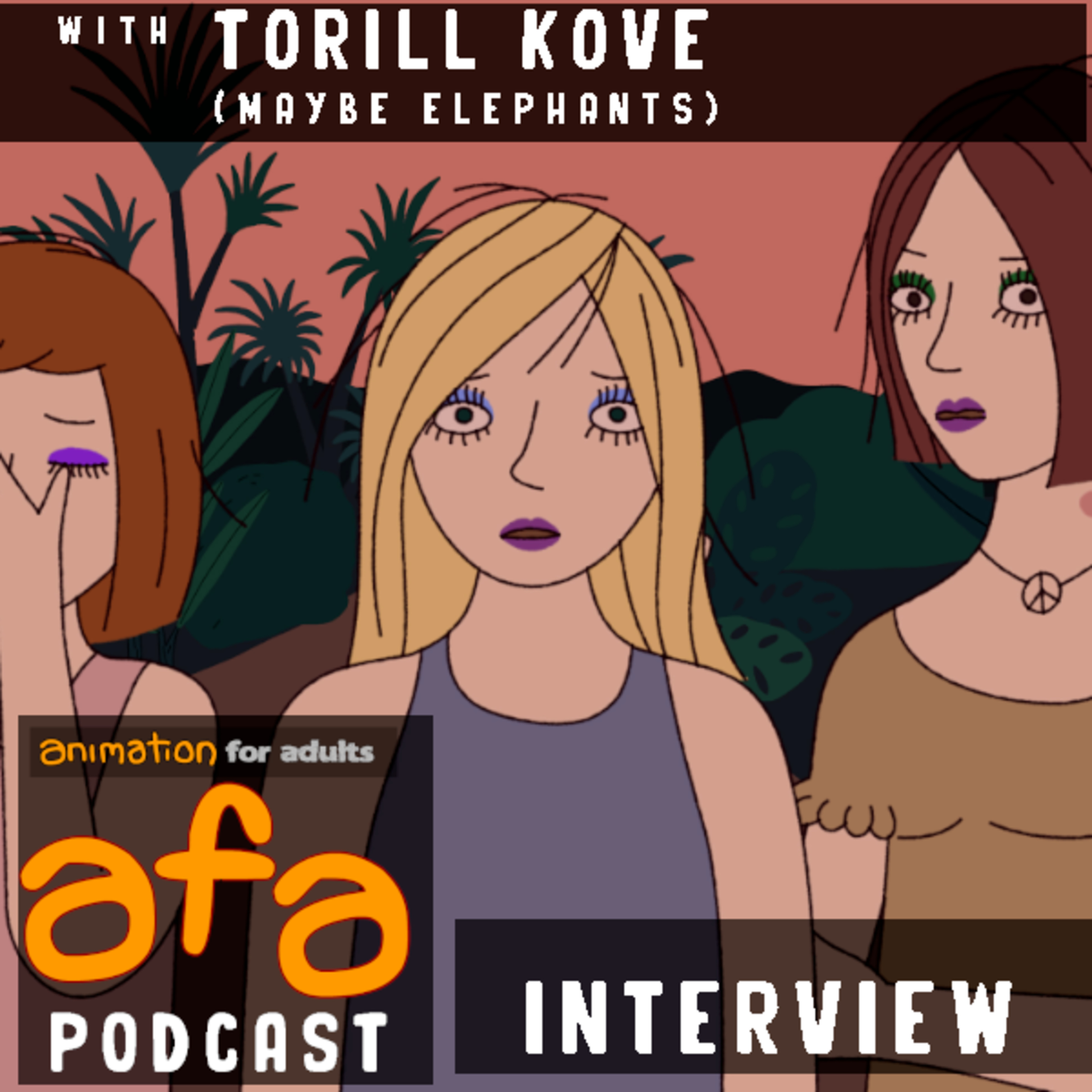
Well hello there, and welcome to the AFA Podcast, the official podcast of animationforadults.com. Interview edition! Via the magic of Zoom, I spoke with Toril Cove, the Oscar-winning director of the new film Maybe Elephants, from National Film Board of Canada and Microfilm. We spoke about the new film, as well as Toril's illustrious career, and I think it's a really good, interesting listen. So without any further ado, here's the interview! To get started at the beginning, what's your origin story? How did you first get into animation?
So I'm a bit of a late bloomer, you could say. My background is in urban planning. I studied... I got an undergraduate degree in urban studies, and then I got a graduate degree in planning, and then I went and worked in that field for a while, and I found it sort of oddly unsatisfying. And then because I had always been drawn towards the arts, I guess, in a kind of hobby sort of way, I decided that I would just try to do something with that and try to make a living drawing, illustrating, and stuff like that. And then I was living in Montreal at the time, and Montreal, as you probably know, was for a while being a kind of an animation hub of the city in Canada because the film board is here.
And then in the 80s and 90s, there were all these commercial studios that propped up. And so it was just kind of in the air. So I explored that a bit and decided to go back to school and did about a year and a half of animation studies. And then I started getting work as an animation production assistant at the film board. I did old-fashioned trace and paint for a while. And then towards the mid-90s, I kind of pitched my own project at the film board. And then to an Norwegian producer, that would be 95 or something like that. And then I made my first film. And then, you know, I've made a few since then.
That was my grandmother, I and the King's shirts. Yeah, so that was my grandmother, I and the King's shirts. Was there any truth behind that story? Or was that just a fanciful? Well, it was mostly a fanciful thing. I mean, the whole thing with my grandmother being part of the resistance, destroying the shirts, that was just a fanciful thing. But I think it was kind of playing on the idea that...
that a lot of Norwegians of her generation were in fact participating in the resistance movement during the war. And it seems like every family, at least it seemed like that when I was younger, it seemed like every family had someone among them who had fought in their resistance. My family didn't. They weren't really that kind of family, so I sort of made one of them. But I mean, the context of that story is all sort of historically factual.
the rough outlines of the history of Germany invading Norway and the king running away and all that. That's basically all true. So the sort of spirit is all true that surrounds it. The historical context is accurate, or at least more or less accurate. And the story involving my grandmother is fiction. So how did you find your style? Have you ever thought about using any different style medium or have you always been sticking to 2D?
Yeah, so that is just, you know, that is just kind of something that evolved over time. I just basically, the way that I draw now, I mean, obviously it's, it has evolved and changed some over time. You know, I'm hoping that I'm better at it now than I was 30 years ago. But there is more of a recognizability and the, you know, the line quality and the design and the... compositions and all that kind of stuff but basically i just you know i had kind of um idols drawing idols that i looked up to when i was younger um one of them was actually my dad he had a really kind of cool simple drawing style um And then there was Sol Steinberg. I really loved his drawings, still do. And then there's this Finnish children's author and also kind of like a comics artist called Tove Jansson. Oh, yeah, I know her well. Yeah, so she, you know, her art definitely played a role in influencing mine. I just, I mean, I still, I just, I just love the way she puts drawings together. Yeah, no, she's amazing. And she has her drawings art.
just extraordinarily expressive she does so much with so little and i really admire that uh so that's uh you know so that's kind of where it comes from but i having said that i also think that when i first started making you know when i started um my grandmother iron the king's shirts a lot of the um i mean practically all i knew about animated short film 2d uh was stuff that came out of the film board you know their 2d animation um artists that had made you know films there you know in the 70s and 80s and 90s um they they were also a big influence on me but maybe especially in terms of character design um And then, you know, as I became more confident in drawing my, you know, making up my own characters, I feel like I moved away from that a little bit and kind of come back to a little more to where I started. So it's, you know, it's an evolution. It's in flux. I'm still working on it. Trying to make it fit. Yeah, I see it's become more digital over the years, but... Yeah, but I mean, I still, it is more digital, but I still draw everything by hand. It's still, I mean, I draw a lot of it. I mean, I draw everything now on a tablet, but it's still...
It's still hand-drawn. I don't automate anything in my animation. It's all handmade in between. It's digital with definitely a handmade component to it. What's your process like? How did you get started on film? In film? Yeah. Well, I think I was working at the film board for just hanging around animators in their animation studio in the early 90s.
Suddenly it was like, oh, my friends are animators and animation directors. And I was just looking over their shoulders on a daily basis, really getting to know the process of making an animation short film from the inside. I did a lot of trace and paint. And I think the interesting thing about doing trace and paint is that you do... you learn a lot about animation that way because you're tracing one or painting one drawing after the other and you can kind of see right in front of you on the papers and the cell you know the slight differences in in movement or you know the progress of movement and you see okay well here's a chameleon lifting his hand to slap the fly you know this only takes three drawings you know but now he's moving more slowly here it takes 15 drawings you know so it's like a um kind of learn learning by watching almost uh kind of learning the sort of the um the process of certain kinds of movements so when i when i um started
making my own film even though it was my first film my first professional film i kind of felt like i had quite a bit of experience just judging how animation happens um so that's pretty you know how i got started i mean i pitched i pitched the the king's service project to a producer at the film board and then she took it to norway and pitched it to a producer there it just so happened that she was going to a festival around the time that i was pitching to her and we found collaborators um in in oslo to co-produce that first film that i made and then the following four films have been made much the same way just with a different norwegian producer What's the story behind the Danish puppet? Not an easy question to answer. Well, I mean, it was, I don't know. I mean, it's like, I don't remember exactly what made me want to start into that, but I think it had something to do originally with being fascinated by the idea of...
of fate and coincidence, I guess. And I always thought the story about how my parents met was kind of interesting because there was just so many coincidences that had to happen along the way. And so I started out writing the story about how they met, kind of almost like their story, like a biographical document, basically. And then as I was working on it, I thought, you know what, this actually isn't that interesting to other people besides the nearest family. There was also some really private stuff in there, and I thought, I didn't really want to continue with that idea. But by that time,
by that time i had also um become fond of you know the larger concepts of of how you know the role that coincidence plays especially in bringing people together um and um there was in my mother's story there was uh there was a there was not a danish poet there was a danish artist i think she had at some point been engaged to a danish artist in kopenhagen um and um So I liked that idea of having a Danish poet in there. So that's how the Danish poet was born. And the rest, you know, it was just a process of trying to, you know, trying to build a story, you know, wrap this coincidence concept idea, kind of wrap it up in something that was a little bit like a fairy tale and that had a lot of Scandinavian components to it. And there was a little bit, and there was a life imitates art components in it. And there was a bit of, you know, Danish poet fandom in there. So, I mean, there was like, it was basically like a stew with many different ingredients that came together in the end.
Do you have a particular affinity with the medium of the short film in itself, or have you ever longed to do a longer form piece? I can say that I long to do a longer piece. I have done it once. I directed a feature animation film back in 2012-13 or something like that. It wasn't my story. I was brought into the project to direct it. It was an interesting experience, and I learned a lot from it, but I found it also a little...
let's call it alienating exactly, but I felt quite removed from the actual production process because the job of a director in a feature film is really to kind of oversee everything that's getting done by others. I think it's, I mean, I know that there are feature film directors that are more hands-on, but my experience was not to be that hands-on. So it didn't really immediately make me want to make another one. And I think... I think that if I were to make another feature, it would have to be based on the story that I've written myself. And I just kind of find that the things that I want to write about or make a film about, they tend to be short form.
You know, and I like the freedom that a short form allows you. There is that, you know, I guess a little bit similar to, you know, in literature to a poem or to a short story that you have, you're constrained by this, you know, fairly short amount of time that you have to get your message across. And I like that challenge. And I like it also that it doesn't necessarily have to take that long to produce one. You know, if need be, I could do it myself and all that. So, yeah, I do have an affinity to the short form. I think if I have, if I ever write something that lends itself to a feature.
think it would be really exciting to do it but i'm not i'm not really planning for that awesome um so to bring us up to date uh with maybe elephants so how did how did that come about um well there was um you know after i'd made me in my molten which is uh also a little autobiographical snippet from life with family I kind of felt already then that there was possibly a sequel involved or a sequel could come after that. I like the characters of the, you know, the parents that are kind and well-meaning, but also a little clueless. I think that's a, you know, those are nice character traits to put into a story, I think, you know, character traits to give to parents. And then I like the dynamic between the three sisters. And I thought, you know, I could bring them into teenagehood.
that's sort of the natural route to go with that would be to write a story about the period that my family spent in Kenya when you know my sisters and I were teens and my parents I guess were approaching middle age and you know so there was something kind of compelling about that to make a film that's set in a different in a different place something that's outside of Norway It was actually originally the working time for the film for the longest time was foreign country. And the idea originally was to do something, you know, write a story about what happens to family when you take it, when you take it out of its kind of comfort zone bubble and a small kind of protected little rural place in Norway to this huge, you know, metropolis in an African city. Yeah, so that was basically the, you know, that was the seed that got planted early on.
Is it your most autobiographical film, would you say? Or is it Me and My Moulton and the two of them together? I think so. I think so. I mean, Me and My Moulton is also quite autobiographical, but it feels like a kind of, I don't know what to say, like a smaller story, basically. I mean, Me and My Moulton has kind of, I mean, they're underlying topics, but basically it's about this notion that, you know...
parents do the best for their kids but mostly they do what they would want for themselves you know that's kind of the underlying theme there so it's like you know one fairly simple idea i mean there are others things there too that have to do with empathy and um uh and hiding feelings is another one that's another theme in there but but but maybe elephants just feels like a bigger autobiographical story um there's more stuff about my mom in particular more stuff about, you know, the relationship between the siblings, you know, there's more kind of growing up Anst. So it's a little more, I'd say it's a little more texture, a bit more complex, maybe, especially emotionally. I really like the portrayal of your mum in the cloud. I thought that was really effective. Yeah, thank you. The cloud almost kind of takes on its own personality after a while, you know. It keeps coming back. How do you think your style has evolved?
So I think that the style, and I mean, this is just how I see it. I'm not sure that others will look at it that way. But I think that visually Maybe Elephants is a little more complex than my other films. It's the first time that I worked. I mean, we had an art director on Maybe Elephants because I had ideas about how I wanted the film to look.
And I had lots of sketches for the backgrounds and for characters, especially the part of the film that was taking place in Kenya. And I liked what I was doing, sort of the conceptual sketches, but it wasn't really clear to me how I could translate that into something that was doable in 2D animation without hiring a whole oil painting team, basically. So I worked with an art director who was an animator and illustrator in Norway that I've worked with many times before. And she's really a very, very talented illustrator and animator in her own work. And I think because she and I know each other so well, we made a really good team.
And she was able to really kind of dissect the stuff that I had done. I said, oh, well, like she kind of deconstructed it and put it into something that was the look of the film that was very much rooted in what I had presented her with in terms of, you know, line drawings and sketches. But at the same time, it was its own thing. And I think that's what when, you know, if your observation is that this film looks a little different, I think that has a lot to do with it. And so it's more, I think the visual part of the film is like it's more layered, it's more textured, there's more play with light and dark, you know, it's like there's more use of shadow than I've had in my other films. And I think because the art direction team sort of employed all of those tools, I think in the end it's visually more kind of nuanced and expressive than my other films. You know, I think it does some really...
I think it plays on mood really well. Yeah. So I think that was an evolution that might be, you know, specific to this particular film. I don't know that I will be able to really duplicate that unless I work again with the same art director. I think I learned a bunch of stuff that I can glean from it and take with me on my own to my next film. But I think there is definitely like a among the listeners stamp on the visual quality of the film. Wonderful.
what particular challenges did you face making maybe elephants um well there was i mean i i think from a sort of director's point of view i there were some very you know there were some challenges that i had with directing the animation team in particular um I don't have a lot of experience doing that. And I find it very difficult because, I mean, I have my own style of animating and I don't know exactly what it is. You know, I mean, I'm kind of self-taught. It's pretty intuitive. I mean, I learned the basics at school and then I have just kind of picked up on styles that I have seen other animators do that I really like. And so it's a kind of like a hodgepodge of different, you know, different influences. But ultimately my style is very simple. I mean, I don't really do full animation. It's quite sort of, it's kind of like my drawing style. It's kind of naive.
and simplistic and it's even though it's simple it's actually kind of hard to explain to people how to do that because i don't i don't really know the language um so uh i found i found that difficult uh so luckily i had really great animators so in the end it wasn't that big of a problem i think if if i wasn't um if i wasn't happy with some animation because it was like too slow or too fast or you know too fully animated or too this or too that typically i could um you know fix that by just referring uh people you know i mean just ask them to look at some certain shots in my film and say you know this is you know the comic timing here it's i want it like the way the kids are falling off their chairs and me and my little you know it's like um Yeah, so that was difficult. But like I said, the animators were amazing, so it worked out just fine. I think there was a little bit of a time challenge. We had decided that we would do this film in a fairly constrained time period. That was a little bit of a time challenge, a little bit of a challenge. And other than that, I think there were some issues associated with just sort of politically with a white woman making a film that takes place in an African country. That had its challenges as well. But I think...
I think it was actually a really interesting challenge, ultimately. And I don't think that it was a challenge that hampered the film in any way at all. Yeah, so I'd say those were the most difficult things. Is there a particular message you'd like audiences to take away from Maybe Elephants? No, not really. No, I don't think so. I don't...
I didn't have any kind of goal in that sense in mind. I mean, there are things that people say to me after they have seen it that always makes me... I mean, obviously, anytime somebody says something nice about the film after they've seen it, you know, it makes me happy. But it makes me feel like I have, I guess, succeeded in a way when people tell me that they understand the cloud, you know, that they have seen that cloud over others or they experience it themselves. You know, I think...
I think that kind of makes me feel like I have succeeded in a way to say a little bit of something in the most kind of oblique of ways about an impact that depression might have on an individual and his or her family. So I think that's good. There have been actually many times when people have told me, people who are Kenyans or who are from Africa but other parts of East Africa or even parts of West Africa, people who have spent time in those places, they tell me that they kind of recognize them.
the mood or they recognize particular landscapes or that they feel like that there's something about the way that the film depicts Kenya that really resonates with them. That makes me feel good because it's not that, you know, we have simple tools in this animation. It's all 2D, right? So there's no special effects or anything like that. So that always makes me feel happy to hear that. And yeah, and of course, I like it in an audience. I like it in this audience, in an audience of this film that I see that people have like a range of emotion.
find parts of it funny and they find parts of it you know moving or melancholy um yeah so i i kind of like the idea of people experiencing a range of emotions when they've seen it or when they see it but no particular message no i don't think so okay um Can you tell us anything about what you're working on next? Have you thought about, have you started thinking about your next film? Or is that, are you just taking a break? I think it's a little early to talk about that, actually. But I mean, I think one thing I'll say, the work that I'm doing now is that I'm turning the film into like a graphic novel. Yeah, and that's kind of interesting because I think the book will be a bit different from the film. And it's fun for me in a way because a lot of things had to be taken out of the original script for the film because it was too long. I mean, I think if I kept the original script, the film would have been, you know, 45 minutes.
so it's too long and too complicated and you know it's like too much of different kinds of things and now I feel like because it's a book I can put it back in and that's kind of fun so I'm basically you know redrawing and recoloring everything so it's not going to look like it's going to have like visually it will be different from the film because you know my art director isn't doing it and I don't I'm not just I can't just kind of copy what she has done so I'm just doing everything from scratch basically so Yeah, so that'll be done sometime in April, I think, and hopefully the book will be out later this year or next year. Next film, I don't know yet. I'll have to see. You know, I'd like to make another one, but I can't really, you know, it's too early. Early days. Well, Toroko, thank you very much for speaking with us today. It's been fascinating. Yeah, it's a pleasure. Thank you very much.
Hey there, guys, and thank you again for tuning in to this episode of the AFA Podcast. If you want to stay up to date with the latest animation news, reviews, and animator interviews, check out the main website at animationforadults.com. Best way to keep an eye out for new and shiny stuff would be to follow us on our social media accounts at Twitter at AFA Blog, Facebook, Pinterest, Tumblr, and Instagram. You're also welcome to go through our podcast catalog wherever you stream your podcasts, including Apple Podcasts, Anchor, Spotify, Amazon Music, Audible, Google Podcasts, Stitcher, and Acast. We are always looking for feedback, so feel free to leave us a review, rating, or even send us a voice message via our Anchor page.
Or you can even drop us a line at podcasts at animationforadults.com. If you want to support the podcast and the website by proxy, then please zip over to our Patreon page and check out our rewards for becoming a patron. Or if you just want to do us a one-time donation, you can check out our Ko-Fi page and buy us a virtual cup of coffee. Every little bit helps. And as always, I gotta give a shout-out to our friends at Animation Nights New York, a very special monthly screening event for some of the coolest animated short films and VR experiences from around the world, curated by industry experts and amazing staff who are striving to connect new talent through both live and virtual events. For more information, check them out at www.animationnights.com. Until next time, see you, Space Cowboy.