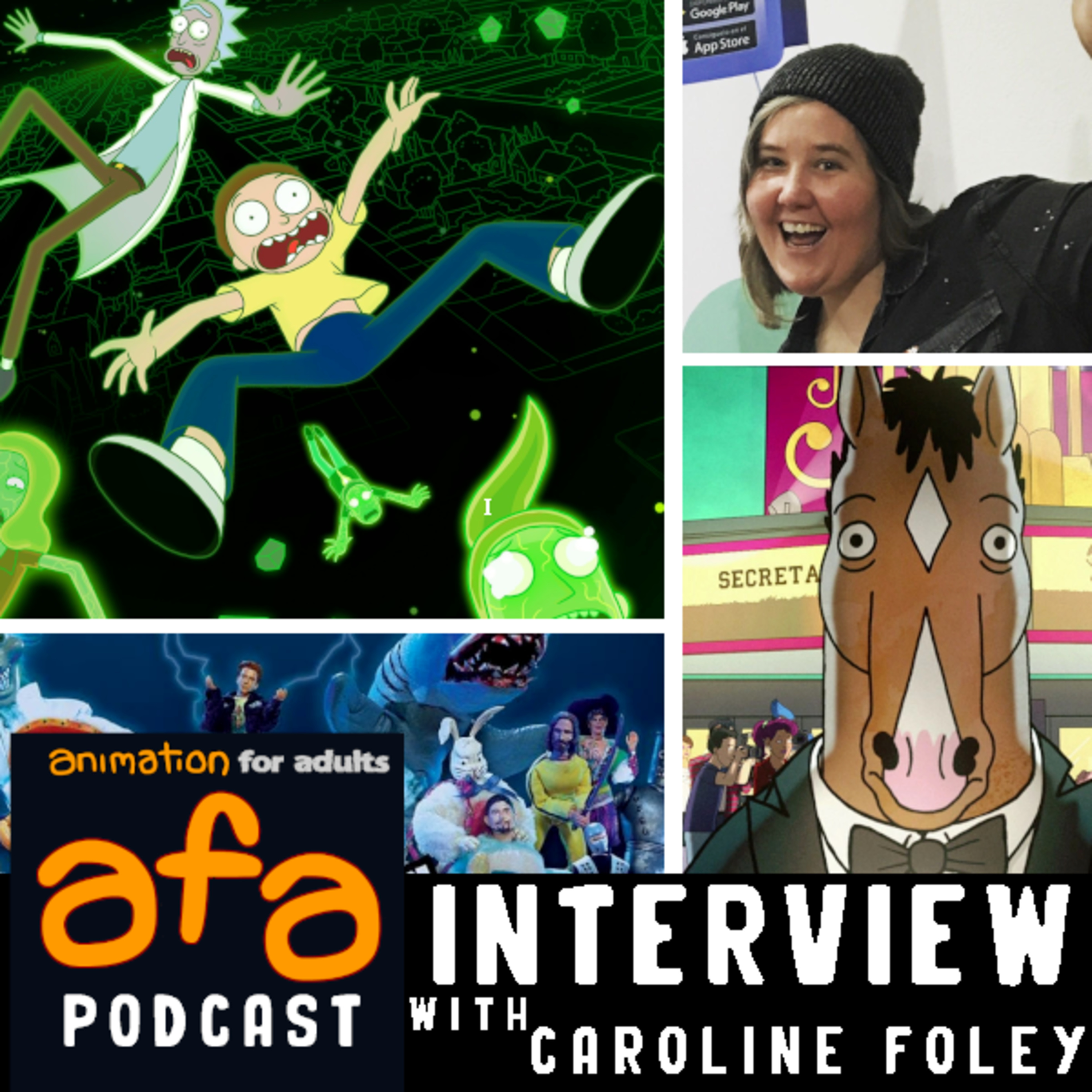
Well, hello there and welcome to the AFA podcast, the official podcast of animationforadults.com. This is an interview special episode where I got to speak with Caroline Foley, who is an animator, storyboard artist and story editor, whose credits include Rick and Morty, Bird Jack Horseman and Robot Chicken. I had a lot of fun with this one and I think you will too. Enjoy. Okay, so to start at the beginning, how did you get into the industry? Yeah, so I think for me, you know, I've always...
grown up with um you know a lot of disney movies and so that was kind of like you know all kids kind of grow up with a you know their favorite animated film so for me when i was about 13 the lion king came out and there was a little featurette that i saw and they were you know going behind the scenes showing all the different you know character designers and animators and right at the end they got to this one animator that it was a woman and it had been um all men at that point and i think she was the animator for zazu the bird and it just kind of blew my mind that you know like I've always loved animation but I didn't really see myself as you know as it being something that I could do and so that kind of uh I think inspired me a lot and set me on the path um so I uh I went to a four-year community college to kind of like you know figure out what I wanted to do there wasn't really a lot of animation going on in San Diego and I was like I have to have to go out to college so I was lucky enough to go to tell arts and um to graduate just in time for that 2008, 2009 financial crisis. Yeah. So I was actually working for a little studio and I got about, you know, maybe a year's worth of work in before they were like, ah, sorry, we can't do this anymore. Financial crisis. So it was really rough. I was living in Skid Row, surviving on food stamps, you know, looking for work. And so I had a re-entry into the industry.
I had a friend who was working at this company called Shadow Machine, and they were making robot chicken at the time. And he was like, hey, we're looking for interns. Come on over and test out. And I got the gig. So even though 2D animation was my first love, I was also very into stop motion. And so that was kind of like my re-entry. And from there, I'm sure you'll have more questions for me about the projects that I've worked on. But that's kind of like how it all went down. So you were a pretty big animation fan growing up.
Well, other than the Lion King, can you say which particular shows were like a big inspiration for you? When I was growing up? Yeah. So, okay, when I was really little, I love Sesame Street. I still do. They have all these like little cute animated segments in there. I think those left a big impression on me. And I love shows like Rocco's Modern Life. And there was the Disney Afternoon. So stuff like DuckTales and Gummy Bears were really huge for me.
And a little later, SpongeBob came around. And I remember when that, like, they were teasing trailers for that. And I was like, oh, man, this looks so cool. And they would play the intro as, like, a teaser or something. And it just blew my mind, like, the mix of style with the 2D. Because, you know, the intro has got these, like, little miniature sets and stuff. And I think that also had, like, a huge impact on, like, what was possible in animation. Awesome. So one of the first things you did was your own short No Naked. Yeah. How do you think that helped you transition into working in TV?
Yeah, so when I first got to CalArts, No Naked was the first thing that I storyboarded. I sat down and it just came out of me. And I was like, oh, this is kind of funny and it feels very me. But I'm not ready to really tackle this film yet. You know, I had a lot to learn about animating and, you know, what could I do to make it a little better? So I made it my goal to do that film in my fourth year. So it really was all of my skills coming together to make that film. So it was, you know, the...
The storyboarding, the writing, the animation, everything I had learned. I even did the sound design and then the voices for the two kids, Ty and Yelly. It was a lot of fun. But, you know, I really pushed myself to, you know, with the animation and to, you know, really experiment with timing. And I think those are the two biggest things that people walk away with or at that time when it was when it came out.
So I would say, yeah, animation and the timing of everything, you know, with timing, I mean, in regards to like animation timing. Yeah. You feel quite a lot of different animation roles in your career so far. And I think our listeners probably know what a storyboard artist does. But when you've worked as a story artist, can you explain a bit what that entails? Oh, are you talking about story versus storyboard? Story artist is a specific credit I've seen you credited under.
yeah it's kind of so story storyboard is kind of this the same thing in the animation world um uh And then there's, you know, the script writing aspect. In animation, there's so many different ways you can write, you know, with, you know, starting with an outline and then going into a script or starting with an outline and going into, you know, storyboarding. But story, I think for, you know, for animation, it's mostly talking about storyboarding, if you're a story artist. What was your experience like working on Bojack Horseman? How closely did you work with the show's writers or showrunners?
Not very closely, actually, unfortunately. So storyboarding on BoJack Horseman, we had a little bull pit where we were all kind of set up all the different teams. Not a bull pit, a bullpen. And so we could all interact with each other, you know, if we had, you know, something we wanted to work through beat by beat, you know, we could all come together and go through stuff. But the writers were not always around. If they were, it was mostly because they were walking through and they were going to, you know, show things to Netflix, you know, for approvals and all that. But yeah, unfortunately, not a lot of close interaction there.
BoJack was a very cool project to be a part of. I was actually real early on in the process. So it was originally a pilot that was not sold yet. So before it was with Netflix. And so if you watch BoJack Horseman, the very first and second episodes, half of episode one and half of episode two were actually the pilot. So they took the pilot, split it in half, made two separate stories from it.
So I was on that pilot doing animation, kind of figuring out how Bojack was going to move. He's got this big head. If we swing his head around, is there going to be... uh, a smear frame, a smear frame in animation is when, um, uh, you go off model and things get elongated to kind of help, uh, sell the movement that's happening instead of it all being static and still, but it didn't really work for BoJack because we did want, um, you know, it to be, let's go be, it was a more serious show. Um, but it was really cool to be a part of that early process and, uh, come back later and on season two, um, help out with, uh, storyboards. Um, I got to do this really fun sequence on the first episode of season two.
with Bojack playing Secretariat, doing all his weird little poses with, what are you doing here? I think that was one of my favorite moments to work on with Bojack. But also, like, I was storyboarding the very first sequence with baby Bojack and his parents fighting in the background in the silhouettes. So it was definitely a show where, you know, you get tested in both areas. Like, how funny can you be, you know, and how can we sell this drama? So it was really fun being, you know, getting to, like, scratch all those itches performance-wise.
And you also worked as lead animator on the first three seasons of Rick and Morty. What were the challenges of being the only full-time US-based animator on the show? Yeah, so lead animator stateside for things like, you know, the Goodbye Moon Men sequence in season two. And that was a really cool sequence to do. So we have a partner studio up in Canada called Bardell. They do really great animation. It's all...
digital puppets they're kind of one of the premier studios that does that um so so they have their team over there and their own like lead animator for all of that work and then so i'm over here in the states doing mostly like these specialty sequences and um fixing things up that need some help uh and making new sequences because a lot of times there was writing that was happening that was you know after an episode was finished like oh we need a new scene here uh you know kind of punch up this joke that kind of thing um But so I got to work on the Goodbye Moon Men sequence in in season two, which up until that point in the show, there really wasn't a lot of morphing stuff happening. So this was this was new for the pipeline. And it's not really a sequence that you can ship out very easily because, you know, it's so organic. You know, it's so up to the artist who's accomplishing. So so in order to, you know, have that work, we did not send it overseas. We kept it in house. And I remember it was.
it was kind of funny so we watched these animatics before we start on an episode and so i you know watched watch the animatic for that episode and i saw that sequence and and my eyes just lit up and i was like oh man i hope i get to work on that like you know i knew it would be difficult to send to to bardell um and so i was just kind of you know sitting thinking for you know the weeks leading up to it and then um uh the I can't remember if it was a technical director or the producer, Mike Mandel, came over and they're like, hey, so we have this sequence. We're not sure what to do with. And how do you feel about animating this? And it was the goodbye moon man. I was like, oh my God, yes, please. So for two and a half, three weeks, I was just in absolute bliss animating wild morphs and just these crazy organic lines and stuff moving around. It was really a joy.
That was a really fun show to work on too. But then also, like BoJack Horseman, Rick and Morty is a very serious show at times. So I also worked on the Rick's suicide sequence. So that one was very complex and very emotionally taxing. So I always like to think of animators like myself as actors, maybe shy actors. We're just accomplishing the performance slowly over time, frame by frame rather than in real time. So I was animating that.
that Rick suicide sequence, I, well, just to back up, it came, it came from Bardell and it needed a little bit of help. So the sequence is over a minute long. So to put that in a pipeline, to put that on one animator, you know, who's trying to keep stuff on a schedule is really difficult. So, so they did, you know, the best they could with, you know, the resources of time that they had. And so it came back to me and there was a lot of work to do. So I sat, you know, down with that, that whole sequence for, you know, about two and a half weeks, just showing up to work every day in that mind frame of, you know, trying to get into.
the emotion that Rick was feeling. It was really difficult. So, you know, there's the two sides of Rick and Morty, you know, doing all those fun, crazy morphs and then, you know, doing all these more serious sequences that need a lot of very serious acting. So it was a great challenge to be a part of that. Very high watermark in my career for animation. Yeah, well, the Goodbye Moonman section is a phenomenal bit of animation. So you should be very proud.
And now to bring us a bit more up to date, you're working on a couple of YouTube-based shows. How is the adjustment from working in TV, from traditional broadcasting into the YouTube shows? Oh, I think it's awesome, honestly. So the YouTube shows I've worked on are Toka Life Stories and Blippi Wonders, which is a big left turn from what I was doing for broadcast. So they're kids' shows. And I love it because I've always wanted to work in kids' animation.
And I wanted to kind of break away from animation and get more into the storytelling side of things and become a writer. So for both of those shows, I was the story editor. And the nice thing about YouTube is usually stuff is short format. Like you still have to follow rules, you know, of like what you can and can't do. But the short format is a lot of fun. It's really satisfying because, you know, when you make an episode of like Rick and Morty.
it's like, you know, the whole process of writing and storyboarding and animation, it's so, it takes so long. It's like, you know, a year before you'll see anything. Whereas with Took a Life Stories, Blippi Wonders, you know, the process is, these are short format. They're like three and a half minutes. So you get to, you get more episodes and they come out quicker and they're just so easy to digest. And I find it really satisfying. And in such a short amount of time, you really get to the essence of the story that you want to tell.
Uh, and, and really like challenge yourself to bump up the comedy, bump up the action, you know, no still moments unless it really serves a purpose. Um, so I feel like it really, I got to cut my teeth on those, um, two shows. Um, and, uh, you know, uh, YouTube is doing really well right now, you know, compared to all the streamers, they seem to kind of be figuring stuff out and while YouTube keeps chugging along. So there's something to be said about that too, you know, about, um, the accessibility of YouTube to, to your audience. So, as you have alluded to, you primarily for most of your career worked in adult animation. Was it particularly something that interested you? But you said you want to work in kids animation. Have you been wanting to work in kids animation the whole time?
Yeah, I've always wanted to work in kids animation. So the thing about kids animation versus adult animation is it is kind of two separate worlds. So it's different networks of people. So when I started working on Robot Chicken, a lot of those people will continue to work on other adult shows, mostly stop motion shows. But they're all Adult Swim people and Adult Swim is like the huge...
adult animated market. So you start seeing a lot of the same people there. So to break into, you know, kids for me, just because I got my start in adult, it took a huge effort and I had to kind of stop taking job offers from adult animated shows because I was like, no, this is really what I would like to do. And I had a great time working in adult animation. It was a lot of fun. I think it was perfect for the time in my life. But, you know.
I've been in the industry for, you know, 14 years now. And, you know, after about a decade is when I decided to make that effort. And I was like, if I don't start doing this now, you know, when will I ever do it? So it was a little dream of mine and I just wanted to follow it. And I had, you know, a lot of really cool projects behind me that really helped me with, you know, recognition.
you know, people, people wanted to work with me just because I had worked on Rick and Morty and BoJack Horseman, you know, they, you know, and a lot of people who work in kids want to work in adult. It's just kind of funny. Like the grass is always greener on the other side. Right. Yeah. So, yeah, it took it took a big effort, but I'm really happy where where I am now in the projects that I've been working on. And for me, I've always just wanted to, you know, be work on stuff that's really inspiring for kids in a positive way. And, you know, stuff like, you know, it was huge in my house growing up because my mom ran a daycare. So we always had little kids and it was always on. And and I think that left a huge impression on me. And and just, you know, the way the way that I think, I guess.
It's a warm, comforting, familiar space to be in. And I think also it takes you back to that time when you're little and the days feel bigger and, you know, there's so much more possibility in everything. And so for me, it's like it's kind of going back. It's like re-tapping into some warm and fuzzy memories of being little and having fun and unlimited potential for the day. Awesome.
You've also done some work in comics. Yeah, only independently. Yeah, so I do have my comic Tim Town, which I am branching out and animating little sections of that. So I am going to make a little quick short film with Tim Town. So Tim Town the comic is something I made to kind of...
Let's see. Let me back up here. So it's basically based on my time living in Skid Row and having a rough time, but also looking back on those times with fondness. So it kind of documents some of these weird instances and these weird experiences that I had. And then I dial up the weirdness. So, of course, there's some things in the comic that are totally outrageous. But a lot of it has some truth, and I wanted to remember that time in my life. So it's...
It's like acknowledging that I went through this difficult period and I came through, but also it's really silly and it's a really lighthearted, dark comedy. So it's just kind of, yeah, me honoring myself and in that I went through a difficult period of my life there. But also that it it was also like it wasn't like a dark period. It was it was also fun, you know, and and it was weird. I have a lot of cool stories and I think it can be inspiring to a lot of people. You know, there's there's a big.
In animation, it's difficult to, you know, get into animation if you're from a background that's, you know, you're not well funded, you know. Uh, so, so I think a lot of people struggle to get in, you know, now it's a lot easier because you don't have to go to like a big prestigious school. You can learn a lot online about animating and there's so many digital programs now. Um, but, uh, but there was a big gap, you know, people who were, who were financially able could work in animation and people who were not financially able, you know, even though they had this dream, it really, you know, it's a struggle. So I think for me, um, it's just kind of honoring that and then also being a positive, um, influence for those who also want to follow their dreams. And it's like, you can, you know.
It's hard, but you can, and you can look back on it with fondness and maybe have a good time too. Maybe have a silly time. It does not have to be a struggle. So you've done 2D animation, you've done stop motion, you've done CD. What's left in your career goals-wise that you've still got? I would love to work on a feature one day.
There is a friend of mine I went to school with who I haven't, you know, we haven't connected since we've graduated, but his name is Joel Crawford. And he directed the Puss in Boots, The Last Wish movie, which I was blown away by that movie. I thought it was so good. There's not a lot of films that... that mix so, so much. Like it is absolutely hilarious. You've got all these different bad guys showing up and it has these moments of real, like when Puss has his panic attack, you know, like that's a real emotional moment. And then it's got this cool wolf, you know, like it's just, it's got everything. And at moments it's absolutely got this frenetic energy to it. So it's just like, they really, they did it all. Like they shot for the moon and they got it with that movie. And it's just, it's a delight.
How do you do that? I don't know. But I would love to work on a movie and, you know, maybe a movie like that, something that's for kids, but also it's so much more. So, yeah, I think working in feature would be absolutely fantastic. Hey there, guys, and thank you again for tuning in to this episode of the AFA Podcast. If you want to stay up to date with the latest animation news, reviews, and animator interviews, check out the main website at animationforadults.com. Best way to keep an eye out for new and shiny stuff would be to follow us on our social media accounts at Twitter at AFA Blog, Facebook, Pinterest, Tumblr, and Instagram. You're also welcome to go through our podcast catalog wherever you stream your podcasts, including...
Or if you just want to do us a one-time donation, you can check out our Ko-Fi page and buy us a virtual cup of coffee. Every little bit helps. And as always, I gotta give a shout-out to our friends at Animation Nights New York, a very special monthly screening event for some of the coolest animated short films and VR experiences from around the world, curated by industry experts and amazing staff who are striving to connect new talent through both live and virtual events. For more information, check them out at www.animationknights.com. Until next time, see you, Space Cowboy.