
EPISODE · Apr 15, 2026 · 47 MIN
The AI Chip War: Why Everyone's Watching the Wrong Fight
from Deep Dive · host Deep Dive
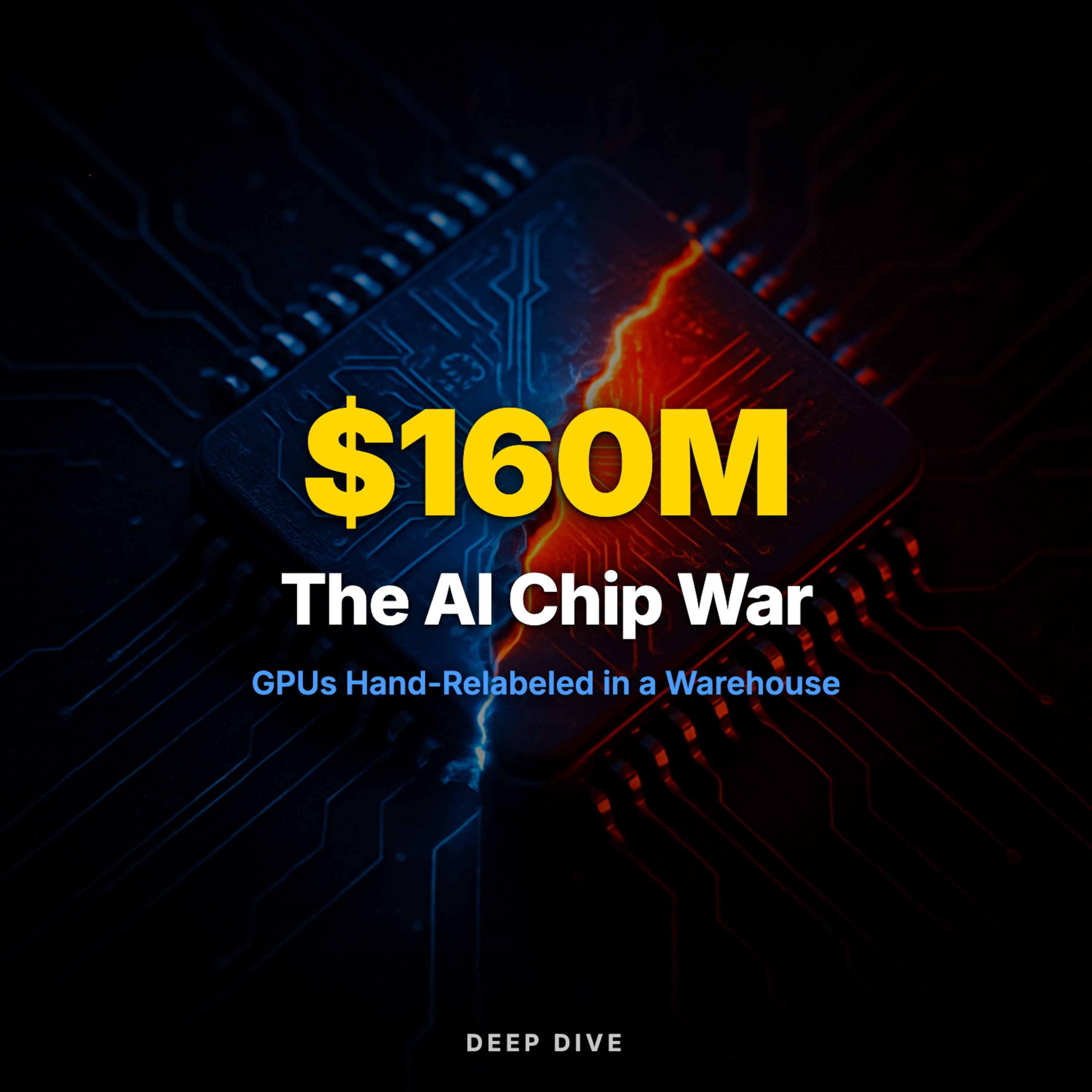
$160 million of NVIDIA GPUs. Hand-relabeled in a warehouse. December 2025 — federal agents seize $50M of NVIDIA chips and cash from a shell company called Hao Global. Shipments routed Thailand → Singapore → Malaysia. Workers in transit warehouses physically relabeled each chip. Fake company names, fake destinations, all heading to Shenzhen.You don't relabel things that aren't scarce.The AI chip war isn't one war — it's four, stacked on top of each other. Compute, memory, packaging, and power. The bottleneck keeps moving. The press keeps writing about whichever one was binding last year.NVIDIA: $4.6-4.8 trillion market cap as of April 2026 — larger than Japan's GDP. Q4 FY26 revenue $68.1B, +73% YoY, ~$272B annualized. 73% gross margin (Intel and AMD historically ran in the 40s). Four customers = 61% of revenue — was 36% a year prior. Customer A alone is bigger than NVIDIA's entire gaming business. Those same four customers are building chips to compete with NVIDIA: TPU, Trainium, Maia, MTIA. The top revenue source is the biggest strategic threat. CUDA is the moat — 18 years old. The chips are expensive; the lock-in is free.Then memory. SK Hynix's HBM gross margins now beat TSMC's. The chokepoint moved from logic to memory. TSMC's CoWoS packaging is the constraint nobody can scale. China can't get EUV from ASML — the diffusion-limited piece of the entire export-control regime.Export controls: what worked, what didn't, the Biden→Trump reversal, the Gulf pivot (Humain, G42). China's parallel stack — Huawei Ascend 910C, DeepSeek R2, the SMIC ceiling.Dylan Patel's EUV math: global AI compute capped at ~200 GW by 2030. Sam Altman has already asked for ~250 GW cumulative. The constraint isn't silicon. It's electricity.Three predictions the data actually supports. What everyone in this story is right about — and what they're wrong about.RELATED EPISODESThe Real Cost of AI — the infrastructure-spend story underneath this oneHow LLM Inference Actually Works — the hardware-war chapter, deepenedCerebras IPO — the alternative-architecture bet against NVIDIAThe Two Apples — custom-silicon angle from the platform sidePalo Alto's 26 CVEs — AI cyber spend as the demand-pull for AI infraCHAPTERS00:00 Cold open — $160M of GPUs hand-relabeled, Hao Global, December 202500:38 Intro + preview — why the press is watching the wrong fight01:23 The four bottlenecks — compute, memory, packaging, power02:56 NVIDIA dashboard — $4.6-4.8T, 73% margin, 4 customers = 61%07:43 HBM chokepoint — SK Hynix margins now beat TSMC11:38 CoWoS packaging — the constraint nobody can scale13:34 Export controls — what worked, what failed, the reversal21:27 China's parallel stack — Huawei 910C, DeepSeek R2, SMIC ceiling26:50 Taiwan math — the concentration risk and CoWoS dependency31:48 Gulf pivot — Humain, G42, and where the chips actually went33:55 Power constraint — Dylan Patel's 200 GW ceiling by 203037:17 The pattern — bottlenecks move and the press is always a year behind42:28 Three predictions for 2026-2028SOURCESDylan Patel (SemiAnalysis) — EUV math, power-ceiling analysisGregory Allen (CSIS) — export-control reversal coverageChris Miller — 'Chip War' (book) — historical baselineNVIDIA Q4 FY26 earnings + 10-K customer concentration disclosuresTSMC + SK Hynix earnings disclosures (HBM margin disclosures)Bureau of Industry and Security (BIS) — export-control rule frameworkGoldman Sachs capex analysis (Oct 2025)FERC grid interconnection data; Talen Energy + Constellation PPAsDeepSeek R2 technical disclosures + Huawei Ascend 910C analysisHao Global GPU smuggling — DOJ + federal seizure filings (Dec 2025)
Embed this episode
NOW PLAYING
The AI Chip War: Why Everyone's Watching the Wrong Fight
No transcript for this episode yet
Similar Episodes
No similar episodes found.
Similar Podcasts
No similar podcasts found.