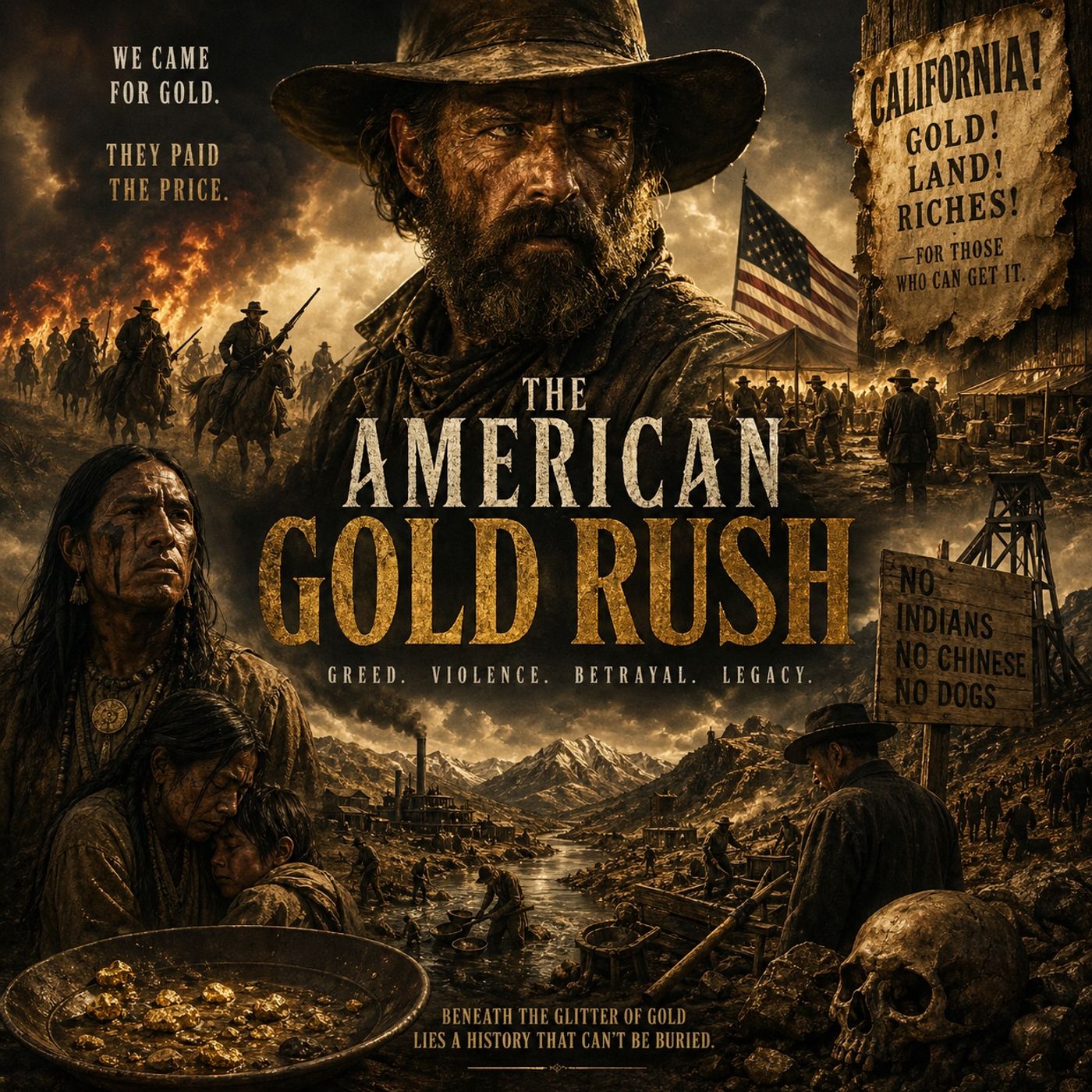
The American Gold Rush episode artwork

EPISODE · Apr 25, 2026 · 1H 7M

The American Gold Rush

from Disturbing History · host Disturbing History-True Stories

Most of us learned a version of the Gold Rush that was cheerful, portable, and mostly wrong. In this episode we set that version aside and go looking for what actually happened — the history that didn't make it onto the plaques.On 1/24/1848, James Marshall found gold at Sutter's Mill on the American River.California was still technically Mexican territory at the time; the Treaty of Guadalupe Hidalgo, which formally transferred the region to the United States, wasn't signed until 2/2/1848 — nine days later. What followed was one of the most consequential and destructive episodes in American history, compressed into less than a decade.This episode covers the near-total collapse of California's Native population, from an estimated 150,000 people at the time of the discovery to fewer than 50,000 by 1870. We examine the California legislature's Act for the Government and Protection of Indians, passed in 1850, which functioned as a slavery statute for thirteen years.We look at Governor Peter Burnett's 1851 declaration that a "war of extermination" between the races was inevitable, and at the state-funded militia campaigns that historian Benjamin Madley has documented in his research on the California genocide.We also cover the Foreign Miners' Tax of 1850, the violent expulsion of Chilean and Mexican miners from the southern diggings, and the legal framework that stripped Chinese miners of any recourse in California courts — including the California Supreme Court's 1854 ruling in People v. Hall, which held that Chinese witnesses could not testify against white men.The environmental destruction of hydraulic mining, which began around 1853 and wasn't stopped until the Sawyer Decision of 1884, transformed entire river systems and buried farmland under debris. The Malakoff Diggins mine alone carved a canyon nearly 7,000 feet long and nearly 600 feet deep from what had been a Sierra Nevada hillside.The stories of John Sutter and James Marshall — both of whom died broke — are here, along with the story of Sam Brannan, who made $36,000 in nine weeks selling shovels to miners and died penniless in 1889.So is the story of Mary Ellen Pleasant, a free Black woman who arrived in San Francisco in 1852, built a substantial fortune, and used it to fund abolitionist causes including John Brown's raid on Harpers Ferry. And the story of Bret Harte, the 23-year-old journalist who wrote the only honest account of the 1860 Wiyot Massacre and had to flee the region under death threats.The Gold Rush produced California. It also produced the Chinese Exclusion Act of 1882, eighteen unratified Native treaties buried in Senate archives until 1905, and a pattern of racialized dispossession that shaped the state for generations.This episode takes all of it seriously.If this episode stayed with you, share it with someone who needs to hear it. You can reach us at [email protected], and you can find more at paranormalworldproductions.com.Have a forgotten historical mystery, disturbing event, unsolved crime, or hidden conspiracy you think deserves investigation?Send your suggestions to [email protected] History is a dark history podcast exploring unsolved mysteries, secret societies, historical conspiracies, lost civilizations, and the shadowy stories buried beneath the surface of the past.Follow the show and enable automatic downloads so you never miss a deep dive into history’s most unsettling secrets.Because sometimes the truth is darker than fiction.

Most of us learned a version of the Gold Rush that was cheerful, portable, and mostly wrong. In this episode we set that version aside and go looking for what actually happened — the history that didn't make it onto the plaques.On 1/24/1848, James Marshall found gold at Sutter's Mill on the American River.California was still technically Mexican territory at the time; the Treaty of Guadalupe Hidalgo, which formally transferred the region to the United States, wasn't signed until 2/2/1848 — nine days later. What followed was one of the most consequential and destructive episodes in American history, compressed into less than a decade.This episode covers the near-total collapse of California's Native population, from an estimated 150,000 people at the time of the discovery to fewer than 50,000 by 1870. We examine the California legislature's Act for the Government and Protection of Indians, passed in 1850, which functioned as a slavery statute for thirteen years.We look at Governor Peter Burnett's 1851 declaration that a "war of extermination" between the races was inevitable, and at the state-funded militia campaigns that historian Benjamin Madley has documented in his research on the California genocide.We also cover the Foreign Miners' Tax of 1850, the violent expulsion of Chilean and Mexican miners from the southern diggings, and the legal framework that stripped Chinese miners of any recourse in California courts — including the California Supreme Court's 1854 ruling in People v. Hall, which held that Chinese witnesses could not testify against white men.The environmental destruction of hydraulic mining, which began around 1853 and wasn't stopped until the Sawyer Decision of 1884, transformed entire river systems and buried farmland under debris. The Malakoff Diggins mine alone carved a canyon nearly 7,000 feet long and nearly 600 feet deep from what had been a Sierra Nevada hillside.The stories of John Sutter and James Marshall — both of whom died broke — are here, along with the story of Sam Brannan, who made $36,000 in nine weeks selling shovels to miners and died penniless in 1889.So is the story of Mary Ellen Pleasant, a free Black woman who arrived in San Francisco in 1852, built a substantial fortune, and used it to fund abolitionist causes including John Brown's raid on Harpers Ferry. And the story of Bret Harte, the 23-year-old journalist who wrote the only honest account of the 1860 Wiyot Massacre and had to flee the region under death threats.The Gold Rush produced California. It also produced the Chinese Exclusion Act of 1882, eighteen unratified Native treaties buried in Senate archives until 1905, and a pattern of racialized dispossession that shaped the state for generations.This episode takes all of it seriously.If this episode stayed with you, share it with someone who needs to hear it. You can reach us at [email protected], and you can find more at paranormalworldproductions.com.Have a forgotten historical mystery, disturbing event, unsolved crime, or hidden conspiracy you think deserves investigation?Send your suggestions to [email protected] History is a dark history podcast exploring unsolved mysteries, secret societies, historical conspiracies, lost civilizations, and the shadowy stories buried beneath the surface of the past.Follow the show and enable automatic downloads so you never miss a deep dive into history’s most unsettling secrets.Because sometimes the truth is darker than fiction.

NOW PLAYING

The American Gold Rush

0:00 1:07:13

No transcript for this episode yet

We transcribe on demand. Request one and we'll notify you when it's ready — usually under 10 minutes.

Bitcoin Gateway Lea meakin Welcome to Bitcoin Gateway, the podcast where we dive deep into the world of Bitcoin, hosted by Lea Meakin. This show is for anyone who’s ever felt overwhelmed by the complex world of cryptocurrencies and wants a simple, straightforward explanation. Each episode, we’ll break down the basics of Bitcoin, explore its history, and discuss its potential impact on the future of finance. Whether you’re a complete beginner or just looking to expand your knowledge, Bitcoin Gateway is here to help you understand Bitcoin, one episode at a time. Explicit WTF Conspiracy ? Operation: Disclosure Jolly West Welcome to Conspiracy Theory Or Not?, your deep dive into the world of secrets, shadows, and speculation. This podcast is dedicated to unraveling history's most controversial and mind-bending conspiracy theories, asking tough questions and exploring hidden truths. Whether you're a skeptic or a believer, we take you on a journey through some of the most mysterious events and covert operations ever revealed.In this episode, we explore the dark and mysterious world of MK-Ultra—a top-secret CIA program that ran from the 1950s to the early 1970s. The program's purpose? To develop mind control techniques for use in espionage. But as we will uncover, the methods employed often crossed ethical boundaries, involving everything from drugs to hypnosis and, in many cases, torturous experimentation.We’ll investigate the history and controversial practices behind MK-Ultra, shining a light on its disturbing experiments, key figures, and pivotal events. Drawing from two essential books, "The Sea Explicit Vampires of White Chapel Transmissions From Atlantis Entertainment Vampires of White Chapel follows the story of FBI Agent Arianna Grayson as she hunts the serial killer, Allister the Annihilator but gets more than she bargains for. She discovers he’s a vampire, sired by the notorious murderer Jack The Ripper. Grayson is pulled into the world of the vampires and the show follows her story as an unwilling fledgling, Allister’s fall to monstrosity and the real history of Jack and his vampire origins. (Fiction Podcast/Horror) Explicit The Midnight Cinema Screening Unkn  Welcome to The Midnight Cinema Screening.This is basically the place where we hang out after midnight and talk about movies and TV shows that stuck with us… the good, the bad, the weird, and the ones that probably shouldn’t exist but somehow do. I also talk about true crime. If you love horror, cult classics, creepy shows, and the occasional random deep dive into something strange, you’re in the right place. Nothing here is super scripted or overly serious. It’s more like sitting around with friends after a late-night movie, breaking down what worked, what didn’t, and the moments that made you pause the screen and go, “Wait… what just happened?”Some episodes we’ll be reviewing movies.Some we’ll be talking about TV episodes.And sometimes we’ll just go down a rabbit hole about the weird history behind something we watched.So if you like late-night movie talk, dark stories, and conversations that feel a little unfiltered Explicit

Frequently Asked Questions

How long is this episode of Disturbing History?

This episode is 1 hour and 7 minutes long.

When was this Disturbing History episode published?

This episode was published on April 25, 2026.

What is this episode about?

Most of us learned a version of the Gold Rush that was cheerful, portable, and mostly wrong. In this episode we set that version aside and go looking for what actually happened — the history that didn't make it onto the plaques.On 1/24/1848, James...

Is there a transcript available for this episode?

Yes, a full transcript is available for this episode. You can read the complete transcript on the episode page.

Can I download this Disturbing History episode?

Yes, you can download this episode by clicking the download button on the episode player, or subscribe to the podcast in your preferred podcast app for automatic downloads.
URL copied to clipboard!