
EPISODE · Jun 23, 2026 · 52 MIN
The Anti-Satellite Missile Problem
from Orbital Estimate · host Lohengrin
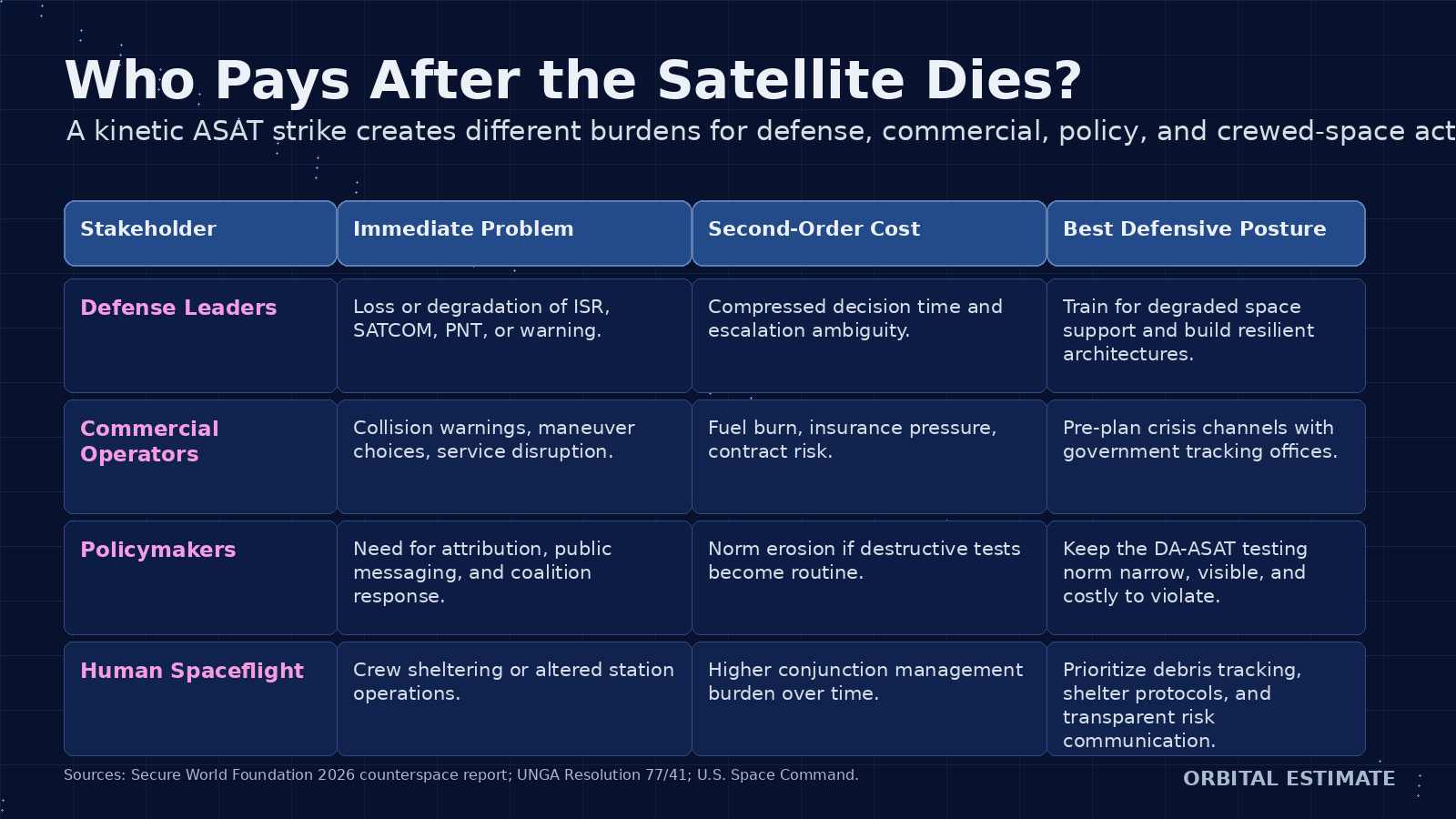
A direct-ascent anti-satellite missile is one of the most deceptive weapons in modern strategy. It appears clean because the explosion happens in silence. It appears limited because the target is a machine rather than a city. It appears rational because the military purpose is obvious: destroy the satellite that helps the enemy see, communicate, navigate, warn, target, or command. The missile leaves Earth, reaches an intercept point, and turns a spacecraft into fragments.Then the fragments keep moving.That is the strategic problem. A kinetic ASAT strike may deliver a clear tactical effect, but it can also produce a debris field that threatens spacecraft far beyond the original target set. The weapon wins a moment and then leaves an inheritance. In low Earth orbit, that inheritance circles the planet at several kilometers per second, crossing paths with military satellites, commercial constellations, civil systems, and crewed platforms. A missile shot upward can bring costs downward, outward, and forward in time.The central danger is not that states lack reasons to build these weapons. The danger is that their reasons are intelligible. Modern military power depends on space infrastructure. The United States and its allies use satellites for precision fires, missile warning, satellite communications, positioning, navigation, timing, weather, intelligence, surveillance, reconnaissance, and command and control. A rival that cannot match American joint power directly has reason to look for pressure points in the architecture that makes it possible. Satellites are among the most tempting of those pressure points.A direct-ascent ASAT missile, then, is not an exotic curiosity. It is a tool for attacking military dependency. It is also a political signal, a technological demonstration, and a confession about how much risk a state is willing to impose on the orbital environment. The missile can destroy a satellite. The debris can damage the logic of space operations itself.What the Weapon Actually DoesA direct-ascent anti-satellite weapon is launched from Earth toward a satellite in orbit. The basic concept is simple enough to fit on a napkin, which is usually where dangerous ideas begin behaving too well. The missile ascends, the kill vehicle separates or maneuvers, and the weapon attempts to collide with the target at high relative velocity. It does not need a large conventional explosive. At orbital speeds, velocity supplies the violence.The technical difficulty sits in the timing. A satellite is not hanging above the battlefield like a lantern. It is moving around Earth at orbital velocity, and the attacker must know its orbit well enough to place a kill vehicle into the correct intercept geometry. Space surveillance, tracking fidelity, guidance, discrimination, propulsion, thermal control, and terminal maneuver all matter. The weapon must reach the right volume of space at the right time. Miss that appointment, and the state has merely purchased a spectacularly expensive gesture.This is why direct-ascent ASAT systems live near ballistic missile defense in the technological family tree. Exoatmospheric intercept, kill vehicle control, high-speed tracking, and precision guidance all sit in neighboring technical districts. That overlap does not mean every missile defense system is an ASAT system wearing a fake mustache. It means the technologies rhyme, and in strategic competition, rhyming is rarely innocent.The attraction is equally plain. A kinetic intercept is visible. Radars and telescopes can observe the event. The destroyed satellite stops functioning. The debris field proves the kill. For a government trying to signal technical maturity or military resolve, that visibility has political value. A cyberattack can be denied. Jamming can be temporary and ambiguous. A kinetic ASAT strike is a declaration written in orbital fragments.That clarity has a cost. A launch may be detected by missile warning systems. The target state must interpret what is happening under time pressure. In a crisis, the difference between an ASAT launch, a missile defense event, a long-range strike, and a strategic warning problem may be clear to analysts after the fact. It may be less clear to decision-makers staring at live warning data while clocks become cruel.The act is also irreversible. Jamming can stop. Malware can sometimes be removed. A dazzled sensor may recover. A shattered spacecraft cannot be reassembled by diplomatic phrasing.Why States Want ASAT MissilesThe military motive is not mysterious. Satellites support the kill chain. They help identify targets, move data, synchronize forces, guide weapons, warn against missile launches, and connect commanders to units distributed across the globe. A state that can degrade an adversary’s space support can slow decisions, disrupt precision targeting, complicate force flow, or degrade strategic warning.For rivals of the United States, this has special appeal. American military power is deeply space-enabled. The U.S. joint force does not merely use satellites as helpful accessories. It depends on them for speed, reach, precision, and coordination. A weaker conventional power may conclude that it cannot defeat the American system plane for plane, ship for ship, or brigade for brigade. It may instead attack the orbital layer that lets the system behave like one machine.This is classic asymmetric logic. The side facing the more capable force looks for the hinge. Space systems are attractive because they are few relative to the number of terrestrial units they support, expensive to build, and difficult to replace quickly. Even when a military architecture is more resilient than outsiders assume, the perception of vulnerability can shape adversary planning.ASAT weapons also serve status politics. China’s 2007 destruction of the Fengyun-1C weather satellite shocked defense establishments because it proved a capability while creating a large, persistent debris problem. India’s 2019 Mission Shakti likewise demonstrated membership in the small group of states able to conduct a kinetic satellite intercept, though India emphasized the lower altitude of the test and the expected decay of debris. Russia’s 2021 destruction of Cosmos 1408 showed that Moscow retained a destructive direct-ascent capability, while also demonstrating a startling willingness to endanger the environment in which Russian systems and Russian cosmonauts operate.These tests communicate with several audiences at once. They tell adversaries their satellites are vulnerable. They tell domestic constituencies the state has technological greatness. They tell military bureaucracies that counterspace programs deserve money, prestige, and protection. They tell allies, clients, and rivals that the state belongs among the serious space powers.They also tell everyone else that the state is willing to make orbit more dangerous for proof of membership. That is a rather expensive initiation ritual. One might prefer a handshake and a bad conference lanyard.Debris Is the Strategic CostThe central flaw in destructive ASAT use is debris. NASA’s Orbital Debris Program Office defines orbital debris as human-made objects in orbit that no longer serve a useful purpose. The definition sounds bureaucratic. The physics does not. In low Earth orbit, debris typically travels at roughly 7 to 8 kilometers per second. The average impact speed with another space object is about 10 kilometers per second and can be higher. At those velocities, small objects behave with shocking violence.1This is why “space junk” is an unserious phrase for a serious hazard. Junk sits in a garage. Orbital debris moves like ammunition with no commanding officer. A fragment too small to track reliably may still be large enough to penetrate, disable, or destroy a spacecraft. The most uncomfortable debris population is the one operators cannot consistently see but still must fear.A kinetic ASAT strike converts one trackable object into many objects. Some can be cataloged by space surveillance networks. Others fall below reliable tracking thresholds. Operators then face conjunction warnings, uncertain miss distances, possible avoidance maneuvers, fuel expenditure, interrupted service, insurance questions, and altered mission planning. Even a fragment that never hits anything can impose cost. Analysts must track it. Operators must plan around it. Customers must absorb service risk. A dead satellite becomes a tax collector with orbital mechanics.Altitude matters. Debris at lower altitudes may decay within years as atmospheric drag pulls fragments down. Debris at higher altitudes can remain for decades, centuries, or longer. NASA notes that debris below 600 kilometers normally falls back within several years, while debris around 800 kilometers may persist for centuries, and debris above 1,000 kilometers can remain for a thousand years or more.2 The moral of the altitude story is blunt: where a satellite is shattered can matter almost as much as what satellite is shattered.The 1978 work of Donald Kessler and Burton Cour-Palais remains central because it described how collisions can generate new debris, raising the probability of further collisions.3 Public discussion often turns “Kessler Syndrome” into cinematic fog, as if one ASAT shot automatically locks humanity out of orbit. That overstates the case. Space is large, and debris risk varies by altitude, inclination, density, solar activity, and time. Yet each major fragmentation event pushes the environment in the wrong direction. It adds mass, fragments, uncertainty, and future collision pathways.The weapon’s tactical purpose may be specific. The debris effects are broad. That is the great contradiction. The attacker chooses the target, but it cannot fully choose the downstream distribution of risk.Cosmos 1408 and the Absurdity of Self-EndangermentRussia’s November 2021 Cosmos 1408 ASAT test is the cleanest modern example of this contradiction. U.S. Space Command stated that Russia launched a direct-ascent ASAT missile on November 15, 2021, Moscow Standard Time, striking Cosmos 1408 and creating more than 1,500 pieces of trackable debris, with many smaller fragments likely generated as well.4 U.S. Space Command assessed that the debris would remain in orbit for years and perhaps decades, threatening human spaceflight and multiple countries’ satellites.NASA’s account made the operational risk immediate. The International Space Station crew undertook emergency procedures. Hatches to several modules were closed. Crew members sheltered in their spacecraft for two passes through or near the debris cloud. The station passes through or near the relevant orbital region roughly every ninety minutes.5The most revealing fact is that Russian cosmonauts were aboard the ISS. Moscow created a debris hazard that threatened a platform carrying its own people. Strategy sometimes wears a helmet. In this case, it misplaced the chin strap.The Cosmos 1408 test showed the difference between control over an action and control over its consequences. Russia controlled the launch decision. It controlled the target choice. It controlled the political timing. It did not control the debris field once the satellite fragmented. After impact, physics took custody of the evidence.This matters because ASAT debris is not rubble beside a destroyed radar site. It does not stay politely near the target. It becomes part of the orbital operating environment. It moves, disperses, decays at different rates, and intersects with future mission planning. The military act becomes a geographic condition, except the geography moves.The Strategic ParadoxThe destructive ASAT missile survives as a strategic object because it combines real military utility with severe strategic liability. That is why it is hard to dismiss. A weapon can be foolish and useful at the same time. Many state arsenals contain such items. Some of them have very fine procurement paperwork.The utility is straightforward. Destroying a satellite can impose immediate loss. It can blind a sensor, cut a communications pathway, remove a data source, or signal willingness to escalate. If a satellite is enabling strikes against national forces, a commander may see its destruction as a rational military act. In a severe war, especially one involving regime survival or major territorial stakes, the debris penalty may seem tolerable when weighed against near-term battlefield needs.The liability is equally clear. A kinetic ASAT strike is visible, irreversible, debris-producing, and hard to explain away. It may invite retaliation in space, cyber, economic, diplomatic, or terrestrial domains. It may threaten allied and commercial systems. It may alarm neutral states. It may convince adversaries that broader attacks on space architecture are underway. In a crisis between nuclear-armed powers, the fear of being blinded can compress decision time and worsen escalation risk.The target category also matters. Many satellites are dual-use. Earth observation can serve agriculture, disaster response, and military targeting. Communications satellites can carry civilian traffic and military data. Positioning, navigation, and timing support both civilian infrastructure and military operations. A commercial spacecraft may be privately owned, internationally financed, launched by one provider, insured through another market, operated through ground stations in several countries, and used by defense customers. A missile does not care about corporate structure. Governments, insurers, lawyers, and customers do.This creates a proportionality problem under the law of armed conflict. A satellite may be a lawful military objective under some conditions, but a lawful target is not automatically a wise target. The expected military advantage must be weighed against foreseeable collateral consequences, and in space those consequences include debris risk across time. A strike that looks limited in target selection may be expansive in orbital effect.The Outer Space Treaty adds another layer. Article IX requires states to conduct activities with due regard for the corresponding interests of other states and to consult when an activity may cause potentially harmful interference.6 Yet the treaty does not provide a simple enforcement machine for wartime ASAT use, nor does it resolve the problem of dual-use systems, verification, attribution, or proportionality. Space law matters, but it does not float above state interest like a kindly schoolmaster with perfect attendance.Commercial Space Has Entered the Target SetThe older picture of space warfare, with government satellites targeting government satellites, is too clean for the current era. The Department of Defense Commercial Space Integration Strategy makes plain that commercial systems are being folded into national security space architecture.7 Launch, communications, remote sensing, data relay, cloud processing, analytics, and ground services increasingly rely on private firms.Commercial actors are therefore infrastructure providers, political actors, regulatory subjects, wartime enablers, and potential targets. They are not neutral ornaments hung around the national security state. In a major crisis, an adversary may judge a commercial satellite by the service it provides, rather than the logo painted on the bus. A private system supporting military communications or targeting may be treated as part of the conflict architecture, even while it also serves ordinary civilian customers.This creates unpleasant ambiguity. A commercial satellite may support humanitarian response on Monday, maritime tracking on Tuesday, and military operations on Wednesday. Its owner may be headquartered in one country, its customers spread across several, its ground segment distributed globally, and its data integrated into allied defense networks. Striking such a system could trigger military, legal, diplomatic, market, and insurance consequences at once.Commercial operators should treat this as a design problem rather than a press release problem. Orbit selection, maneuver capacity, fuel margins, autonomous conjunction assessment, encrypted telemetry, cyber defense, ground station redundancy, customer contracts, and government coordination all matter. A company operating in LEO cannot treat ASAT debris as a distant Pentagon issue. Debris does not ask for a business card.For defense planners, commercial dependency also complicates deterrence. If commercial systems are woven into military operations, then adversaries may target them. If governments want the benefit of commercial augmentation, they need plans for warning, attribution, protection, compensation, and response. The state and the market are now co-tenants in orbit. The lease agreement was written in launch manifests, and nobody enjoyed reading the fine print.Norms Against Destructive TestingThe emerging norm against destructive direct-ascent ASAT testing is one of the more practical arms-control developments in space security. It is narrow, observable, and aimed at a behavior that creates obvious harm. In 2022, the United Nations General Assembly adopted Resolution 77/41 on destructive direct-ascent anti-satellite missile testing.8 The resolution did not eliminate ASAT capability. It did not ban every counterspace tool. It did mark debris-generating direct-ascent testing as a dangerous and irresponsible behavior.The narrowness is a strength. A sweeping ban on “space weapons” quickly runs into definitional mud. Many technologies are dual-use. Rendezvous and proximity operations can support inspection, servicing, or attack. Lasers can range, communicate, dazzle, or damage. Cyber tools can support operations or sabotage them. Electronic warfare can be reversible or strategically significant. Space security debates often fall into the swamp because the same capability can wear several uniforms.Destructive direct-ascent ASAT testing is easier to identify. Did a state launch a missile? Did it destroy an object in orbit? Did the event create debris? Those questions are more observable than intent, software access, or sensor dazzling. The norm therefore functions as a firebreak. It does not abolish conflict. It limits one especially damaging form of demonstration.Secure World Foundation’s 2026 Global Counterspace Capabilities Report shows why that distinction matters. The report tracks counterspace capabilities across co-orbital, direct-ascent, electronic warfare, directed-energy, and cyber categories, and notes that debris-producing tests by the United States, Russia, China, and India have created thousands of cataloged fragments, with many still on orbit.9 The trend line is plain enough: counterspace competition is expanding, and the debris legacy of past kinetic tests remains part of today’s operating environment.A norm against testing will not prevent wartime use by itself. If leaders believe a satellite is enabling decisive attacks, they may still order a strike. Yet norms shape reputational costs, allied alignment, diplomatic pressure, and pre-crisis expectations. They make reckless behavior more expensive. In strategy, cost is often the closest thing to conscience.Policy: Make the Strike Less Useful and More CostlyThe United States and its allies need a two-part answer: resilience and consequences.Resilience reduces the payoff of an ASAT strike. If an adversary believes destroying one satellite will blind a force, the temptation rises. If the target architecture is distributed, redundant, maneuverable, commercially augmented, allied, cyber-defended, and capable of partial reconstitution, the payoff falls. The purpose is not to make space systems invulnerable. The purpose is to make a kinetic strike expensive, escalatory, and insufficient.This means proliferated constellations, disaggregated missions, protected ground segments, hardened command links, commercial backups, allied data sharing, rapid launch options, and realistic training for degraded space services. Joint forces should rehearse operations under disrupted SATCOM, degraded PNT, delayed ISR, corrupted data, and constrained access to space-based support. A military that can fight only when the orbital layer is clean and friendly has built a porcelain spear.Consequences matter too. A state that uses a destructive ASAT weapon should expect costs beyond the satellite it kills. Those costs do not need to be symmetrical. Responding to a debris-generating attack by creating more debris may satisfy the primitive desire for mirrored punishment while worsening the domain for everyone. Better response options may include cyber action, economic penalties, diplomatic isolation, public attribution, countermeasures against ground infrastructure, or conventional military responses tied to the broader conflict.The response must be planned before crisis. Leaders should decide how to distinguish temporary interference from permanent destruction, reversible jamming from kinetic attack, cyber disruption from physical debris creation, and attacks on national systems from attacks on commercial providers supporting military operations. Perfect public clarity is neither possible nor desirable, since ambiguity has deterrent value. Total vagueness invites miscalculation.Allies should be built into this planning. Space deterrence is increasingly collective. Allied ground stations, allied data, allied launch facilities, commercial firms under allied jurisdiction, and shared warning networks all shape the response to a space crisis. The first hours after an ASAT event will require attribution, debris characterization, public messaging, operator warnings, and diplomatic alignment. A coalition should not begin building its crisis process while the debris cloud is already spreading.Commercial operators need similar preparation. They should know which government channels will provide tracking data, how maneuver recommendations will be communicated, how customer obligations will be handled, and how service degradation will be reported. For firms integrated into defense operations, the question is sharper. They may be treated by adversaries as part of military architecture. Branding will not save them. Neither will cheerful language about connectivity.Forecast: The Temptation Will RemainDirect-ascent ASAT missiles will remain attractive because they are visible, technically legible, and militarily meaningful. The norm against destructive testing will make peacetime demonstrations harder to justify. It will raise diplomatic costs. It will help distinguish responsible behavior from debris-generating theater. Yet it will not erase the wartime temptation.In a severe conflict, a state may decide that the immediate benefit of destroying a satellite outweighs the long-term orbital cost. That calculation becomes more plausible when the target supports strikes, missile defense, strategic warning, or command and control. It also becomes more plausible for states that believe their adversaries are more dependent on space than they are. If one side thinks the other lives in a glass palace, rocks become interesting.The trouble is that orbital rocks keep circling back.The contest ahead is not merely over who can destroy satellites. It is over who can preserve command, commerce, deterrence, and access to orbit while preparing for conflict in a domain where damage can outlive the war that produced it. The states that handle this best will combine resilience, restraint, credible response options, and a hard-headed understanding of commercial dependency.There is majesty in building machines that cross the atmosphere and work in vacuum. There is greatness in the engineering discipline required to place fragile instruments into orbital motion and keep them alive through radiation, thermal cycling, and distance. There is also a particular smallness in proving national strength by making the orbital environment more dangerous for everyone else.A missile can kill a satellite in minutes. The fragments may keep voting in orbital politics for years.That is the difference between a shot and a legacy.BibliographyKessler, Donald J., and Burton G. Cour-Palais. “Collision Frequency of Artificial Satellites: The Creation of a Debris Belt.” Journal of Geophysical Research 83, no. A6 (1978): 2637–46.NASA. “NASA Administrator Statement on Russian ASAT Test.” November 15, 2021.NASA Orbital Debris Program Office. “Frequently Asked Questions.” NASA Johnson Space Center. Accessed June 8, 2026.Secure World Foundation. Global Counterspace Capabilities: An Open Source Assessment, 2026. Edited by Victoria Samson and Kathleen Brett. Broomfield, CO: Secure World Foundation, 2026.United Nations General Assembly. “Destructive Direct-Ascent Anti-Satellite Missile Testing: Resolution Adopted by the General Assembly.” A/RES/77/41. December 7, 2022.United Nations Office for Outer Space Affairs. “Treaty on Principles Governing the Activities of States in the Exploration and Use of Outer Space, Including the Moon and Other Celestial Bodies.” Opened for signature January 27, 1967.U.S. Department of Defense. Commercial Space Integration Strategy. Washington, DC: Department of Defense, 2024.U.S. Space Command Public Affairs Office. “Russian Direct-Ascent Anti-Satellite Missile Test Creates Significant, Long-Lasting Space Debris.” U.S. Space Command. November 15, 2021. This is a public episode. If you would like to discuss this with other subscribers or get access to bonus episodes, visit orbitest.substack.com
NOW PLAYING
The Anti-Satellite Missile Problem
No transcript for this episode yet
Similar Episodes
Jul 14, 2026 ·5m
Jul 13, 2026 ·11m
Jul 10, 2026 ·11m