
EPISODE · May 23, 2026 · 19 MIN
The Apology is The Newest Wall
from The Experience of Adoption · host Thoughtless Delineation
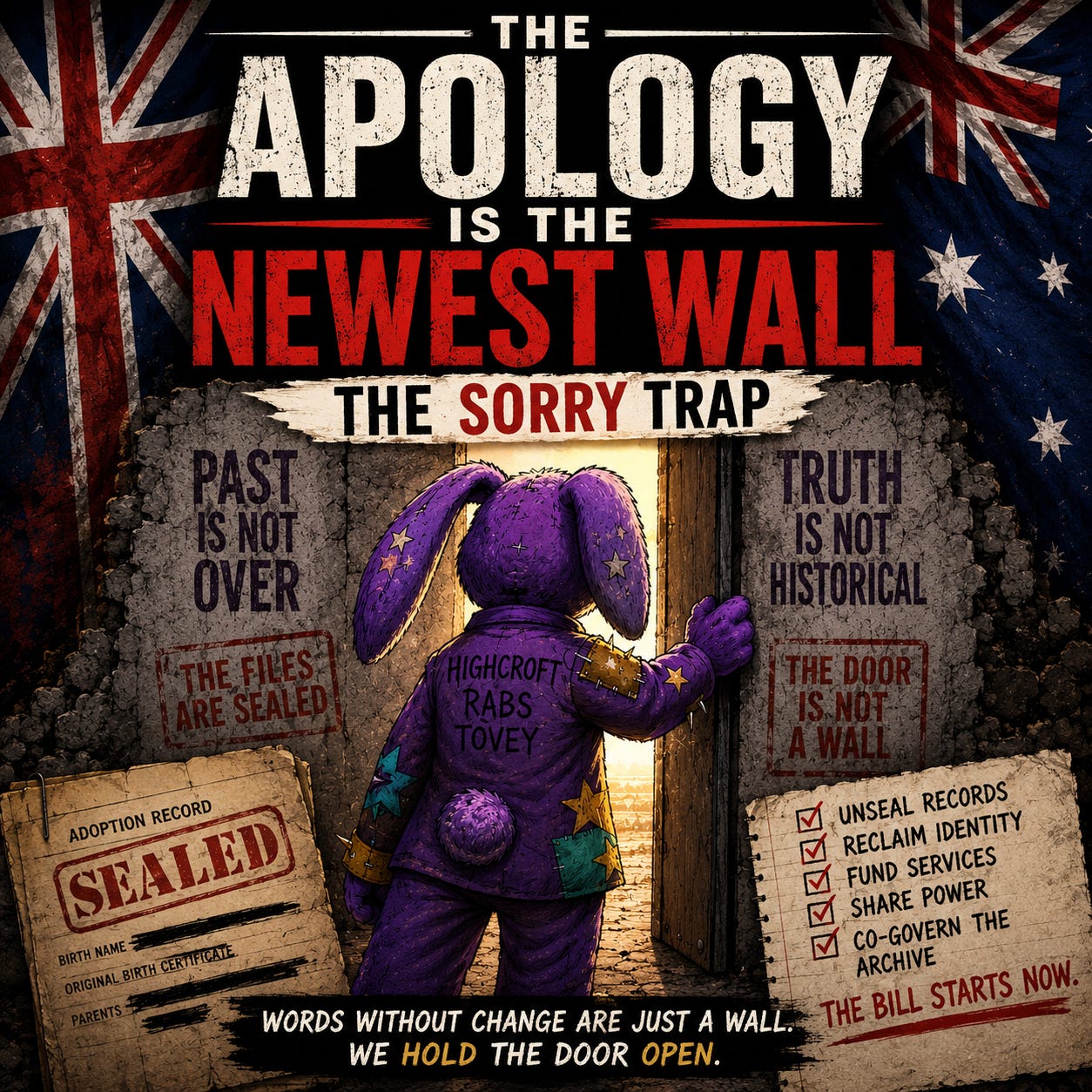
In memory of Highcroft Rabs Tovey.When a country finally says sorry, something is supposed to end. The wrong is named, the file closes, the survivors are released into the rest of their lives. I want to tell you what actually begins.This spring the United Kingdom moved closer to apologising for forced adoption than it ever has. The Prime Minister said his instinct was to apologise, and that there was a very strong case for it. A cross-party committee told the government to do it properly — an unqualified apology, written with the mothers and the adopted people, not at them. The Church of England began drafting its own sorrow for the mother-and-baby homes it ran. Between 1949 and 1976, an estimated 185,000 babies were taken from unmarried mothers in England and Wales. In 1968 alone, English courts signed more than sixteen thousand adoption orders. The apology, when it comes, will be aimed at a system that once ran at full industrial capacity.I am not going to tell you the apology does not matter. It matters. Survivors have carried this for sixty years, and to be believed out loud, by a state, is not nothing. I have felt the pull of that wish myself — the longing for an institution to say the true sentence at last.But I am Australian. And I have seen this film.In 2013 my country issued its national apology for forced adoption. The Prime Minister stood up and said the words. People wept; I was one of them. And then more than a decade passed, and the survivors did the accounting. The words had been real. The repair had not arrived. In most states the records stayed sealed. The support services stayed thin, underfunded, and quietly wound down. A new category of grief opened up, and it had a name we did not expect to need: after the apology.After the apology is a strange country to live in. The official story says your chapter is closed; your body says it is not. You are expected to be lighter now, and you are not lighter, and the distance between those two facts becomes a new thing to carry — set down on top of the original thing, which has not moved at all.That is what nobody tells you about the sorry. An apology is an external event. It happens in a room, in a parliament, in a press release. It addresses the part of you that lives in public — the part that has spent a lifetime being told its own displacement was a kindness. Call that the adaptive self: the version of you assembled, over years, to be legible to other people.It does not reach the other part. Underneath the adaptive self there is a lower signal — a steady subsonic hum that has been running since before you had language for it. It is the part of you that knows it began somewhere else: in a body, in a room, under a name the record no longer admits exists. I feel it as a pressure beneath the sternum, the particular quiet of a question that has never once been allowed its answer. An apology cannot touch that frequency. It was never built to. You can be acknowledged in full daylight by the highest office in the land and walk back out of the building with the sealed file still sealed, the original birth certificate still out of reach, the first name still legally unreachable. The public wound gets dressed. The private one is left exactly where it was.Here is the word the apology depends on, and you will hear it in every official account: historical. Historical forced adoption. Historic wrongs.Watch what that word does. It picks the harm up and sets it down in a sealed past — finished, survived, over. It writes the apology’s last line before the apology is even drafted: we are sorry for what happened. Not for what is happening.Highcroft Rabs Tovey would have put it differently. Tovey was an adopted man and an advocate; he led Adoptee Watch UK. Notice the name first — three of them, carried by one person. Tovey, the birth name the record tried to write over. Rabs, the purple rabbit he wrote and survived through. Highcroft. A name is meant to be the most ordinary thing a person owns; for someone the system has processed it becomes a thing you assemble, and defend, and carry in pieces. For Tovey the name was the wound and the resistance in the same breath.He spent two decades documenting what the official frame leaves out. Through Adoptee Watch UK and the Forced Adoption and Care Order Survey he ran from 2002 to 2024, his work followed the State’s removal of children out of the past tense and into this one. Because the forced adoption Britain is preparing to apologise for is not a discrete postwar scandal that began in 1949 and ended in 1976. The logic underneath it — that a child is better taken than a poor or unmarried mother supported — did not die. It changed its paperwork. It became the care order being signed somewhere in Britain this week.Tovey did not live to hear the apology. He died earlier this year, before the State could bring itself to say a single word of it aloud. This is what the clock does. It is not a metaphor, and it does not wait. For the people this apology is supposedly for, it is already running out. It ran out for him.The word “historical” is doing that sealing. If the wrong is “historic,” then the care order signed this week becomes a separate, unrelated matter — different department, different era, nothing here to be sorry for. It is not separate. It is the same machine with the signage replaced. To date the harm is to exempt the present from it.This publication has a name for the machinery that does this work: the Architecture of Silence. Its hard tools are obvious once you have seen them — the sealed adoption file, the amended birth certificate that names people who were never in the room, the legal route to reclaim your birth identity that exists on paper and is barred in practice by cost and a bar set almost too high for any human to clear.The apology is the architecture’s softest tool. It is the one that does not look like a tool at all. It produces the visible appearance of reckoning — the bowed head, the co-written paragraph, the front page — while every hard mechanism keeps running underneath it, untouched. The file stays shut. The certificate remains false. The reversion stays barred. An apology that is not bolted to the unsealing of records is not the end of the silence. It is the silence in its most advanced form: a silence that has finally learned how to speak.So what do you do with that, if you are one of the people the apology is supposedly for?You do not refuse it. Refusing the apology hands the institution the easy story — that survivors can never be satisfied, that the wound must be in them rather than in the system. That is the cynical turn, and it is a trap, and it is also exhausting in a way that helps no one.You do something harder. You accept the apology and refuse the closure. You take the words, and you treat them not as an ending but as a door — a door the institution would much prefer to let swing shut, and that you now wedge open with the whole weight of your body. Because a door held open is the only version of an apology that leads anywhere at all.And then you name the bill, because an apology is the start of a bill, not the payment of one. The bill is specific, and it is not abstract. Original birth records released to every adopted adult as a right, not a favour granted at an institution’s discretion. A funded, low-barrier legal route to reclaim a birth identity — the exact change Tovey spent years campaigning for, so that a name like “Tovey” is simply a thing a person is allowed to have again. Reunion and reckoning services resourced properly and permanently, not announced warmly and defunded quietly two budgets later. Co-governance of what happens next — survivors with their hands on the archive itself, not survivors consulted on the wording of their own sorrow. And the mothers are elderly now. Whatever is owed to them is owed against a clock — the same clock that ran out for Tovey.This is the post-tragic position, and it is the one this publication writes from. It does not pretend the harm away — that is the pre-tragic lie, the rescue myth, and we are done with it. It does not collapse into the conclusion that nothing can ever change — that is the tragic dead end, and it is comfortable, and it is also a kind of surrender. It does the third thing. It holds the full weight of what was done, without flinching, and then it turns toward what can still be built, and it gets to work.So when Britain finally says the words, watch the verb tenses. Listen for “happened,” and count how many times you do not hear “happening.” Notice whether the sentence is followed by a date — a bill, a reading, a release of records — or followed only by applause.Because an apology with a date attached is the beginning of repair. An apology with only applause attached is the newest wall — and it is the most dangerous wall the Architecture of Silence has ever built, precisely because it is the first one designed to look like a door.The sorry is coming. Make it the start of the bill. Hold the door open with your body. That is not despair, and it is not naive hope. It is devotion — and the work it asks for is still ours to do. Tovey did his share. The rest is ours.TAKEN UK SurveyThe TAKEN UK survey, developed alongside the work of Highcroft Rabs Tovey, is more than a questionnaire — it is a survivor-built counter-archive documenting forced adoption, care orders, identity erasure, and family separation from 2002–2024.Where governments frame forced adoption as “historical,” the survey deliberately extends the timeline into the present tense, challenging the idea that the system ever truly ended. It gathers testimony from adoptees, mothers, and families affected by coercive removals, sealed records, and ongoing state intervention.In doing so, the project resists what this publication calls the Architecture of Silence: the institutional process of sealing harm in the past while its underlying mechanisms continue operating in the present. See the full Survey Here: Taken UKThe “Sorry” Trap:The United Kingdom is preparing to perform a long-overdue ritual of state. As the Prime Minister signals an instinct to apologise for the forced adoption of 185,000 babies between 1949 and 1976, and as the Church of England drafts its own expressions of sorrow, a weight that survivors have carried for sixty years is finally being acknowledged in full daylight. In 1968 alone, sixteen thousand adoption orders were signed—a system operating at an industrial, relentless capacity.To be believed out loud by the state is a powerful, necessary thing. But as an Australian, I have seen this film before. When my country issued its national apology in 2013, we wept, believing the file was finally closing. A decade later, the accounting tells a different story: the words were real, but the repair never arrived. For survivors, an apology is rarely the end; it is often the beginning of a strange new country where the official story says the chapter is closed, while the body—and the system—insists it is not.The Linguistic Trap of “Historical”The primary tool the State uses to manage its culpability is the word “historical.” When officials speak of “historic wrongs” or “historical forced adoption,” they are performing a specific, tactical maneuver. This phrasing picks up the harm and sets it down in a sealed past—finished, survived, and safely over. It writes the apology’s final line before the survivors have even been heard.By relegating these actions to “history,” the State exempts the present from accountability. This logic ignores the fact that the underlying philosophy of forced adoption—the belief that removal is preferable to supporting a struggling mother—did not die in 1976. It simply changed its paperwork. It became the care order being signed in a British court this week. To date the harm is to deny that the machine is still running, even if the signage has been replaced.The Architecture of Silence’s Softest ToolThe “Architecture of Silence” is a structural system designed to suppress the truth of identity. Its “hard tools” are obvious: the sealed adoption file, the amended birth certificate naming people who were never in the room, and legal routes to reclamation that are barred by prohibitive costs and bureaucratic hurdles.The national apology, however, is the architecture’s “softest tool.” It is the one that does not look like a tool at all. It produces the visible appearance of a reckoning—the bowed head, the somber press release—while leaving every hard mechanism of the system untouched.“An apology that is not bolted to the unsealing of records is not the end of the silence. It is the silence in its most advanced form: a silence that has finally learned how to speak.”The Public “Adaptive Self” vs. the Private “Subsonic Hum”There is a profound psychological tension between the person the State sees and the person who actually exists. The “adaptive self” is the version of the survivor assembled over decades to be legible and acceptable to society—the version told that their displacement was a “kindness.” This self can stand in a gallery and receive an apology.But it does not reach the “subsonic hum” beneath. This is the steady signal of a hidden identity that began in a different body, under a name the official record no longer admits. It is felt as a “pressure beneath the sternum,” the quiet of a question that has never been granted its answer. You can be acknowledged by the highest office in the land and walk out with the sealed file still sealed and the original birth certificate still legally unreachable. The public wound gets dressed; the private one is left exactly where it was.The Legacy of Highcroft Rabs ToveyThe life of Highcroft Rabs Tovey serves as a vital case study in why the “clock” is a matter of justice, not ceremony. Tovey, an advocate who led Adoptee Watch UK, carried three names: Tovey, the birth name the record tried to erase; Rabs, the name of the purple rabbit he wrote and survived through; and Highcroft. For Tovey, his name was his wound and his resistance in the same breath.Tovey spent decades documenting how the State’s removal of children moved out of the past tense and into this one. Crucially, Tovey died earlier this year, before the State could bring itself to say a single word aloud. For elderly mothers and survivors, time is the ultimate constraint. When the State delays its words, the clock runs out. An apology delivered to a graveyard is a hollow victory for the Architecture of Silence.Accepting the Apology, Refusing the “Closure”We must adopt what I call the “post-tragic position.” This rejects the “pre-tragic lie”—the rescue myth that suggests adoption was a simple kindness—and refuses the “tragic dead end,” where we conclude that nothing can ever change. Instead, we accept the apology but refuse the closure. We take the words and treat them as a door that we must now wedge open with the whole weight of our bodies.An apology is the start of a bill, not the payment of one. The bill is specific, and it is a demand:* Original birth records: Released to every adopted adult as a legal right, not a discretionary favour.* Funded legal routes: Low-barrier pathways to reclaim birth identities so that a name like “Tovey” is simply a thing a person is allowed to have again.* Resourced services: Permanently funded reunion and reckoning services that cannot be quietly defunded two budgets later.* Co-governance: Survivors with their hands on the archive itself, not merely “consulted” on the wording of their own sorrow.Conclusion: Beyond the ApplauseAs the UK prepares its statement, watch the verb tenses. Listen for “happened” and count how many times you do not hear “happening.” A genuine apology must be followed by a date—the date of a bill, the date of a record release, or the date of a legislative reading.An apology followed only by applause is the newest wall the Architecture of Silence has ever built, precisely because it is the first one designed to look like a door. If the apology is just a wall designed to look like a door, how do we collectively hold it open? This is a public episode. If you'd like to discuss this with other subscribers or get access to bonus episodes, visit thoughtlessdel.substack.com/subscribe
Embed this episode
NOW PLAYING
The Apology is The Newest Wall
No transcript for this episode yet
Similar Episodes
No similar episodes found.
Similar Podcasts
No similar podcasts found.