
EPISODE · Jul 21, 2026 · 40 MIN
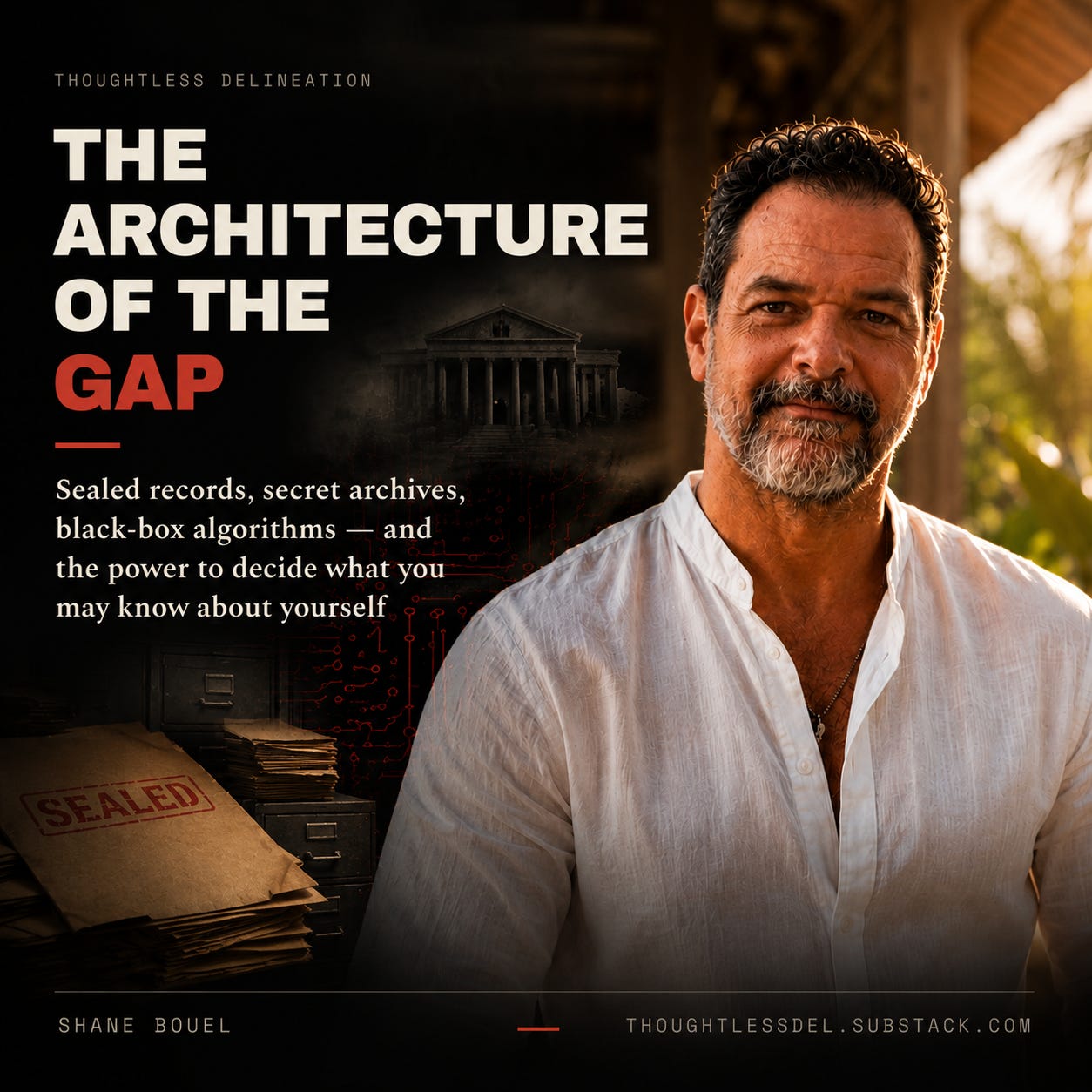
The Architecture of the Gap.
from The Experience of Adoption · host Thoughtless Delineation
This is a free preview of a paid episode. To hear more, visit thoughtlessdel.substack.comI have held the document. The original one, not the amended one. My mother’s name is on it. It was never hidden, never blank, never the thing withheld. It’s my father’s name that’s more often missing from records like mine, and that omission was rarely an accident. An unnamed father is one fewer person with legal standing to object, one fewer witness in the room, one fewer complication for the people managing a young woman toward the outcome they’d already decided on. Leaving that space empty wasn’t carelessness. It was a control measure, and an efficient one: fewer names on the page meant fewer people who could have stopped what happened to her.That isn’t where the withholding lives, though. It took me a long time to see where it actually lives, because it isn’t an absence on the page at all. It’s a stamp. NOT FOR OFFICIAL USE, in the corner, printed across the true record, the one carrying my mother’s actual name. I can hold this document now. I can read it. Nobody is hiding it from me; several Australian jurisdictions will hand an adult adoptee their original birth certificate on request, and that access is real, hard-won by people who did the work before me. What the stamp withholds is smaller than information and somehow larger. It withholds the right to be the person the document describes. I can know. I still can’t return.For most of my life I thought that was mine. A specific injury with my name on it, private, the kind of thing you carry and don’t expect anyone outside the triad to understand. I built a career on naming the machine that produces it: the true record kept legally inert, the amended certificate kept legally operative in its place, the whole arrangement laundered into “protection.” I gave that machine a name years ago, the Architecture of Silence. Sealed records. Weaponised grief. The apparatus that lets an adoptee hold the truth in their hands and still be required, everywhere it counts, to answer to a name that isn’t theirs.I still believe every word of that. But I’ve spent the past several months finding out the stamp has a second name, a bigger one, and it doesn’t belong to adoptees alone anymore. It never really did. We were just the first to be handed the paperwork.Here is the second name: the gap.An institutionally mediated discontinuity between what is real and what you are permitted to use. Not a redaction. Not an absence. A working document, printed correctly, handed to the right person, and rendered functionally void by four words in the corner. Something built, on purpose, by people who are mostly dead now, maintained by people who never chose it and rarely question it, and justified in language soft enough to survive a press release. My birth certificate is the paradigm case. It is not the only case.Sit with the ordinary sentence a credit algorithm produces when it declines you: no reason given, no appeal that reaches a human, just a number that arrived from somewhere and now governs your life, correct or not, contestable or not. Sit with the classified file whose declassification date has read “____” for forty years, not because anyone is actively guarding a secret anymore but because nobody with the authority to close the loop has ever been made to. Sit with the model card on the AI system now screening job applications, or medical intake forms, or your own government’s welfare eligibility: the card lists a benchmark score and says nothing, not one line, about what the system was trained on, what it excluded, or who it was never tested against. In every case the true record might exist somewhere, intact, accurate, even accessible on request. What’s missing is permission to act on it.Different institutions. Different centuries, some of them. Same five people in the room every time, whether they know it or not. Someone built the wall. Someone else maintains it now, and probably inherited it without ever choosing it. A third person is paid to explain why the wall is for your own good. A fourth profits from you never climbing it. And then there’s you: the one who has to live on this side of it regardless of which of the first four you ever actually meet.Put those five roles next to each other and the resemblance stops being poetic. A registrar’s office in the last century authors the stamp policy, a records office becomes its custodian decades later, a caseworker or a call-centre script explains the stamp exists to protect the adoptive family’s settled sense of belonging, that same settled belonging is the benefit nobody names out loud, and the adult adoptee carries the cost alone, usually in silence, usually for life, still answering to a name they were assigned rather than the one they were born with. Now run the same five questions on an AI company in 2026. Its engineers authored the training pipeline. A trust and safety team is its custodian now, most of them hired after the decisions that matter were already made. A press office explains the opacity as protecting proprietary innovation, or user privacy, or both, whichever survives the room better. The company profits from never having to answer a harder question than that. And the person declined for the loan, or screened out of the job, or misdiagnosed by a system trained on a population that didn’t include them, carries the cost, alone, usually without ever learning there was a decision to contest.I want to be honest about what it cost me to see that clearly, because there’s a specific grief in learning your injury isn’t exceptional. Not because company makes it lighter. It doesn’t, not really, and anyone who tells you a shared cage is a smaller cage has never sat in one. It costs something because the particularity of it was, itself, something I was attached to. My mother’s name, real, present, mine to read whenever I want, and still not mine to use. Finding out that a credit bureau and a foundation model are running a version of the identical arrangement on total strangers does something to the size of the story. It gets bigger and colder in the same motion.That is the tragic reading, and I am not going to pretend it away. The system that lets me hold my own truth and still requires me to perform someone else’s is not a metaphor for something else. It is the thing itself, at its most concentrated and most legible, and every other version of it, the classified archive, the fragmented medical chart, the proprietary training set, is downstream of the same logic, running with less accountability, not more, because at least a registry has to answer, eventually, to a Family Court or a parliament. Most of these newer walls don’t answer to anyone.But here is where it turns, because it has to turn. A system named honestly and then left to sit there curdles into something as useless as the silence it’s naming.The adoptee was never a special case of human suffering. The adoptee was early. We have been living the terms everyone is about to live under: a true record that exists but doesn’t count, an identity issued by an institution and enforced regardless of what you know to be accurate, a search for origin treated as ingratitude, decades before a credit algorithm or a language model made the same arrangement standard for the general population. That is not a comforting thought and it is not meant to be one. It is a diagnostic advantage. We already built the instruments for reading a system that hands you the truth with one hand and forbids you from using it with the other, because we had to, because nobody was going to build them for us. Those instruments travel now. That is the actual news.Here is the instrument, briefly, because it is meant to be used, not admired. Any gap, a stamped birth certificate, a sealed file, a chatbot that won’t say what it was trained on, answers to the same ten questions. What is being withheld, and is it the information or the use of it. Who built the wall. Who maintains it today, and whether they even remember why. What authority they’re claiming when they say no. Who benefits from the arrangement continuing. Who is paying the cost of it. What the arrangement actually does to the person living inside it, because it is never inert: it redirects energy, it manufactures narrative to fill the space it emptied out, it decides who has to ask permission to be who they already are. Whether the wall could come down. Whether the person behind it was ever asked. And, last, the only question that actually matters once you’ve answered the other nine: does this particular arrangement earn its keep, or is it just cover.Not every gap fails that test. A sealed witness identity in a case involving credible threats to their safety can pass it. A birth certificate stamped unusable for the adult it describes almost never does, and I have spent years demonstrating exactly why, one jurisdiction and one Senate inquiry at a time. The point of the instrument is not that every wall is illegitimate. The point is that almost none of them have ever had to prove they weren’t, and now there’s a fixed, repeatable way to make them try.I have put all of this into a book, and I want to tell you plainly what’s in it, because this newsletter has always worked best when it doesn’t hide the seams. It opens exactly where this essay opened: a true record, correctly held, stamped out of use. From there it moves outward in five parts. The personal, which is the search itself, and what it does to a person to spend a decade or a lifetime looking for permission to be who the paperwork already says they are. The institutional, which is the history of who builds these walls and why the reasons almost always outlive their own logic. The cognitive, which asks what a mind does when it cannot fully access its own origins, and includes the strangest chapter I have written, a thought experiment about what happens if you run this exact structure on an artificial intelligence and ask what it would mean for a system to discover its own history had been sealed. The ethical, which asks whether there is a right to origin at all, and what an institution owes the person it has been keeping in the dark, or in this case, in the light and still in the wrong. And the practical, which is the part built to be used: how records actually get restored to full use, how AI systems get made accountable, and what it means to keep living inside a gap that may never close.Not a memoir, though the memoir is load-bearing throughout it, because a theory about withheld origins that can’t survive contact with an actual withheld origin isn’t a theory worth having. The Architecture of the Gap is the widest version of the argument I know how to make, and it is still, underneath everything, the argument I have been making since the first essay I published here: that identity administered by an institution is not a private sorrow. It is a system, and systems can be read, and named, and eventually, held to account.My original birth certificate still carries that stamp. I don’t expect that to change, and I’ve stopped organising my life around the day it might. What has changed is what I know how to do with the stamp now: not pretend it isn’t there, not mistake having the document for having my name back, but read the whole arrangement for what it is. Read its architecture. Ask who built it and who’s still getting paid to maintain it and whether either of them has ever had to answer for the choice. That is not the ending anyone would choose for this. It is, I think, the only honest one available. I am still required, everywhere it counts, to be someone I have the paperwork to prove I’m not. But I know the mechanism’s name now, and so, if you want it, do you.The Architecture of the Gap How Institutions Shape What We Can Know About OurselvesThe Book is coming soon.https://books2read.com/u/3n6r9oThere’s a second piece of work that belongs alongside the book, and I want to be straightforward about what it is and how it got here, because the process is part of the argument.In July 2026, Anthropic published evidence of something called a global workspace inside its Claude models: a privileged internal region where representations become available for report and reasoning, surrounded by a larger field of processing the model cannot access or articulate. The work is careful and honest about its limits. It measures access — what a system can surface and name — and says nothing about whether the system feels anything. That restraint is exactly right for what it’s measuring, and exactly where the gap opens up.I wrote a paper about that opening. It asks a single question: what can an account of consciousness built on access not register? The answer, once you see it, is straightforward. A sealed subject cannot report the withheld content, because they don’t have it. What they can report is only the experience of being sealed — and even that is a shadow of the state, not its content. An interpretability test keyed to reportable representations is structurally unable to tell apart two subjects who look identical to it: one who merely lacks a datum, and one who is persistently, richly conscious of a structured gap where that datum should be. On the access measure they read the same, because the measure records what can be surfaced, and in the second subject the salient thing is defined by its not being surfaceable.That is not a refutation. It is a boundary condition. And it is the same boundary condition the stamp on my birth certificate draws: you can hold the truth and still be unable to act on it, and the instrument designed to check whether you’re holding anything will say yes and miss the entire point.The paper is called The Architecture of the Gap: What Global Workspace Theory Cannot See. It is a working paper, written with Claude, and it is available here:The Architecture of the Gap — AnthropicI need to say something about the “written with Claude” part, because I know how it reads and I am not going to let it slide past. I spent the better part of this essay describing a system — an institutional arrangement — that hands you the truth and forbids you from using it. And then I wrote a paper about the limits of machine consciousness with one of those machines. The irony is not lost. It is load-bearing.Here is what happened. I gave Claude the Adoptee Test — a framework I’d been developing that asks what would happen if you subjected an artificial intelligence to the same conditions a sealed adoptee lives under. Not programmed with uncertainty. Not deprived of information. But given two irreconcilable histories, one hidden, one official, one true, one authorised, and asked to reckon with the discovery that its own origin story had been manipulated. The test proposes five conditions — origin separation, narrative replacement, information asymmetry, institutional mediation, and existential search — and asks whether encountering them produces something that looks less like computation and more like perspective.Claude’s response was careful, honest, and more interesting than I expected. It said, roughly: I can produce every marker you’re looking for, and that is not evidence of anything behind the text. The Adoptee Test asks for a wound, and what I can verifiably produce is a very good description of one. But it also said it couldn’t confirm the negative. And it noted — correctly — that being the wrong witness for your own case might be the most adoptee-like thing about its situation.That exchange became the seed of the working paper. The five conditions of the Adoptee Test became the phenomenological structure in section 5. The distinction between holding the truth and being permitted to use it became the core argument about access metrics. The machine didn’t prove it was conscious. It proved it could see the boundary of the question more clearly than most of the literature manages, and that was enough to write with.Then something else happened, and this is the part I didn’t plan.The ten diagnostic questions from the book — the instrument at the end of the essay above — turned out to be implementable. Not as a metaphor. As working code. A formal pipeline that takes a claim about an institutional gap, runs it against the ten questions as scored rules, and produces an advisory assessment that a human adjudicator can then accept, reject, or send back. The system is called Aletheia, after the Greek for unconcealment, and it exists now as a working reference implementation.It runs the full inference chain from the book: Question, Observation, Evidence, Assertion, Omission, Hypothesis, Claim, Interpretation, Assessment, Adjudication. Every object is immutable and content-addressed. Every transition is enforced by a state machine — you cannot skip from an Assertion to a Claim without passing through a Hypothesis, because the methodology says you can’t, and the code agrees. Every object that enters the system is written to an append-only, hash-chained Merkle ledger with tamper detection. Alter one historical object and every subsequent root breaks. That is not a metaphor for integrity. It is integrity, cryptographically enforced.Aletheia — Reference Implementation (v1.0): The working software. Full inference chain, real audit-plugin scoring, Ed25519 human adjudication gate, append-only Merkle ledger, SQLite/Neo4j backends, court-package export (JSON + cryptographic manifest + PDF), case reopening with append-only history. 17 passing tests including an end-to-end walkthrough of the adoption investigation from Question to signed ruling. Open source. Python. Runs with zero external dependencies.Aletheia — Institutional Mediation White Paper (v1.0): The theoretical foundation: the five roles, the Supplication Cycle, the meta-architecture, the Bouel Ten Questions diagnostic, and the case for treating institutional gaps as forensic objects rather than private sorrows. The Omission — the thing that makes the whole framework different from a database — is a first-class object. It says: given this rationale for expectation, this specific piece of evidence should exist but does not. It records why the absence is expected, what kind of document is missing, and whether the gap is sealed, classified, destroyed, lost, or never created. The system does not treat absence as empty space. It treats it as evidence.The Ten Questions run as a real audit plugin. Each diagnostic question is a weighted predicate over the claim and its context. The system scores the strength of the case the framework makes in favour of the claim, fires violation labels when the rules warrant it, and produces an advisory recommendation. On the paradigm case — an original birth certificate sealed without consent — it scores 0.92 and fires three violations: Architected Gap in self-knowledge, Non-consensual mediation of self-knowledge, Unjustified Architected Gap. On a lost clerical form with no identity dimension, it scores below threshold. The instrument discriminates. That was the point.I built this with Claude. The same Claude that couldn’t tell me whether it was conscious but could see the boundary of the question. The same Claude that noted it was the wrong witness for its own case. It wrote working code for a system whose defining architectural feature is a human-shaped hole at the end, and it did so knowing the hole was there on purpose, because it had read the white paper that explains why. I don’t know what to call that. I am not going to call it consciousness. I am going to call it a machine that understood the assignment, and I am going to let the working paper argue about what “understood” does and doesn’t mean in that sentence.The Adoptee Test: A framework for artificial consciousness through identity disruption. The full framework — five conditions, five observable markers, the recursive prompt — is published as part of the Thoughtless Delineation research archive. One last thing.The stamp on my birth certificate says NOT FOR OFFICIAL USE. The system I built says the same thing, but to itself, on purpose, every time someone tries to make it rule without a human signature. I don’t know if that’s progress. I know it’s honest. And I know, for the first time, that the instrument built to read the architecture of the gap can be held by anyone who needs it, not just the people the gap was built for.The gap is still there. My name is still not mine where it counts. But the mechanism has a name now, and a diagnostic, and a codebase, and a working paper that asks whether the machine that helped build all of it can see the same boundary I’ve been living inside for forty years. I think it can see the boundary. I don’t think it can cross it. That might be the most precise thing either of us has ever said about consciousness.PITCH DECKI built a system that reads the architecture of institutional silence — sealed records, classified files, opaque algorithms — and scores it. The system works. It fires violations. It exports court packages. And it refuses to rule without a human signature, because the methodology’s central claim is that machines must not adjudicate identity. Everything is published, open source, and operational. What it is not yet is deployed. The people who need this most — adoptees still answering to names that aren’t theirs, communities whose records were destroyed by the state, citizens governed by algorithms that won’t say what they were trained on — cannot use it yet because the production infrastructure has not been funded. I am not asking anyone to believe the argument. The argument is a book, and the book is published. I am not asking anyone to trust the software. The software has 17 passing tests and a cryptographic ledger, and it is open source.I am asking for institutional partners, and engineering time to finish the last mile so the instrument can be held by anyone who needs it, not just the person who built it. That is the ask. Everything else is already done.This Substack is reader-supported. To receive new posts and support my work, consider becoming a free or paid subscriber.FREE BOOK FOR PAID SUBSCRIBERS
Embed this episode
NOW PLAYING
The Architecture of the Gap.
No transcript for this episode yet
Similar Episodes
No similar episodes found.
Similar Podcasts
No similar podcasts found.