The Architecture of Thought: From Reason to the Abyss episode artwork

EPISODE · Dec 31, 2025 · 34 MIN

The Architecture of Thought: From Reason to the Abyss

from Trinity and Christian Life · host Ajay Daram

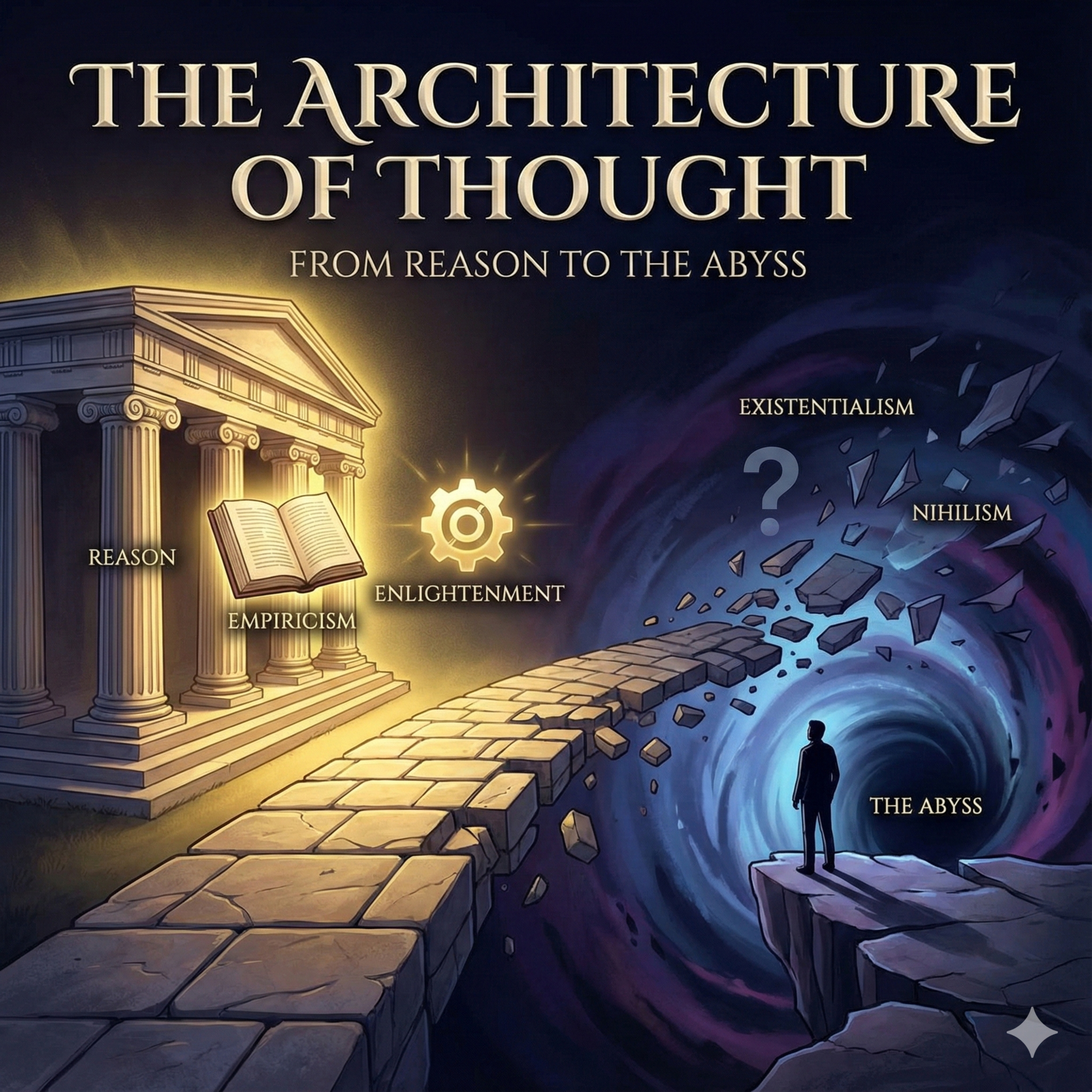
Join us on an intellectual journey through the five pivotal movements that have defined the trajectory of the Western mind: Rationalism, Empiricism, the Enlightenment, Existentialism, and Nihilism. We explore how the history of philosophy is a "grand narrative of construction and deconstruction," moving from the search for a stable centre of authority to the confrontation with the void.In this episode, we examine how the 17th century sought certainty through two competing epistemologies: Rationalism, which looked inward to the architecture of the mind, and Empiricism, which looked outward to the evidence of the senses. We discuss the Enlightenment's optimistic synthesis of these views before turning to the Existential revolt of the 19th century and the terrifying descent into Nihilism in the 20th.Key Topics Covered:1. Rationalism: The Citadel of Reason Discover the "Continental Rationalism" of the 17th century, where reason was viewed as the supreme arbiter of truth. We discuss René Descartes, the "Architect of Modernity," who stripped away all beliefs to find certainty in the cogito—"I think, therefore I am". We also explore Baruch Spinoza’s use of the "Geometric Method" to deduce metaphysical truths, arguing that freedom is simply the rational understanding of necessity.2. Empiricism: The Tabula Rasa Contrast Rationalism with the British Empiricists, who argued that the mind is a blank page (tabula rasa) waiting to be written upon by experience. Learn about Francis Bacon’s "New Organon," which championed the inductive method to overcome the "Idols of the Mind," and John Locke’s mechanical explanation of how simple sensory ideas combine to form complex thoughts.3. The Enlightenment: The Age of Autonomy Explore the 18th-century "Age of Light," which synthesised induction and deduction into the "Analytical Method"—the heart of modern science. We examine the era's moral core: a radical belief in human autonomy that rejected the dogma of original sin in favour of progress through human effort.4. Existentialism: The Anti-System Witness the 19th-century revolt against abstract systems, where the "Many" (unique individuals) conquered the "One" (universal truth). We discuss how thinkers like Kierkegaard, Nietzsche, and Sartre "eliminated the middleman" by fusing philosophy with art to address the subjective experience of anxiety and freedom. Learn why Sartre declared that "existence precedes essence" and how this places the total weight of responsibility on the individual.5. Nihilism: The Void Finally, we confront the spectre of Nihilism—the total rejection of established laws and the denial of objective meaning. We trace its roots from the 19th-century Russian revolutionary movement to the "power-mad nihilism" of the 20th century, exemplified by the absolute destructiveness of the collapsing Third Reich.Conclusion: The challenge of the modern age remains the reconciliation of these forces: maintaining the Rationalist respect for truth and the Enlightenment’s hope for progress, while honouring the Existentialist insight into freedom without falling into the abyss.

Join us on an intellectual journey through the five pivotal movements that have defined the trajectory of the Western mind: Rationalism, Empiricism, the Enlightenment, Existentialism, and Nihilism. We explore how the history of philosophy is a "grand narrative of construction and deconstruction," moving from the search for a stable centre of authority to the confrontation with the void.In this episode, we examine how the 17th century sought certainty through two competing epistemologies: Rationalism, which looked inward to the architecture of the mind, and Empiricism, which looked outward to the evidence of the senses. We discuss the Enlightenment's optimistic synthesis of these views before turning to the Existential revolt of the 19th century and the terrifying descent into Nihilism in the 20th.Key Topics Covered:1. Rationalism: The Citadel of Reason Discover the "Continental Rationalism" of the 17th century, where reason was viewed as the supreme arbiter of truth. We discuss René Descartes, the "Architect of Modernity," who stripped away all beliefs to find certainty in the cogito—"I think, therefore I am". We also explore Baruch Spinoza’s use of the "Geometric Method" to deduce metaphysical truths, arguing that freedom is simply the rational understanding of necessity.2. Empiricism: The Tabula Rasa Contrast Rationalism with the British Empiricists, who argued that the mind is a blank page (tabula rasa) waiting to be written upon by experience. Learn about Francis Bacon’s "New Organon," which championed the inductive method to overcome the "Idols of the Mind," and John Locke’s mechanical explanation of how simple sensory ideas combine to form complex thoughts.3. The Enlightenment: The Age of Autonomy Explore the 18th-century "Age of Light," which synthesised induction and deduction into the "Analytical Method"—the heart of modern science. We examine the era's moral core: a radical belief in human autonomy that rejected the dogma of original sin in favour of progress through human effort.4. Existentialism: The Anti-System Witness the 19th-century revolt against abstract systems, where the "Many" (unique individuals) conquered the "One" (universal truth). We discuss how thinkers like Kierkegaard, Nietzsche, and Sartre "eliminated the middleman" by fusing philosophy with art to address the subjective experience of anxiety and freedom. Learn why Sartre declared that "existence precedes essence" and how this places the total weight of responsibility on the individual.5. Nihilism: The Void Finally, we confront the spectre of Nihilism—the total rejection of established laws and the denial of objective meaning. We trace its roots from the 19th-century Russian revolutionary movement to the "power-mad nihilism" of the 20th century, exemplified by the absolute destructiveness of the collapsing Third Reich.Conclusion: The challenge of the modern age remains the reconciliation of these forces: maintaining the Rationalist respect for truth and the Enlightenment’s hope for progress, while honouring the Existentialist insight into freedom without falling into the abyss.

NOW PLAYING

The Architecture of Thought: From Reason to the Abyss

0:00 34:01

No transcript for this episode yet

We transcribe on demand. Request one and we'll notify you when it's ready — usually under 10 minutes.

MG Show MG Show The MG Show, hosted by Jeffrey Pedersen and Shannon Townsend, is a leading alternative media platform dedicated to uncovering the truth behind today’s most pressing political issues. Launched in 2019, the show has grown exponentially, offering unfiltered insights, comprehensive research, and real-time analysis. With a commitment to independent journalism and factual integrity, the MG Show empowers its audience with knowledge and encourages active participation in the political discourse. Breaking News Show | eTurboNews Juergen Thomas Steinmetz News is relevant to the global travel and tourism industry, human rights and global issues.Breaking news when it happens and only from the source. Eat to Live Jenna Fuhrman, Dr. Fuhrman Our health is our most precious gift and smart nutrition can change your life. Each month, join Dr. Fuhrman and his daughter, Jenna Fuhrman as they discuss important topics in the world of nutrition. Eat to Live will change the way you eat and think about food. French Your Way Jessica: Native French teacher founder of French Your Way Boost your French listening skills and test your comprehension with this one of a kind series of podcasts. Get the chance to listen to a real conversation between native speakers talking at normal speed AND customise your learning experience through carefully designed sets of questions (2 levels of difficulty) available for download at www.frenchvoicespodcast.com. All interviews also come with the transcript. French teacher Jessica interviews native speakers of French from around the world who share a bit of their life and passion. Where else would you meet in one same place a French yoga teacher based in Melbourne, a soap manufacturer from Provence, or a couple cycling around the world?

Frequently Asked Questions

How long is this episode of Trinity and Christian Life?

This episode is 34 minutes long.

When was this Trinity and Christian Life episode published?

This episode was published on December 31, 2025.

What is this episode about?

Join us on an intellectual journey through the five pivotal movements that have defined the trajectory of the Western mind: Rationalism, Empiricism, the Enlightenment, Existentialism, and Nihilism. We explore how the history of philosophy is a...

Can I download this Trinity and Christian Life episode?

Yes, you can download this episode by clicking the download button on the episode player, or subscribe to the podcast in your preferred podcast app for automatic downloads.
URL copied to clipboard!