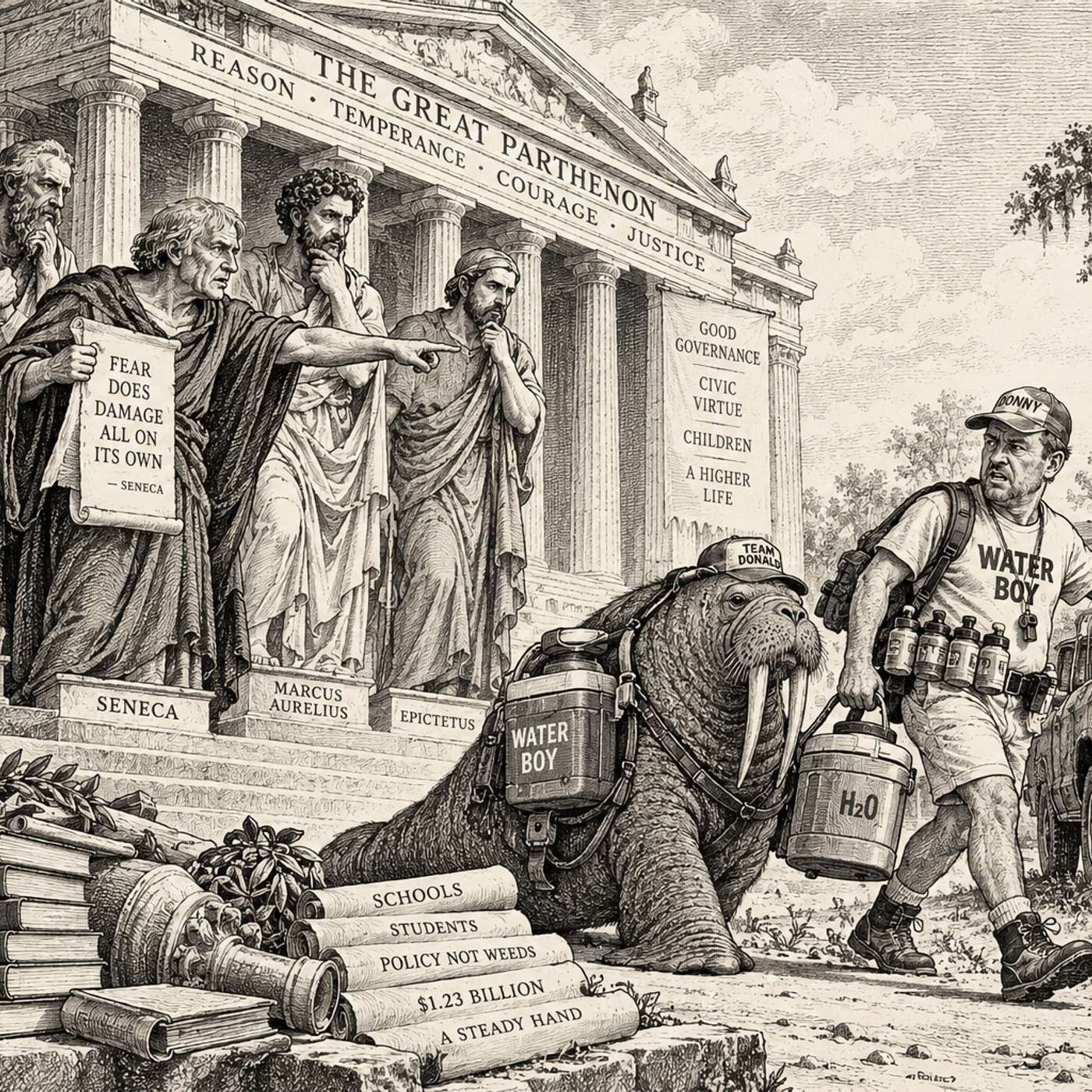
The Argumentative Waterboy
from The Paul Truesdell Podcast Hosted by Paul Grant Truesdell, JD., AIF, CLU, ChFC
The Argumentative Waterboy What This Is About A week ago I said, Mr. Barber, you're next. This is that piece. It is about a man running for the Marion County School Board in District 5 against Sarah James. His name is Donald Barber. His campaign calls him Donny. I call him the argumentative Waterboy, because he ran a city's water system and because of his long history of plain obnoxious arguments. By the end of this you will see that the record backs the nickname. This is not about his family, his faith, or his children. It is not about whether he can read a utility budget. He can. It is about temperament. A man who could not keep the peace inside one small-city department now wants a vote over a school district with a budget of roughly $1.23 billion. That figure is the tentative 2026-27 budget, as reported by The Florida Trib. A Lesson from Rome Go back with me about two thousand years. Seneca was the most celebrated philosopher in Rome and the tutor to a young emperor named Nero. Seneca spent years trying to restrain the boy's worst instincts. It did not take. Nero grew into a ruler consumed by suspicion. He had his own mother killed. He turned on his wife. And in the year 65 he ordered his old teacher to take his own life. Seneca had written that fear does damage all on its own, and that plenty of men walk straight into the fate they spend their lives dreading. He lived just long enough to watch his student prove it. Now jump to 1996. Andy Grove, the man who built Intel into a giant, published a book called Only the Paranoid Survive. Business schools still assign it. But read Grove carefully and notice where he pointed his paranoia. Outward. At competitors, at shifts in technology, at the forces that could wipe a company off the map in eighteen months. He did not point it at the people down the hall. That difference is the whole story. What Happened in Williston Williston is a small city in Levy County. From 2018 into early 2026, Barber worked there, most recently as the administrator over water, wastewater, gas, and the city's fiber system. In 2025 the city grew tired of the fighting inside its Utilities Department and hired the law firm Douglas & Douglas to find out what was going on. Attorney Meagan Logan interviewed 35 city employees over five days. The bill, according to the Levy County Citizen, came to $25,000. Twenty-five thousand dollars. In a small town. To learn why grown men could not work in the same building. Her fifteen-page report, dated September 22, 2025, is posted on the city's own website. Anyone can read it. Here is what it found. The department had split into two camps, and the employees themselves had a name for it: the great divide. You were either on Team Donald or on Team Jonathen, the second camp named for Utilities Director Jonathen Bishop, Barber's boss. The split traces to October 2024, when the city manager restructured the department. Barber's authority was cut back to water, wastewater, and gas, with explicit instructions to stay out of the other divisions. Barber considered it a demotion and believed it came because of complaints against him. According to the report, Bishop tried more than once to apologize, even though the decision was not his to make. Barber would not accept the apology. Eventually Bishop stopped trying. Look at one of those complaints, because it tells you everything. A city employee had been driving a city vehicle at 51 miles an hour through a 25-mile-an-hour school zone. Barber was right to be angry. Nobody serious defends that. But rather than let the director handle it, Barber called the entire department to the city barn and lectured them. Multiple employees told the investigator he spoke to them "like they were 10 years old." He had the right point and lost the room anyway. That is a pattern, and the report documents it. Many employees acknowledged that Barber would yell at and belittle Bishop and others. The report says he struggled to accept suggestions from anyone and always preferred to be in control. Even employees who liked him conceded that communication was his weak spot, and that good ideas died because of the way he delivered them. A city manager put a rebuke in writing over the tone of his emails. Some employees said he quoted the employee handbook selectively, leaving out the parts that did not help his case. In June 2025, Barber filed his own hostile work environment complaint. And one former employee told the investigator he would not come back to work for the city as long as Barber was still there. When the council took up the findings, according to the Levy County Citizen, Vice President Michael Cox asked publicly why Bishop was demoted and put on probation while Barber was only sent to leadership classes. Leadership classes. The city, bless its heart, thought it could fix a temperament with a workbook. What I Saw at Stone Creek I do not have to take the report's word for any of this. I saw it myself. Most of the candidate forums put on by our Republican clubs are polite affairs. Softball questions, a round of applause, coffee and cookies. Nobody gets pressed. At Stone Creek, I was the moderator, and I asked Donald Barber a hard question. He became visibly argumentative and upset. In front of the room. One hard question. That is all it took. Think about what a school board member faces on a normal Tuesday night. Angry parents at the microphone. Reporters. A superintendent defending a budget. A colleague who votes the other way. If a friendly question from a fellow Republican at a club forum gets under his skin, the public comment period is going to be a long four years. And I Want to Be Fair Here The same report that documents the fighting also says this, and you deserve to hear it from me before you hear it from his campaign. Almost everyone interviewed agreed Barber is extremely smart and knows city operations cold: utilities, grants, planning, growth. Many said he did the bulk of the department's work and made his boss look good. One employee called Bishop the body and Barber the brain. By most accounts, the investigator wrote, Bishop was a poor manager. Many employees said Barber got a raw deal from a city council that had it out for him. The investigator also concluded that the conflict did not amount to a legal hostile work environment claim. She found that the dysfunction started at the top, with council members meddling in daily operations. And in Archer, where Barber became the part-time city manager in early 2026, he inherited books in such poor shape that he could not give a financial report. By June he told commissioners the city was operating at a positive net income, according to WCJB. So understand what this is and what it is not. This is not the story of an incompetent man. It is the story of a capable man who could not stop fighting, in a workplace where the fighting became the job. That is the strongest case for Barber. It does not answer the question voters actually face. The Archer Ask Now look at what came next, because it is all in the public record. In January 2026 the little city of Archer, in Alachua County, hired Barber as its part-time city manager. Twenty hours a week. Thirty thousand dollars a year. That deal runs to February 2027, according to the Alachua Chronicle. By August, about six months in, a new contract was on the table. Full time. Ninety thousand dollars a year, plus health insurance, retirement, and twenty weeks of severance if he were let go without cause. From thirty thousand to ninety. A sixty-thousand-dollar jump. That is an eyebrow eraser in any town. In Archer it lands differently. According to WCJB, this is a city that had to admit it missed a state deadline for its financial reports. It had a...
Embed this episode
No transcript yet.