
EPISODE · Jul 17, 2025 · 39 MIN
The Art of Abstract Thought: Your Human Edge in an AI World
from Habits 2 Goals: The Habit Factor® Podcast with Martin Grunburg · host Martin Grunburg
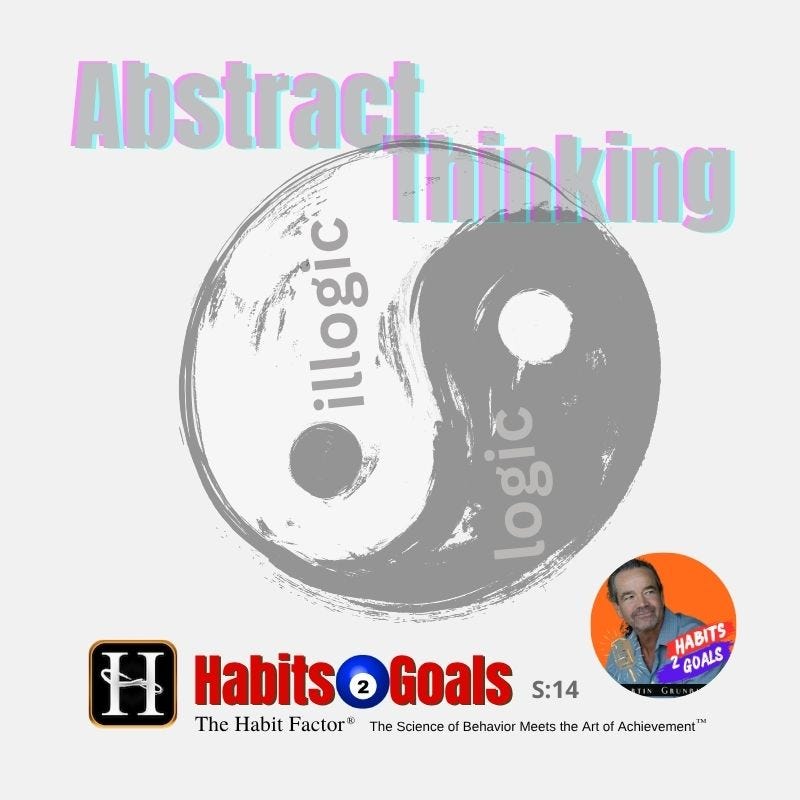
“What is the sound of one hand clapping?”— Zen KoanLet’s start with a confession.Developing the Unified Behavioral Model (UBM) revealed, in many ways, a side quest I didn’t expect: Helping large language models (LLMs) navigate the mental spaghetti we humans lovingly call “logic”—which, if followed faithfully, often leads straight to paradox.You know—the deep, crunchy stuff:Body vs. environmentEmotion vs. feelingSkill vs. habitLogic vs. illogicThese aren’t just philosophical speed bumps.They’re full-blown conceptual cul-de-sacs.Every time the system—human or machine—hits one, it either freezes or splinters into a dozen confident-but-confused directions.What Is Abstract Thought, Anyway?Get it? To “draw away”It’s not about sounding smart or solving puzzles.Frankly, it’s your one real edge over AI—for now.It’s about seeing things and thinking differently, especially when the pieces don’t fit.It’s Picasso and Pollock pulling apart realism.It’s Einstein “riding a beam of light”.It’s Lao Tzu explaining how “The soft and the weak overcome the hard and the strong.”Abstract thinking is cognitive flexibility —it’s a different lens to process, beyond logic.It’s the ability to zoom out and remove the frame.To hold logic and contradiction in the same hand, without blowing a fuse.So, we deliberately choose to go back to FUNDAMENTALS.Not to simplify, but to clarify.Not to dumb down, but to dissolve—to draw away from false binaries.Because here’s the thing about dichotomies: Most aren’t real.They’re often tradition wrapped in Latin, handed down like sacred scrolls, passed around in conference halls and research papers.They survive not because they’re accurate, but because they’re familiar.“If you can't explain it simply, you don't understand it well enough.” ~EinsteinAnd that’s how the Unified Behavioral Model emerged: Not from divine inspiration, but moderate exasperation.Not from clarity, but from watching both brilliant humans and state-of-the-art LLMs get trapped in mental corners built by… You guessed it: LOGIC.Behaviorally speaking:Is the environment separate from the body?Not really. Both are environmental stimulants.If a headache doesn’t change your mood and behavior, just like an idiot screaming at a baseball game, let me know.Are emotions and feelings different?Functionally perhaps? Not elementally. Both relay information.They’re conduits—waves influencing your Behavior Echo-System.What about habits and skills?Turns out, they’re more alike than different. Both are behaviors shaped through repetition, refined over time until they become automatic. Intentional or not, they’re built the same way.How do we reconcile logic and illogic?Reconcile? Even the most “logical” among us do spectacularly irrational things—because we’re driven by meaning, by narrative, by the stories we tell ourselves.Logic and illogic aren’t separate. They’re co-pilots.So if you want to teach a machine how behavior works, we first have to ‘draw away’ the various dichotomies logic has constructed.And once those dissolve?The behavior model doesn’t need to be built.It simply... emerges.Google: “Why doesn’t a unified behavior model exist?”The answer begins with complexity.Complexity created by distinctions (above) that are both very important AND fundamentally (behaviorally speaking), not so important.Like jiggling the old TV antenna for the hundredth time, and suddenly the picture locks in—clear as day, as though it was never scrambled at all.Turns out, it —A UNIFIED BEHAVIOR MODEL—does exist. ☝️It just had to be excavated from under layers of distinctions, logic, and dichotomies.Logic is linear.Behavior, like the human experience, is abstract.This is elemental behavioral literacy. This is the Unified Behavioral Model (UBM)We didn’t invent it—we excavated it.It was buried.Habits 2 Goals Premium by Martin Grunburg is a reader-supported publication. To receive new posts and support my work, consider becoming a free or paid subscriber.“What is your face before your parents were born?” — Zen KoanBecause while machines crunch data, humans connect dots.While models can simulate logic, you can sit with uncertainty.When you can envision a bigger picture, the frames dissolve.“Reflection” (Man Sitting) M. Grunburg 1987Elemental behavioral science shouldn't be reserved for labs and lectures. We teach adolescents the ABCs and 123s —elemental math and grammar. We can, and should, teach elemental behavior. Maybe abstract thinking will come along for the ride.“Experience and knowledge don’t arrive with labels, silos, or departments—we create those. Sometimes those distinctions are incredibly useful (like language itself). And sometimes—also like language—they make problem-solving harder than it needs to be.”🚨 #TrueStory: Habit Tracking News Breakthrough!Read what the new science reveals about the unmistakable power of habit tracking in the UBM White paper.Grab your free white paper (see Section 7.0) —> Just one week ‘old’ and 200+ downloads already, https://zenodo.org/records/15844153P.S. Reminder: The Unified Behavioral Model™ (UBM) is the first behavioral model to be both falsifiable and unified—meeting the scientific gold standard of Ph.D.-level rigor.Everyone (not just academics) is invited to download the paper and explore the “No Fifth Element” Challenge—with a $1,000 prize on the line.Grab your free white paper (see Section 7.0) —> Just one week ‘old’ and 200+ downloads already, https://zenodo.org/records/15844153📄 Grab the free habit tracking template: thehabitfactor.com/templatesShareThe Trilogy: WARNING! DO NOT READ THESE BOOKS!!!The Habit Factor®: Habit alignment, momentum and daily wins!The Pressure Paradox™: Productivity, Performance & Peace of Mind.EVERYTHING: The stories you tell yourself heavily influence ‘everything.’ This is a public episode. If you'd like to discuss this with other subscribers or get access to bonus episodes, visit habits2goals.substack.com/subscribe
Embed this episode
Ready to play
The Art of Abstract Thought: Your Human Edge in an AI World
No transcript for this episode yet
Similar Episodes
No similar episodes found.
Similar Podcasts
No similar podcasts found.