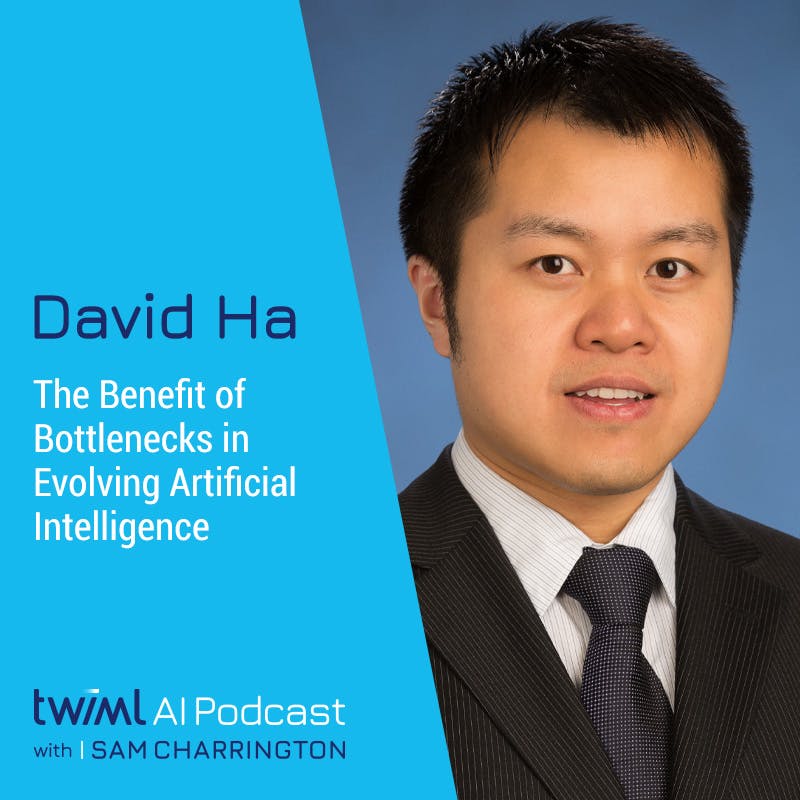
The Benefit of Bottlenecks in Evolving Artificial Intelligence with David Ha - #535 episode artwork

EPISODE · Nov 11, 2021 · 59 MIN

The Benefit of Bottlenecks in Evolving Artificial Intelligence with David Ha - #535

from The TWIML AI Podcast (formerly This Week in Machine Learning & Artificial Intelligence) · host Sam Charrington

Today we’re joined by David Ha, a research scientist at Google.  In nature, there are many examples of “bottlenecks”, or constraints, that have shaped our development as a species. Building upon this idea, David posits that these same evolutionary bottlenecks could work when training neural network models as well. In our conversation with David, we cover a TON of ground, including the aforementioned biological inspiration for his work, then digging deeper into the different types of constraints he’s applied to ML systems. We explore abstract generative models and how advanced training agents inside of generative models has become, and quite a few papers including Neuroevolution of self-interpretable agents, World Models and Attention for Reinforcement Learning, and The Sensory Neuron as a Transformer: Permutation-Invariant Neural Networks for Reinforcement Learning. This interview is Nerd Alert certified, so get your notes ready!  PS. David is one of our favorite follows on Twitter (@hardmaru), so check him out and share your thoughts on this interview and his work! The complete show notes for this episode can be found at twimlai.com/go/535

Today we’re joined by David Ha, a research scientist at Google.  In nature, there are many examples of “bottlenecks”, or constraints, that have shaped our development as a species. Building upon this idea, David posits that these same evolutionary bottlenecks could work when training neural network models as well. In our conversation with David, we cover a TON of ground, including the aforementioned biological inspiration for his work, then digging deeper into the different types of constraints he’s applied to ML systems. We explore abstract generative models and how advanced training agents inside of generative models has become, and quite a few papers including Neuroevolution of self-interpretable agents, World Models and Attention for Reinforcement Learning, and The Sensory Neuron as a Transformer: Permutation-Invariant Neural Networks for Reinforcement Learning. This interview is Nerd Alert certified, so get your notes ready!  PS. David is one of our favorite follows on Twitter (@hardmaru), so check him out and share your thoughts on this interview and his work! The complete show notes for this episode can be found at twimlai.com/go/535

NOW PLAYING

The Benefit of Bottlenecks in Evolving Artificial Intelligence with David Ha - #535

0:00 59:04

No transcript for this episode yet

We transcribe on demand. Request one and we'll notify you when it's ready — usually under 10 minutes.

Frequently Asked Questions

How long is this episode of The TWIML AI Podcast (formerly This Week in Machine Learning & Artificial Intelligence)?

This episode is 59 minutes long.

When was this The TWIML AI Podcast (formerly This Week in Machine Learning & Artificial Intelligence) episode published?

This episode was published on November 11, 2021.

What is this episode about?

Today we’re joined by David Ha, a research scientist at Google.  In nature, there are many examples of “bottlenecks”, or constraints, that have shaped our development as a species. Building upon this idea, David posits that these same evolutionary...

Can I download this The TWIML AI Podcast (formerly This Week in Machine Learning & Artificial Intelligence) episode?

Yes, you can download this episode by clicking the download button on the episode player, or subscribe to the podcast in your preferred podcast app for automatic downloads.
URL copied to clipboard!