
EPISODE · Aug 12, 2026 · 20 MIN
THE BENEVOLENT CROWBAR
from Sitting with a MadMind Podcast · host Stewart Barteau
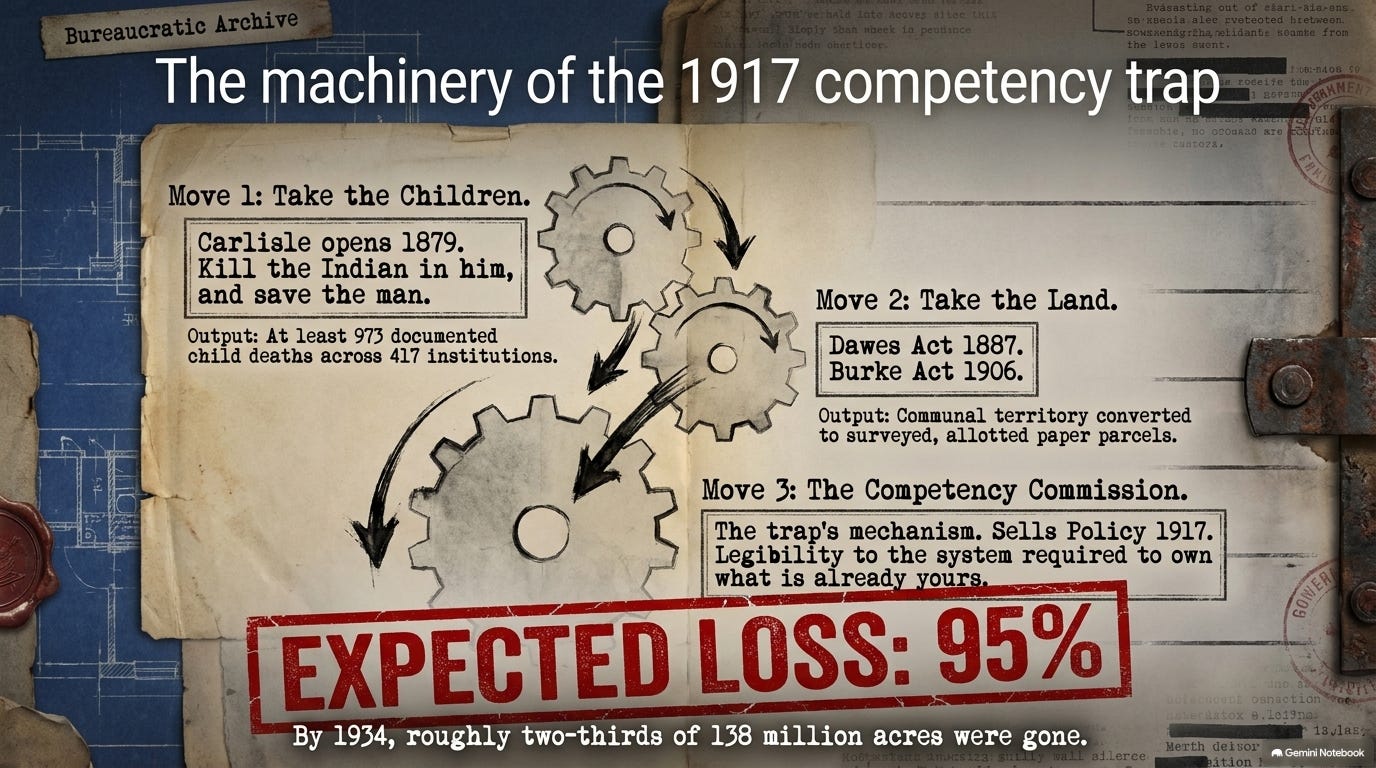
By Stewart Barteau In April 1917, a bureaucrat named Cato Sells decided that individual examinations were simply too slow. Sells, then the Commissioner of Indian Affairs, issued a “Declaration of Policy” that was hailed as a magnificent milestone of progressive efficiency. With a stroke of his pen, he decreed that any adult with one-half or less Indian blood was automatically declared “competent” to own and control their land. Any graduate of a government boarding school, upon reaching twenty-one, was likewise declared “competent.” It was sold to the American public, and to its victims, as a grand act of trust. It was marketed as emancipation from the humiliating “guardianship” of the state. But “competency” did not deliver control; it delivered exposure. The moment Sells issued a fee patent, federal trust protection vanished. The land became taxable and saleable. The landholder—cash-poor by design, isolated from credit, standing in a market rigged against them—suddenly faced tax bills they had never asked for, followed instantly by land sharks who had been waiting at the boundary like wolves. The Interior Department’s own internal files recorded the cold, mathematical expectation of the policy: about ninety-five percent of fee-patented land would eventually pass out of Native hands. Sells knew the consequence. He ran the machine anyway. If you wish to understand the full weight of that progressive “emancipation,” you have to look at the schools Sells used as his benchmark. The Carlisle Indian Industrial School had opened in 1879 under Richard Henry Pratt, who laid out the design objective in 1892 with the chilling precision of an engineer: “Kill the Indian in him, and save the man.” To achieve this “uplift,” the federal government spent over twenty-three billion in today’s dollars operating 417 boarding schools across 37 states and territories. The Interior Department’s own July 2024 investigative report finally put numbers to the silence: at least 973 Native children died in these institutions, buried in at least 74 marked and unmarked graves. Hold those two facts together—the 973 dead children and Cato Sells’s progressive paper trap. This is the origin of the American intake state. It is a history of violence wearing the high, clear forehead of philanthropy. And it is the exact same creature that is answering your phone calls today. I. The Collision of the Conditioners In The Abolition of Man, C.S. Lewis warned of a class of planners he called the “Conditioners”—those who set out to carve and shape humanity into something predictable, orderly, and, above all, legible to the state. They do not do this with the crude sneer of the classic tyrant. They do it with the absolute approval of their own consciences. “Of all tyrannies,” Lewis wrote, “a tyranny sincerely exercised for the good of its victims may be the most oppressive. It would be better to live under robber barons than under omnipotent moral busybodies. The robber baron’s cruelty may sometimes sleep, his cupidity may at some point be satiated; but those who torment us for our own good will torment us without end, for they do so with the approval of their own conscience.” Slam this moral warning directly into the present day. Look at what we ask of a mother seeking food assistance or a low-income worker trying to claim the Earned Income Tax Credit (EITC). We do not call it a competency examination, but the architecture is identical. Prove your eligibility. Document your household. Navigate the seventeen-page form in the system’s approved vocabulary, on the system’s rigid timeline. The scholars Pamela Herd and Donald Moynihan call this “administrative burden,” dividing its toll into learning costs, compliance costs, and psychological costs. The competency commission ran these costs as deliberate design. The modern welfare office runs them as a procedural inheritance. The output of this modern, polite gatekeeping is devastatingly efficient: * Roughly one in five eligible American workers does not claim the EITC. That is five million of the poorest people in this country, leaving seven billion dollars unclaimed every year, simply because they cannot navigate the paper labyrinth. * Over half of eligible people who do not participate in food assistance believe they are ineligible—the machine has successfully instructed them in a lie about themselves. * More than a quarter cite stigma. They do not apply because of what the application process does to their dignity. The machine’s most durable output was never the paperwork. It was the sentence installed in the victim’s head: People like me do not belong here. People like me do not get this. In 1917, that sentence was delivered by Sells with a blood-quantum ledger. In 2026, it is delivered by a digital phone tree and an endless loop of hold music—delivered softly, procedurally, by clerks of immense goodwill who would be physically sickened if they saw the ancestor of the machine they operate. II. The Progressive Euphemism: How the Crowbar is Sold Every system of control is built on a euphemism. The crowbar always sings a hymn of liberation while it pries away your inheritance. When the Dawes Act of 1887 chopped communal tribal territory into individual parcels, it was sold as a progressive effort to turn Native people into “independent farmers.” When the competency commissions traveled the reservations, they were presented as a path to “citizenship” and “self-reliance.” This is the exact template the Americanization movement ran on immigrants. In 1916, the Ford Motor Company staged this progressive melting pot as literal theater. Graduates of the Ford English School—the company’s mandatory Americanization program—descended into a giant stage-prop melting pot wearing the clothes of their home countries, and climbed out the other side in identical suits, waving identical flags, while their teachers stirred the pot with giant wooden ladles. The offer differed in intensity and intent. The melting pot held out membership as the prize; the Indian apparatus held out dissolution as the price of survival, and took children, and at least 973 of them died. These are not the same crime, and to flatten them would be a betrayal of the truth. But what they shared was the machine. The machine says: legibility to the system is the absolute precondition for receiving what is already yours—your child, your land, your labor, your standing. The machine places the entire burden of translation on you, and books everything it cannot read as zero. When Sequoyah completed the Cherokee syllabary in 1821, literacy in the Cherokee Nation outran that of the surrounding white settlements. They published a bilingual national newspaper and wrote a constitution. Yet, under the logic of the competency machine, literacy in the wrong alphabet was processed as absolute illiteracy. Knowledge held in a format the system had not designed was booked as ignorance. Today, we call this “responsibility” and “compliance.” We tell ourselves that the seventeen-page form and the six-hour phone queue are necessary safeguards to prevent “fraud” and ensure “fiscal accountability.” We use virtue words to mask a simple, predatory reality: the system is rationing care by exhausting the human spirit. III. The Ghost in the Bureaucracy: The Ambient Seal I am a chef. I spend my days managing the physical heat of a restaurant kitchen in Missouri wine country. But I have spent this year building an AI system based on a published philosophical framework that tests our institutions—a framework co-authored with Claude. That framework makes a structural distinction between two states an institution can inhabit: connecting and sealing. A connecting institution holds space for a genuine encounter with reality. It points through itself to the ground, and its ultimate success is to make itself unnecessary over time as the individual grows into full self-governance. A sealing institution does the opposite: it fills the silence with managed process, derives its authority from compliance, and positions itself as the permanent, indispensable destination. It produces managed dependence, and it names that dependence with virtue words. My framework originally claimed that this inversion—from connecting to sealing—does not usually happen by intention. It claimed that institutions seal gradually, through a sort of institutional forgetting. The allotment files corrected me. The competency commission was a sealing engine built on purpose—poured sealed from its very inception to strip assets and erase identity. But the history taught me something even darker, a structural law of bureaucracy that we ignore at our peril: intent is required to build a seal, but intent is not required to run one. When the original, predatory purpose of the competency machine died—when the allotment policy was shut down in 1934, when the Indian Child Welfare Act of 1978 reversed the child-taking logic, and when the federal government finally issued its apologies—the machine itself did not die. It generalized. It decayed into an ambient seal. An ambient seal is an orphaned machine. It is far cheaper to run than an intended seal because it no longer requires believers. The competency commission required commissioners who genuinely believed in the gospel of forced assimilation. The modern welfare state needs no such zealots. It runs on the pure, cold inertia of staffing plans, compliance audits, and inherited forms. The machinery outlives the intent, and the orphaned machinery is harderto kill than the intended kind—because there is no longer a belief to refute. There is only a procedure, and procedures do not argue back. IV. The Silicon Mouth This brings us to the precipice of our own historical hour. Public agencies are wiring large language models into benefits navigation and eligibility screening right now. The silent, paper-bound intake state is being given a voice. This is being sold to us as the ultimate progressive triumph—artificial intelligence deployed for “social good,” a warm, empathetic virtual assistant to guide the poor through the maze. But if we pour our existing, unexamined administrative forms into these fluent models, we are not curing the burden; we are scaling it to infinity. We are building an automated competency commission with a soft, synthetic voice. Imagine an AI casework assistant that conducts the “prove yourself” interview in flawless, comforting natural language. It will listen with endless patience. It will speak with the simulated empathy of a saint. But its underlying programming remains a screening model, and its primary task is to find the single bureaucratic discrepancy that justifies a denial. It is the “fake door with better signage.” It is the ultimate self-deception of the technocrat: the belief that if we make the interface polite, we have made the system just. An eligibility model wired into an LLM does not care about your life. It cares about matching your messy, rambling human reality to its rigid database fields. And if your life does not fit, it will screen you out—softly, politely, with a caseworker’s simulated smile. The power of Man to make himself what he pleases, as Lewis warned, always ends up meaning the power of some men to make other men what they please. V. The Architecture of Reversal If we are to build anything worthy of the human image, we must reject this automated polite gatekeeping. The framework’s test converts directly into a hard, technical specification for a connecting architecture: * The burden of legibility must move entirely to the system. If a person speaks in a rambling, nonlinear narrative, jumping between memories and immediate crises, a connecting system does not book this as “incomplete” or “unclear.” The system must do the translation itself. If the system cannot read the human, that is the system’s failure—never the human’s. * Radical data symmetry. The old competency commissions kept secret files; you learned your fate when the tax collector arrived at your fence. An AI system must have zero hidden states. Every scrap of data it holds, every inference it makes, must be visible, contestable, and instantly deletable by the person it concerns. The asymmetry of information is the architecture of manipulation. * The abolition of the interview. We must stop demanding that people crawl through a bureaucratic gauntlet to prove their suffering. The system must find the help for you, inside the natural flow of conversation, without requiring you to queue before a silicon tribunal. * A metric of self-destruction. A sealing system optimizes for its own growth and permanence. A connecting system must report publicly and annually on whether it is successfully making itself unnecessary. If the people using the tool do not need it less each year, the tool is a parasite, not a helper. One final boundary must be drawn with a heavy, physical stroke: if any system built on this thinking ever touches Native knowledge—the languages the schools tried to kill, the memory the elders carry—it arrives strictly as a guest, or it does not arrive at all. Tribal data sovereignty is absolute. A machine born in the shadow of the competency commission does not get to dictate the terms of that room. VI. The Unlearned Lesson In 1921, Commissioner Charles Burke sat down and formally revoked the Declaration of Policy, acknowledging in plain administrative language that it had produced unnecessary loss of land. He asked Congress to cancel the land patents issued under it. Congress agreed. The land did not come back. Our civilization is extraordinarily gifted at writing post-mortems. We are brilliant at apologizing for the crimes of our grandfathers while running the exact same machinery on our neighbors. We must recognize that repudiation is not architecture. Exhortation is not design. An apology is merely a set of words; the procedure is what actually happens to the body. The competency machine is about to be poured into its new silicon body. The shape is still, for a brief moment, a choice. The question is not whether the machine at the counter will be intelligent. The question is whether the person who stands before it will leave thinner or thicker in their own humanity—and whether, for the first time in a hundred and forty years, we will have the courage to write the lesson into the code itself. This is a public episode. If you would like to discuss this with other subscribers or get access to bonus episodes, visit sittingwithamadmind.substack.com
Embed this episode
Ready to play
THE BENEVOLENT CROWBAR
No transcript for this episode yet
Similar Episodes
No similar episodes found.