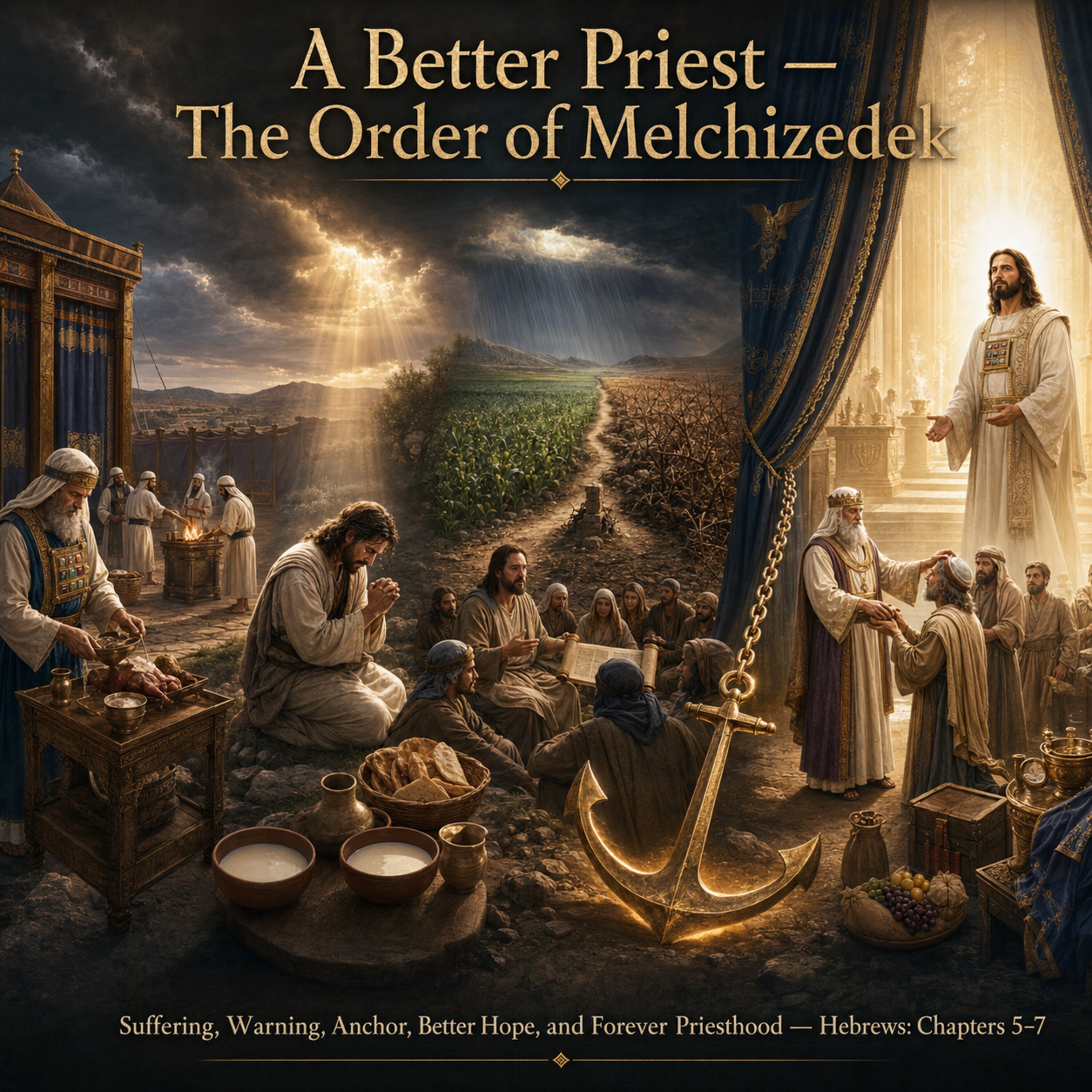
The Bible - NT - 19c - Hebrews, Chapters 5-7
from Wisdom for the Present: Eastern Wisdom Literature Hosted by Kanu Emeruwa
In the ancient text of Hebrews, chapters five through seven, we find a profound exploration of divine empathy and leadership. Imagine a doctor who knows every symptom but has never felt the ache of illness. This is how humanity often perceived the divine—distant, clinical, untouched by human suffering. But the author of Hebrews challenges this view, presenting a radical redefinition of divine leadership through the figure of Jesus as the ultimate high priest. The original audience, Jewish Christians in the first century, faced severe persecution. They were tempted to retreat to the familiar safety of the Levitical system, a tangible religious structure with visible rituals and legal protections. But the author argues that this new Christian system, though invisible, offers something far superior. The high priesthood of Jesus is not based on genealogy or human frailty but on the power of an endless life. Hebrews chapter five begins by emphasizing that a high priest must be taken from among men to deal gently with those who are ignorant and going astray. This shared human weakness breeds empathy. Yet, Jesus, though sinless, shares in human suffering, offering prayers with strong crying and tears. This dismantles the notion that true strength is unfeeling. Instead, it invites us to use our own infirmities to connect with others, cultivating deep empathy. The text warns against spiritual stagnation, urging believers to move beyond the basics of faith. It challenges the modern tendency to consume information without application, emphasizing that true maturity comes from exercising our moral and intellectual muscles in real-world situations. The author uses a stark warning to jolt the audience awake, highlighting the danger of coasting on the basics. The metaphor of rain falling on land illustrates how the same resources can produce vastly different results depending on the condition of the soil. This challenges us to examine how we use our resources—are we cultivating growth or allowing thorns to take over? Finally, the text introduces the mysterious figure of Melchizedek, whose priesthood prefigures that of Christ. This priesthood merges the roles of king and priest, offering perfect mediation and ultimate authority. It challenges us to let go of inferior systems and embrace the better hope that draws us near to God. In This Episode * The radical empathy of a sinless high priest who shares in human suffering * The historical context of Jewish Christians facing persecution and isolation * The temptation to retreat to familiar but ineffective systems * The warning against spiritual stagnation and the call to maturity * The metaphor of rain and soil as a reflection on resource use * The introduction of Melchizedek as a type of Christ's eternal priesthood * The merging of kingly and priestly roles in Jesus * The challenge to embrace disruption and let go of inferior systems * The concept of being saved to the uttermost and the permanence of Christ's priesthood * The invitation to rest in the completed work of Christ and abandon self-justification Practical Reflection 1. Where in your life are you acting like an ancient, exhausted priest, making daily sacrifices to prove your worth?2. How are you using your resources—are you cultivating growth or allowing thorns to take over?3. What systems or coping mechanisms are you clinging to that are familiar but ineffective? Suggested Substack Excerpt In Hebrews chapters five through seven, we explore the radical empathy of a sinless high priest and the challenge to move beyond spiritual stagnation. This episode invites us to embrace disruption, let go of inferior systems, and rest in the completed work of Christ. AI Disclosure This episode was created using Google NotebookLM Audio Overview, based on human-curated source material, structured guidance, and editorial review. AI is used as a tool for clarity and delivery, not as a replacement for thoughtful study or engagement with the original texts. Copyright © 2026 Wisdom for the Present / Kamashcu Production Studios. All rights reserved. This is a public episode. If you would like to discuss this with other subscribers or get access to bonus episodes, visit wisdomforthepresent.substack.com
Embed this episode
No transcript yet.