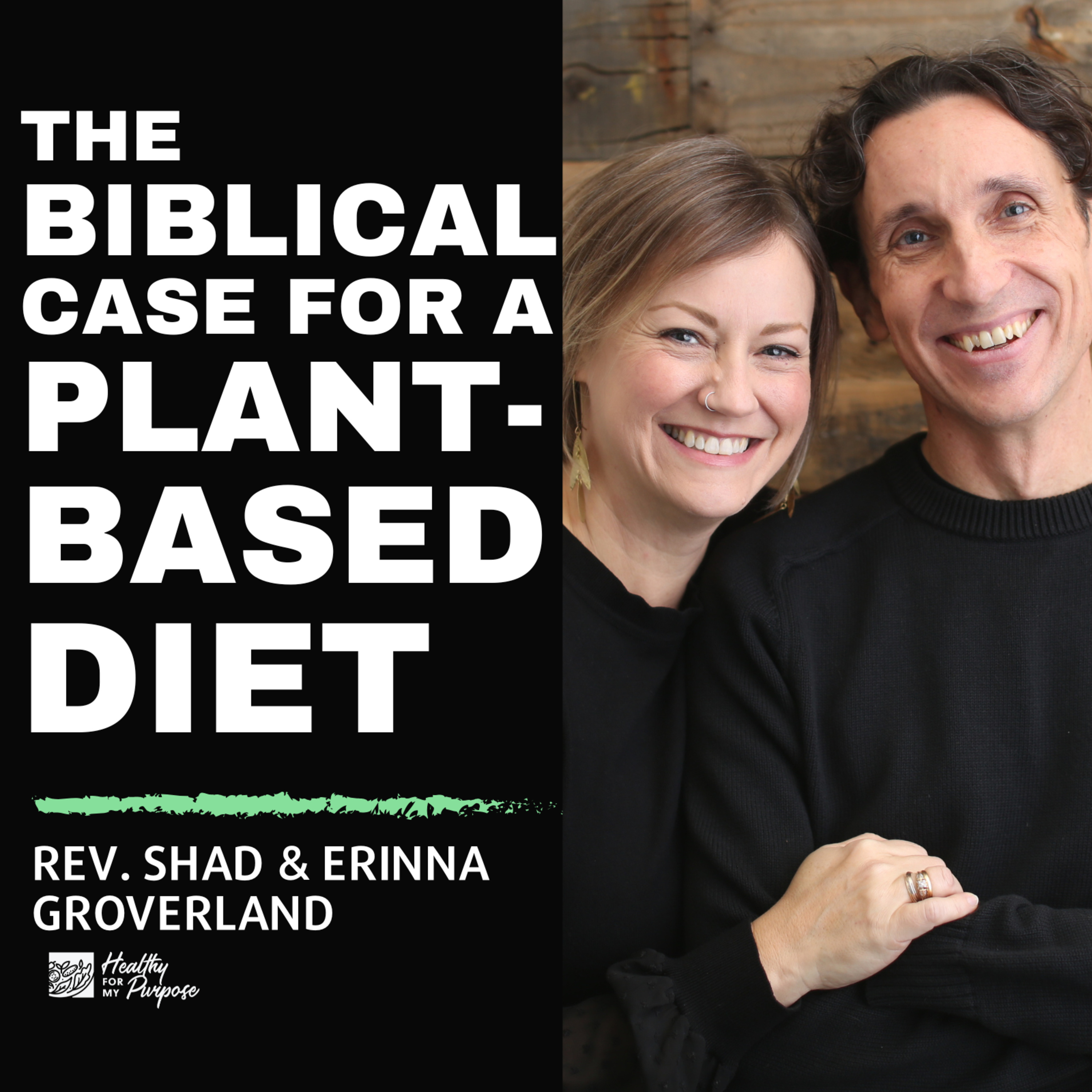
all right hey everyone welcome to another episode of healthy for my purpose we have the awesome reverend shad and arena groverlin and we're going to be having a very unique conversation we're going to be talking about veganism the church or bible how does plant-based nutrition weave into the scripture and all of that fun stuff so you're really going to enjoy this episode so let's go ahead and dive in but before we get into all of the nuances of veganism the bible christianity and church reverend shad and arena can you just give us a little background about your own personal journey, how you came into eating plant-based. And then we can get into how you evolved into creating the church and the other things. But let's just hear your personal stories first. You first? Yeah. Okay. Let's see. Veganism. So I, around the year 2000, for some reason, I decided I didn't really like the texture of meat in my sandwiches. So it started out as a textural thing for me. And then as I learned more about vegetarianism and stuff, I started eliminating meat. And then I started, and then in 2003, I had always been allergic to dairy products and had always had like a...
phlegmy thing that had going on all the time. And as a singer, that's really not the best thing that you want. So at some point, and it never really occurred, I guess, to my family to take me off of the dairy products. That was just what we had. That's what we ate and cheese and everything. And so I realized, I said, okay, there's other options out there. Let's try it and see what that's like. And it cleared up like in a week, it was cleared up. And so it was more, it started out all, of course, with the health stuff. But then as I learned more about animal rights and that sort of thing, it became more about spiritual reasons, I guess, for veganism. And it sort of all plays together now where we are.
Sure, I'll dive into it. Let's see. So it goes back to when I was 12 years old. So my father is also a pastor. And one day, Sunday morning, he just came out and gave a talk based on the book Diet for a New America, which many people in the vegetarian community are familiar with the book. And so he went into the whole, you know, how animals are treated to become food on our plate and the whole thing. And I was 12 years old. And after that talk, I just decided I'm going to become vegetarian. And it wasn't even something that the whole family did. I just decided I was going to do it.
and uh i became a part of my life and i had to go you know to mcdonald's my friends and order the cheeseburger without the cheese or the meat and insert the french fries and just try to manage without the knowledge of how to be a vegetarian as a little kid but slowly figured it out over time and uh over time i was a vegetarian but i was becoming less having less of a taste for cheese and well mostly eggs mostly eggs i was losing a taste for eggs and then i met erina she was already vegan and she was like you're mostly already there why don't you just take the next step and she become vegan and she started talking about you know Look at the way chickens are treated to get you those eggs. Look at the way cows are treated to get you that milk and et cetera, et cetera. And it was really yogurt. I love yogurt. So she exposed me to that. And I kind of knew it, but I just was ignoring it until she really put it in my face. And then we were dating. We wound up being engaged. And she was cooking. So it was kind of a no-brainer. I was getting delicious vegan meals. And the next step was easy because there was no transition of missing anything because the meals were so delicious and amazing. And it couples with the whole spiritual process of my whole life. I've been studying Jesus Christ and different spiritual masters. Just about across the board, they're saying,
you know, harmful to animals is not allowed in this practice. And you have to equate the two. And a lot of them are saying you have to give up meat, you got to give up dairy, you got to give up these things. And so it's just a similar thing, just kind of a natural progression over time that unfolds. And you look back and go, oh, I'm vegan now. And this feels good. It makes sense. Awesome. Yeah. When you were talking about your phlegm, you know, with milk, I could totally relate to that. And it's so funny. I mean.
I shouldn't say it's funny, but it's interesting that it's so normalized consuming dairy, but most of the world is allergic to it because we weren't really designed to consume basically mammary fluid from another animal. So yeah, so it's not surprising you saw all that clear up after you kind of abstained from it. And your story, so you mentioned this was like back in 2000, you made this change. So it's been like over 20 years for both of you, is that right? For me, I went fully vegan in 2012-ish.
Yeah, that's when I made the change. So it's been about 12-ish years. Yeah. Okay, cool. Yeah. Sounds like a long time. It doesn't feel like a long time. Time flies, I guess, when you're having fun. So I had the privilege of meeting you guys at the VegFest. And what was really intriguing to me, you guys were setting up there because you had an all-vegan church that you started. Can you tell the audience a little bit about the story of how this developed and what is a plant-based church? And tell us all of those things above.
Sure. I'll kick off and you jump in and fill in the interesting parts that I'll miss. So in the faith I grew up in, the founders, Charles and Myrtle Fillmore, were ethical vegetarians in the late 1800s and pioneering it really in the early 1900s. And it was a big part of the teaching of practical Christianity, as they called it at that time. And they put out flyers about it. They taught classes about it. It was really tied into this is how we practice this faith. Over time, that...
drifted out of the faith itself, which is called unity. And by the 80s and 90s, it was almost entirely gone. And only people that really understood the history would know that it was ever even a part of the faith to begin with. So I was ordained in that faith. I had two ministries in that faith with Erna. And eventually I became the CEO of the central office that oversees all the ministries. And I really want to make a concerted effort to sort of reattach to the foundational teachings of that organization, which many of them had kind of...
drifted off, we'll just say. And that was one of the things I wanted to focus on, as well as really getting re-centered back into the Bible and the teachings of Jesus Christ and how that faith particularly looked at it. I moved on from that position, and we accomplished a lot of great things there. But as we were looking at our next steps and what we wanted to do, we'd had two ministries before that, and it felt like there was a calling to do that again. But to really do it the way we felt the founders of the organization, the founders of Practical Christianity, Charles and Merrill Fillmore, really intended for it to be done so that we would have to do a sort of clean slate, fresh start.
as we see their intention for how it would be done. And that would be that there would not be animal products served during fellowship. And that we would talk about our impact on the animal environment. And the healing was also a huge part of Practical Christianity as they started it as well. The ability to heal our own minds, heal our own bodies, to heal with plant medicine and the things that God gave us without being dependent on pharmaceuticals or doctors or the medical system. So those things we said, well, let's just start a church exactly how we felt they intended it to be, but in a modern way and in a modern setting. Anything you want to add there?
No, well, we don't want to like proselytize veganism necessarily. We don't want to be like, you have to be vegan to be part of this church. So we kind of toyed with the idea of calling it plant forward. We definitely want to make sure that there is vegan food available for people and that there is no animal products, but we don't want to say you have to be vegan to be part of this ministry. So a friend of ours that is vegan, she's a great vegan cook, has taken over and is in charge of hospitality. So we don't have to even really worry about that, which has been amazing. And we're hoping to kind of develop that. But I think that's kind of, we do have a number of folks that are interested in the...
original teachings of the Fillmore is the practical Christianity and are not aware of the vegan aspect of it. And so there's sort of a little balance. We're trying to figure out how to walk the line of, you know, we encourage you to be vegan. We think that's the best route, but you know, we don't mandate that obviously. Yeah, really we want to, the core of the teachings is that each person has a direct communication channel to God and to Christ. And we don't, we don't insert ourselves in between that. We give advice, we give our interpretation of the Bible, we give what.
we feel like is being said, but ultimately the decisions for your life are between you and God. We're not going to judge you on those decisions. And we're really mindful of creating an inclusive environment where if someone starts talking about veganism in a shameful way of someone's eating meat, we're going to try to curtail that and say, every person is deciding what's best for their life, for their family, between them and God, and their health practitioner, who they're working with. We're just going to say at this church, this is what we do, but we're not shaming, blaming, or ostracizing anyone that's made a choice because some people might be there for the health freedom aspects and really the health aspect of it and not necessarily be on board with veganism, or they're just there for the way we interpret the Bible and look at the Christ teachings and not interested in either one of those. but we just want to also make an environment where we would like to go to a church where anything was served we could eat and we wouldn't have to question about it we have to go through the ingredients and find who made it if it was a pot love track down the person that made that particular dish just know that it was all stuff we could eat and that'd be incredible so it's the environment we want to create yeah i'm glad you said that um you know because i think what i hear you saying is it's not so much that it's a prerequisite to be a follower of christ of course not but i what i hear you saying is you want the the church that you're serving in to be a place of healing and restoration and
putting foods into our temple that's actually going to edify us and you know that kind of leads us into a gateway of i think how so many of us in the modern church have fallen into the trap of forgetting about that peace you know when people come into the church we automatically know that we need to create a love and environment a healing environment but sometimes we fall to the trap of serving toxic food to the members, you know, through potlucks and different things. And there is this little bit of friction because you have people in the church that might be suffering from diabetes or high blood pressure or obesity. But at the same time, the church is actually serving the very foods, you know, that is contributing to that. And so it's this tension that I think a lot of churches are not mindful. And I think if we, you know, having this conversation, I think can pique those conversations because now it makes us say, well, what about on the health part? Are we representing Christ in the nature of?
place of healing and restoration, or are we being a part of the problem? And I love to hear what you're saying there, that this is not a salvation issue. This is an issue of providing an environment that is safe, that is healing, that is going to help the members in every way. So thank you. Yeah. Yeah. And the science is unequivocal. It's just overwhelming.
And, you know, I we like to compare diet to tobacco, like, you know, back in the, I guess, 50s and 60s, pastors were smoking at the pulpit. And, you know, it's just kind of just, you know, part of the commonplace of, you know, going to church. And we haven't quite achieved that with food, with diet. And there's this, I think, cognitive dissonance around it where. I think some people think, maybe some people are unaware, but I think there's enough information out there to know enough that processed foods, for example, are kind of a no-brainer for most people. In fact, there's a lawsuit going on right now with a 16-year-old I was sharing with Searcy, who's suing the processed food company for his development of type 2 diabetes.
So, you know, churches are not only, you know, serving that, eating this themselves, but also serving it to its members. At some point, there has to be, you know, a change, like some kind of an awakening around that. And, you know, I guess from your perspective, like how, you know, how do you see that unfolding? I mean, is it, I mean, I know you can't predict the future, but just from your point of view and how you're working with your members and how you communicate with your members and just looking at the broader church landscape, how do you see that unfolding? Well, I think the conversation has become much more prominent everywhere. And our government's talking about it now. We're starting to actually talk about fluoride in water. And we're starting to talk about what we're putting into our bodies and the effect. And should our government really be telling us what to put in our bodies? Have they been very good at it in the past? Is that really their role? And the conversation is becoming so widespread that it's on people's minds for maybe the first time in history. I don't know. But it's on people's minds. You can tell it's on people's minds. And whether they're vehemently against it or they're open to it, it's on their mind either way. And so that's causing two things. It's causing an immediate trigger reaction.
because they are thinking about it. And so they're already kind of defensive about if they've chosen not to want to go down a path of questioning what they eat and what they drink and all that sort of stuff. Or they're hungry for a place that is authentically resonating with where they're thinking. And they don't know what to do about it yet. A lot of people are like, I don't know how to eat. I don't know how to drink. I don't know how to do this. I don't know how to pray. I don't know how to do these things. But I feel like I should be doing something about it because I've heard about information. So it's sort of just vibrating there. And the thing is that the church, by and large, is way behind the curve that's already happening, even in politics, which is mind blowing. And so you see, I mean, fundamentally, I'll talk to people.
And they go, well, I don't know how much it plays into my relationship with God. It's like, all right, well, have you ever tried to pray while you have food poisoning? You can't. It's not possible. You are not thinking about that point unless you're asking God to take you from this body because it's so miserable. But to have a legitimate just solid prayer or to just sit and silence and contemplate, it's just an extreme example of if we're not taking care of the body, the sugars, the type of food we eat is just causing voices in the head and it's just your heart's pumping and you're not able to settle and do that practice, then everything kind of falls by the wayside. So it's like your body's an antenna. If you're not tuning this antenna.
the frequency of god you're not going to be able to get that contact that download and have that communication channel if your antenna is covered in you know processed sugars and fats it's hard for it to broadcast or receive so we've got to clean that antenna to really be able to do that process yeah i love that i love that analogy of the antenna you know like one of the things that i you know i talk about frequently when i went plant-based and i did the daniel fast i didn't turn back is that i actually heard the voice of god more clearly that's that's the antenna and i think a lot of times we don't realize the um the cloudiness that's there because we haven't debugged it. Right. And it's not until you kind of detox and move away from those foods that you realize, wait a minute, my radio was really on 45%. I just didn't, I just didn't know it because now everything is getting turned up because I'm now clearing my mind and clearing my spirit and my body and I'm feeling better. My emotional state is better. And all of those things kind of trickle down. So, you know, I think the important point that you made there, if the church can really understand, and you can talk a little bit more, I know, Irina, you're going to say something, can really tap into this idea that.
their divine purpose and calling is housed in their body, there might be a little more openness to realize that we are mandated to take care of this body. It's not even a choice. It's actually written in the scripture that your body is a temple of the Holy Spirit. And I think we've got the memo when it comes to drugs and very radical things or sexual immorality or whatever. We got the memo, but somehow we normalize bad food as not being a part of that. So, yeah.
Right. And I'm curious as to why we haven't, why we're so disconnected from our bodies. Like that's not something I was taught. I was raised in a Southern Baptist church in the South and you know, it was all about just feeding our faces. I mean, I understand the food and the friendship and all that stuff is part of the culture, but it was never, you know, we never sat down and said, okay, so what are you feeling after you eat that? You know, like what, are you feeling anxious? Are you feeling calm? Are you, is your heart beating? Like those kinds of things. There was never a connection between my body and what I'm feeling and like.
God and spirituality and, you know, food, like all those different pieces weren't put together for us. And I'm not sure where along the way it was lost because like you say, it is in scripture that our bodies are the temple of God. So I don't know. I question a lot of times, like, where does that come from? I assume it's a societal thing that it's just society sort of churches follow the society, but. Yeah, I was just going to say that. I'm so glad you brought that up, Arena, because, you know, it's, it's an area of the church and among Christians where we are following the world, you know, like we have this narrow path that we're supposed to be walking down. We're supposed to, you know, we believe.
we believe in a God that you can't see. Like, and for people who don't, they find that different. I mean, obviously that's something different. Like that's what we do. And, and so we can't be of this world, right? Like we aren't of this world. And so, but somehow in this area of our lives, we are that world. And, and sadly, and this is why Cersei and I talk about Satan's secret weapon is toxic food. He comes in through the back door of the church. Sadly, when you look at the data, you know, 79% of evangelical Christians and pastors have overweight and obesity.
And comparing that to the rest of the world or the rest of Americans, I should say, which is at 70 percent, we're worse. We're not in line with or better. We should be better. Right. But we're not even in line. We're worse. We're worse than the world. And so somehow the enemy has, you know, gotten a foothold. And for some reason, and I have, you know, I've had these conversations with people at my own church, at other churches.
There's this reluctance. And I think this is going to segue into our conversation about the Bible and what the Bible says. There's this reluctance to give up those vices. And there's a reluctance to even see them as vices, which is even worse. And there's like this unawareness, this lack of self-awareness that they're addicted to these foods. And I think it's because there is some scripture that I think.
you know, many Christians aren't interpreting the way I interpret it. And I'm just going to say, I'm just going to cut to the punchline at the end, and then we can go back and dissect it. But I go back to the garden, right? So Genesis 129 is the garden. That's how it was originally designed. That's perfection. God created us in his image. And if that's the case, you know, if the garden is reflective of heaven, right, then...
would one say that God is a vegan? I mean, if he created us in his image, I mean, it's controversial, but I'm just going to come out and say that's the way I read it. And so what is your interpretation? What are your thoughts about that? Well, you hit a lot of points. And when you're speaking, it brought up a thing I heard. I was listening to a young pastor and he was talking about, he was carpooling with one of the older pastors in his church to some church event.
And the pastor is just speeding and cutting in and out of traffic and doing this whole thing. And he kind of calls him out on it. He goes, you know, you're breaking the law here. That's a sin. You know, that's dangerous. The pastor goes, don't worry, God's on my side. You know, that sort of thing. And there's this bypass of, well, I'm a pastor. I'm a minister. I'm a spiritual individual. These things don't apply to me. And when I was growing up, my mother was very big into natural health, natural medicine and raising us that way. She gave me this talk series of tapes. It was called Dead Doctors Don't Lie. I don't know if you ever heard of it, but it's all about the statistics of the doctors in their particular field.
have the worst form of the issue that their field is designed around. And so if it's heart doctors, they die more of heart issues than your average American, like you were saying. If it's, you know, the diastasis, they had it worse than anyone else on the average. And they're trying to break down why. And it's for whatever reason they felt like because they're an expert in this field, they had a bypass around the basic fundamentals of what creates health in that field. That was a theory they had, but, you know, who really knows? But there is something, too. I get to go around the fundamentals of a system I'm in because I'm an expert in this system.
but then ergo you're actually suffering more than anyone else who has no expertise in the area because they're like well i guess all this applies to me because i'm not an expert so i'll actually eat better and i'll do better i'll try harder anything on that so i mean and then so yeah so going back to the garden going back to genesis both both creation stories that's the diet that's given to us is this plant-based seed-based diet And when you start to get into the minutiae of the Bible, for me, you know, I call it a Bible tennis. I've done this online and with people I've done it purpose. You just start batting Bible quotes back and forth. Like, well, here's my Bible quote. Well, here's my Bible quote. Well, here's my Bible quote. Here's my Bible quote. And no one's going really anywhere. Because if you've got the Bible quote, that justifies your point of view. And you can pretty much grab a series of quotes out of the Bible and justify any point of view you could ever have as sick and twisted as it might be to as beautiful and loving and harmonious as it might be.
And if you're trying to slice the Bible into small sections, then you can get it to say whatever you want from slavery is allowed and vindicated to slaughter, to, you know, suppressing women, all the way to the other side of like, no, slavery could never have been allowed, never been vindicated. Women were supposed to be equal and going in that direction. And so it's, it's really requires zooming out. And Aaron, I was saying this as we were coming here. If you can't look at the message of the Bible as a whole and you're trying to slice it into individual quotes, then it fails you almost entirely. Because now what are you going to do? You're going to cherry pick the quotes you want to use to justify the stance you want to make. And when I go and listen to sermons on Sunday and I shop at the churches, as a pastor myself, I go, I see exactly what you did there. You grab that one, that one, and that one to make that point. But I could have grabbed the ones in between each one of those and made the exact counterpoint.
And we all know that that's how it works. Everyone goes, oh, well, I don't cherry pick. Well, no, you cherry pick the way you want to cherry pick and I cherry pick the way I want to cherry pick. But if you zoom out and look at this message of compassion that Jesus brought and this message of love and unity and equality and who Jesus is talking to and dealing with, how everyone's been lifting people up. you get to the point of what would Jesus eat? You know, we can get into the individual moments, but like, what is the message of the Bible here? Is it about let's create more suffering for more people and more creatures? Or is that, like you said, start getting back into Eden, getting back to the creation, getting back to this heaven on earth experience where we don't have to have suffering at each other's expense. I love that because it, you know, I agree with you in that sense, because a lot of times we are looking, well, you know, even with specifics, well, it doesn't specifically say that, but even if you take all things off the table, even when you're talking about the plant-based nutrition.
we already see the negative effects of what these other people are doing and so if there was never even a bible verse on any of this this idea of eating things that are harming you that are going against you is like you're saying it's going against the compassion it's going against the larger principle of love god with all your heart and love your neighbor how can you know what i mean how can you you're not going to eat things that are harming you and love your neighbor and love god and so i think if we really just broke it down like you said to you know looking at it for what it is it becomes an easier discussion without having to get into the tip for tap but go ahead No, I was just going to just say, Reverend, I was waiting for you to drop the mic after what you just said, because it was so powerful and so true. Yeah, because there's a lot of scripture in the Bible that people have thrown out, you know, even like the feeding of the 5,000 and, you know, and some of the scriptures in Mark, for example, or Acts, that basically, you know, said that, you know, that defiling yourself is not necessarily what you're eating, kind of opening the...
the way to eat whatever you want, but it doesn't, you know, it doesn't line up with the original kind of intent of the scripture and God's word. And so it's just, I think this misconception and lack of wanting to really look at it from a compassion perspective for yourself and for others. I mean, when you go into Genesis 129 and it talks about what our diet is supposed to be, and then you go into the next verse, which is what animals eat, which is vegetation. It's like we were living in harmony. in eden before sin entered the picture you know before um all of that and so it was it's just going back to the beginning and striving to get back to that place um it's hard to argue you know you can't you know you you can't i mean let's just take let's just take for example you know and i didn't i honestly didn't see this myself personally until i was 41 years old it was 2012 i was you know watching this documentary called earthlings along with this other one called forks over knives which looks at more the health aspect but earthlings looks at our relationship with animals and how we use animals and um
It was this one scene, I'll never forget it, when I think it was a kosher butcher, when they had this cow, they inverted him in this machine and they zoomed in on his eyes. And at that instant, I made that connection. I looked into that cow's eyes. I was watching this movie on my laptop and I saw my dog, Malcolm. And I was like, oh my goodness, I can't believe what I've been doing and didn't know it until just this second.
And it hit me like a ton of bricks, like really hard. And I remember crying. I remember repenting, you know, just feeling horrible and walking in and telling my husband I'm going vegan. His eyes look just like the cow's eyes. Actually, to my surprise, he was kind of heading down that path anyway, more for health reasons. He was having some health issues and he was kind of transitioning pescatarian towards more plant-based vegan. So he was like ready to do it with me, which was, you know, for me, that's a sign from God just saying, yeah, I'm moving in the right direction. This is supposed to be happening. And so it just changed everything after that. My sinus infections cleared up because I wasn't consuming dairy anymore. The phlegm I had, you know, just packed in my sinus cavity and my body and the inflammation and everything.
And it just completely transformed. But I think it does go back to this compassion piece that Jesus teaches, because I felt like at that moment, I was finally living my values. Like I didn't know I wasn't living my values until I started living my values, if that makes any sense. Absolutely. Yeah. I mean, and I think I'm sure you've noticed just bringing up the conversation of eating meat with people who eat meat, there's a reaction. It's sort of a barrier, a wall goes up. And I'm sure people are not going to be happy with me for saying this, but.
Fundamentally, I think in the consciousness of everyone, there's an internal battle going on. And how aware of that battle they are is how present it is for them in their everyday life. And some people are so aware of that battle, they're looking for a reason to stop eating meat and they haven't found it yet. But they're looking for someone to call them out. They're looking for the movie. They're looking for the thing that's going to finally flip that switch.
But no matter the person, that internal struggle is there. And I think it's part of the health reasons that go along with eating meat because you have that internal struggle that's going on. And there's a constant stressor around my heart saying, this doesn't feel right. And I'm trying to communicate to the brain that this doesn't feel right. But there's been a block put in place because the brain doesn't want to deal with it. One, it might be too painful to come to terms with, like you had the experience, Gigi. Coming to terms with that could be pretty painful. But also that I like doing what I'm currently doing. I don't want anything disrupting, you know, unsettling my water. But that struggle is there. And when I talk to people...
I can almost always see it and hear it behind the voice when the conversation happens. It's like, I'm not, we want to be talking about whether you should do it or not. It might just be like, Oh, what are you guys gonna have for dinner? And we'll say, we're gonna have for dinner. And it's like, Oh, you guys don't eat meat. No, we don't eat meat. And it's like, we haven't said anything about what we think you should eat or not eat or what you're left with. But because that, that churning is happening in the consciousness, either the claws come out or the walls go up or whatever happens, happens. And so more frequently I've been trying to say to people,
I don't have to push anything on you. Your consciousness is calling you towards something. And I'm not even sure what it's calling you towards. I'm not going to say it's calling you towards eating less meat, but your consciousness is stirring on something. And once you become aware of what your consciousness is stirring on, you're now accountable to acting on that. And if you don't act on it, your body starts to crumble. It starts to fail because that's because internal stressor that's causing a lot of disruption in your body. So I know people that know they've now become aware of this internal struggle, but they're fighting it.
Because the cultural systems and the people around them are saying, you know, you shouldn't go vegan. Don't do it. You just want to have your parties eating the finger hot dogs with us. They don't want to do it, but they now know better and their body is reacting. And so until you go, okay, I'll flip that switch. Then you have the release of, okay, now I've got that. I believe everyone has that churning going on inside. It's just how far they're pushing it down or where they're going to let it out or not. I just keep stepping on my pedestal. Start preaching.
Yeah, and I think we're also we're so disconnected from nature in general, animals, I mean, just nature at all. But so we don't see when other creatures suffer. We don't understand that they have that capability. And so once I remember I was vegan already, but I was using a bug spray or something on it. And I saw a wasp and I saw it struggling and suffering from what I'd sprayed on it. And it was just a moment of I cannot believe an insect can suffer like that.
I can't even imagine what it's like for animals that I know, you know, that I can see their features and that I can understand a little better how they suffer. So I think somehow if once people understand the connection and see the suffering in animals and can equate that to something that they experienced in their lives, I think it's a, it's a step in that direction. And it's an understanding of that. And that's something also is harder to get past. Yeah. And I think anyone that has a pet can relate to that if they stop and really think about it. Like if they just take a moment to just, you know.
Follow the thread, you know, like I was one of those hypocrites. I was, you know, all over Michael Vick for abusing pit bulls because I had two pit bulls at the time. And while I was eating my ham sandwich, it was so ridiculous. You know, I was like, you know, Michael Vick, why are you abusing these poor little creatures or, you know, the sweetest dogs and da, da, da, da. Right.
And I'm sitting there chowing down on a ham and cheese sandwich or whatever, turkey sandwich. I don't know what I was eating, but it was, you know, it's just, I just had this cognitive dissonance. I just had a separation in my brain that it was okay to make, you know, a pig or a cow or a turkey or a chicken suffer. But my dog, you know, you couldn't touch my dog. I mean, it was like, you know, it was this protective thing of, you know, because.
you know, Malcolm was my, I call him my firstborn. He was my baby. And, but it's, it's, it is this cognitive dissonance I think people have pet owners. So I mean, any pet owners out here listening to this, you know, I wish, you know, consider just stopping and thinking about it, you know, thinking about what if your dog and it is, and it's legal in, you know, certain countries around the world to consume dog meat. If you can envision your dog being thrown into a small cage with a bunch of other dogs and then going to a slaughterhouse and then being murdered and then chopped up into body parts for people to eat.
Like that's essentially what's happening. You know, that's essentially what's happening with these other animals and relate that to what's on your plate, you know, really. And if that bothers you, I think it goes back to what you were saying about this kind of internal, you know, conflict that you're having, you know, recognize it and really try to unpack that and what that means for you. Yeah, that's so true. Because I think just to play on what you said, Irina, is that we are really disconnected. Our plates are disconnected. Like we don't really have a conscious understanding of how does the food get to our plate.
We're going into grocery stores. We're just picking up of this, picking up of that. And it's not like back in the day where you are going out in the field and you're raising these animals and you're seeing step by step what is actually happening. We just show up to the grocery store. And I think a lot of people have become desensitized now to how meat gets on our plate. We just think it got there because I went to the grocery store. And that's how enough kids even think of it. And when you start to explain to children, wait a minute, this is how it actually comes to your plate. They're mortified. But it's become a grocery store experience and it has desensitized us.
And I think because we live in such an industrial world where we are completely disconnected from the process, which adds to the disconnect, right? Because we don't even see our food grown. We don't even see. And it works even on the positive side, too, because if we were able to put our hands in the dirt and see how food is grown and be able to be to relish in God's beautiful blessing of plants, it can also bring another connection the other way. But we are so removed. We're just thinking, hey, broccoli comes off of a grocery store aisle. And so it does it both ways for the goodness and also for the awareness of the animals.
Yeah. And I'll also add, you know, it's okay to take your kid to an apple orchard, but take their kid to the slaughterhouse. Like there's, there's obviously a problem here and, you know, they don't want, they don't want, they don't want their kids exposed to the reality of factory farms. And I mean, even organic farms that aren't factory farms, just the act of taking a knife and slitting a throat or putting a bullet in the head, you know, and watching the animal, you know, kind of suffer bleed out or suffer and die. and then watch their body parts get chopped up into pieces. I mean, are you going to really show your kids that? But you'll show your kids how apples grow on trees, how strawberries grow in fields, how maple syrup comes out of the tree. You know, like you're going to show your kids that, but you're not going to show your kids the reality of it. And even dairy, you know, which is not, I mean, you know, you go to see how, you know, cows are, female cows are hooked up to machines. They're forcibly impregnated. They get their calves taken away.
um and removed and either the baby goes to a veal industry situation where they're locked in a cage and then you know killed and served as veal meat or they're they become they live the life of the mother where they become dairy cows where they're hooked up to these machines and they're forcibly impregnated and then you suck the milk out of them and you know the conditions are horrific you know you look at any of the films and you can't hide yourself from it either it drives me crazy when people i can't watch that i was like well but you're eating it or you're drinking you should watch it you know what are you talking about and so yeah and so anyway i'm you know i just feel like this um concept of shielding children from what's on their plate.
is really, I mean, it's really feeding the issue, but also not necessarily, you know, I think if you're really unpacking it, am I really doing the right thing, feeding this to them, you know, if I'm afraid to show them how, where it comes from and how it's made. Yeah, it's, you know, for us in our church, we're big on health freedom. People be able to make the choices that's best for their lives. It's like, I should know my body better than anyone else knows it. I should know my children's body better than anyone else knows it. I should be making those decisions with my wife, with my God, those sort of things.
Going along in that work, it hit me at some point, well, there should be dietary freedom as well. We didn't get to choose what we eat. And that's really the unfair part of this system. And it's in some ways unfair. You see it happen in vegan communities that we're shaming people that eat meat when really they've been victimized into a system that has forced them to eat meat. And they didn't know that ever happened. And that's such an unfair part of this process. But not only did they not know what's happened, they've never been allowed to peer behind the curtain.
because that curtain has been locked. So we don't know what's back there. And as a vegan, someone exposed you or somehow you got exposed to see what's behind the curtain. And that's so shocking to you. It changes the way you live, but others haven't had that opportunity. And in fact, as you said, there is a system designed to make sure they never see that and that their parents never saw that and their grandparents might've seen it because they might've actually worked on a farm.
But the children, did they ever make a choice of this is what I'm going to eat? They sat down and said, this is how this got to your plate. And this is how this got to your plate. Which one would you like to eat? They never had that choice. And so their taste buds were designed to crave one thing. And their friends were chosen based on their collective cravings of that same thing. And their church was chosen based on their collective craving of that one thing. And their society was built around the advertising campaigns and the corporations based around we all crave the same thing. There's another group of people that crave something different. But they were silenced. They were pushed off to the side as.
weird as you know outsiders you don't want to be like them so now you have 99 of the world says yes this is the thing you should crave this is the thing you should eat this is what's healthy so it's it's such an unfair system that we have been victimized into eating this way seeing this way believing this way our doctors have been trained this way so now to stop and go is it possible everything i knew about life yeah was forced on me i never even got to choose it but it was forced on me and that's the deep compassion i have for that because i used to eat meat And I used to love a Wendy's chicken sandwich. It was amazing. But it was culturalized into me. I now love whatever Erin is going to make, which is not going to have meat in it. I'm going to love tofu and potatoes. And I crave those things.
But I've had to switch my world. And now with people that make that food, that understand that food, I've redesigned my world. Now I'm redesigning a church that supports that as well for people that want to come into that world with us. But it's such an unfair system on the other side that we're now trying to rebuild a new world for this new ideology so people can at least have a choice. Yeah, I love that, Reverend Chad. I love your compassion because I think part of this conversation as well is if you have no compassion and you are trying to offer
you know veganism you've missed the mark you've missed the mark because veganism without compassion and love to me it's just it's just a diet because like you said it's it's it's knowing having the compassion for the system that we're all in and allowing our voices or what gg and i are doing what you're trying to do what all the other people are trying to do is to give people an awakening so that they can make a choice that's it it's just to put it before them but i love the fact that you're coming in compassion because if you get if you get into the weeds of some of the paths of veganism sometimes it comes off angry and sometimes it comes off harsh and people have been turned off by the veganism message not that because it didn't have some bright truth to it but people were turned off because it lacked the compassion for people not the animals but for the people that they were trying to bring the message to and so it's like how can you have compassion for animals and all of this and then you lack compassion for me I don't want to be part of it and so it's I love to hear that you emerge the compassion to the people and for obviously for the animals as well
Yeah. And I'm growing from this conversation as well. And I will, I will admit, because I'm not, you know, I'm candid about my, my shortcomings. When I went vegan, I was that angry vegan. Like I was that, and I still try to, I have to manage, like trying not to be judgmental. Sometimes it's hard, but that's why I appreciate this conversation. Cause I know it's not, you know, you know, in the Bible, I, you know, being judgmental in this regard is not, you know, it's not a good thing. It's not really what, what, you know, it's not exuding the compassion that Jesus showed us. And so, and, and so I appreciate this conversation. And I do think that.
you know, the system that we're all in, that we all share, is something that I think people are becoming more aware of in terms of, you know, it's focused on making money and, you know, really driving revenues more so than nourishing people's bodies and temples. And then on top of it, I think that, you know, we have to also acknowledge the fact that we are taught, like you said, taught to eat these things. We can be taught to eat something different. you know, there's this reality that, you know, and this study of the science supports it. You know, when you expose yourself to something over and over again, at some point you acquire a taste. People have heard that, acquired a taste for something. And that's it. You can acquire a taste of healthy whole plant foods just the way you acquire a taste. In my case, it was like, you know, Fruity Pebbles and, you know, hot dogs with cheese. You know, I acquired a taste for that, but I, you know, eventually acquired a taste for, you know, kale and tempeh.
you know raw vegetables and rice and beans like simple foods like that you're gonna be fired up I actually just met with a gentleman about my age, and he's interested in our church, but his family already has a church. They have a church there to go to. I'm not trying to get people from other churches, but he's been interested, so I met with him. And his parents died from heart issues. I believe his grandparents also died from heart issues. And now he's starting to see that as a possibility in his life when they died at a young age. And so he's really interested in the health side of things. He actually showed up to the VegFest. He was there, saw our booth, was interested in the church. And he said, you know, I really have to go in this direction. He's like, well, you know, it's hard. I said, how is your wife with this whole thing? Is she on board?
And he's like, well, she understands why I want to do it, but she also doesn't want to go down that road. And for us, I've heard that story over and over and over again. And it's like telling someone they should quit alcohol, but then giving them no plan for how to do it and no support system like AA to do it with. Just like, you should stop drinking alcohol. I'm like, great. I should also fly and be able to manifest things out of the sky, but I can't. Without handing them a community to help them with that process, it's really an unfair thing to put on somebody. So I was just saying to him, I'm like, I'm not trying to pitch you my church, but I was telling you, being in a church where health is the norm and taking care of the body is the norm.
and challenging social norms is also the norm, that's where you find the support system to help achieve what you're trying to achieve. And I said, is your church health conscious? He's like, no, absolutely not. It's like, all right, I'm not judging that church, but if you're a person that's looking to get into that world, you need to start creating that universe around you to support you in a process. I'm not gonna say one's better than the other, but if you're looking for the camp that helps you do that, you need to find a church that cares about those things and talks about those things and has people there that know those things that can help and support you lifting that up.
yeah that's a powerful uh reverend shad because and i think it's a it's a and i think it goes back to the conversation we had in the beginning it's a sounding the alarm for the wider body of pride that people should have a safe space around health in every church. It shouldn't be like, and you guys are trailblazers in this area, but it should be that all churches should do this, should incorporate this piece into the puzzle of building our spirituality and building our lives. And so when I hear you say that, you know, one of the things I joke around with Gigi a lot, I say that the body of Christ should be a blue zone. Like we should be standing out. It shouldn't just be the seven day Adventists in Roma Linda that, you know, import health into their faith, but it should be all of us that have access to that.
Because we should be standing out like Daniel did when he refused the king's died. And people are just wondering, what is up with old Christians? Why are they living longer? Why are they? And that's my prayer for the body of Christ. And that's what gives me the drive and the passion for what I do. So it's like, if we can start a revival in one church and then another church and then another church and eventually create this wildfire where we become a blue zone collectively, that is my dream. I just brought that up when you said that. I love that. I love what you say about refusing the king's meat and how, like, as a society, we've all just sort of...
because we can't afford certain things. We think we deserve to live a certain way and to eat the sweets and eat the things that the fats and the, the fancy, you know, stuff that would have been like the, the, where the Kings had the, you know, not simple foods, not healthy. But yeah, I love the idea of refusing that stuff. Like in general, let's refuse that stuff. You know, all the stuff that is, Oh, we just think we're so special. We have to have all these things. Like let's, let's humble ourselves and you know, eat how, how Daniel ate, eat how God intended us to eat.
yeah we even have a t-shirt that says refuse the king's diet but it's going to take gold you know i think it's you know this whole daniel story to me is such a symbolic story because it's going to take existing the system yeah it's going to have pushback you remember you know even the guy that came to daniel said listen it's going to have my head if you are not fit like these other guys is my head beheaded and and figuratively speaking a lot of people feel like they're going to be beheaded if we go down this road you're talking about multi-million dollar companies that are invested in this you're talking about this is a this is a world change when we decide to refuse the king's diet you are going up against the king a system that is designed to behead you if you decide to do it but i think with the boldness and the faith like daniel had as believers we can stand up and do it And God will show up and think, you know what, these people are healthier than those that ate the King's diet. God will show up and give us all. Yeah. Yeah. Because you're talking about food companies. You're talking about, you know, lobbying groups, pharmaceutical companies, money off of these chronic diseases. I mean, they make a lot of money. Medical supply companies, you know, dialysis centers. I mean, you name it. It's like a multi-trillion dollar industry. It's so big that, you know, that, you know, when you go against basically by eating healthy, you're going against that system. And it is a big deal. Yeah.
It's one of the things that really gets me excited about the Fillmore Church. Reading the writings from the pioneers of private Christianity, Charles and Myrtle Fillmore, I mean, they were saying this back in 1910, 1905, and they were talking about pharmaceutical drugs, and they're like, people around us are taking oceans of pharmaceutical drugs, and where is this getting them nowhere but sicker? And they're saying, don't go to your doctor and get a diagnosis, because as soon as you're handed a diagnosis, your mind believes in the diagnosis, and now creates a worse problem in your body. You've got stress, and now you've got more inflammation, and now you've got more sickness. They're like, start to learn to talk to your own body. And Myrtle Fillmore...
Healed herself with tuberculosis. She just had been doctors for entire life and finally said, I can't do this anymore. There's got to be a better way. God's in my life. I was born of a child of God. I should not be inherently sick. And she worked and she healed herself with her mind and with affirmations. And so having these people, they were having these conversations over a hundred years ago, before these organizations really had gotten a stronghold in every aspect of society, they were saying, watch out. Don't let people take God out of your life and your ability to heal your body. Don't let them insert themselves in between you and your kids and you and your wife and you and your food and you and your God.
And they saw it happening and they're warning us and it still happened, except the people that really stuck and heard what they were saying, there's been thousands and thousands of miraculous healing stories that came out of the work they did. And to really just say, this has been since the beginning of time we've had this ability. Women used to be able to birth their own babies with other women without men getting involved with surgical procedures. You know, like this was the way things were done. And now we've complicated it and there's more sickness and there's more death on the birthing table and there's more problems. Like how can we not make the connection that we've lost something magical about what we could do just with each other and our own intuition and what God gave us.
Part of that too is that we've moved away from real food. Because when you move away from real food, I mean, if they were to look into the future and see what madness is happening now, it's because we are so far away from the apple. we're down the pipeline of fruit loops and you know so we're so removed from whole plant food that our bodies are not designed for processed food um you know that it's not even designed for meat because i think the more meat each generation ate is the less they started to live like even if you go from the time of noah and you go all the way down there their lives were cut because meat in of itself does cut the lifespan and so even if you look at it even from that it's just it you know there's so many layers to this so when we look at noah and we look at what unfolded with the flood and at the end of that moment that is when god says now you can eat the living creatures of the earth but also in that moment god says the living creatures, the animals are going to despise and fear you. So at that moment, and now creates this conflict between us and the animal kingdom. And before that point, I think you could argue that there were not predators on this planet from the garden of Eden up until the time there were not predators until that moment. God said, you can now become a predator, but that also means you've now become prey because these animals now fear and despise you. They are now also hunting you. And so now we have this world of conflict in the animal kingdom. So a lot of people want to justify like, well, God gave us meat at that point. This is our covenant. This is our blessing. This is what we're supposed to eat. But you really look at it. This is a curse.
We were cursed at this point in time. And part of that curse is that we'd come out of the flood. The reason for the flood is that we were so sinful in our nature, our activity. God's like, all right, well, you can eat the animals, but just prepare for now. There's going to be a lifetime of conflict. And that's going to be this, you know, we used to live in harmony, but now we're not living in harmony. So to that point, we're vegan, clearly vegan. That's what God gave us in both creation stories. Now there's meat, but now there's also conflict with the animal kingdom. Ooh, you know what? You know, you know what else is deep about that? You know, I know that verse, but it wasn't until you just said this.
The conflict and the despising part that you mentioned is also physiologically. Because when we eat these animals, it promotes the inflammation in our body. It promotes the disease. So even though there's conflict in terms of battling on the field or whatever, but it's also just when you ingest the animal and consume the animal, you get more inflammation, you get more heart disease, more type 2 diabetes, more cancer. You name it, you get more of it.
It's just another, it's another different spin on it, so to speak, but it's still this conflict within your body by eating it. So yeah, yeah. And there's the consciousness consumption as well. And Charles Fillmore, the husband, used to talk about you're consuming the consciousness of suffering and death when you're eating something that just suffered and died. And he gave a specific example. I think it was an elk that was killed in some small town and had a really hard time killing this thing. It fought and it was a struggle and it was just a horrifying experience. And then everyone in town ate of the meat and everyone got horribly sick. And his justification was you just consume.
violence and horror and suffering at the most horrible way. And now it went into your body and now your body's reacting with that same violence and suffering and, you know, and horror in your health. And so they said, you can't separate the consciousness of what you eat from what's going into your body. And if you're creating suffering and conflict and, you know, caged animals and in their own feces, you're now consuming that same, you know, the East, they'd call it karma. You're consuming this karma into your body. And they might just say, it's just a passing on of sin. You know, it's just the give and take of God. It's the balance of the universe.
Wow. Wow. That was a beautiful way of kind of unfolding it, because I think a lot of times people use that scripture to say we were given permission, but it was a permission with a price. You know what I mean? It wasn't so much permission like it was God's best. It was like, now this has happened, so now this will happen. And now this has happened, so this will happen. You know what I mean? And like all of the other things that happened once we left the garden, there was just always this. Now you will have this. And now because it's the unfolding of the consequence of sin.
and so that to me is just another chapter of now that we're in sin now you're now you're in this section of the story and so i think if we look through the through the lens of that It really changes how we look at it. It wasn't about permission. It was more of, you know, one of the steps that sin unfolds. Not that it's God's best. And I think that's the question we have to ask ourselves. Is this God's best? Not if it's permissible, but is it God's best? Because not everything that's permissible is God's best. And I think that's where we get the confusion that if something, it's like even the Bible says, you know, because of the hardness of your heart, you can divorce. Now, is that God's best that he wants a couple of divorce? No, it's not, but it's permissible. And so that's where we have to come down to what is God's best for us?
Yeah. I'm trying to, I mean, you look at the chronology of the Bible and trying to understand this. I mean, it just is all over the map and what's happening and trying to understand like, what is the logical timeline here? Why is this happening? And I was thinking about, okay, from a parent's perspective, I'm a parent. Let's say God is a parent, I'm a parent. Say I tell my daughter, if you get A's, we'll get ice cream. All right. At the end of this semester, if you got straight A's, we'll get ice cream. At the end of the semester, she got straight D's. I'm like, geez. I'm like, all right, well, next semester, if you get B's, we'll get ice cream. If you can get B's, we'll go get ice cream. You're like, she pulled off C's and you're like.
okay, if you get straight C's the following semester, we'll get ice cream. I just would like to get you somewhere. And that's kind of how God's dealing with us. He's like, oh my goodness, people. All right. I have to keep lowering the bar to try to like make something you can sort of get to because God sets off with this really high bar. This beautiful expectation for what you can do. And instantly we're eating it from the tree of knowledge of good and evil. We miss that bar. He's like, I'm going to have to kick you out. But still, I've got this amazing place here. It's like fail, fail, fail, fail. All right.
Get divorced. Do whatever you're going to do. Try to not kill each other. And we'll send Jesus Christ. You see, that's the ultimate answer, you know? I'm going to come down myself and be the sacrifice. Because of your own self, you can't do it. And that is the long story of the gospel. Because we continue to fail, right down to the common denominator, he had to say, you know what? That's it. I'm coming down myself. And that's the essence of the gospel. That is the essence of it. And so now that Jesus has come, do I want to co-labor with him?
to get his best through his strength. Because all of this still means that I have to rely on God, giving up the need, going against everything I've been taught, like you said, going against the system. How am I going to do this? I'm going to have to tap in to Jesus. I'm going to have to draw on his strength. I'm going to have to allow him to work through me to change. And that's where the secret sauce lies is that it is possible if you rely on Christ that you can do a whole paradigm shift and get God's best if you co-labor with him. But it's going to take a co-laboring. Otherwise,
We're going down here. We're going down. I love that analogy, though. That was awesome. Well, and where is Jesus Christ born?
You know, I was just really praying on that, you know, this morning in the last couple days. I'm writing my Jesus Christ is born talks on Sunday. It's like, where was Jesus Christ born? Among the kings in the palace? No. With a great marketing team to let the whole world know? No. Was Jesus Christ born with a bunch of rich people who could really fund this ministry? No. Where was he born? With mom and dad and animals. That's where he was born. He was born with his family. And for me, that's one of the most beautiful signs. It's like, first Genesis, you're born in the Garden of Eden. Where? Among animals and fruits and trees and nature. Second birth, you know, so it's the second generation of us being born.
We're born in a stable with mom and dad and animals once again. So whose ministry is this? Is this our ministry? No, this is not human beings ministry. This is the planet's ministry. And you'll see several times it's referred to Jesus came to save the world. Didn't say Jesus came to save just humans. It says Jesus came to save the world. That's all of us. Where was Jesus born? With all of us, not just among humans. It could have been just humans. God could have easily said he's born in a palace with a great marketing team and a whole announcement system. But no, he's born with the best of us. Just the humility and the humbleness of the family, the whole planet family. Oh, wow. That's beautiful.
like like you said it's almost like a back to eat in a second atom you're placed back with everything around that matters the animals the people the trees the whatever um and that's beautiful i have to tap into that sermon that you've been coming with on sunday yeah wow which brings us to if someone is intrigued about you know the church that you guys have where can they join the church? Do they have to be local? Can they be international? What's the process? How can someone tap into this if they're here? And you know what? I love what Reverend Shadden Arena is saying. I want to be a part of this movement. How do they get involved?
No, you're the maestro of this. Well, so we're just kind of ramping up. In the new year, we're going to start doing classes, groups, and that sort of thing where it's not just Sundays. We've been doing it just Sundays up until now. Right now for, well, our website is filmore.church, www.filmore.church, if you have to say that anymore. So on the website is all the information about us. There's a way, let's see, we are live streaming on Sundays to a private Facebook group because we're trying to make sure we know everyone who comes in there. We want to keep it as a community and not just people kind of dropping in and out.
They would just need to go on there and follow us and we can connect with them in that way. Yeah, so through the website, if you give us your information, it gives you two options. Am I a local in the area or am I out of the area? If you're a person that's not in the area, then it'll take you down the options for living abroad and give you a link to be able to watch the live stream and join that group if you have that connection so that we can send you specific communications for people that are not in the area to let you know about what classes are online and those sort of things. So we have the two things going on. Yes, we invite you to join us. We're Fillmore Church, fillmore.church.online on Facebook and fillmore.church.
And it's Kansas City is when you say local, you're in Kansas City, right? So anybody in the greater Kansas City area, whether it's Kansas or Kansas City, Kansas. It's not, there's not a Missouri, right? There's a Missouri. There's a Missouri, yeah. So there's Kansas City, Missouri. I should know that. We were just there like a year ago. Kansas City, Missouri or Kansas City, Kansas, regardless of where you are, which state you're in, it's still local for you. So we'll definitely put that information in the show notes along with a link to get to both the Facebook group and your website. Thank you so much for being on our podcast. We really appreciate you. We just are very grateful for everything you've shared, the perspectives you shared, and we look forward to sharing this with our audience as well.
Great. Thank you so much for having us. It's been fun. Yeah, absolutely. What a good time. Yeah, we appreciate what you guys are doing too. Let's just all get it from our different aspects, our different ends. We'll get them. We'll get them all. Sounds good. All right.