KPBS On Demand is supported by Rug Expo, serving San Diego for over 30 years, family-owned and locally operated, offering rugs sourced from around the world, along with cleaning, repair, and appraisal services to help preserve your investment. Visit rugexposd.com. Previously on Cinema Junkie. Hey, is audio on? Yes, hello. Hello, okay. All right, so first off, let's talk about your book. Okay.
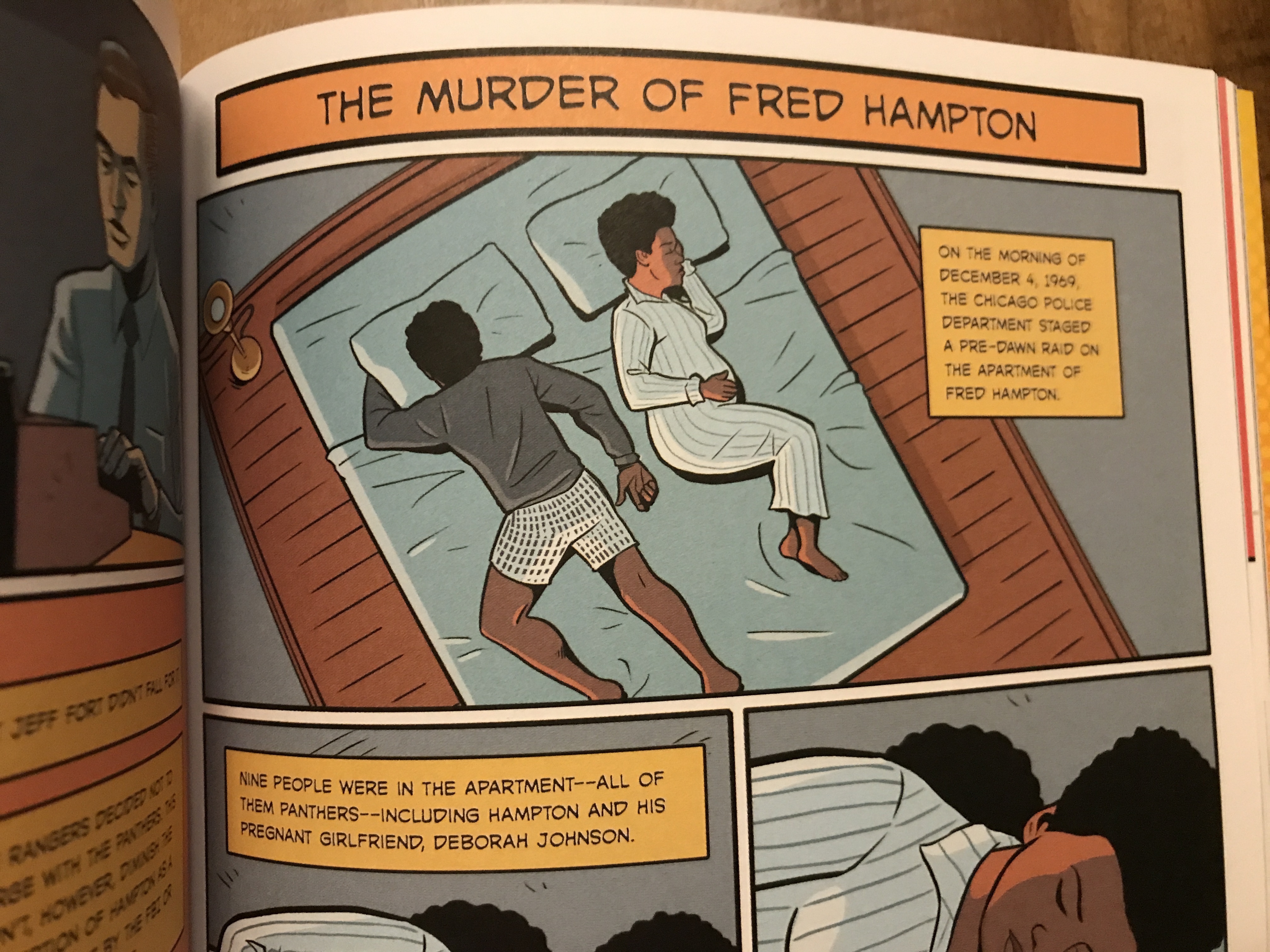
Well, you get the idea. But to quickly recap, David Walker and I began a discussion about his new graphic novel, The Black Panther Party. It's a book that began from his desire to write about Fred Hampton and his murder, and eventually turned into a more expansive look at the Black Panther Party and the historical context that helps explain why they came to be. Today, I'll continue that discussion, and then also talk to him about the new film, Judas and the Black Messiah, which just started streaming on HBO Max. Hi, I'm Beth Accomando, and this is listener-supported KPBS Cinema Junkie Podcast. Since this is Black History Month, I thought it would be great to have Walker on to discuss his book, and then to provide some insight into the new film Judas and the Black Messiah, which looks to Panther Party member Fred Hampton and FBI informant William O'Neill. The Black Panthers are the single greatest threat to our national security. Our counterintelligence program must prevent the rise of a Black Messiah. You're looking at 18 months for the stolen card, five years for impersonating a federal officer, or you can go home. What do you want?
Get close to Hampton. The Black Panthers are forming a rainbow coalition of oppressed brothers and sisters of every color. Neutralize you by any means necessary. I need to take one quick break and then I'll be back with the rest of my interview with David Walker. We pick up the conversation with a look at some of the social programs the Black Panthers set up.
KVBS On Demand is supported by Bill Howe Plumbing, Heating, and Air Flood and Restoration Services. Family owned and operated for over 46 years, Bill Howe has been serving San Diego homeowners with home services since 1980. Bill Howe's full service team offers heating and air solutions along with dedicated flood and restoration services and an expert plumbing team. Their trained professionals are available 24 hours a day, seven days a week to respond to both routine needs and unexpected emergencies. Bill Howe is committed to providing excellent communication, transparent pricing, and quality workmanship on every job. Appointments can be scheduled by phone, online, or through live chat at their website. Call 1-800-BILL-HOWE or visit billhowe.com because we know how.
As you mentioned, there are there's violence in this and there's a lot of horrific things that are going on. But you also highlight some of the things about the Black Panthers that people may not be aware of or may not remember as well. Things like the Breakfast Program and the newspapers they put out. And that also has a place in your book. Oh, yeah, because, you know, like the Breakfast Program is honestly.
one of the most important things they did. And it's one of the main reasons the FBI went after them. So much vigor and so much ferocity. And it was because in J. Edgar Hoover's estimation, the breakfast program was a successful way to indoctrinate young black folks into this militant mindset. And here's the thing. If you...
And because I've met some of these people and they're my age, right? I have met people my age, a little bit older. And if the Black Panthers come up in conversation and they're from like Oakland or the Bay Area or Chicago or New York, they say, oh yeah, they fed me when I was a kid. There's an entire generation of Black folks and poor white folks and Puerto Rican folks too and other people in this country who are fed by the Black Panther Party. And there's a whole generation of people that are the children of Panthers. And I think that that's...
really something that's crucial to remember and to talk about. They had their free breakfast program. They had health clinics. When sickle cell anemia was reaching epidemic proportions in the Black community and mainstream healthcare was doing nothing about it, they started the first sickle cell anemia testing program in this country. They didn't bring acupuncture over to this country, obviously, but they were some of the first non-Chinese practitioners of acupuncture.
used to help with addiction problems. I try to be very clear about that. So acupuncture, which is used in a lot of substance abuse cases, that treatment plan was brought over from China by members of the Panthers. There's so many, and even... When we look at the idea of community newspapers or podcasts now or blogs or the things that we've taken for granted in a lot of ways, in some ways they pioneered that too with their newspaper. They weren't getting a fair shake in the mainstream press, and so they started their own press to spread the word and to galvanize. And there's so many things in our country right now that either they had a helping hand in normalizing, and in some cases they were also part of...
a problem that arose. The most strict gun control laws in this country were passed, and this is not a lie, the most strict gun control laws in this country were passed in the state of California in an effort to take the guns away from the Black Panther Party. And it was approved by Governor Ronald Reagan. And people don't realize that, that everything that the NRA fights for right now, the Black Panther Party was fighting for 50-something years ago. And the Black Panther Party lost every single case that they had. So yeah, it's just fascinating to me. There was a moment.
In 67, when the Panthers over this gun control bill that actually got passed, when they protested at the state capitol in Sacramento, California, and there was a big brouhaha, and they ended up going on to the assembly floor where they weren't supposed to go. Cops came. It was very much a circus. And after this happened, every single Panther who was there, there was 20-something Panthers were there. Every single one of them was arrested at a gas station down the street from the Capitol building. But it wasn't just them that was arrested.
it was every Black person who was on the block at the time, right? And I think about that in comparison to what we saw on January 6th, right? Nobody was shot, nobody was beat up, nobody was killed, no property was destroyed, yet every person who was involved in the Sacramento incident and people who weren't even involved were arrested. And then I look at what happened on January 6th and it's like, again, 50 something years later, and the disparities are still there. Well, as someone who grew up in the 60s and grew up kind of with this notion of protest and speaking out for civil rights, seeing what happened on January 6th, I don't know, it had this way of kind of sullying the whole notion of protest because it just seemed like, you know, what they were doing it for was so different from what these other protests had been about and how people can argue, try to argue that they're the same.
is just really troubling. And now I look at some things like, you know, these lines, like you can kill a person, but you can't kill the revolution. And I'm thinking how they'll apply this to, and it just, it hurts. Yeah, yeah, no, I'm with you. I've been thinking about that a lot. And here's the thing, you know, because I'm very different than a lot of people right now. It's, you know, I see a lot of people posting on social media about, we don't want law enforcement to treat, you know, these seditionists, these insurrectionists the same way they treat Black Lives Matter people. We just want the police to stop beating us up, right? And I'm of the mind that I'm like,
Yeah, no, I don't think that's a realistic goal. I don't think the cops are gonna stop beating on us. So how about you beat on them too? Like if there's gonna be equal opportunity, like let's have there be equal opportunity. If we can't get it one way, let's get it the other. And so I know I'm not popular among some of my friends when I say that sort of stuff, but it's just how I feel at this point right now. And maybe I feel this way because I'm so close to the research and the writing of this book. And I see things in, the shade of rose colored glasses that I wear is different than the shade that a lot of other people wear. Well, reading this after.
January 6th. Also, what stood out to me is the sense that the Black Panthers looked to the laws that existed, looked to the Constitution, looked for things to say like, you know, we're not asking for a complete overthrow of the government. We just want the rights that we feel should be guaranteed to us. And these people on January 6th, I don't feel like most of them probably knew much about the Constitution because they're trying to protest over a fair election. It was interesting to me how much value the Black Panthers put into the Constitution, which was interesting on a certain level. It really is interesting because everything they were asking for and everything they were trying to do, so much of it was based on what's already in the law books, what's already in the Constitution. And I'm completely drawing a blank on his name. I think it was Edwin Meese, I think, who was the attorney general under...
Ronald Reagan. But the point is, is that when Huey Newton took law classes in college, Edwin Meese was his professor. If it was Edwin Meese, I'd have to look it up again. Huey Newton was educated in the law and constitutional law by the man who went on to become Ronald Reagan's attorney general. Right. And that's the crazy thing to me. As you pointed out, it's like everything they were demanding was stuff that, you know, and everything they were doing was within. Well, I shouldn't say everything they were doing, but a lot of what they started out doing was lawful. And a lot of the stuff that was illegal that they did only became illegal after laws were passed to keep them from doing it.
And that's something that's very interesting to me, because even the carrying of the guns only became illegal after the laws were changed to accommodate or to disarm them, I should say. Well, another thing that you bring up, which is coming up right now, there's films like the MLK FBI, the Judas and the Black Messiah, even the United States versus Billie Holiday. But all this notion of how much effort the United States government and the FBI put into trying to quiet these people and for the Black Panthers to. break them up. And you focus on this and it's something that I'm not sure a lot of people are aware of in terms of how it specifically relates to the Black Panthers and the sense of all these informants that they had working.
Yeah, no, I mean, it's kind of mind-boggling. The FBI had used informants in the past. They'd used informants to infiltrate everything from the Communist Party to different unions to all sorts of things that J. Edgar Hoover deemed anti-American. And the FBI had created a program called COINTELPRO, which stands for Counterintelligence Program. Again, they used it against certain communist factions in the U.S. They used it against organizations like the American Indian Movement, some of the more radical left movements. But they went after the Black Panther Party in a way that nobody...
They didn't go over after anyone that way and actively worked to have members killed and put into prison. And it's one of the reasons why when I look at what happened on January 6th, it's like, yeah, it didn't have to happen because I know for a fact. And now we're seeing it. The FBI knew. And now we're seeing it that, you know, the leader of the Proud Boys isn't actually an FBI informant. And it's like and I'm the guy who's not surprised by any of this because I know how these systems operate. Right. And the fact of the matter is, is that the vast majority of the people of the Panthers who were killed.
And those who went into prison were either killed or went into prison by direct result of actions of people who were under the employment of either the FBI or their regional law enforcement. And it's not to say that these were undercover cops or undercover agents. These were, in the case of William O'Neill, who's in part responsible for the murder of Fred Hampton, William O'Neill was a convict who tried to get out of doing prison time by doing work for the FBI. I mean, that's what criminal informants always have been. The extent to which they used, the FBI used.
informants against the Panthers is mind-boggling. I talk about it briefly in the book, and it still hasn't been proven yet because it's still a pretty new idea. There was a radical activist out of the Bay Area by the name of Richard Aoki, and he helped the Panthers get started, and he supplied their first guns, and he trained them in a lot of the things that they did. And all the evidence now points to the fact that Aoki was an FBI informant. And what that means, and I said in the book that he was alleged, and because the proof is there.
He was it, right? But no one has been able to come out and emphatically prove, yes, there's no receipts for the paychecks, right? Even though there's field reports with this guy's name all over it. And that means that from the day Huey and from before the day Huey and Bobby formed the Panthers in 66, they had already been infiltrated. This guy, because Aoki was...
You know, for a while, he was a member of the Panthers. You know, he was a Japanese-American. He'd been held as a kid in internment camps in the 40s. But he was, you know, if you really study the history of the Panthers, you see this was one of those guys that was like an honorary member. And, you know, Bobby Seale talks about, yeah, our first guns came from Richard. And I remember when I was reading about this and the very real possibility that he was an FBI informant, and honestly, I do believe he was, it tells you like, oh, yeah, these guys were doomed from the beginning, right? These guys were doomed from the beginning because one of the people who was most helpful in them forming was a rat.
And I sometimes think about the toll that that took just on, I mean, it's bad enough when you find out that your friend stole money from you or cheated on you, your significant other cheated on you. What happens when you find out that this person you thought was your friend was informing on you? And as a result, someone else that you're close to was murdered or put into prison. And when you look at guys like George Sams or William O'Neill or Richard Aoki, and there's a long list of them, it's kind of sad and it's kind of scary. And you realize how much lives were ruined.
We can never underestimate what members of law enforcement and the status quo of this nation will do to maintain that status quo, up to and including acts of murder and, well, does it get any worse than murder? I mean, Geronimo Pratt spent 27 years in prison, eight of those in solitary confinement for a crime he didn't commit. The key witness against him was an FBI informant. I mean, it's like that. So is it worse to spend 27 years in prison for a crime you didn't commit, or is it worse to be shot through the head when you're 21 years old by members of the Chicago PD? I don't know.
Well, since you brought up Fred Hampton, I wanted to ask you about the new film Judas and the Black Messiah, which focuses on Hampton and on William O'Neill, who was the FBI informant. And I was just curious, because you do devote a significant chapter to Hampton in your book, what did you think of the film? I really liked the film a lot. It's not a film that I can necessarily say, hey, go see this, because it ain't a feel-good movie, that's for sure. But, you know, as I said before, I've known about the Panthers since I was a teenager.
That's when I first read Bobby Seale's book. I first became familiar with who Fred Hampton was in my early 20s and really became obsessed with him and his life and his murder. And at a very early age, I started, I had this firm belief that the day that the civil rights movement officially ended was the day that he was murdered. And I still hold to that belief in a lot of ways. And so this is a story I always wanted to put out because I felt like everybody needs to know the story of Fred Hampton. Everybody needs to know. And I remember a time when there was no books about him. And the only people that seemed to know who he was was, you know, people in sort of the radical political movement or people from Chicago. And so I was...
And again, even this particular book that I've written started out with my desire for it to just be about Fred Hampton. And so it was interesting watching the movie because I know some of the people involved in the production. And I went into it with a lot of hesitancy because in a lot of ways it felt like I was watching, I was going to watch a movie that I'd been wanting to make for nearly 30 years. And I can say that I don't think I could have done, I know I couldn't have done a better job than what they did. And knowing how film is made and knowing how, what it means when it says inspired by true events at the beginning of the movie, knowing all that stuff and knowing.
what happened to Hampton and knowing that the history of the Illinois party and the Chicago party in particular, like that movie is really accurate. That movie is more accurate than, it's kind of scary how accurate it is. And so I did, I enjoyed it and I appreciated it and I recommend it, but it's also like, I don't recommend it, but I do, if that makes sense. It's the same, you know, it's like, it ain't a feel good movie, you know, it's, although there are parts of it that I think are great. I love the relationship between Fred and Deborah Johnson, his girlfriend, the mother of their son. And I like the performances.
It's not a question of violence or non-violence. It's a question of resistance to fascism or non-existence within fascism. You can murder a liberator, but you can't murder liberation. You can murder a revolutionary, but you can't murder revolution. And you can murder a freedom fighter, but you can't murder freedom. And I thought it was interesting the way they humanized William O'Neill. And because I've been fascinated with him.
how does a person do what he did, right? And it wasn't just him. I've sort of become fascinated with the informant, the agent provocateur, and to the extent that I've thought about writing this. you know, about someone like that. I mean, it says a lot that the fate that O'Neill found, which was, you know, spoiler alert, he took his own life, you know, he lived for a long time with the knowledge of what he did. And I think he fooled himself for a very long time about it. But yeah, he's like, I think that relationship and from a cinematic standpoint, this is the thing that's crucial. From a cinematic standpoint, it works. I don't know how accurate some of it is, you know, I don't know for sure everything that happened in it. Some of it I know, yeah, this is pretty much how it happened, you know, but I was just watching it was like.
The best part for me, the part I felt best about was people are going to know who Fred Hampton is. And I think that the title of the movie, Judas and the Black Messiah, comes from the fact that J. Edgar Hoover and the FBI, J. Edgar Hoover's number one priority was to stop the rise of what he saw as a black messiah. And there were essentially three people during the course of the 60s that he was overly concerned about, Martin Luther King, Malcolm X, and Fred Hampton. And as a student, as an armchair historian, I honestly believe that Fred Hampton would have been.
the closest thing to whatever, you know, a black messiah might have been. I think that Fred Hampton had what it took to unite people in a way that it wasn't going to, that no one else could have done. In part, it was because of his youth. And I think that in his youth, he had... sort of a cynical optimism and naivete, you know, and he was only 21 when he was killed. But I think that when you look at what he, what the Panthers in general were trying to do, and here's the thing, nobody else had done it. The Panthers were trying to indoctrinate street gangs and politicize them and basically turn street gangs into militants who would stand up to the police, right? And in LA, they, Bungie Carter.
was an ex-gang banger who became a member of the Panthers and he had begun that process and they were recruiting people in prison and then Bunchy Carter was killed and it all kind of fell apart in Los Angeles. And if you study the history of gangs in Los Angeles, if you study the history of the Crips and the Bloods, you begin to see how the Panthers played into that and how the death of Bunchy Carter and the destruction of the Panthers left this void that there had been this glue that was holding people together and then the destruction of the Panthers, it all kind of fell apart and then crack and all that other stuff made things so much worse. Fred Hampton was doing what Bunchy Carter in the L.A. chapter never got a chance to do. And so he had brought together not just, you know, some of the Chicago Black gangs, he had united with the Puerto Rican activists, the Young Lords, there was a group of white, poor white people called the Young Patriots, which I suspect now, the Young Patriots have evolved into what was storming the Capitol very recently, but back in 68, it was very much a different thing. He built this alliance with all of these organizations around, not the ideas of racial empowerment, but around...
equity and righteousness. And so it's interesting to me because I do think that his death and his killing put an end to the possibilities of what that could have been. In a lot of ways, it's the reason why what we saw on the 6th was specifically, almost exclusively white folks at the Capitol. And it was because with the death of Hampton and the destruction of the Panthers, it also created an opportunity to drive more rifts in between people based on race and class. And this is the thing you pick apart when you're looking at history and you go, okay, this thing happened here. And then five years later, this happened here.
And then six months later, this happened here. And oh, this is how it's all connected. This is how one thing relates to another. I think the thing that I wanted to see more in that film was a little more into what made Fred Hampton who he was, because it was amazing that he could walk into these meetings or go up to these gang members and say, like, here's this crazy idea. I want you guys to all be working together. And that takes a lot to get people of that diverse a background or ideas to come together and form a coalition. And I kind of wanted a little more about what made this 20-year-old kid who he was. His high school activism and stuff like that, because he was an activist since he was a kid. And I think that from, again, going back to a cinematic standpoint, I think maybe they felt that that gives him more of an enigmatic quality. Like, you know, he's got this mysterious past because the rest of his family isn't in the movie. We don't really see anything about his mother or the rest of his family. And I see that.
I, you know, part of me feels like I remember when Spike Lee's Malcolm X movie came out and at the time people learned, were just learning about Malcolm X for the first time. Right. And so I feel like, okay, right now there's, there's one good book about Fred Hampton out there and that's called the murder of Fred Hampton. And it was written by one of his lawyers and, you know, and that book just came out within the last 10 years. So it's, it's up until recently, there was very little about him that you could find. And so what I'm sort of hoping is with this movie.
And, you know, maybe with my graphic novel, that all of these people will get a little bit more attention and their stories will be told. And that the stories that haven't been told at all, I've talked to several people and I've said, look, you know, there are panthers who are still alive. I know them, right? And in some cases, they're people's parents or, you know, grandparents. And it's like, and they have stories to tell, you know? I mean, some of them I talked to while I was doing research for the book were, you know, it was, I would get information from people that were just like, oh, you know, you should check out this thing here. And, oh, yeah, that, you know, and I would call people up and...
or send them a picture and say, who's this in this picture? Because they're not identified. And so I would get information like that. And I was like, those voices aren't going to be around forever. And if we really want to understand the history and the legacy of this organization and these people, we need to talk to the rank and file. And we also need to talk to kids who were fed by the program and people who made a living selling the newspaper and all those things and begin to think of them not so much as this mysterious mythic organization, but start to take them apart as individual people and look at them and figure out who they were. We talk about how we need to remember history so we don't...
But what is it about remembering the Black Panthers that's important? What do you think is a key aspect of what they did or what maybe they were on their way to doing that we should remember now? Well, you know, one of them is that, yeah, you have to you have to look at the problem and you have to try to figure out how can you work on the problem within the restraints that are imposed on you by law enforcement or whatever. And you have to not back down. But then there lies the problem, right? It's, you know, when I was in my 20s, my fascination with the Panthers was because I was in my 20s and I had that fire in my belly, you know, and I wanted to go out and bust heads and make the world a better place. And now I worry about falling and breaking my hip. You know, it's I become older. I have some of the same concerns, but not the same fire. And I think that if we could find some of that passion.
and that desire to change and make the world a better place. But really, and this goes down to the myth of the Panthers, and it's that the bad myth of the Panthers is this idea that they didn't want to help. They only wanted to help black people or that they hated whitey. There's that sort of thing. And as an organization, no, that's not what they were about. It's how they've been sold to the public to a large extent. And I would like people to understand that the problems that they faced then, we still face now. And the reason we still face it now is because they, for a whole host of reasons, were not able to do anything about all the problems that they faced. And the fact that...
we don't even understand them or their struggle means that we don't understand our struggle, right? If we don't understand the lengths, that's why I think that this, you know, the movie, the Judas and the Black Messiah movie is important. If you don't understand what law enforcement will do to stop you, If they don't agree with you, you don't even have you breaking the law. They just don't agree with you. Watch this movie. You're going to find out, you know, and, but more, and I should rephrase this, what they will do to you if you are a person of color, you know, because, because again, I have yet to hear about any of the, you know, whether it's, you know, any of these militia organizations or these proud boys where I haven't heard anything about any of them being drugged in the night and then shot through the head, you know, and not to say that I want that. I really don't want that. But, but the extreme measures that were taken against the Black Panther Party, the American Indian movement and other organizations, all of which were fighting for the rights of non-white people.
And we see a lot of this now within the LGBTQ community, you know, the other, the people that are fighting for the other to prove our humanity, we're treated like we're monsters, you know, as if we're like, it's a group of werewolves and vampires that are, you know, and that's the thing, like you could have a werewolves lives matter and people probably respond to that better than they do black lives matter. You know, it's just, yeah, anyway. All right. I want to thank you very much for talking about your new book. Thanks. Thanks for having me on. I appreciate it. It's always good to talk to you.
That was David F. Walker, author of the new graphic novel, The Black Panther Party. We also discussed the new film, Judas and the Black Messiah, which is currently streaming on HBO Max. I continue to celebrate Black History Month next week with Caroline Collins as we look to a collection of films about Black people and place. Films like Eve's Bayou, Get Out, Sorry to Bother You, and Last Black Man in San Francisco. After that podcast, Cinema Junkie will be taking a brief break to retool and relaunch with something that I hope is even more addictive. During the break, we'll replay some of the most popular episodes to keep you entertained. And thank you very much for listening. So till our next film fix, I'm Beth Accomando.
KBBS On Demand is supported by Rug Expo. Serving San Diego for over 30 years. Family owned and locally operated. Offering rugs sourced from around the world. Along with cleaning, repair, and appraisal services to help preserve your investment. Visit rugexposd.com.